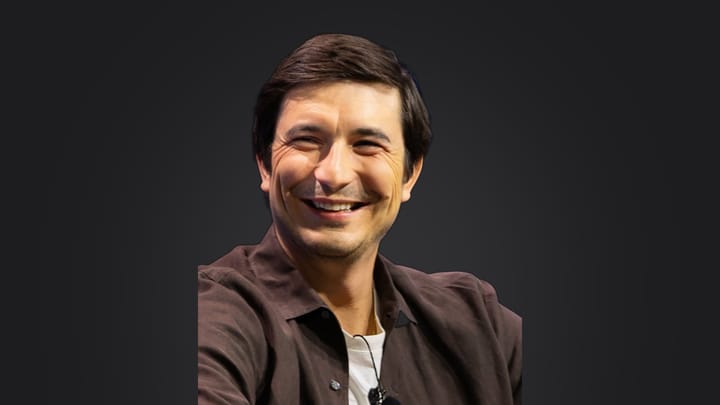

Recorded 14 October 2026 · 58 min
AI agents will generate a very large share of retail trading volume, Vlad Tenev argues, while most assets stay held long term. The reason is that Robinhood's sprawl of stocks, options, crypto, futures and prediction markets is a burden for human users but simply more context for an agent. Tenev is Robinhood's CEO and a former high-frequency trader. He speaks just after launching Robinhood Agents, which moves agentic trading into the app after more than 100,000 customers tried it through a developer-style MCP.
The tension is between empowerment and control. Tenev wants customers to out-trade hedge funds, yet ships agents in a separate account with trade approvals on by default. The same logic drives his view of AI politics: the backlash is about inequality, and the fix is giving ordinary people ownership. The conversation also covers tokenized stocks, the AMC dispute, and why AI labs should not keep their best models in-house.
Beat the hedge fund — ▶ 0:39
Tenev started his career in algorithmic trading and frames the mission as never-ending, "because the wealthy always find a way to get better stuff." The North Star is a customer with an advantage over the hedge fund and the algorithmic trading firm. The roadmap covers more asset classes, lower latency (high-frequency firms fight over "who gets to be the first port in the switch" at the exchange data center), more research tools, and third-party agent apps. Nobody else is doing agentic finance, so Robinhood is "wandering through the fog."
Cabined launch, 100,000 users — ▶ 1:45
Robinhood for Agents launched earlier this year as an MCP plus an agentic credit card. Trading ran in a separate account that customers had to fund deliberately, apart from retirement and the main account. It began with unlevered, cash-settled equities and has since added options, crypto and limited margin. More than 100,000 customers have onboarded. Metrics climb steadily, especially when new capabilities like limited margin unlock, and retention is described as "really, really good."
Models don't want to trade — ▶ 3:09
Two frictions drove Robinhood Agents. Claude Code and Codex are developer tools, and linking an MCP and monitoring strategy elsewhere is too much for an average user. Also, general models plugged into an MCP often don't want to trade, because trading traces are scarce in their training data. Robinhood has worked to make models fluent in its tools and ecosystem. It is not fine-tuning for this launch and chose models customers already know. The product will look "completely different" in 6-12 months.
Approvals on by default — ▶ 6:38
Autonomy is an affirmative choice. Trade approval is the default, autonomous trading is opt-in, and the separate account means the agent won't "go rogue" with the main balance. Linking to the main account would be easy to build, and many customers are asking, so a flag to plug an agent into an existing account is being considered. For now Robinhood wants to "tiptoe into the experience." Many customers like keeping agent money separate, so separate stays the default for the time being.
Agents take volume, not assets — ▶ 9:38
A very large portion of trading volume will be generated by agents. They run 24/7 and span asset classes, while the app's stocks, options, crypto, futures, prediction markets, DeFi, perpetuals, banking, retirement and advisory are a burden for humans. For agents it is "more context, more opportunity, more trade ideas." Early use is paper-cut removal, like building an iron condor. But most assets will stay held long term. He compares trust to early internet card payments, which took roughly 10 years to prove safer than a register, and admits Robinhood is probably early.
Edge is always moving — ▶ 15:15
Alpha has no fixed address. Robinhood Chain drew heavy developer activity, DEX volume and traders bridging over from other chains once it went live. Robinhood's advantage is one place, one shared balance, uniform KYC and simple money movement, which enables multi-asset strategies hard for an unassisted human. On everyone using the same AI: doing what everyone else does means "kind of definitionally" no edge. Few customers will train their own models, so differentiation comes from connecting unique data through the growing agent app store.
Subscription, not revenue share — ▶ 19:04
Most of Robinhood's business will remain transactions and assets, but subscription is growing. Robinhood Gold is already a multi-hundred-million-dollar-a-year business that grew from a small base. The agent marketplace will likely stay subscription-based. Customers don't want partners seeing balances or trades, and Robinhood offers a privacy layer. Revenue share would also force partners into regulation. He is unsure it will rival the Apple App Store and refuses to pre-ordain business sizes. He wants each line, crypto included, to be the biggest in its category.
Looped product development — ▶ 23:32
Tenev wants everyone managing a team of agents that works while they sleep, making Robinhood a 24/7 company. Agents need context and the ability to test their own work, or they stop and say "you do the testing for me, human." That demands rethinking CI/CD and testing. The new bottleneck is how fast changes can be tested against live customers. AI research is being automated first because it is sandboxed with evals. Product work lags because human adoption and behavior change more slowly.
Ownership defuses AI backlash — ▶ 27:52
Tenev agrees that AI negativity is largely about inequality. Crypto reached individuals first and built a "crypto army" that swung the 2024 election, while nobody has exposure to AI companies. His fix is Robinhood Ventures: Fund I holds late-stage names like OpenAI, Databricks and Revolut, with no carry, and Fund II covers seed and Series A with 80 companies at launch. He cites a PitchBook study on seed returns and answers risk with diversification. Without "skin in the game," nobody roots for AI, and companies staying private to $1 trillion-plus worsens it.
Tokenization is irreversible — ▶ 44:00
US stocks are hard to reach from overseas, as dollars once were, which is why stablecoins spread. Tokens add 24/7 trading, fractional ownership and wallet custody nobody can confiscate. Robinhood's stock tokens are live in over 120 countries, creating net new buyers for issuers. On the AMC pushback about voting, he says Robinhood intends to add voting and that few people vote anyway. The same objections met electronic trading versus paper certificates. "The cat's out of the bag." Privates, wine and real estate are next, trading 24/7.
Labs need a license to operate — ▶ 54:28
Asked about AI labs using their models to solve math in-house versus giving tools to everyone, Tenev calls in-house discovery a miss. AI companies need a license to operate, and people turn against technology they don't share in. He describes data centers in neighborhoods running only lab employees' workloads, with the labs making every invention, as a "very centralized, almost dystopian" future. He thinks it is the less likely one. The better outcome is a mathematician using a public OpenAI model, not employees spending tens of millions in compute.
Breadth is the product. Robinhood is not claiming a smarter trader. It is claiming a wider surface. One app holds stocks, options, crypto, futures, prediction markets, banking and retirement, on one shared balance with uniform KYC and simple money movement. A human has to hop between screens to use all of it. An agent does not. Vlad Tenev expects the interesting strategies to be the ones that cross asset classes, because that kind of complexity is "very, very difficult for a human unassisted" to assemble.
Today's use is humbler. Early users tell an agent to put on an iron condor, or to cap downside while keeping upside open, and the agent builds the legs. Tenev calls that removing a paper cut. Richer strategies arrive as more data and assets plug in. This is why he separates volume from assets. Agents will trade constantly and across everything. Most money will still sit in long-term holdings. Activity migrates to machines. Savings do not.
Getting here took more than a connector. The first version, Robinhood for Agents, launched earlier this year as an MCP plus an agentic credit card. More than 100,000 customers have onboarded. Growth steps up each time a capability lands: options, crypto, limited margin. Two problems held it back. Claude Code and Codex are developer tools, and the average customer will not wire an MCP to a brokerage and monitor strategy somewhere else. And general models do not want to trade. Tenev's explanation is that they rarely see trading traces in their training data. So Robinhood spent effort teaching models its tools and the wider ecosystem, and now brings it all into the app. It is not fine-tuning for this launch. It chose models customers already know.
Control is the other half of the design. Agent money lives in a separate account. The customer must move funds in deliberately, apart from retirement and the main account. Approving every trade is the default. Autonomy is an opt-in. The point is that the agent will not run off with your money on its own. Linking an agent to the main account would be easy, and customers keep asking. A flag is under consideration. The default stays separate for now. Tenev treats trust as a matter of timing. Typing a card number into a website felt unsafe for roughly 10 years before it proved safer than a cashier. Phones were for games before they were for finance. He concedes Robinhood is probably early, but not by much.
The same agent logic shapes how he runs the company. He wants everyone managing a team of agents that works while they sleep. Agents need context and the ability to test their own work, or they stop and hand the testing back to the human. So the bottleneck becomes how fast a change can be tested against live customers. AI research is being automated first because it is sandboxed behind evals. Product work lags, because human adoption and behavior change more slowly than code.
There is a political argument underneath all of this. Tenev agrees that much AI hostility is really about inequality. Crypto reached individuals first. Normal people held it before institutions did, and the resulting army was strong enough that the 2024 election hung on its support. AI went to venture capitalists. Nobody has exposure, so nobody defends the data center in their backyard. His fix is ownership. Robinhood Ventures Fund I is an NYSE-listed vehicle holding late-stage names such as OpenAI, Databricks and Revolut, with no carry for Robinhood. Fund II goes to seed and Series A and launched with 80 companies. He leans on a PitchBook study showing seed had the highest aggregate returns of any class despite higher failure rates, and answers the risk with diversification. The problem worsens as companies stay private until valuations pass $1 trillion. Without "skin in the game," he says, nobody roots for the technology.
He turns the same logic on the labs. Keeping advanced models in-house, with employees making every discovery, is a miss. AI needs a license to operate. A future of giant data centers in neighborhoods, running workloads only for lab employees who invent everything, is in his words almost dystopian. He thinks it the less likely future. The better one hands tools to normal people: a mathematician using a public model, not employees spending tens of millions in compute.
Tokenization is the global version of the ownership case. US stocks are hard to reach from overseas, as dollars once were for people in hyperinflating economies, which is why stablecoins took off. A token is available 24/7, fractional, and held in a wallet where nobody can confiscate it. Robinhood's stock tokens are live in over 120 countries. Tenev says that is net new buying for issuers. The AMC objection is about voting. He says Robinhood intends to add it, that few holders vote anyway, and that the same complaints met electronic trading when it displaced paper certificates. He reads part of the AMC fight as 2021 history and part as confusion. His verdict is that "the cat's out of the bag." Privates, wine and real estate come next.
Now the objection that should worry him. If every customer plugs the same frontier models into the same app, where does the edge go? Tenev's answer is close to a tautology. An edge is differentiation, and doing what everyone else does means no edge. It keeps moving. New ecosystems form, as Robinhood Chain showed when developers and traders from other chains arrived quickly. Few customers will train their own models. Differentiation instead comes from unique data, which is the case for an agent marketplace. He prices it by subscription, not revenue share, because customers do not want partners seeing balances or trades. He will not say it rivals the App Store.
The hedge-fund claim is weaker still. His North Star is a customer with an advantage over the quant. But many big-firm strategies depend on low latency and physical proximity to exchanges, which Robinhood does not offer. He floats deploying a strategy colocated with an exchange, with no timeline attached. The evidence so far is adoption: 100,000 onboardings and good retention. There is nothing on returns. And with approvals on by default, much of the autonomy is still theoretical. Access has been delivered. Whether access becomes advantage is untested.
The open question. The North Star is a retail customer with an advantage over the hedge fund, but the only evidence offered is adoption: 100,000 onboardings and good retention. Nothing was said about returns. The edge question was answered with a near-tautology, that differentiation is the edge. The latency strategies that define big firms are not something Robinhood offers today. Watch whether agent-driven accounts actually outperform, and whether the colocation idea ever gets a timeline.
Watch the full video at https://www.youtube.com/watch?v=rkTMQ3oHzFE.
Comments ()