Recorded 15 October 2026 · 21 min
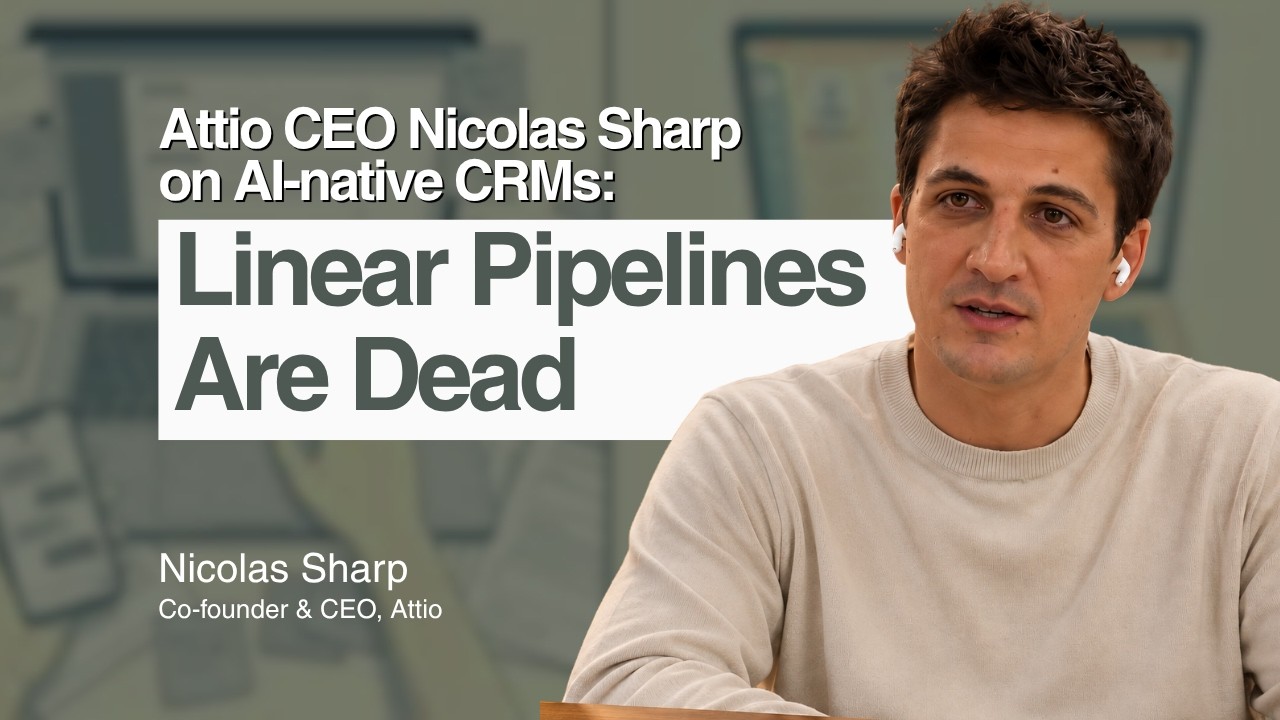
Nicholas Sharp, co-founder and CEO of Adeum, an AI-native CRM, argues that go-to-market software was built around a linear pipeline that agents make obsolete. In his account, agents combine the high-context judgment of a human with the throughput of infrastructure. That combination needs a system of record that stores context and lets agents act on it, rather than merely logging conclusions humans have already distilled.
The interview took place on the day Adeum announced a hybrid architecture. It turns on where value accrues in the AI stack: the model, the harness, or the data layer. Sharp says tight coupling of all three wins, and cites company benchmarks. The open issue is how much of that advantage is architectural, and how quickly organizations can restructure to use it.
Software meets infrastructure — ▶ 1:24
Sharp says software has come in two kinds. Application software is pleasant but low-throughput, limited by human hours and typing speed. Infrastructure runs at machine scale, with billions or trillions of API calls, but historically did different work. Agents do both: the high-context, non-deterministic work of a human at infrastructure scale. His claim is that this combination needs a new architecture, which he says Adeum announced that day as a system of record that gives agents the context they need.
Records become working memory — ▶ 2:43
Until a year or two ago, humans listened to calls, read emails, researched customers, and distilled it all into structured fields, such as whether a customer fits the ideal profile. Automating that busywork means the record no longer has to be only the result of the data. The underlying context can live in the system so work continues from it. Economics change too: agents can work every customer, not just the high-value ones humans could afford to cover.
Beyond skeuomorphic agents — ▶ 4:34
Organizations specialized roles and handovers partly because resources were finite; Sharp notes you cannot put 10 people on every customer 24/7. The first wave of go-to-market agents copied human processes skeuomorphically. He says the field is now moving to agents doing things humans never did, freeing people for higher-leverage work. He frames the architecture as deliberate augmentation, not replacement, and says humans remain an important part of selling. The transcript gives no data on how this division of labor performs.
The pipeline stops being linear — ▶ 7:55
Playbooks assume a fixed path: an outbound SDR, an initial meeting, then an AE if qualified, perhaps an SE. Sharp argues systems need to branch based on new context, and predicts buyers will not want to follow a company's chosen pipeline. That requires a singular view of the customer fed by private and public signals. He calls the shift a technical challenge and an organizational one, saying a lot of change is needed to support it.
Why the harness matters — ▶ 10:02
Sharp expects value at every layer but argues the harness matters most for background work. Millions of signals arrive daily, and each forces choices about inference level, models, sub-models, agents, and sub-agents. Adeum shared benchmarks that hold the model constant and compare harnesses. It claims about an 80% reduction in time to a result and an order of magnitude less inference. These are company-reported figures, with no methodology in the discussion. Customers can also use Claude or ChatGPT directly, with about 40 million actions taken this month through MCP.
SQL with governance behind it — ▶ 12:45
To an agent, the system looks like a Postgres database. Sharp argues models write SQL well because labs train heavily on coding performance, so agents improve at using the system without vendor effort. Policies and permissions sit behind the query layer. The alternatives are maintaining rules in code in front of a raw database, or relying on long prompts agents will not obey. Unlike an API, which is constrained by design and throughput, SQL lets an agent run any query, acting like a data scientist available 24/7. He says Adeum has used it internally for months.
Trust as the adoption variable — ▶ 17:01
Asked what will be true in a year, Sharp points to rising comfort with relying on and building agent systems. He attributes this to personal agent use and to utility great enough that people will do the security due diligence. His guess is that companies will share much more data and let agents decide how data is accessed. It is a forecast, not an observation, and it supports the premise behind his governance-at-the-query-layer design.
Nicholas Sharp's central claim is that go-to-market software was built to compensate for human limits, and that agents remove the reason for its shape. The familiar playbook runs from an outbound SDR to an initial meeting, then an AE if the lead qualifies, perhaps with an SE pulled in. Each handover existed because people specialize and have finite hours. As Sharp puts it, you cannot put a team of 10 on every customer 24/7. Once agents can, the pipeline no longer needs to be a fixed flow. He says the system must instead make decisions and change direction as new context arrives.
That shift changes what a system of record is for. Until a year or two ago, a human listened to calls, read emails, researched the customer, and distilled everything into structured fields, such as whether the customer fit the ideal profile. The record was the output of judgment. Sharp argues that once agents automate the distillation, the raw context should live in the record itself, so work can continue from it. The economics shift as well. Companies used to pick which customers deserved this attention by value, and agents let them cover all customers. The editorial inference is that the record moves from a summary of past work to working memory for future work.
Sharp is careful to frame this as augmentation. The first wave of go-to-market agents, he says, was skeuomorphic: it copied what a human did. The next wave should do things humans never did, leaving people for higher-leverage work. This is a thesis rather than a demonstrated result. The discussion offers one concrete illustration, an agent that can answer how often a competitor comes up in calls within seconds. It offers no data on how the division of labor between people and agents performs in practice. His prediction that buyers will refuse a company's preferred pipeline is likewise asserted, not evidenced.
The more strategic argument concerns where value accrues. Sharp expects value at every layer, and describes Adeum as agnostic about models, with a router that picks the model for each task. For personal work, customers may prefer Claude or ChatGPT, and he says about 40 million actions are expected this month through MCP. The background work is different. Millions of signals arrive daily, and each forces a decision about inference level, models, and sub-agents. There, he says, the harness makes the difference. Holding models constant, Adeum reports about an 80% cut in time to a result and an order of magnitude less inference.
The SQL interface shows how that thinking becomes product. To an agent, the system looks like a Postgres database. Sharp says models are strong at SQL because labs train on coding benchmarks constantly, so every model improvement makes agents better at using Adeum without extra vendor work. The distinctive piece is governance. Rules about who can see what sit behind the query layer, rather than in code before a raw database or in a long prompt an agent will not follow. Unlike an API, which limits what an agent can ask, SQL lets it write any query, while the vendor enforces the rules. The pitch is freedom for the agent and guarantees for the company.
The evidence for this has limits. The benchmarks were shared on the day of the launch, and the discussion gives no methodology, baseline harness, or task definition. The governance guarantees are described, not demonstrated, and the internal use is reported as months of experience. There is also a tension in the argument. If outside agents are meant to reach the data directly, a strong harness matters less for the work they do. The host says the coupling ends up being the moat, and Sharp's answer rests on background, signal-driven work. He does not address how much of that work customers will run through his harness.
Sharp's forecast ties the pieces together. He expects people to grow comfortable sharing much more data inside companies and letting agents decide how it is accessed, partly because personal agent use is building familiarity. If that happens, governance enforced outside the agent becomes more valuable, because trust is delegated to the infrastructure. If it does not, the architecture sits idle. Sharp also concedes that organizations must change substantially to support a non-linear customer journey. Whether trust or structure moves first is unresolved, and the answer will decide whether the system of record becomes more central.
The open question. Sharp argues the tight coupling of data layer, harness, and model is the source of advantage, yet the new SQL interface is explicitly designed to let outside agents of choice reach the data. If customers do much of their inference in Claude or ChatGPT, does the harness advantage persist, or does value migrate to the governed data layer? The 80% figure comes from unpublished, company-run benchmarks, so the question remains untested.
Watch the full video at https://www.youtube.com/watch?v=ne2Ol-o8HE4.
Comments ()