
Recorded 28 June 2026 · 65 min
The number that matters is how long an AI agent can work without a human. A couple of years ago that was 10-20 seconds of human work. It has roughly doubled every couple of months and now means hours. Wu asks why it cannot become days, weeks or months, and argues that first-principles reasoning beats pattern-matching on history.
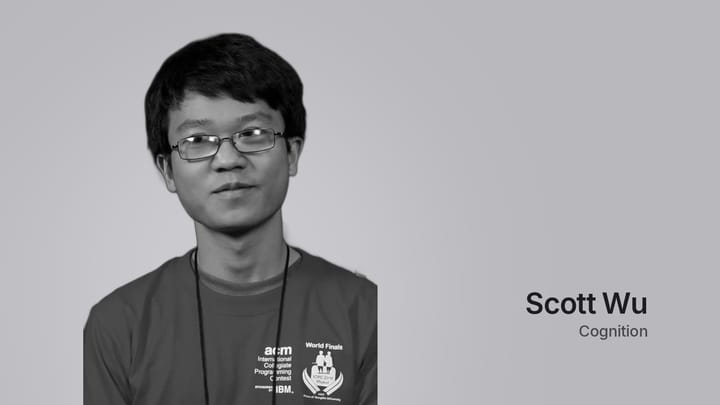
Wu co-founded Cognition, maker of Devin, and talks with the host of the Founders podcast. The conversation starts with his competitiveness, then covers how Devin found its first enterprise customers, why Cognition stays model-neutral, and why he is not selling.
The tension: a founder who admits he is irrationally 'salty' about losing is betting that a late, small startup can build a generational business next to labs that supply his models and also compete with him.
Company building as tree search — ▶ 0:45
Wu's first competitive memory is a math competition he entered at 7 or 8. He waited for his name as places were read out, never heard it, and was furious. He treats building a company the same way: "a tree search" where you explore the decision tree and calculate which branch leads to victory. It is "the only thing I do in my life." His older brother, four or five years ahead, supplied the video-game rivalry. His childhood goal was to become world champion of competitive programming.
A mother's scoreboard — ▶ 5:42
Wu's mother, "definitely the most salty" in the family, told him he was the best before there was evidence. The house had no portraits on the walls, only math trophies on the mantel, each hung as it was won. His father's Go skill, 7 dan and roughly a 2,300-2,400 chess-rating equivalent, is why the family ended up in the US. The host contrasts this with Larry Ellison and Elon Musk, whose fathers belittled them. Wu says his parents would have been happy with a cushy job and never steered him toward founding.
Fear outweighs thrill — ▶ 8:35
Ellison said he is addicted to winning but fears losing more than he loves winning, and Michael Dell told the host the same. Wu agrees that losing "feels way worse than winning feels good" but not by enough to make him stop trying. He adds that getting anywhere means losing a lot. The founders being discussed got where they are "by losing a lot and having their share of wins."
Interface, not coding agent — ▶ 9:59
Cognition's founding team is 9 people, most of whom had already started companies. They see this as "the big one" and want to build a hyperscaler, though Wu says it may or may not work. He frames Devin as the way humans tell computers what to do, since code may not stay the right abstraction. The pitch is a move from Minecraft survival mode to creative mode. Today Devin serves Goldman Sachs, Mercedes and parts of the US government, and teams ship 10x faster and do 10x more.
Throwaway software becomes viable — ▶ 15:43
Software only pencils out today if it will be used somewhere between 10,000 and a million times, because engineers are expensive. YouTube clears that bar. A morning spent reviewing 15 LinkedIn profiles or assembling a spreadsheet does not. Agents change the arithmetic: the agent writes a script on the back end that the user never sees, and the human only decides what to do. Wu says most of this vision gets solved "over the next 5 years or so." He concedes it is not yet at the level of being neural-linked to the AI.
Task length is the exponential — ▶ 18:45
Humans cannot intuit exponentials. A good hunt fed you for a couple of days, but an exponential's equivalent could be a thousand years of food. His parents, who grew up poor in 1960s China, found American cars and appliances jarring, then could not live without them. Pattern-matching is right 99% of the time, and this is the 1%. AI went from 10-20 seconds of unassisted human work to hours, doubling every couple of months. From first principles, why not days, weeks or months?
Agents sent on missions — ▶ 23:01
A year-long agent should not send bulk email, though Wu admits he was still fighting an email editor that would not unindent text. The host offers Edwin Land, who had a researcher spend 2 years thinking about turning Polaroid from black and white to color. Wu's examples of missions: a societal problem he thinks is solvable, a game blending two favorites, a novel way of constructing materials, with the agent running its own experiments for months or years. The host adds a manager agent that picks the missions. Work becomes pursuing curiosities and causes.
Late, early and first — ▶ 32:15
Devin's first real task was setting up MongoDB, a best-of-few run that kept Wu awake that night. The March 2024 launch drew both 'everyone loses their job' and 'scam' reactions. It scored 13% on SWE-bench against 3-4% for the best known system, which still means failing 87% of the time. Cognition started a year-plus after ChatGPT, behind OpenAI and GitHub Copilot, with "no right to exist." Wu concedes being wrong on many details and early. Still, planting the flag on AI as a co-worker rather than a chatbot helped with brand, recruiting and customers.
Migrations as the wedge — ▶ 37:17
After launch, pilots with GPT-4-era agents kept failing on real codebases. The team reasoned that the first tasks to work would be repetitive, scoped and on a tight feedback loop. That meant migrations and version upgrades, like Java 7 to 8 across a 50,000-file codebase. The first win was Nubank, Brazil's biggest bank by market cap. The whole company flew to Brazil and built a custom Devin for one customer. Enterprise is now 75-80% of revenue. Large-company security cycles typically run 12-18 months, and Cognition aims to deploy in 3.
ROI and Switzerland — ▶ 48:30
Ranking engineers by tokens spent is a place where people have "gotten carried away", Wu says. Rank them by output instead. His example: an 18-month, $15 million outsourced project redone internally for $1 million in 3 months. Devin is a compound model system that routes subtasks such as investigating, reproducing, debugging and review across Anthropic, OpenAI, Google, open-source and Cognition's own models. It uses max-thinking models for hard problems and cheap, fast ones for boilerplate. Cognition is not paid on token volume, so it has no incentive for customers to overspend.
Focus, independence, no price — ▶ 52:17
Startups win through a concentrated bet. Wu cites Spotify's Daniel Ek: "we're just going to care way more about music than they are." Investors once said Microsoft's GitHub Copilot would win everything, and Microsoft became a partner. The labs are both suppliers and competitors, but he sees room to cooperate. He refuses to say how many acquisition offers Cognition has had. He would sell only "if we thought it was the most ambitious thing to do," which he admits is an oxymoron. He expects 10 more generations of product experiences, and says nihilists who think it is too late are not founders.
How long an agent can work without a human is the variable the whole bet hangs on. Wu does not treat the current number as a ceiling. He treats it as a point on a curve. If a task that took a human hours can now be handed over and come back finished, the interesting question is what breaks the line at days, or weeks, or months.
The method matters as much as the forecast. Most people predict by pattern-matching: it has been this way for 100 years, so assume it stays. That works 99% of the time. Wu thinks this is the other 1%, and he offers a structural reason people miss it. Human intuition was tuned on a good hunt that fed you for a couple of days. The exponential version of a good hunt is "a thousand years worth of food", and we have no instinct for that. His parents grew up poor in 1960s China and found American cars and appliances jarring. Within a few years they could not live without them. Wu expects the same arc: insane in 5 years, forgotten that we ever lacked it by 10.
What changes when agents run that long is the unit of work. A seconds-long agent takes a command. An hours-long agent takes a task. A months-long agent takes a mission. Wu brushes off the host's quip about sending a year-long agent to destroy a competitor. He admits he is still hand-fighting an email editor that will not unindent a paragraph, and says that should be solved for you. The real prize is the mission: a societal problem he thinks is solvable, a game that blends two favorites, a novel way of constructing materials, with the agent designing and running its own experiments for months. The host's example is Edwin Land, who had someone spend 2 years thinking about how to turn Polaroid from black and white to color. An agent could do that in the background. Wu's picture of the end state is people holding curiosities and causes and sending agents after them. He thinks our ancestors would not recognize a meeting as work. Our descendants will not recognize this as ours.
Under the mission idea sits an economic one. Software today gets written only if it will be used at least 10,000 times, perhaps a million, because engineers are expensive. YouTube clears that bar easily. A morning spent reviewing 15 LinkedIn profiles or assembling a spreadsheet does not. Agents change the arithmetic. The agent writes a throwaway script, runs it and discards it, and the human never reads the code. That is why Wu says "coding agent" may be the wrong label. Code might not be the right level of abstraction for long. What lasts is the interface through which humans tell computers what to do, and that is what he wants Devin to be.
The company is not there yet, and its history shows it. The first version was a viral demo in March 2024, and the pilots at real companies failed. GPT-4-era agents could build toy projects but not work in real codebases. So the team asked which tasks would reach product-market fit first. The answer was repetitive, scoped work with a tight feedback loop: migrations and version upgrades, the same eight changes across 50,000 files. The first success was Nubank in Brazil, where the entire company flew in and built a custom Devin for one customer. Enterprise is now 75-80% of revenue, with Goldman Sachs, Mercedes and parts of the US government as customers. The sales friction is real. Large-company security reviews typically run 12-18 months, and Cognition aims for 3.
Pricing follows the same logic. Wu thinks ranking engineers by tokens spent is a mistake. He wants output measured: an 18-month, $15 million outsourced project redone internally for $1 million in 3 months. He also keeps Devin model-neutral. It routes subtasks such as reproducing a bug, debugging and review across models from Anthropic, OpenAI, Google, open source and Cognition's own. Hard problems get maximum thinking, and boilerplate gets cheap and fast. Because Cognition does not profit from token volume, it has no reason to push customers to overspend.
The obvious objection is that none of this is defensible. Cognition began in early 2024, a year-plus after ChatGPT, behind OpenAI, Google and GitHub Copilot. Wu accepts the premise. A startup has "no right to exist" against that field. His answer is focus. He cites Spotify's Daniel Ek: the incumbents will not care about music as much as Spotify does. Investors told him Microsoft's Copilot would take everything, and Microsoft became a partner instead. The same argument was once made against Datadog and Snowflake. But this is an argument about how markets usually go. It does not show that they will go that way here, and the labs now sell software agents directly. Wu says there is room to cooperate. That is also exactly what a supplier-competitor would say.
He is also candid about his own record. The launch scored 13% on SWE-bench, which means failing 87% of the time, even if the best prior system was at 3-4%. He says Cognition was wrong on many details and early, and that the product still has "a ways to go." On acquisitions he dodges. He will not say how many offers have come in. He would sell only if it were "the most ambitious thing to do," a condition he calls an oxymoron because he defines ambition as staying independent. He is not driven by money. He owns no car and rents an apartment.
What drives him is closer to temperament than strategy. He was the seven-year-old furious at not hearing his name called, and he says he would be "salty as hell" if the team tried everything and simply was not good enough. He could live with that. He could not live with not having gone for it all. That is a reason to run at the curve, and not evidence that the curve will hold. Either agents keep doubling toward months of unattended work, or the line bends. Wu has staked a company on the first outcome.
The open question. The months-long agent rests on extending one doubling trend from hours to months, and nothing here tests whether reliability holds over those horizons. Wu's own launch scored 13% on SWE-bench, failing 87% of the time, and he says the product is still 'a ways to go' from his vision. Watch whether any agent completes a months-long mission unassisted. Also watch whether the model-neutral compound-system position survives when the labs ship their own software agents.
Watch the full video at https://www.youtube.com/watch?v=PYobZzjW_ic.
Comments ()