
Recorded 14 October 2026 · 50 min
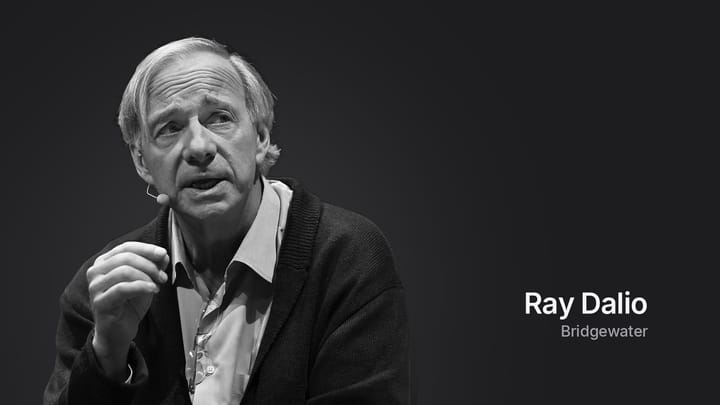
A bubble is not defined by whether the technology pays off in the end. It is defined by whether wealth must be turned into cash before then. Ray Dalio argues that AI's paper wealth cannot be spent, and that the pop comes when holders are forced to sell, whether for a house, a tax bill or a margin call.
Dalio ran Bridgewater for decades with a rules-based, back-tested system and now writes about debt cycles. He tells Nicholas Thompson of The Atlantic that AI is one of five forces, and that it leaves the mechanics of debt untouched. The conversation moves from his bubble indicator to the US deficit arithmetic, a proposed '3% solution', and how China frames AI.
The tension is Thompson's optimist case against Dalio's mechanics. Shocks have not popped the bubble, and a 10x productivity boom could outgrow the debt. Dalio's answer is that the income must arrive, reach the government and arrive in time. He never gives a date.
Five mechanical forces — ▶ 2:38
Debt, internal politics, world order, acts of nature and technology drive history, and the first three run in cycles. Dalio insists "everything's mechanical": causes precede effects. A bond holder expects to be paid back and a borrower has to pay, and "AI doesn't change that." The postwar multilateral order is "over", so power matters again. He expects a super El Niño within a year or two. AI cannot be analyzed separately from money, politics and geopolitics.
A factory without workers — ▶ 8:07
At Bridgewater, Dalio specified his decision criteria, back-tested them and computerized them. One rule combined initial unemployment claims as a growth gauge with commodity prices as a daily inflation gauge, to decide whether to be short bonds. It ran to hundreds of rules across markets. Like a chess engine, the system and Dalio would play side by side. When their moves differed, 65-70% of the time he had forgotten or couldn't program some complexity, and about a third of the time he learned something new to systemize.
Good tech, bad investment — ▶ 13:41
Miraculous inventions pull in capital: in the 1920s it was electricity, refrigerators, movies, radio, cars and airplanes. Companies cannot know whether they are over- or underinvesting, so they go "pedal to the metal" and borrow. With run rates potentially a thousand times larger within a year, nobody sizes it right. Dalio's warning is that people "classically fail" to distinguish a good technology from a good investment. The technology is good. Whether the price is right is the open question.
Wealth is not money — ▶ 15:50
Raise $50 million at a $1 billion valuation and you hold a billion in wealth, but wealth can't be spent. You must sell it or borrow against it, so cash has to appear either way. Wealth grows relative to money, and the pop comes when holders are forced to sell. Dalio dismisses 'will it pay off eventually' as the wrong test: "The end never happens." The real question is whether prices crash in the intervening period.
Triggers and weak hands — ▶ 17:35
The outcome depends on whether holders are in strong hands or weak hands. Can they absorb losses, or do they sell when they find themselves half as wealthy? Thompson lists the triggers: a California billionaire tax, an Anthropic IPO whose employees sell for houses and yachts, and the July margin squeeze at the Situational Awareness fund. Dalio agrees these look like pins moving toward a bubble. The concentration is the danger: AI's share of GDP, wealth, stock market, bond market, trade, geopolitics and employment.
Indicator reads 1929 — ▶ 20:29
Dalio's bubble indicator puts the current mix at the order of magnitude of 2000 and 1929. He says 2008 was a smaller bubble than 2000, because it was a debt bubble in housing rather than a whole-market enthusiasm bubble. He allows that he could be wrong. His practical rule applies whichever way you lean: don't make your everything AI. Don't put one highly volatile, leveraged bet on it, for or against.
Debt plaque and weak demand — ▶ 23:04
Asked why exogenous shocks haven't popped it, Dalio goes to Treasury arithmetic. The US spends about $7 trillion and takes in $5 trillion, a deficit of roughly 40% of revenue, with debt about six times revenue. Interest is about $1 trillion, and about $10 trillion matures and must be resold. Foreigners hold about a third of the debt, and China and Japan are wary, partly over sanctions risk. Supply is rising and demand is weakening. He compares it to plaque: "don't get comfort" that no heart attack has happened yet.
Productivity must reach income — ▶ 29:34
Thompson's rebuttal is a 10x productivity boom, with geniuses in a data center. Dalio accepts that if incomes rise enough, the debt becomes easy to pay. But he sets three conditions: the gain must convert into income, reach the government through taxes worked out politically, and arrive in time. Competition passes much of a productivity miracle through as lower prices rather than income. He cites roughly $280,000 of government debt per household and widening wealth gaps. He declines to give odds and says to check it "year by year".
Stakes don't create cash — ▶ 33:05
Dalio is inclined to free markets but says that in a new world order, with AI deciding economic and military dominance, pure free markets are not necessarily best. Government stakes, as in sovereign wealth funds, reduce how much wealth must become money. But he is "not in favor of the idea in general", and the mechanic remains that the government must find cash. Taxing AI firms in equity doesn't pay bills, and he concedes he hasn't solved it. Equity is not a banana-buying currency.
The 3% solution — ▶ 37:45
Dalio's prescription is to cut the deficit below 3% of GDP so debt stops compounding. Do it proportionately: roughly 4-5% more taxes and 4-5% less spending, left or right. He says Scott Bessent and others agree on 3%. The blocker is that politicians on both sides promise no tax rises and no benefit cuts to win office. Given authority to override politics, he would still want taxes tied to a majority benefiting, and he accepts there would be "some taxes" associated with AI.
China's AI as infrastructure — ▶ 42:05
Chinese leaders treat AI like electricity or running water: universal, with profit a rationing tool rather than the goal. The priority is efficiency and embedding simpler, cheaper AI in manufactured goods, not the frontier model, which is where "most of the benefit" is not. China already produces 32% of world manufactured goods, more than the US, Germany and Japan combined. Dalio adds that Beijing also sees AI as decisive in economic and military warfare.
The AI boom does not have to fail to produce a crash. Dalio is explicit that the usual test for a bubble, whether the investment pays off in the end, is the wrong one. "The end never happens," he says. The verdict arrives 25 years later. What matters is whether prices fall hard in the meantime. That reframes the debate. Nobody serious doubts the technology. The error is that people "classically fail" to distinguish a good technology from a good investment. In the 1920s there was electricity in houses, refrigerators, movies, radio, cars and airplanes. Everyone could see what to bet on. Then everyone bet.
Companies are trapped in that logic. They cannot know whether they are over- or underinvesting, and the penalty for underinvesting is losing. So they go pedal to the metal. When a run rate can be a thousand times larger by year end, nobody sizes it correctly. They borrow, and there are limits to borrowing. Then comes the mechanic Dalio cares about most. Raise $50 million at a $1 billion valuation and you are suddenly worth a billion. That is wealth, not money. You cannot spend wealth. You have to sell it or borrow against it, and either way cash has to turn up. Bubbles pop when holders are forced to sell. A billionaire tax in California would do it. So would an employee who wants a house after an Anthropic IPO. The question is whether holders are in strong hands or weak hands. Someone who is suddenly half as wealthy either buys more or sells.
The danger is concentration. AI now carries a share of GDP, wealth and the stock market. It also bears on the bond market, trade, war and employment. Dalio built a bubble indicator, and he says it reads at the order of magnitude of 2000 and 1929. He ranks 2008 below 2000. In 2008 the subject was housing, a debt bubble. In 2000 it was enthusiasm across the whole market. He allows that he could be wrong. His practical advice holds either way. Don't make your everything AI, whether you are for it or against it, and don't make it one leveraged, volatile bet.
Why hasn't it popped, given the shocks so far? Dalio does not answer with AI at all. He answers with Treasury arithmetic, because the mechanics of debt do not change. The US spends about $7 trillion and takes in $5 trillion. The deficit is roughly 40% of revenue. Debt is about six times revenue. Interest is about $1 trillion, and about $10 trillion matures each year and must be resold. A third of the debt is held by foreigners, and China and Japan are uneasy, partly over the risk of sanctions. Supply is rising and demand is slipping. He compares this to plaque in an artery. Debt service crowds out spending the way a clogged circulatory system starves the body. The absence of a heart attack so far is no comfort, he argues. The numbers can be projected year by year.
The obvious objection is the optimist's. Productivity could rise 10x, and the deficit could be outgrown. Dalio concedes the logic. If incomes rise enough, the debt becomes easy to carry. But he attaches three conditions. The gain has to convert into income. That income has to reach the government through taxes that are worked out politically. And it has to arrive in time. He doubts the first step. Competition tends to pass a productivity miracle through as lower prices rather than income. There is also a distribution problem. The gains accrue to those who own the stocks, while the debt works out to about $280,000 per household. He is not claiming the boom won't come. He is asking where the money arrives, and when. "Wow, that is a scary picture," he says, and he tells listeners to go through it line by line and decide whether they want to bet on it.
The policy answer is less dramatic than the diagnosis. Dalio's 3% solution is to get the deficit below 3% of GDP so debt stops compounding. Do it proportionately, with roughly 4-5% more in taxes and 4-5% less in spending. He says he doesn't care whether the ship turns left or right, as long as it avoids the rocks. He says Scott Bessent and others agree on the number. The trouble is the political bargain. Both sides win office by promising no tax rises and no benefit cuts. Handed the authority to override politics, he would still want taxes that let most of the country benefit from AI, so the result is sustainable through votes.
He is weaker where the arithmetic meets AI itself. Taxing AI companies runs into the fact that they are not yet earning much money. Taking payment in equity doesn't help, and he admits as much. Government stakes in AI firms, like sovereign wealth funds elsewhere, would shrink the wealth that needs converting to cash. But he is "not in favor of the idea in general", and the government would still need cash somewhere. Dalio's own banana example makes the point. A fractional share of Anthropic is not something a grocer will accept, at least not yet.
There is also a competitive frame he cannot ignore. Chinese leaders treat AI like electricity or running water, as infrastructure where profit is a rationing device and efficiency is the goal. They care less about frontier models than about embedding cheap AI in manufactured goods. China already makes 32% of world manufactured goods, more than the US, Germany and Japan combined. The US cannot simply slow down to protect its balance sheet. Dalio sees AI as the thing you must have to be effective in economic or military conflict.
What his framework gives is conditions, not a calendar. A system of hundreds of back-tested rules told him when he and the machine diverged, and most of the time it was his own forgetting. Here the equivalent test is whether AI income reaches the Treasury before the maturities and the forced sellers do. He does not claim to know which comes first.
The open question. Dalio's heart-attack analogy diagnoses risk but never gives timing, and that makes it hard to falsify. Asked why tariffs, the Iran war and several IPOs haven't popped the bubble, he answered with debt charts rather than AI-specific evidence. He also declined to estimate whether the productivity gain converts to government income in time, saying only to check it year by year. Watch Treasury auction demand from foreigners and the share of spending going to debt service. Those are the two gauges he says can be monitored.
Watch the full video at https://www.youtube.com/watch?v=OAN7gQlescA.
Comments ()