Recorded 11 October 2026 · 13 min
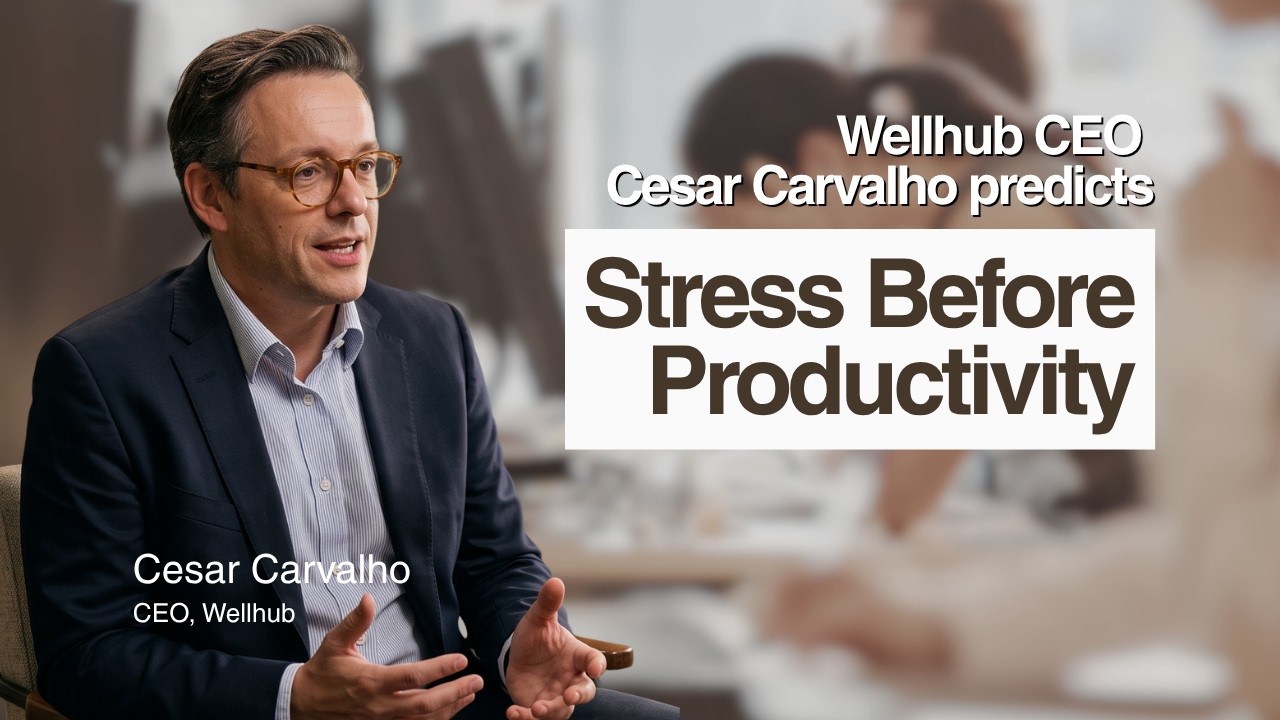
Cesar Carvalho, CEO and co-founder of Wellhub, argues that AI is raising the performance bar faster than it is delivering time savings, and that the cost shows up as stress for employees at every level. Speaking with host Sophia on MTS about a new survey of roughly 5,000 to 6,000 employees, run with Project Healthy Minds, he says the effect is worst where leaders push adoption without clear guidance or managed expectations.
The most notable finding is where resilience comes from. According to Carvalho, the strongest protection against AI anxiety lay outside work, in exercise, sleep and eating, rather than in workplace measures. The research comes from a wellness vendor, and the interview offers no effect sizes, which leaves open how much weight the finding can bear.
Stress follows unguided mandates — ▶ 0:31
Wellhub serves more than 60,000 companies, with about 6 million employees on its plans, and surveys 5,000-6,000 employees a year; this year's study, with Project Healthy Minds, examined AI. Carvalho reports that stress rises during AI implementation, especially where leaders push usage without clear guidance or managed expectations. It affects leaders as well as individual contributors. Loneliness is also rising, which he attributes to remote work and to roles not being refilled. The interview gives no magnitudes for any of these findings.
A higher bar, felt unevenly — ▶ 2:27
AI is raising expectations so that companies can do more with less, Carvalho says. Advanced users must keep delivering while also helping others and rebuilding roles. Less advanced users worry about AI's impact on them. His economic corollary is that doubling output requires good sleep, exercise and eating, so well-being becomes two to three times more important. That multiplier is his own estimate, offered without a stated basis, though the logic treats physical health as an input to output.
Work more before saving time — ▶ 4:24
Responding to the host's Jevons paradox framing, in which AI raises expectations rather than reducing hours, Carvalho describes a transition. Adoption involves a learning period in which people work more and the return per hour is unclear. Many organizations have not yet reached the point of saving meaningful hours daily. He predicts it may get harder before it gets easier. This treats the pattern as temporary and does not address whether savings, once realized, would simply be absorbed by higher expectations.
Protection lies outside work — ▶ 5:21
Asked which factors protect employees from AI-related anxiety, the roughly 5,000-person survey found workplace levers: aligned expectations and a clear goal, including a defined finish line for the AI transformation. Carvalho says the largest effects came from outside work: exercise, sleep and eating well. These give people the resilience to face challenges and manage anxiety. He says the data lets the field quantify the long-assumed link between wellness and performance, but no figures are offered in the conversation.
Agency drives engagement — ▶ 6:55
In Wellhub's work with client companies, outcomes improve when agency shifts to employees, who decide what works for them and when. Carvalho compares well-being to a fingerprint: everyone has their own. Companies that let employees choose, widen access and lower barriers see the best results, he says. This is an observation from his company's client experience and is presented without supporting metrics. It also aligns with Wellhub's own product, which offers many gyms, studios and apps.
The leadership blind spot — ▶ 8:31
Carvalho warns that executives deciding on wellness programs have blind spots. Leaders can buy well-being that suits their lifestyle and can move meetings and control their agendas more than most employees. Speaking as a CEO himself, he says leaders must be self-aware that their flexibility and access are not shared across the organization, and design programs to cover that gap. The point sits notably alongside the survey's finding that stress is highest where leaders push AI use without guidance.
Carvalho's central claim is that AI's first effect on work is a higher bar, not a lighter load. Companies expect employees to produce and deliver more so that, in his phrasing, they can do more with less. Wellhub's annual survey of roughly 5,000 to 6,000 employees, run this year with Project Healthy Minds, found stress rising during AI implementation. It was concentrated at companies where leaders push adoption without clear guidance and without managing expectations. It also reached leaders, not just individual contributors. The framing is notable because it locates the problem in how AI is introduced rather than in the technology itself. That is a claim about management practice, and executives can act on it.
The mechanism he describes is a mismatch in AI fluency inside the same organization. Employees who are advanced with AI keep their usual deliverables and are also asked to help colleagues and rebuild roles around the tools. Those further behind carry a different burden: worry about what AI might do to them. Carvalho describes frustration on both sides, which is why stress does not map neatly onto seniority or skill. Loneliness adds a second pressure. He attributes it to remote work and to roles that are not refilled when people leave, so fewer colleagues are around. These are survey findings as he reports them. The interview offers no percentages, so the size of each effect is unknown.
Host Sophia raised the Jevons paradox: productivity gains from AI seem to raise expectations rather than reduce hours. Carvalho's answer is about timing. Adopting AI requires a learning period in which people work more, and the return on each hour invested is unclear. Many organizations, he says, have not reached the point where employees save a meaningful number of hours each day. He expects things to get harder before they get easier. That is a prediction, and it differs from the host's framing. Jevons implies a structural pattern in which savings are absorbed by higher demands, while Carvalho describes a transitional dip. The interview does not test which is right.
The most distinctive finding concerns what protects people. Asked which factors shield employees from AI-related anxiety, the survey pointed to some workplace measures: aligned expectations and a clear goal, including a defined finish line for the AI transformation. But Carvalho says the factors with the greatest impact were outside work, namely exercise, sleep and eating well. When those are in check, he argues, people have the resilience to face the challenges ahead and the protection to handle anxiety, and so perform better. He says the data now gives substance to the familiar idea that well people perform well, and offers ways to quantify it. No quantification appears in the conversation, however.
Carvalho extends the logic into an economic argument. If an employee is expected to be twice as productive, he says, that output cannot be delivered without sleep, exercise and good eating, so well-being becomes two to three times more important. The multiplier is rhetorical rather than measured, and he gives no basis for it. The underlying reasoning is still worth noting. If AI raises the output expected per person, the physical inputs to that output become a binding constraint. That reframes wellness spending from perk to productivity input, which is what the host's phrase about wellness as a business investment implied. Whether it holds depends on effect sizes the interview does not provide.
Readers should weigh the source. Wellhub sells access to gyms, studios and wellness apps, with more than 60,000 corporate clients and about 6 million employees signed up, so a finding that off-work health buffers AI anxiety supports its own category. Carvalho does not claim otherwise, and the claim is plausible on its logic, but the interview does not test it independently. His product-side observation is similarly anecdotal: outcomes improve when agency shifts to employees, who choose what works for them and when. He compares well-being to a fingerprint. Companies that let people choose, widen access and lower barriers see the best results, he says, though no metrics accompany the claim.
His closing advice points at a structural asymmetry. Leaders can buy well-being that fits their lifestyles, and they can move meetings and control their agendas more than most staff. Carvalho, speaking as a CEO himself, says that flexibility is not shared across the organization and that program design must correct for the gap. This sits uneasily next to the survey's headline. The people with the most flexibility are the ones setting AI expectations, and stress is highest where they do so without guidance. The unresolved question is whether outside-work wellness can offset stress that clearer guidance would prevent. The interview gives no comparison of the two levers' effects.
The open question. Does outside-work wellness actually offset AI anxiety, or does it compensate for stress that clearer guidance and managed expectations would prevent in the first place? Carvalho names both levers but never compares their effects. He also treats the current extra workload as a learning-curve dip, and it remains untested whether higher expectations will absorb the time savings once they arrive.
Watch the full video at https://www.youtube.com/watch?v=nhSSws15OGY.
Comments ()