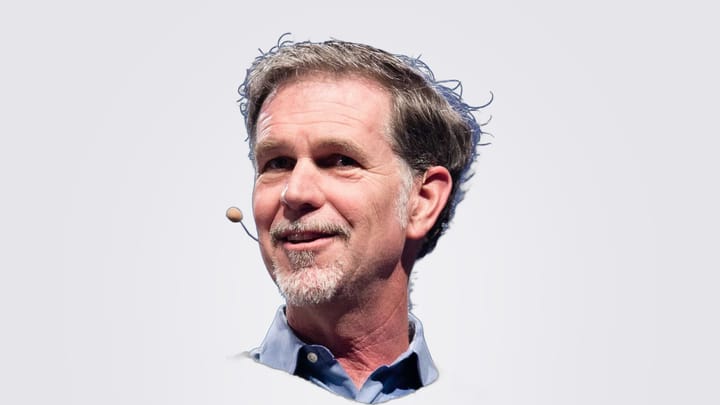

Recorded 13 August 2026 · 47 min
AI has doubled in quality every year for a decade, Reed Hastings says. If that holds, it will be 32 times better in five years and 1,000 times better in 10. He frames this as a workforce dividend: every company gets the equivalent of double its staff and must choose between halving headcount and using the surplus to attack competitors. He expects the second, and a wave of creative destruction.
Hastings, Netflix co-founder and a former CEO who left the board only recently, talks with the hosts of Semafor's CEO Signal about life after 29 years at the company. He spent a lifetime scaling a global, virtual business. Now he runs Powder Mountain, a 10,000-acre Utah ski resort, and sits on Anthropic's board. The tension running through the talk is control versus letting go. He hands Netflix to two co-CEOs he trained, stays out of the Warner Bros. Discovery decision, and carries Netflix's culture of candor and dissent into a business with 150 employees.
Parent to godparent — ▶ 4:23
Leaving the board felt like going from parent to godparent. CEO is the front line, and the board of a company that is doing well is "a pretty easy gig." The real drop was from 70 hours a week to 1. He has been strict about not meddling. In the first couple of months he lobbed in opinions. Ted Sarandos and Greg Peters made clear they could ask what Reed would think, set it aside, and do what they judge best. They "can mimic me and conjure me easily."
Buying a ski mountain — ▶ 5:54
After retiring in January 2023, Hastings skied the winter as a customer, then bought the mountain at the end of the season. Powder is 10,000 acres, almost the size of Manhattan. It was losing money and still is while he invests in new lifts and a private luxury real estate development, a younger, artistic take on the Yellowstone Club. He hadn't planned it. It is a swing from very virtual and global to very physical and local, where he knows all his customers.
COVID forced the timeline — ▶ 8:18
COVID broke his plan to stay at Netflix 10 more years. He wasn't badly ill and lost no one close, but felt life could take twists. He judged his life could be more interesting, and that Sarandos and Peters were fully capable and would probably run Netflix better. Sarandos became co-CEO in 2020. Peters, then COO, was promoted two and a half years later. No single moment convinced him, just many good interactions and hard ones worked through together. He calls COVID "the real proving ground."
Co-CEOs are not a model — ▶ 10:40
Hastings won't pitch co-CEOs as a general model. "I think of it as a high performance technique," and it works only when two people trust each other and love the organization more than themselves. He calls that a rare set of personalities. Nobody pushed him out. He kept giving Sarandos and Peters more discretion until they were effectively operating as co-CEOs, and then formalized it by promoting Peters. The board stayed involved and weighed the standard alternatives: just one of them, or an outsider.
Walking away from Warner — ▶ 11:49
Hastings wasn't involved in Netflix dropping its Warner Bros. Discovery bid. Sarandos and Peters sorted out the trade-offs themselves. Netflix would have stayed in at the same price, but Larry Ellison raised his bid and paid Warner even more, so the question was whether to raise. It was value, not strategy: they were comfortable with both the strategy and the price they had offered. They had a chance to match and decided not to. "It's all very clean."
Team, not family — ▶ 14:57
The 2000 internet slowdown forced a layoff of a third of Netflix, and the company got more done, not less. The reason was talent density: keep the two-thirds who help most. A one-third layoff every year is impractical, so Netflix kept the bar high and called itself a championship sports team, not a family. A family can never do layoffs, and claiming to be one while acting otherwise breeds cynicism. He frames it as a values tension, like kindness against honesty in children. At work, Netflix leans into honesty even when it feels unkind.
Farming for dissent — ▶ 18:22
Netflix named the practice, which is the top-level tactic. A leader acting as informed captain polls the team and scores a proposal from -10, disaster, to 10, the best thing we could ever do. It is not a democracy. A pile of negative threes can still end in a yes. Years later the team revisits who opposed a decision, such as global expansion, to sharpen thinking about the future. One condition: the leader must keep an open mind. Saying 'we are definitely doing this show' and then asking for objections is not farming for dissent.
Netflix model, ski mountain — ▶ 21:50
Hastings went from about 15,000 people to about 150 and says the vast majority of the Netflix model applies. The exception is safety: lift safety and maintenance are regulated close to airline level, so freedom and responsibility doesn't apply. The business is a golf club for skiing. The US has 4,000 private golf clubs and only 3 private ski clubs, partly because the acreage is so large. Epic and Icon are Costco; Powder is boutique, limited to about 600 families. His priorities: community, beauty, then money.
An AI degree in 1986 — ▶ 28:33
Hastings earned an AI degree in 1986-88, when AI meant hand-written facts, inferences and rules. Those systems never worked: too rigid, too specific, and they didn't encode how we think. Neural nets took 40 years to get big enough. Today AI is like a graduate student across many fields, not yet a PhD. On Anthropic's board he sees a team more committed to beneficial AI than to being the biggest company, "more humanist than capitalist," even as competitors move very quickly.
Doubling every year — ▶ 30:48
AI has roughly doubled in quality every year for a decade. Continued, that means 32 times better in 5 years and 1,000 times in 10. Hastings reads each doubling as doubling your workforce: halve headcount and keep the business lines, or use the capacity to attack competitors. He expects mass attack and creative destruction. He concedes there is no guarantee the curve continues. His advice to CEOs is judgment over paranoia. The skill is choosing which scenarios to go deep on, like a chess master. Small firms can move fastest, since it's attitude, not size.
AI tutors and chess — ▶ 37:01
Hastings says technology in schools has yet to deliver amazing results, but self-paced learning is the breakthrough to come, so kids behind don't feel dumb and kids ahead aren't bored. His answer to the worry about young brains leaning on AI is chess. Computers solved it 30 years ago, yet there are more active players than ever and the median 10-, 15- and 20-year-old is significantly better, thanks to AI tutors. He wants that for biology, politics, chemistry and maths, maybe in 5 years. Teachers shift to emotions, communication and teamwork, which they weren't trained for.
Most executives will get AI wrong because they have never managed an exponential. Reed Hastings puts it flatly: "most humans are underestimating" what a doubling every year does. Cars never improved at that pace. Computer chips did, but they sat buried inside one part of the economy. Almost nothing else in business has compounded this fast, so almost nobody has instincts for it. A frontier model that feels impressive today becomes 30 times better in five years and 1,000 times better in 10. He is careful on one point. There is no guarantee the curve holds. It merely looks likely, because so much effort is aimed at it.
What follows is a choice, not a forecast. Hastings treats each doubling as doubling your workforce. A CEO can cut headcount in half and keep the same business lines. Or the CEO can put the new capacity to work against competitors. He expects the second to win out, which means companies attacking each other in "the great act of creative destruction." Software is already easier to make. Soon, he says, everything will be. Size does not decide who moves first. Small companies are often the most aggressive users of AI, so he sees it as attitude, not scale. He is his own example. At Powder he asks AI to teach him how ski lifts and sewer systems work, and uses it to rebuild the resort's software.
Surviving that kind of churn depends on how a company treats its people, and Netflix's answer came out of a crisis. After the 2000 internet slowdown it laid off a third of its staff. It then got more done, not less. The lesson was talent density: hold on to the two-thirds who help most, and keep the bar high. A one-third layoff every year is impractical, so the company stopped calling itself a family and described itself as a championship sports team. The logic is blunt. If you call yourself a family, you can never do a layoff, and people turn cynical when you do one anyway. A team has coaches who change the lineup to win. Hastings frames the trade as a values tension, like teaching children to be both kind and honest. At work, Netflix explicitly leans into honesty, even though it will feel unkind, and explains why.
Candor needs machinery, or it stays a slogan. Netflix named it: farming for dissent. A leader acting as informed captain polls the team and scores a proposal from -10, disaster, to 10, the best thing we could ever do. It is not a vote. A pile of negative threes can still end in a yes. The score exists so the leader is informed, and so the team can look back years later at who opposed global expansion or a given show and ask what they misjudged. One condition matters. The leader must hold an open mind. Announcing that you are definitely doing a show and then asking for objections is not farming for dissent. His own example was a Latin American series, framed with the downside up front: a fight with the traditionalists.
Open-mindedness has a limit, and Hastings draws it. The maxim that only the paranoid survive is too simplistic, he says, because taken literally the paranoid are delusional. Worrying about a comet is time not spent on scenarios that matter. The skill is judgment about which threats and opportunities to go deep on, like a master chess player who runs some lines far ahead and others barely at all. Get that wrong and you lose. Some risks, such as AI destabilizing monetary policy, are beyond a CEO's control. You cope if they arrive. What you can do is focus on customers and the things under your control.
The same discipline governed his exit. He did not plan Powder, but he did plan the handover, and it took years. COVID was the trigger. He had not been seriously ill and lost no one close, yet it made him feel life could twist. He could stay 10 more years. Or his life could be more interesting, and Ted Sarandos and Greg Peters could run Netflix as well, probably better. Sarandos became co-CEO in 2020. Peters, already COO, was promoted two and a half years later. Hastings saw no single moment of proof, only a run of good interactions and hard ones worked through together. He kept widening their discretion until they were operating as co-CEOs before he formalized it. He does not sell the model. It is "a high performance technique," and it needs two people who trust each other and love the organization more than themselves. That is rare. The test came when Netflix dropped its Warner Bros. Discovery bid after Larry Ellison raised his offer. Hastings was not in the room. Netflix would have stayed in at the same price. The question was whether to raise, and they chose not to.
Powder is the opposite bet. Netflix meant 15,000 people and millions of customers he never met. Powder means about 150 people and a community of roughly 600 private families. The leadership model transfers almost entirely, with one exception. Lift safety and maintenance are regulated close to airline level, so freedom and responsibility gives way to rules. The business is a golf club applied to skiing. The US has 4,000 private golf clubs and only 3 private ski clubs, partly because you need so many acres. Epic and Icon are Costco: mass market, and good for getting people skiing. He wants boutique and beautiful. His priorities run community first, so that he and Patty spend a third of their time there, then beauty, then money. Locals don't love the exclusivity. He says it is not a big tension point, and he points to three new lifts, snowmaking and new lodges on the public side. The mountain was in financial trouble and was going to change either way.
The strongest test of his optimism is education. Hastings is on the Khan Academy board and has championed charter schools. He is blunt that technology in schools has not yet produced amazing positive results. The promise is self-paced learning, so that kids who are behind don't feel dumb and kids who are ahead aren't bored. The obvious objection is whether young brains should turn to AI to learn how to think. His answer is chess. Computers solved it 30 years ago. There are now more active players than ever, and the median 10-, 15- and 20-year-old is significantly better, thanks to AI tutors that beat your uncle. He wants that for biology, politics, chemistry and maths, but would not rush. Maybe in five years. Teachers would shift from transmitting facts to judgment, teamwork and emotional regulation, which they were not trained for.
That is where the argument is thinnest. The chess case is a single analogy offered for a list of subjects, and the readiness date is a hedge. The curve itself is an extrapolation from one decade. Hastings holds all of it with the same posture, which he names as his one thread: he loves taking risk, and calls it a privilege to work on hard problems. Whether the doubling continues is the one input nobody in this conversation can supply.
The open question. Everything about AI here rests on one extrapolation: 'twice as good every year', never defined, which Hastings then converts into 'double your workforce'. He admits there is no guarantee the curve holds, yet builds the CEO choice (cut or attack) on it. The education case rests on a single chess analogy, and he concedes today's classroom technology has no amazing results yet. What would need to be true for AI to be worth a doubled workforce? Watch what he claims about that, and when.
Watch the full video at https://www.youtube.com/watch?v=wQTDXbrdvr0.
Comments ()