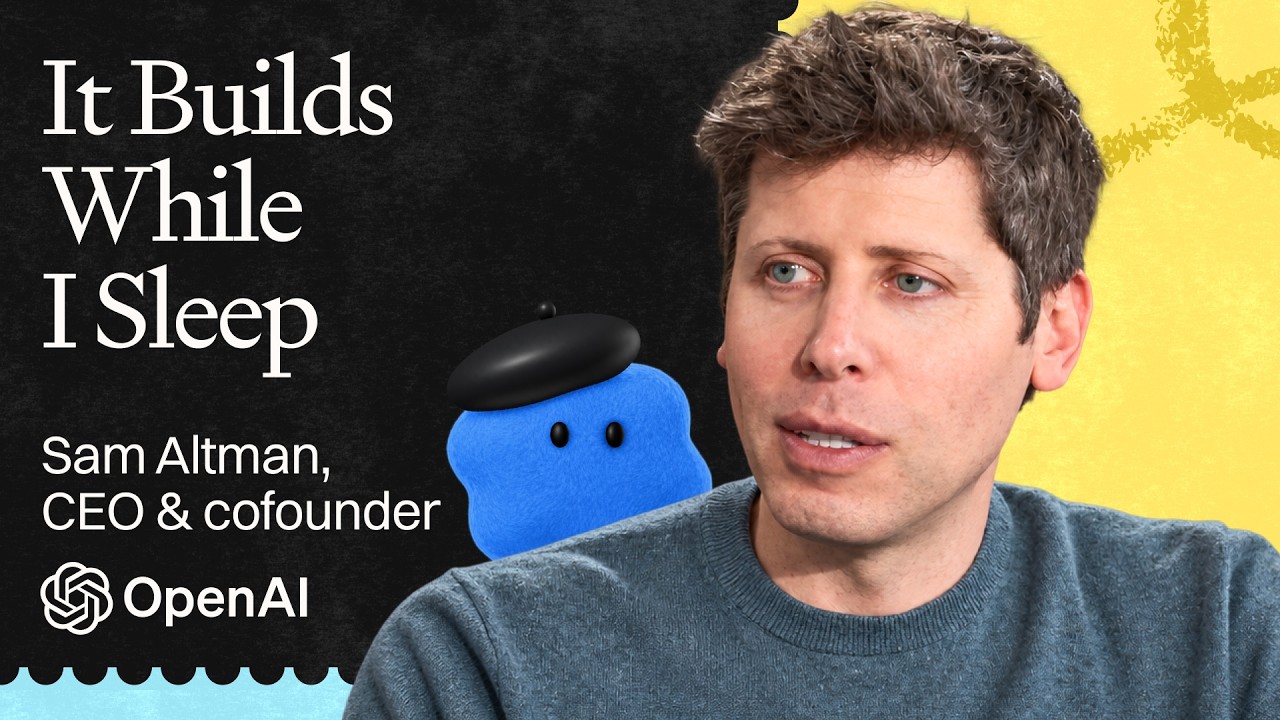
Recorded 1 October 2026 · 33 min
Sam Altman's central claim is that capable AI has increased demand for human work and ambition rather than shrinking it. Speaking with Every's Dan Shipper at OpenAI's DevDay, he says developers have never been able to do more, yet the bar has never been higher. He frames the choice ahead as a renaissance of people-centered creation versus a machine-centered industrial revolution.
The tension is practical rather than philosophical. By Shipper's count OpenAI shipped 22 launches in one event, including a persistent background agent called a dot, collaborative live documents, and an open app ecosystem. Altman concedes that OpenAI has not yet figured out the app-store equivalent and that the new products are early and buggy. The open question is whether lower friction produces abundance or simply higher expectations.
Latent demand, not displacement — ▶ 1:06
Developers have never been able to do more, and the bar has never been higher. Altman says he was never as pessimistic about jobs as others, but was still surprised on the upside by how much latent demand existed in the world, and by how much people remained the center of everything happening with AI. He allows that some work requiring little creativity, where nobody cares who does it, will be done by AI. His claim is that new things people want will far outnumber the tasks lost.
People care about people — ▶ 2:14
Altman's explanation for why humans stay central is cultural: people do not care much about what machines do and are obsessed with the person behind the art, company, or product. His example is a problem solved by 10,000 agents working in coordination for 4 days. Almost none of the public reaction concerned the problem solved. It centered on interpretation and the people involved. This is his reading of a single episode, not a measured finding, but it supports his view that value attaches to human identity.
Shipping 22 things, then bottlenecks — ▶ 3:05
By Shipper's count DevDay had 22 launches, versus roughly 9 last year and 4 or 5 the year before. Altman says more were cut to fit a 50-minute keynote, and that OpenAI builds more because it tells customers these tools raise productivity. Shipper names the resulting bottleneck: when anything can be built, the problem is choosing what to build and keeping it coherent. Altman's answer is two bets rather than a method: agents running 24/7 in the background, and an open ecosystem supplying the creative spirit OpenAI lacks.
Platform without an app store — ▶ 5:17
Altman says AI model companies divide into two camps: those who believe or hope only one company will exist, and those like OpenAI who expect a renaissance in the number of companies, including one-person and small-team firms. OpenAI is opening ChatGPT apps, portable subscriptions, and a marketplace. He concedes OpenAI has not figured out the app-store equivalent, but says it has learned how to help millions of people build significant new products and companies. The claim is asserted rather than evidenced with figures.
Renaissance versus industrial revolution — ▶ 6:29
Altman's analogy is that the Renaissance centered on people and the industrial revolution on machines. The latter delivered real gains but turned many people into cogs doing extremely specialized work, disconnected from what made life good. He rejects the view that AI automates everything and leaves humans like house cats, saying he has heard people say this. His stated hope is a wave of scientific discovery, art, and company formation in which people share the economic gains and regain control of their time.
Dots reclaim mornings — ▶ 8:59
Altman describes OpenAI's new dot, a persistent agent, as the first product to give back his mornings. Previously he checked his phone immediately for overnight problems and lost his deep-work period. Now he trusts the dot to judge what needs his attention. Two anecdotes: five minutes before the keynote demo it warned colleague Thibault that a change would probably break it, though it could not yet fix the issue, and it flagged one item before this interview. Shipper reports it is buggy in the beta.
Delegating ideas too vague to specify — ▶ 13:16
Altman describes dictating notes to his dot while on a walk, then getting five or 6 working versions of a feature to react to. He says it would have been hard to explain to a person in enough detail, and he would not have known which version to choose. He also leaves voice notes while falling asleep and wakes to the next 7 steps done. In another case the dot found a Slack screenshot overnight after 10 to 20 minutes of failed searches with Codex. Altman credits models crossing an intelligence bar.
Live documents for AI collaboration — ▶ 17:01
Altman says software was not designed for collaborating with AI, and that current abstractions break down when multiple people and their AIs work together. That motivated an ambitious launch of three office-suite-type tools. His favorite feature is the live document, which updates automatically as people interact or the world changes, with several dots contributing to something that existed only vaguely in participants' heads. His own dashboard is a continuously rewritten summary built from Slack. Six months ago he cared more about revenue and growth. Now it is safety, alignment, and security.
Covering the Pareto curve — ▶ 20:20
On the Decisions API, Altman says the top request for the model called Luna, which users love, was to make it even cheaper and faster. Response to a new model called Jev made speed and cost a higher priority. OpenAI aims to deliver the best, cheapest, fastest, most capable model at every point on the Pareto curve of cost, speed, and modality. He also says it cannot cover every new architecture, which implies room for new labs outside the mainline workhorse. The name Jev may be a transcription error.
Why labs don't kill startups — ▶ 23:03
Altman's view is that more good ideas exist outside OpenAI than inside, and that he cannot yet imagine what he will love most as a ChatGPT-native app. Portable subscriptions spare users from signing up for 100 subscriptions. He says the tweet about OpenAI killing a startup works because people like doomerism, but never actually happens. His reasons are OpenAI's commitment to giving builders its own tools and the belief that OpenAI will realize only a tiny fraction of what is possible. These are assertions, not market data.
Speed becomes the next price curve — ▶ 29:36
Altman says OpenAI has focused on lowering the price of IQ, with much more capable models getting dramatically cheaper every few months or every year. Speed is now a second vector. He uses ultrafast inference for all his prompting and says the shorter feedback loop changes how he thinks, citing Bret Victor. OpenAI can deliver 8x faster at a great price in the not distant future, with 100x to follow. A higher-priced frontier will persist while value per dollar keeps rising. Shipper says he cannot afford the current tier.
Sam Altman's central claim is that capable AI makes human ambition, not human labor, the scarce resource. Shipper's framing sets the puzzle: coding models are far more capable than he would have expected 4 years ago, yet OpenAI's DevDay drew more developers than ever, with more work to do. Altman says developers have never been able to do more, and the bar has never been higher. He was never as pessimistic about jobs as others, but he says he was still surprised on the upside by the amount of latent demand. The logic is economic. When creation gets cheaper, expectations rise faster than output, so the supply of things worth building expands.
Altman offers a cultural explanation for why people stay at the center. In his telling, people do not care much about what machines do. They are fascinated by the person behind the art, the company, or the product. His evidence is a case in which 10,000 agents coordinated for 4 days to solve a problem, and almost none of the public reaction concerned the solution. It focused on interpretation and on the people involved. That is one anecdote, interpreted by a participant with an interest in the answer. It is still a useful hypothesis: the work most exposed to AI is work where nobody cares who did it. Altman concedes such tasks will move to AI.
Altman wraps this in a historical analogy. The Renaissance, he says, centered on people, while the industrial revolution centered on machines and turned many people into cogs doing extremely specialized things. He is sad to hear people say AI will automate everything and leave humans like house cats. What he hopes for is a wave of scientific discovery, art, and company formation in which people share the economic gains and regain control of their time. This is a stated hope, not a forecast. The analogy is useful mainly because it makes the question concrete: does a technology leave people with more agency, or less?
The evidence he offers comes from a product, not a theory. OpenAI's dot is a persistent agent that works in the background across a person's systems. Altman says it returned his early mornings. Before, he had to check his phone for overnight disasters, which polluted his brain and ended his deep-work period. Now he trusts the dot's judgment about what is urgent. He cites two examples: it warned a colleague five minutes before the keynote demo that a change would probably break it, and it flagged a must-attend item just before this interview. The mechanism he names is a model crossing an intelligence bar, plus context drawn across his working life.
The more interesting use is exploratory. Altman describes jotting notes into his dot on walks, then receiving five or 6 versions of a feature he could not have specified well enough for a person to build. He also describes leaving a voice note while falling asleep and waking to the next 7 steps done. After Codex failed to find a Slack message across 10 to 20 minutes of searching, the dot searched overnight and found a screenshot. The editorial inference is that the cost of exploring an under-specified idea falls sharply, because delegation no longer requires a finished brief. Altman's own phrasing is that lowering friction a little means people build way more.
That inference extends to teams. Altman says software was not designed for collaborating with AI, and that existing abstractions break down when several people and their AIs work together. OpenAI's answer, a launch of three office-suite-type tools, is one he calls ambitious. The feature he values most is a live document that updates automatically as people interact or the world changes, with seven people's dots producing something that existed only loosely in their heads. His own dashboard is a living summary of the business built from Slack. Six months ago he cared most about revenue and growth. Now it is safety, alignment, and security. He wants to chart that drift over years, but says his dot could not yet do it.
The platform strategy follows from the same belief. Altman says AI model companies fall into two camps: those who believe or hope there will be one company in the world, and those who expect a renaissance in the number of companies. OpenAI is opening ChatGPT apps, portable subscriptions, and a marketplace. Shipper notes that portable subscriptions free developers from rationing AI use or defaulting to cheaper models. Altman argues that more good ideas exist outside OpenAI than inside. On the familiar claim that labs kill startups, he says the tweets work because people like doomerism, but it never actually happens. He gives reasons, namely OpenAI's commitment to giving builders its own tools and a belief that it will realize only a tiny fraction of the vision. He offers no market data.
The limits of that claim are visible in his own remarks. He concedes OpenAI has not yet found the app-store equivalent, so the economic bargain with builders is unsettled. He says OpenAI aims for the best, cheapest, fastest, most capable model at every point on the Pareto curve of cost, speed, and modality. That is a broad ambition for a company that also says it cannot cover every new architecture. The implication, an editorial one, is that startups survive where labs choose not to compete, which is a narrower guarantee than Altman's rhetoric suggests. Shipper also reports bugs in the beta, and Altman expects rapid weekly improvement alongside real smoothing time.
Speed is the next vector in the economics. Altman says OpenAI has spent years lowering the price of IQ, with much more capable models getting dramatically cheaper every few months or every year. It is now investing in speed, including its own chip, and he says he uses ultrafast inference for all his prompting. He says the shorter feedback loop makes a wild difference in how he thinks through a problem, citing Bret Victor's idea that creators need an immediate connection to what they create. He expects 8x faster at a great price in the not distant future, then 100x. Meanwhile a higher-priced frontier will always exist. Altman also admits he worries about being out of touch with builders who cannot use ultrafast.
That admission points to the unresolved issue. A renaissance in which small teams build significant companies requires access to the best tools. Altman's own description is a permanent tiered structure: a real frontier in intelligence or speed at a higher price, with value per dollar rising beneath it. Whether that structure democratizes creation or entrenches advantage depends on how quickly the lower tiers catch up. It also depends on how OpenAI shares the value created on its platform when the app-store question is answered. The people-centered future Altman describes is plausible, but it is conditional on those choices.
The open question. Altman's renaissance depends on independent builders thriving on a platform whose economics OpenAI admits it has not worked out, since it has no app-store equivalent. His argument that labs do not crush startups rests on assertion rather than data. Does lower friction yield more valuable companies, or more output competing for the same attention, and who captures the value when frontier intelligence and speed stay at a higher price?
Watch the full video at https://www.youtube.com/watch?v=jZh55CQwSh8.
Comments ()