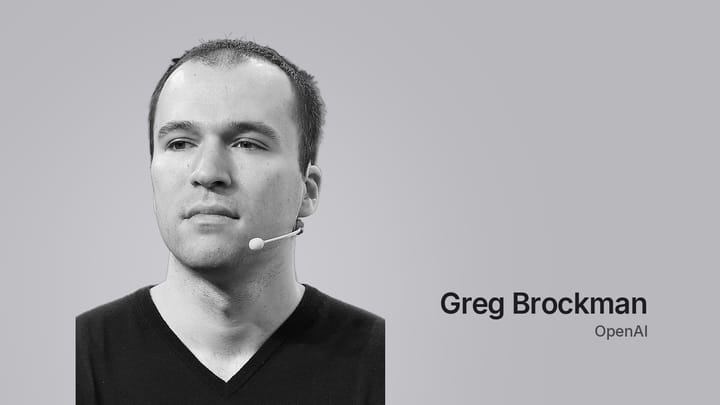

Recorded 30 Sep 2026 · 30 min
The binding constraint on AI is no longer capability but ambition. Greg Brockman, OpenAI co-founder, says the models already write software better than basically anyone he knows, and the people pulling ahead are those who keep asking for something bigger than last time. He has stopped writing software himself and now directs an AI to do it.
The host, who shows Brockman an app built to prepare for the episode, pushes for practical advice: what to build, what survives the next model, what to try this weekend. Two claims pull against each other. The mechanics of building are commoditised, so anyone can start a company and a wave of entrepreneurship is coming within 1 to 2 years. Yet value shifts to domain insight, trust and relationships, and work that merely patches model weaknesses dies. Underneath sits OpenAI's own pitch: Dots, a proactive agent that acts before you ask.
Three use cases — ▶ 1:10
ChatGPT has 1.2 billion weekly active users, and about 300 million people use it for health queries every week. Yet most usage only scratches the surface. Retention data shows a clear threshold: a user who finds 3 different things ChatGPT can do becomes a power user and keeps coming back. Reaching the third is the hard part, because an assistant that can do anything gives no hint of what to do first. OpenAI sees a gap for the AI to suggest more, such as turning a request into a presentation or spreadsheet.
No buttons, just proactive — ▶ 2:10
Users want simplicity: no buttons, no sliders, no model pickers. "That's not the AI we were promised." The target is something you talk to that pursues goals and acts first. His example: an email you have ignored for days. The AI researches the right answer, drafts a reply and asks for approval. Brockman says this happened to him just before the recording, so it is not theoretical. The burden of working out what the system can do shifts from the user to the AI.
Directing, not coding — ▶ 3:23
Models now write software better than basically anyone Brockman knows. He calls himself pretty good at it, yet no longer writes code: he directs an AI and gives lots of feedback and guidance. Astra is strong at Blender and 3D modelling and can drive Microsoft Paint. A friend had Astra produce CAD plans for a guest house, took them to a contractor, and it is now being built. Voice mode is also hooked up to tools, so it can read your email and calendar and help free time for deep thought.
Always not ambitious enough — ▶ 5:49
Asked whether he is ambitious enough with AI, Brockman says the answer will always be no, because there is "no ceiling to what you might imagine." Having achieved one thing means you can dream bigger. The host's prep app researches guests, suggests topics and drafts questions, title and thumbnail. Each episode still takes at least 40 hours after 12 years of making them. Brockman's ideal is an app where you approve the questions, do the interview, and everything else is handled.
Watch store, world's best programmer — ▶ 8:06
Small businesses are easier to start because founders carry PhD level intelligence in their pocket, and owners hand off tasks nobody would have done before. In one story, an antique watch store owner said AI was no use to him. An employee showed him: he had no website, so he asked the AI for one, then added the story behind each watch. Brockman's test: if you had the world's best programmer on your payroll, what would you put them to work on?
Mechanics are commoditised — ▶ 10:53
Parts of app building are becoming commoditised and democratised, which makes differentiation matter more. The moat is deeply understanding the problem and every stakeholder. Education has teachers, parents, students and administrators, each needing the right information and guard rails. Which language you write in, whether C++ or Swift, is something "who cares about that," and was never what the barrier should have been. The core of a business is the insight and the unique way of looking at the world.
Renaissance within 2 years — ▶ 12:05
Asked whether more consumer businesses will appear when YC batches are 60% B2B, Brockman says the enterprise and consumer line will blur and a company will become less well defined, less a big mass of organised humans. Enterprise sales is fundamentally relationships, which cost too much at consumer scale. AI that amplifies meaningful relationships could make that motion work for consumer businesses. His prediction: a massive renaissance of entrepreneurship, with leading edges visible now, kicking in over the next 1 to 2 years.
Build what scales — ▶ 14:27
Some activities scale as models get smarter; others work around model limits and are hard to make durable, like prompt-and-handcraft startups. Interfaces shift with capability: chat suited the 3.5 and GPT-4 era. The coding agent era began around the end of 2025, when AI went from 20% to 80% of software production. Now comes the personalized agent. Defensibility comes from industry depth. In hospitals, trust with patients, doctors, administrators and insurers means a better model makes an incumbent product stronger.
Morning briefing has depth — ▶ 18:45
Brockman defends the morning briefing agent as having 3 levels: pending Slacks prioritised, then research across presentations on a strategy question, then an agent that has called colleagues and partners and only needs approval on a purchase order. He says Dots has the technology for that last level. The label stays the same while the capability changes: AI that writes software today is totally different from 5 years ago. His agent also queries the data warehouse, replacing a Stripe data team that took a week to answer.
Tokens as a proxy — ▶ 20:40
OpenAI correlates token usage with lines of code, commits and PRs, and admits these proxies are imperfect. A better signal is how upset people get in a 2-hour internal outage. "Token maxing" is not a primary objective but a decent proxy, and leaderboards track it. The finance team closes the books much faster, and one comms person manages a journalist event with Codex. At the extreme, solving Navier-Stokes took 10,000 agents for some number of days. The payoff goes to people who point compute at the right problem.
Start small, automate at 5 — ▶ 24:48
The white page problem is the hardest in AI. Start small: type something, push enter, iterate. Pick a pain point like an ignored email, copy-paste it first, then connect Gmail. Once you have done a task 3 to 5 times, automate it, a software engineering maxim Brockman applies to AI. Accountability stays with the owner, since the customer either pays or doesn't, and goals must come from people. For a weekend, sign up for Dots, connect context, text it and set a recurring task.
Capability is no longer what limits most people. Imagination is. Brockman's evidence starts with usage. ChatGPT has 1.2 billion weekly active users, and about 300 million of them ask it health questions every week. Yet the retention data says most are barely using it. A user who finds 3 different things it can do becomes a power user and stays. Reaching the third is the hard part. An assistant that can do anything gives no hint of what to do first.
The people who get past that point look different. Brockman says the models are "better at writing software than basically anyone I know," and that he himself no longer writes it. He directs. A friend asked Astra for CAD plans for a guest house, handed them to a contractor, and the house is being built. An antique watch store owner who insisted AI was useless to a watch seller ended up with a website and a visual story for every watch, after one conversation. None of this required new capability. It required asking for more than the day before. Asked whether he is ambitious enough, Brockman says the answer will always be no.
The same logic applies to small businesses. Founders now carry PhD level intelligence in a pocket, and they hand off tasks that nobody would previously have done at all. Brockman's prompt is simple: if you had the world's best programmer on your payroll, what would you put them to work on?
Which raises the obvious question. If anyone can build software, what is worth paying for? Brockman's answer is that the mechanics have been commoditised and the human factors have not. Whether you write C++ or Swift is something "who cares about that." What matters is understanding the problem and every party to it. Education has teachers, parents, students and administrators. Hospitals have patients, doctors, administrators and insurers. A product that earns trust across all of them has a position that a smarter model strengthens rather than erases.
That leads to his durability test. Some work scales as models improve. Some work exists to get around their limits. The second kind rarely lasts. Startups built on a model plus handcrafted prompts had their moment, but each jump in capability suggests a new interface. Chat fitted the 3.5 and GPT-4 era. The coding agent era started around the end of 2025, when AI went from 20% to 80% of software production. The era now opening is the personalized agent.
Brockman's picture of that agent is specific. Not a task tool on a laptop that stops when you close the lid, which "was never the AI that was promised," but something with its own cloud computer that acts proactively. He treats the morning briefing as a ladder. At the bottom it summarises notifications. Higher up it prioritises the Slacks you owe replies to. Higher still it researches a strategy question across your presentations. At the top it calls your colleagues and partners and asks only for approval of a purchase order. He says Dots has the technology for that top rung. His own agent already queries the data warehouse, replacing a Stripe-era process where a data team took a week.
OpenAI's internal evidence is a mix of proxies. Token usage is correlated with lines of code, commits and PRs, and Brockman concedes they are "not perfect." The better signal is emotional. After 2 hours without a model, people say they cannot do their work, though they had nothing like it 6 months earlier. The finance team closes the books much faster. A comms person runs a journalist event with Codex handling the back end. At the extreme, solving Navier-Stokes took 10,000 agents for some number of days. The lesson he draws is to point compute at a problem that matters and be willing to push the token budget high.
His advice for entering this world is modest. Start small. Pick one irritation, like an email you keep avoiding. Do it by hand with copy-paste. After 3 to 5 repetitions you understand the process, and that is when to automate. Accountability does not transfer. The customer still pays or doesn't, so the owner must stay deep in the details, and goals must come from people.
From this he extends the argument to the whole economy. Enterprise sales is fundamentally relationships, which are too expensive at consumer scale. AI that amplifies relationships might make that motion viable for consumer businesses, and the line between the two blurs. A company becomes less a big mass of organised humans. He sees the economy as fractal and full of suboptimality in every sector, and sees new hybrids, as edtech joined education and technology. His prediction is a massive renaissance of entrepreneurship, kicking in over the next 1 to 2 years.
The objection is hard to miss. Brockman tells founders to build where improving models help them. But the agent he describes, one that researches, calls partners and prepares purchases, is the general platform stepping onto that ground. Hospitals and schools sound defensible because of trust and stakeholders. He gives no test for how long that holds against an agent that reads every document and talks to every party. The renaissance claim also has no numbers behind it. The productivity evidence is self-described proxies and a reaction to an outage. The 20% to 80% shift is stated, not shown.
What he does offer is a bet. Insight, relationships and trust are the scarce things, and the mechanics are not. If he is right, the next 2 years will show which founders have an insight and which only had a way of writing code.
The open question. Brockman tells founders to build where better models make them stronger and to avoid patching model limits. But the agent he describes, which researches, calls colleagues and prepares purchase orders for approval, is the platform moving onto that same ground. He names hospitals and education as defensible because of stakeholder trust, but gives no test for when an agent that reads every document and calls every partner erodes that moat. The 1-2 year entrepreneurship renaissance is also asserted without a single number. Watch for evidence of which vertical products get stronger, and which get absorbed, as Dots-style agents spread.
Watch the full video at https://www.youtube.com/watch?v=qy8Gr27yLMk.
Comments ()