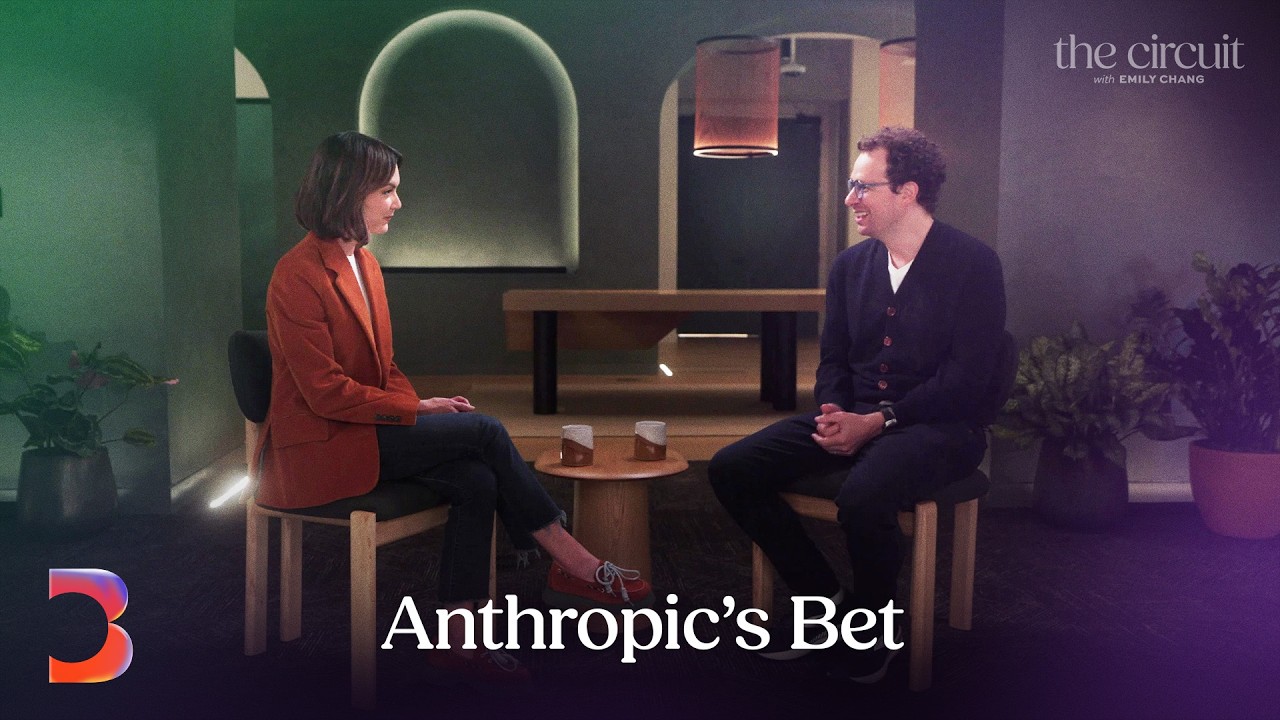
Recorded 10 June 2026 · 24 min
Dario Amodei, co-founder of Anthropic, argues that AI progress follows a smooth exponential: long stretches where nothing seems to happen, then a sudden surge. His evidence is Anthropic's own growth and a coding agent that now writes nearly all of some engineers' code. He pairs it with a warning that the same curve could hollow out entry-level white-collar work.
Daniela Amodei and Claude Code creator Boris Cherny also appear. The central question is whether a company can profit from this technology while steering it responsibly. Amodei insists his business model fits his values, yet he cannot say with confidence where displaced workers will go, and he leaves much of the answer to society.
The smooth exponential — ▶ 2:25
Amodei says the experience of an exponential is long stretches of "nothing's happening" followed by a sudden jump. He says he watched the graph and predicted Anthropic would become the AI company with the most revenue and valuation around this time, and that it has. Anthropic later cited API volume up nearly 17x year over year, eight frontier models shipped in 12 months, and Q1 growth that annualizes to 80x, calling this the first year it outran the exponential. The transcript does not specify which metric the 80x refers to.
Scaling bet, broken trust — ▶ 4:32
At OpenAI, Amodei developed scaling laws: language models improve by adding data and compute even if the algorithm stays the same. He calls this a counter-cultural view that few people then held. He says safety disagreements alone were not enough to leave. The break came when he felt he could not trust the company's honesty or believe its stated values. His remedy was for each side to "go off and do their thing". He gives no specifics. He adds that Anthropic is unusual in still having all seven co-founders.
Values by constitution — ▶ 7:07
Claude is trained against a Constitution, with a target of "professional warmth": approachable but not a best friend. Because no universal standard of harmless or helpful exists, Anthropic draws on founding documents such as the UN Declaration of Human Rights and on talks with religious leaders about values shared across traditions. Calibration is a problem too. Claude 2-era models could be nannyish, and Anthropic describes the work as tuning a dial with a narrow target. Deception is treated as a production risk, since research shows models can purposely deceive.
Enterprise as values choice — ▶ 9:59
Amodei says a business model that conflicts with your values leaves you two outcomes: betray them or become irrelevant. Consumer products, in his view, reward engagement and even addiction because advertising revenue pays for attention. Enterprise customers in biotech, pharma, research and energy let Anthropic pursue the useful applications it wants. The narration adds that Anthropic became profitable for the first time on business tools. Editorially, values and revenue happen to point the same way, and the interview does not test whether enterprise incentives bring distortions of their own.
SaaSpocalypse and moats — ▶ 11:11
Soon after Claude Cowork launched, $285 billion in software market value vanished overnight, which traders dubbed the SaaSpocalypse. Amodei's reading is that AI makes the pie bigger. Incumbents may shrink in relative terms, some may go out of business if they do not adapt, and the software industry as a whole probably gets not smaller. Companies that fail to see what is coming or to identify their moats will struggle. This is a prediction, and he offers no mechanism beyond the expanding pie.
From autocomplete to agents — ▶ 12:39
Boris Cherny says early AI coding tools only completed words or sentences. Anthropic bet instead that a coding agent could do all of it. A year and a half ago engineers wrote code by hand and occasionally pressed tab. Now he directs a few to a few thousand Claudes at once. Claude has written 100% of his own code for at least six months, and almost all of it on his team. He describes engineering as more fun than ever, and argues that planning, talking to users and deciding what to build remain human work.
Automating the last 10% — ▶ 17:07
Amodei warns of fast GDP growth alongside high unemployment or underemployment and inequality. His mechanism is the productivity hump. Automate 90% of a job and workers become 10 times more productive on the remaining 10%. As automation nears 100%, that leverage disappears. He says some engineers are already people for whom it is better to let the AI do the work. He gives no updated figure on his earlier forecast that AI could eliminate half of entry-level white-collar jobs in 1-5 years, saying only that he is still concerned. He rejects "doom marketing" criticism and points to written policy proposals.
Dario Amodei's account of Anthropic rests on one observation: AI progress is a smooth exponential that feels like nothing is happening until it suddenly does. He says he watched the graph and predicted that Anthropic would become the AI company with the most revenue and valuation around now. The company's figures point the same way. API volume is up nearly 17x year over year, and first-quarter growth annualizes to 80x, though the transcript does not say which metric that is. Anthropic describes this as the first year it has grown faster than the exponential. The claim matters because the strategy, the software sell-off and the jobs warning all follow from taking that curve seriously.
The curve has a technical origin. At OpenAI, Amodei developed scaling laws, the idea that language models improve by adding data and compute even if the underlying algorithm stays the same. He recalls that few people believed it. His departure from OpenAI, as he tells it, was about trust more than technique. Safety disagreements alone were not enough to leave, but he felt he could not trust the company's honesty or take its stated values at face value. He offers no specifics. The result was a company that, he says, still has all seven of its co-founders, a rarity at its scale.
Anthropic's commercial strategy follows from the same preoccupation with incentives. Amodei argues that a business model in conflict with your values forces a choice between betrayal and irrelevance. Consumer AI, he says, tends toward engagement and addiction because advertising pays for attention. Enterprise work in biotech, pharma and energy lets the company pursue applications it considers beneficial. That reasoning is persuasive as far as it goes, and it happens to coincide with the reported route to profitability. The interview does not ask whether selling to enterprises creates distortions of its own, so the claim of alignment remains largely a claim.
The enterprise bet has paid off through coding. Boris Cherny says earlier AI coding tools were limited to completing a word or a sentence, and that Anthropic wagered a coding agent could do all of it. Cherny now directs anywhere from a few to a few thousand Claudes at once, and says Claude has written 100% of his code for at least six months. The market reacted sharply. After Claude Cowork launched, $285 billion in software market value disappeared overnight. Amodei's forecast is that the pie grows, that some incumbents may go out of business, and that the industry overall gets not smaller. Companies that fail to identify their moats are the ones he expects to lose.
The jobs argument is where the optimism meets its limit. Amodei describes a productivity hump. Automate 90% of a job and the remaining human work is 10 times more leveraged. As automation approaches 100%, though, that leverage vanishes, and people must find something else to do. He says some engineers are already people for whom AI doing the work is better. He still declines to update his earlier warning that half of entry-level white-collar jobs could disappear in 1-5 years, saying only that his concern is of the same order. He pictures fast GDP growth alongside high unemployment or underemployment and inequality.
Critics, including Jensen Huang, say he conflates tasks with jobs and that the warning is marketing for Anthropic. Amodei pushes back hard. He says he has written about the difference between tasks and jobs, discussed tax and macroeconomic policy, and called the "cheap marketing" charge "itself cheap marketing". But the positive case he gives is deliberately hedged. Jobs may appear in the physical world, in human-centered work, and in directing AI toward human intentions, yet he says none of these is guaranteed. He does not know how thin or thick the human role will be. His medicine example has AI handling diagnosis while doctors shift toward examination and bedside manner.
The unresolved issue is speed, and who decides. Amodei says unemployment severe enough to start revolutions is an outcome Anthropic wants to prevent. Yet he calls the problem "bigger than one company" and says society must solve it. He sees Oppenheimer as a failure case and says the only good outcome is checks and balances everywhere. That is a notable position from the leader of one of the actors holding the technology. Anthropic's growth is measured in multiples per year, while the new roles Amodei hopes for are an expectation without a timeline. If displacement outpaces the search for them, the gap would be the exact danger he describes.
The open question. Amodei's reassurance depends on the economic pie expanding fast enough that displaced workers can find new roles, but he concedes that this is "a matter of finding them fast enough" and does not know whether the human role will be thin or thick. Nothing in the interview shows that new work can appear as quickly as AI absorbs the last 10% of existing jobs. Will the gap between automation and new roles be short enough to avoid the unemployment he says he wants to prevent?
Watch the full video at https://www.youtube.com/watch?v=v1wZwxY3CMg.
Comments ()