Recorded 6 April 2026 · 39 min
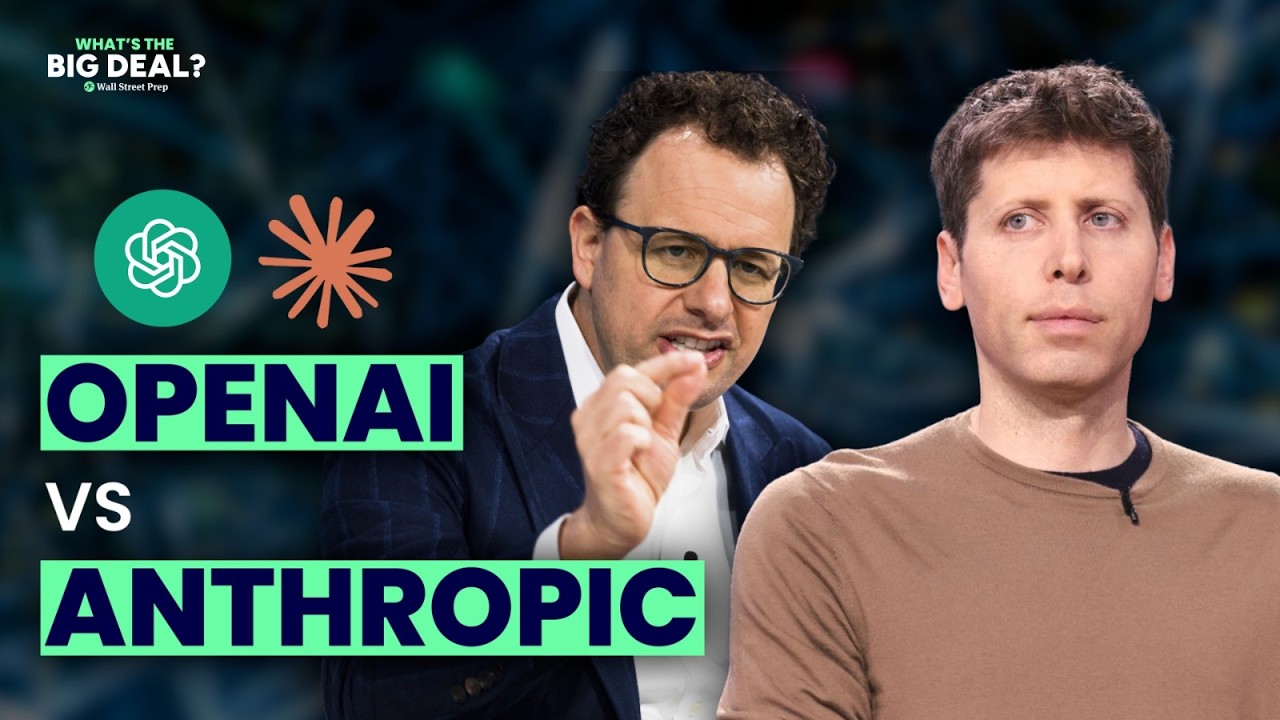
OpenAI and Anthropic, both preparing IPOs, report similar run-rate revenue ($25 billion as of end-February and $30 billion as of early April), yet are valued very differently. The open question is whether OpenAI's owned compute justifies the gap. On the What's the Big Deal podcast, hosts Deborah Taylor and Graham Smith argue the two are structurally different businesses: one built on consumer reach and a roughly half-trillion-dollar infrastructure commitment, the other on enterprise customers and leased capacity.
The tension is that the evidence is thin. Run-rate figures are undefined, IPO valuations are rumored, and Smith concedes his compute explanation for the valuation gap is improvised. Taylor's back-of-envelope math points to a fragmented market, while Smith worries that compute-driven leaps in model quality could still produce a winner-takes-all outcome. Neither host claims to know which strategy wins.
Compute breaks software economics — ▶ 2:50
Smith argues these companies only look like software businesses. Traditional software spends on CapEx and R&D up front, then signs long-term contracts and converts cash at a high rate with light maintenance spending. LLMs invert that: compute capacity and infrastructure become a limiting factor on growth. GPUs, originally built for graphics, suit LLM math better than standard processors, and TPUs are an even more specialized AI engine. Both OpenAI and Anthropic must spend heavily on compute, which makes them poor candidates for conventional software valuation logic.
Own versus lease compute — ▶ 6:23
OpenAI builds and owns compute capacity; Anthropic leases it, mainly from Amazon and Google. Smith likens this to retailers that own versus rent their stores, and suspects an EBITDAR-style metric will emerge to compare them. OpenAI tells investors its commitment of roughly $500 billion (Smith is unsure of the exact figure) is a barrier to entry. Taylor sees control for owners, and agility and lower upfront cash for renters, who risk 'being in the queue' if capacity is constrained. Both hosts say it is too early to name a winner.
Compute as progress bottleneck — ▶ 8:45
Smith's reading is that compute is a barrier to progress as well as to entry: more capacity coming online should make models smarter. On that view, OpenAI's spending could pay off even if its product is less compelling to some customers than Anthropic's today. He notes that committed capacity is being built now and expects visible step changes in model capability soon, which would show how much ownership matters. He hedges heavily, calling this wait-and-see and describing himself as no expert. It is a hypothesis awaiting test, not demonstrated evidence.
Consumer reach versus enterprise visibility — ▶ 10:36
OpenAI has the stronger consumer brand and awareness, but Smith recalls (without citing a figure) that the vast majority of its users are on the free tier. Anthropic sells to enterprises through Claude, with Claude Code a popular tool, giving it more revenue visibility, longer contracts and customers with budgets. Smith notes investors favor predictable recurring revenue and concludes Anthropic currently has a slight business-model advantage. He explicitly leaves open whether that holds over 3-5 years, depending on what OpenAI's compute buildout delivers.
API revenue is stickier — ▶ 12:55
Taylor reports that about three-quarters of OpenAI's revenue comes from subscriptions, mostly consumers, with the rest from APIs. For Anthropic, about 85% comes from APIs. The mechanism is switching cost: developers write code that pulls from a specific model's API, whereas a chatbot user can change providers easily. Smith adds a caveat. If models become good enough to take over a program built on a competitor's API and keep running, that stickiness erodes. He doubts the industry is there yet, so Claude's developer integration is a near-term advantage.
Partnerships as hedges — ▶ 15:29
Microsoft is OpenAI's close partner and funder, while Anthropic leans on Google and AWS. Smith says it is too early to call this a differentiator, because Microsoft, Nvidia and Amazon have invested in both companies, which looks like hedging. Taylor draws a market-structure inference: Microsoft, Amazon and Google dominate cloud without any one winning, and their partnering with both labs may keep AI fragmented instead of consolidating around one. Smith agrees that alignment with one partner does not guarantee victory, though he raises the AGI scenario as a counterweight.
Run rate is murky — ▶ 18:34
OpenAI's reported run rate is $25 billion as of end-February; Anthropic's is $30 billion as of early April, a more recent date. Smith says run rate suits hyper-growth companies (he recalls a report that Anthropic doubled revenue month-on-month), but the method is unknown. It could be the last quarter times 4 or the last month times 12, and could include unsigned expected contracts or capacity not yet turned on. He says he does not know what is in the numbers or how much confidence to place in them, and expects S-1 filings to clarify.
Same revenue, different valuations — ▶ 21:21
Anthropic raised $30 billion at a $380 billion valuation in February; OpenAI's latest round was $122 billion at $852 billion. Taylor cites a report that OpenAI's training costs are about 4x Anthropic's despite comparable quality, and speculates, as her own interpretation, that Anthropic's enterprise focus makes its training more efficient. Smith suggests the roughly $500 billion infrastructure commitment might account for the valuation difference, but admits he is 'making this up on the fly'. He adds that surplus capacity could be leased out as a secondary revenue stream.
Institutional money and retail demand — ▶ 27:04
Anthropic's recent round drew more institutional investors, including Fidelity and D. Shaw, which Taylor thinks could flatter its IPO valuation because such investors anchor listings. Rumored IPO targets, flagged as rumor, are about $600 billion for Anthropic and $1 trillion for OpenAI. Smith finds those in line with trajectory: Anthropic's run rate has reportedly doubled in a couple of months. Taylor says retail allocations in IPOs are typically 5-10%, but SpaceX reportedly expects about 30% and these companies may follow, reflecting strong public appetite for AI.
What the valuations require — ▶ 30:15
Taylor's analysis finds that $1 trillion for OpenAI implies roughly 30% revenue CAGR over a decade and a revenue multiple of about 40x, similar to Cloudflare's IPO. Cloudflare, however, was the market leader in network security, whereas OpenAI shares the lead with Anthropic. Anthropic's rumored $600 billion implies about 25% CAGR and a 20x multiple, with lower near-term CapEx needs. She treats it as a deliberate challenge to the excitement. Both sets of multiples rest on run-rate figures the hosts have already called uncertain, an editorial caveat.
Fragmentation or winner-takes-all — ▶ 32:12
Using a $5 trillion global AI market in 10 years (a figure Taylor says she is hearing), those growth rates give each company roughly $300 billion, about 6-7% of the market. She concludes the market will be fragmented, with room for cloud providers and end-user industries like healthcare and finance. Smith agrees on market size but says concentration depends on model progress: if one model nears AGI-like quality, the other may be unnecessary. He sees compute spending replacing Moore's law as the constraint, and is skeptical that regulation will intervene.
The most striking fact in this discussion is that two companies with similar revenue are being priced very differently, and nothing in the public data fully explains why. OpenAI reported a run rate of $25 billion as of the end of February. Anthropic reported $30 billion as of early April. Their latest private rounds valued OpenAI at $852 billion and Anthropic at $380 billion, and the rumored IPO targets are $1 trillion and $600 billion. Deborah Taylor and Graham Smith spend the episode hunting for an explanation. The leading candidate is not revenue but infrastructure.
Smith's starting point is that these firms only resemble software companies. Conventional software spends on development, signs long-term contracts, then converts cash at a high rate with little maintenance spending. Large language models break that pattern because compute capacity limits growth. OpenAI is building and owning that capacity, and tells investors its commitment of roughly $500 billion is a barrier to entry, though Smith is unsure of the exact figure. Anthropic rents capacity from Amazon and Google. Smith compares the split to retailers that own their stores versus those that lease them, and wonders whether an EBITDAR-style metric will emerge to compare such businesses.
Both hosts see trade-offs and decline to pick a winner. Ownership brings control, and Taylor notes that a renter is in the queue if capacity is scarce. Renting brings agility and lower upfront cash needs. Smith adds a longer-term argument: if more compute makes models smarter, spending now could matter more than who has the better product today. He also floats the idea that unused capacity could be leased to a rival, giving OpenAI an option Anthropic lacks. Taylor accepts the point, though it is speculative. The honest summary is that the case for owning compute rests on capability gains that have not yet arrived.
The business-quality evidence points the other way. Anthropic sells mainly to enterprises. About 85% of its revenue comes from APIs, per Taylor, against roughly three-quarters of OpenAI's from subscriptions. The stickiness mechanism is concrete: developers build code that pulls from a specific model, while a chatbot user can switch with a click. Smith recalls that most OpenAI users are on the free tier, though he cannot cite a figure. He also warns that stickiness may fade if models become good enough to slot into a competitor's API. For now, he says, Anthropic has the slightly better business model.
Efficiency adds a second data point. Taylor cites a report that OpenAI's training costs are about 4 times Anthropic's, even though she sees no discernible quality difference when she uses both. Her explanation is that Anthropic's enterprise focus lets it train for narrower uses, while OpenAI must serve every application. She frames this as her own interpretation. Taken together with the revenue evidence, it leaves Smith surprised that the valuation targets differ so widely. His fallback is that investors may be paying heavily for OpenAI's compute platform, and he says plainly that he is "making this up on the fly".
The revenue comparison itself deserves caution, and Smith supplies it. Run rate is an extrapolation, and the method is unknown. It could be the last quarter times 4 or the last month times 12. It might also include unsigned but expected contracts, or revenue from capacity that has not yet come online. Smith recalls a report that Anthropic's revenue doubled from one month to the next, which makes the extrapolation method more consequential. That means the headline claim, that Anthropic has caught or passed OpenAI, rests on a figure whose definition nobody outside the companies knows. Smith says he expects the S-1 filings to settle it.
Taylor's valuation work then tests whether the rumored prices are plausible. A $1 trillion OpenAI would need revenue growth of roughly 30% a year for a decade and would trade at about 40 times revenue. She compares that with Cloudflare's IPO, then notes that Cloudflare led its market, whereas OpenAI shares the lead with Anthropic. Anthropic at $600 billion needs about 25% growth and trades at about 20 times. Her multiples are computed on run-rate figures that the hosts have just called uncertain. They are best read as illustrations of how much growth the prices assume, not as precise estimates.
From this she draws her main argument. Growing at those rates, each company would reach roughly $300 billion in revenue in 10 years. That is only 6-7% of a $5 trillion AI market, a forecast she says she is hearing, without a source. Her conclusion is that the numbers do not require a duopoly or monopoly. Room remains for Amazon, Google and Microsoft, which have invested in or partnered with both labs, and for end users such as healthcare, robotics and financial services firms. The hedging by the cloud providers fits that picture, since no single partnership guarantees an outcome.
Smith accepts the market-size arithmetic but not the conclusion that follows from it. In his view, concentration depends on how fast models improve. If one gets so good that another is not needed, the result could be winner-takes-all. He observes that progress is now limited by money, GPUs and power, where it once was limited by Moore's law, so the leader may simply be whoever builds the most compute. He hopes regulation will prevent a single winner but is not holding his breath, given the political environment in the US and the speed of the technology. Editorially, a large market is not the same as a contestable one. Market-size arithmetic shows there is room for many, but it cannot show the model layer will not concentrate.
The hosts end on a smaller, testable question: who lists first. Smith picks Anthropic, guessing that its enterprise relationships extend to the banks that assemble an IPO, though he calls it a shot in the dark. Taylor picks OpenAI, citing pressure to move first and its public messaging. They agree that being first will matter for investor appetite and valuation. If so, the order of listing could affect the price each company gets before anyone knows whether owned compute produces a capability lead. The disclosures should reveal whether the premium is for assets or for hope.
The open question. Does owning compute deserve the valuation premium OpenAI is reportedly seeking, or is it a cash-draining liability that Anthropic's leasing model sidesteps? The hosts cannot say, and the answer depends on numbers neither has seen. These include how run rate is calculated, whether it counts unsigned contracts or capacity not yet online, and how much of the compute commitment is actually funded. The S-1 filings should settle those points. Whether the capacity now being built delivers the step-change in model capability Smith expects is a separate test, and it will arrive later.
Watch the full video at https://www.youtube.com/watch?v=u6X67nHDGxg.
Comments ()