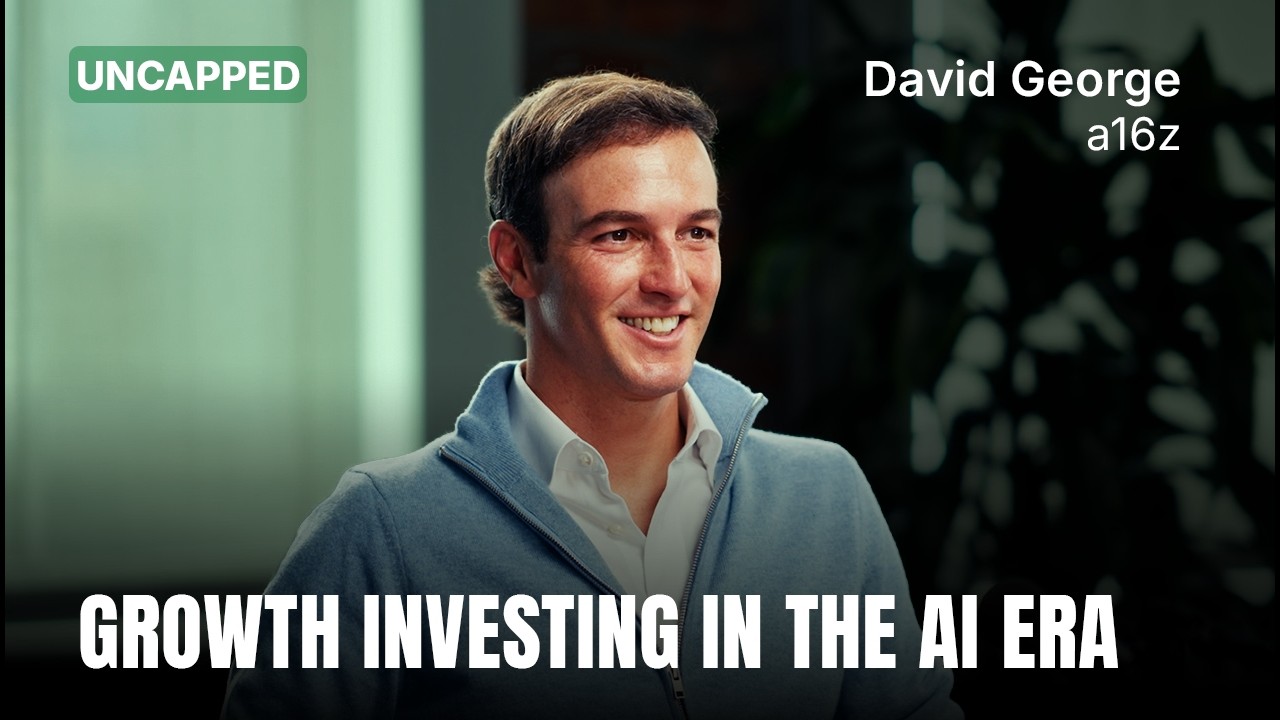
Recorded 1 October 2026 · 53 min
David George, who invests at growth stage for Andreessen Horowitz, argues that asking which part of AI will win is the wrong question: the answer is "probably" all of them. His case rests on an asymmetry. Demand is already unprecedented yet less than 5% diffused into the B2B economy, while supply is constrained at every step of the chain, with data center capacity unobtainable until 2028.
The conversation, with a Benchmark partner, tests that thesis. The interviewer asks what could break it, and raises a sharper worry: today's revenue belongs to sellers of tokens, and buyers have not yet shown comparable returns. The discussion then widens to consumer products, autonomous driving, and what an AI cycle means for venture capital, valuations, and founder narrative.
Everything works, probably — ▶ 1:06
George agrees with Benchmark's Eric Fisher that open source and frontier models, and Nvidia and new chip companies, will both succeed. His own framing is that any question of the form "will this or that win" gets the answer "probably" in AI. His starting evidence is scale: the infrastructure buildout has surpassed the railroads as a percentage of GDP (the interviewer cites roughly 3%). He expects spending to grow roughly 10x, in the many trillions, over many years rather than one.
Revenue rests on coders — ▶ 1:57
OpenAI, Anthropic, and SpaceX AI with Cursor represent roughly $120 billion of revenue, George says, adding more monthly revenue than all hyperscalers except Amazon. Yet it comes mainly from about 30 million coders, probably a steep power law within them, against 1.5 billion knowledge workers and a billion consumer users. He estimates AI is under 5% diffused into the B2B economy. Legal is the next function taking off, about 12 months behind coding. For broad knowledge work, he says, "we're like nowhere."
Supply-constrained through 2028 — ▶ 4:03
George says data center capacity cannot be had until 2028 because every step of the supply chain is bottlenecked. If 4 gigawatts became 8, he thinks it would all be used, possibly at different prices. He sees two ways this could fail: coding proving anomalous among white-collar work, which he calls extremely unlikely, or an algorithmic breakthrough that sharply cuts compute. He judges the second unlikely too: inference will be the larger market, and more reasoning at inference time has kept improving results.
Sellers versus buyers of tokens — ▶ 7:01
The interviewer's key challenge: most revenue belongs to token sellers, and the outcome would be bad if buyers did not profit. George is optimistic but offers mostly anecdote. He says the 20% productivity drop in an older AI-coding study would probably not replicate today, and Stripe feels high returns from more efficient coding. Procter & Gamble probably sees no big gains yet and needs hand-holding, as with Palantir and Databricks. He argues firms should aim AI at front-end products, where 10x-100x revenue is possible, since cost-cutting is capped.
Why users pay for frontier — ▶ 10:45
The frontier labs capture 95%-plus of dollars, about $125 billion across three companies, and OpenAI and Anthropic alone have raised about $350 billion. George sees users paying 10x more for frontier tokens, a revealed preference even among heavy users. He gives two reasons. Consumer surplus is so large that the premium is worth paying. And the labs' first-party products, such as Codex and Claude Code, tightly couple harnesses with models, so nobody swaps in another model without the harness and interface.
Defending against the labs — ▶ 13:27
George's framework: labs will prioritize first-party products inside coding's "blast radius" and horizontal tools for all 1.5 billion knowledge workers, like Office and Google Apps. Elsewhere, an app is perhaps priority number six to 15 for them. Harvey, in which Andreessen is a large investor, shows the dynamic: clients now demand that law firms use it. Two moats protect such apps: last-mile product details and real on-the-ground go-to-market work. Platform logic also restrains the labs, since a platform only works if what is built on it earns more than the platform does.
Abstraction layer is contested — ▶ 18:20
George expects strong demand for N-1 and open-source models as well. If usage rises 50x, cost will matter, and N-1 should soon beat today's frontier. Application companies already feel this because model cost is their gross margin. He expects a contest for the abstraction layer that routes work by value required, among apps, labs, and firms like Databricks, Palantir, and Snowflake. Customer support shows diffusion's pace: the technology has been good enough for years, yet penetration is tiny, implying many years of sales and messy integration.
Consumer is still skeuomorphic — ▶ 20:18
More than a billion people use AI products, but George says most do what they once did in a search engine, so consumer is early. He expects products to become proactive and multimodal, citing improved voice and agent tools like OpenClaw. He forecasts monetization through subscriptions, ads, or an ad form not yet invented, and calls the native format unknowable, as newspaper classifieds would not have predicted it. His rule of thumb: roughly 10x more value accrues to user surplus than the roughly 10% that accrues to companies.
Autonomy repeats the Uber pattern — ▶ 25:53
George argues autonomy is underappreciated. Taxis were under 0.1% of US miles, and Uber and Lyft 10xed the market, with San Francisco taxis going from $100 million to $1 billion within three years. He says Waymo is 10-14x safer than humans. Ownership costs about $0.80 per mile against roughly $2 for ride-hail, so he sees elastic demand. For owned cars, he puts willingness to pay for full autonomy at a minimum of $10,000, across 17 million new US cars a year. There are fewer than 10,000 Waymos in the US.
Product cycles versus capital cycles — ▶ 33:27
George says venture returns now arise at growth stage. An older internal analysis found half of private returns came from C-round and later, and he guesses 70/30 within five years as companies stay private longer. AI is unusual because money converts directly into better models; $40 billion into Salesforce could not, and the Vision Fund showed capital damaging software firms. He scores the product cycle 9-10 out of 10 now, against 1 in 2021 and 8 in 2010. The capital cycle is about 6, "okay, but not great."
Narrative as capital asset — ▶ 43:17
In a market where capital improves the company, a higher valuation means less dilution and a weapon for raising more. George says narrative drives valuation, hiring, retention, and sometimes customers. Palantir is his example: he says no one knows what ontology means, yet CEOs now see it as a trusted place to implement AI. He calls founders like Databricks' Ali Ghodsi and Elon Musk "the asset class", since they keep finding new products. The interviewer adds that private-market sentiment hangs on two or three companies, so narrative will matter more as they list.
David George's argument is that AI investors should stop asking which layer will win, because the structure of the market makes the question nearly moot. Demand is large and barely tapped. Supply is scarce at every step. In a market where everything built gets used, success is not zero-sum, so George's answer to "this or that?" is "probably" both. He borrows the formulation from his interviewer's partner, Eric Fisher, who applied it to open source versus frontier models and to Nvidia versus new chip makers. The claim is a forecast, not a finding, and its strength depends on the two premises beneath it.
The first premise is demand that is huge in absolute terms and shallow in reach. George puts the combined revenue of OpenAI, Anthropic, and SpaceX AI with Cursor at roughly $120 billion, adding more monthly revenue than every hyperscaler except Amazon. Yet this comes largely from about 30 million coders, probably concentrated in the top million of them. Set against 1.5 billion knowledge workers, he estimates AI is under 5% diffused into the B2B economy. The optimistic reading, his own, is that the established revenue is the floor. Legal is the first function behind coding, about 12 months back, and he argues broader knowledge work is simply further behind.
The second premise is supply. George says data center capacity cannot be obtained until 2028 because of bottlenecks throughout the supply chain, and he believes that if 4 gigawatts became 8, the extra would be consumed, perhaps at different prices. The interviewer asked what would falsify this. George named two scenarios, coding turning out to be an anomaly, and an algorithmic breakthrough that cuts compute needs. He dismissed both as unlikely. Coding's gap with other work looks to him like a data-collection and application problem. On efficiency, he notes that inference will be larger than training, and that more reasoning at inference has so far improved results.
The sharpest challenge came from the interviewer: most of the revenue belongs to sellers of tokens, and the next evidence needed is that buyers are earning returns. George's response was confident and thin. He expects the old finding that AI coding made developers 20% less effective would not replicate, and he cites Stripe's sense of high returns from more efficient coding. For Procter & Gamble he concedes probably not yet. This is the weakest link in the chain. A thesis that rests on enterprise return on investment is being supported by executives' feelings about their own productivity and by hand-held deployments at firms like Palantir and Databricks.
George does offer a useful view of where value sits within the stack. Frontier labs hold 95%-plus of dollars, and OpenAI and Anthropic alone have raised about $350 billion, so they have scale benefits. Users reveal their preference by paying 10x more for frontier tokens, which he attributes to the size of consumer surplus and to first-party products whose harnesses are tightly coupled to the models. That coupling is a real advantage. It also explains why he expects labs to concentrate on coding and on horizontal tools for knowledge workers, while leaving specialized markets to applications.
Application companies, in his account, defend themselves through details the labs will not chase. The last-mile product matters to users, and winning requires on-the-ground go-to-market effort. Harvey illustrates it: end clients now demand that law firms use it, and the hallucination objection of 18 months ago has faded. There is also a structural restraint on the labs. By George's logic, a platform stops being a platform if what is built on it does not earn more than the platform does, so picking off random companies costs trust. The restraint is a judgment about incentives, not a guarantee. George himself says that if the labs make an area a priority, outcomes could differ.
Pricing complicates the model layer. George expects the appetite for frontier models to be undisputed, but he also expects N-1 and open-source models to be huge, since a 50x rise in usage will make people care about cost. Application companies already do, because model cost is their gross margin. This points to a contested abstraction layer that allocates work to whichever model delivers the needed value, with apps, labs, and data platforms all competing for it. Customer support is his cautionary example on speed: the technology has been good enough for years and penetration remains tiny.
Beyond enterprise language work, George applies the same logic to consumers and to autonomy. A billion people use AI, mostly as a search substitute, and he expects the shift to proactive, multimodal assistants to open a market whose ad format has yet to be invented. Autonomy follows the Uber precedent: taxis were under 0.1% of US miles, and a better product 10xed the market. He cites Waymo as 10-14x safer than human drivers, ownership at $0.80 per mile against roughly $2 for ride-hail, and fewer than 10,000 Waymos in the US. These are his figures and arguments, and they establish a direction rather than a timetable.
The same structure shapes his view of capital. George says AI is unusual because additional money converts directly into better models, where $40 billion into Salesforce could not. This favors growth-stage investing, since returns concentrate at C-round and later and a strong power law pays when a bet is right. It also raises the value of narrative: a higher valuation is a weapon when capital improves the company. He rates the product cycle 9-10 out of 10 and the capital cycle about 6. The interviewer observes that the market hangs on two or three private companies, and narrative will matter more as they list.
The unresolved issue is the thesis's falsifiability. Because George treats demand as insatiable and supply as the only limit, almost any outcome in the next five years reads as consistent with it, a delay as diffusion and a price move as repricing. The variable that would test it is the one the interviewer raised: whether buyers, outside coding, can show returns that justify more capacity at prices sellers can sustain. If they can, capacity arriving in 2028 will be absorbed. If they cannot, the concentration George describes, in a few labs and a few million coders, becomes a vulnerability, not a runway.
The open question. George's thesis depends on token buyers eventually capturing returns, yet his evidence is anecdotal: Stripe feels productive, Procter & Gamble probably does not yet, and the cited productivity study is old. If value stays concentrated among coders and frontier sellers, will the 1.5 billion knowledge workers diffuse quickly enough to absorb capacity scheduled for 2028 and beyond, at prices that still reward the labs' trillions in spending?
Watch the full video at https://www.youtube.com/watch?v=4H1FbNRdtM0.
Comments ()