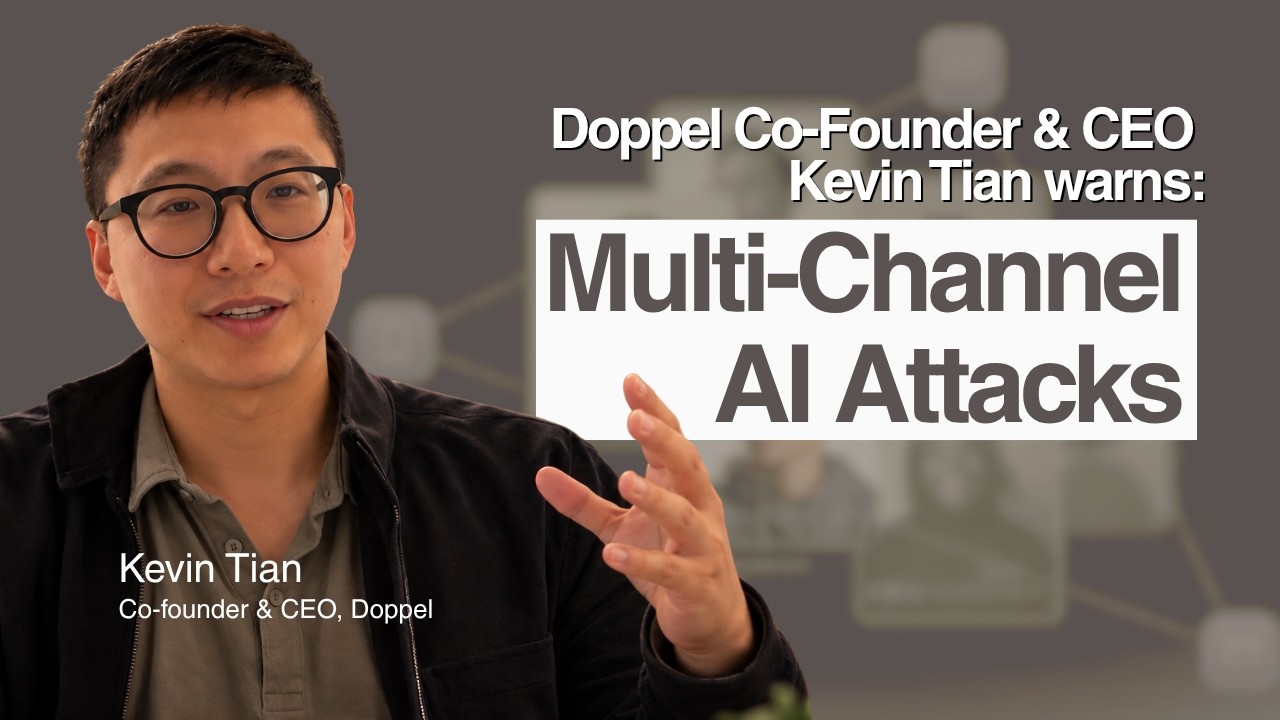
Recorded 15 October 2026 · 13 min
Kevin Tian, co-founder and CEO of Doppel, argues that AI's most consequential effect on cybersecurity is a surge in the volume and reach of impersonation attacks rather than a new class of threat. Those attacks now arrive by email, phone, SMS and video, and increasingly target software agents as well as people. He spoke with Sophia of MTS on the day Doppel announced risk signal ingestion and a partnership with the 49ers.
The tension is between a vendor's thesis and the evidence on offer. Tian's case that manual defenses will fall behind is mechanistic and plausible. But this is a product-launch conversation: it offers few numbers, no measure of attacker versus defender success, and a speaker who acknowledges his bias toward Doppel's own platform.
Founding bet on impersonation — ▶ 0:57
Tian and co-founder Rahul were engineers at Uber in 2022, when Rahul's roommate, one of OpenAI's heads of research, gave him a preview of coming technologies. Their hypothesis was that AI's greatest threat would be social engineering: deepfakes, impersonation, phishing and fraud. The name Doppel is short for doppelganger. Tian says the past couple of years have borne this out, pointing to large enterprise attacks and, in sports, fake players and disinformation campaigns. He offers no specifics, but frames AI mainly as something that makes executing such threats much easier.
Multi-channel attacks, agents as targets — ▶ 2:16
Phishing email is the familiar form, but Tian describes attacks that now span email, phone and video conferencing. Doppel's own defensive AI agents can call people and send SMS, and on average these calls produce 9-minute conversations. That figure comes from Doppel's platform, not from observed criminal campaigns. A second shift: agents are now on the receiving end too, picking up phones or reading and answering email. Defense therefore has to protect both humans and agents from social engineering.
Behavior as risk signal — ▶ 3:13
Doppel's risk signal ingestion, announced the same day, combines real-world security data with employee behavior to identify who is most exposed to social engineering. Tian's examples: publicly sharing Google Drive or O365 files without limiting the audience, weak password hygiene, and not using MFA. These habits mark people as more susceptible. The interview does not explain how the scores drive interventions such as training or simulated attacks, or whether they reduce successful attacks. Editorially, the logic is that defenders cannot treat all employees as equally exposed.
Ground truth beats platform scale — ▶ 4:02
For the 49ers, Doppel offers an end-to-end service: taking down impersonators, such as someone posing as a 49er on Instagram, and simulating attacks by having AI agents pretend to be a player and call a coach. It recently added email security to stop attacks in real time. Asked why Instagram does not handle this itself, Tian concedes platforms do a lot but operate at enormous scale. Doppel's problem is more tractable, he says, because working directly with clients means it knows the legitimate accounts and assets.
Volume forces automated defense — ▶ 6:45
The hardest part, Tian says, is scale. One of the most common ways AI has changed the threat landscape is by increasing attack volume. Defenders who take down content manually, build security awareness training manually, or rely on hardcoded email rules or an unreliable black box will fall behind. His illustration is an attacker's AI engine spinning up a thousand phone calls and targeted phishing emails posing as your parents. The conclusion is that AI attacks require AI defense. He concedes Doppel is biased, and gives no data on how much volume has risen.
A pendulum, not a winner — ▶ 9:07
Asked whether attackers or defenders are ahead, Tian declines to name a winner. He calls it a pendulum that swings back and forth, notes recent high-profile attacks, and says the goal is zero. He is nonetheless very bullish: Doppel and other cybersecurity companies are building technologies that could not have been built 6-12 months ago. His optimism rests on the pace of defensive innovation, not on any metric. Because both sides keep innovating, he argues, complacency is not an option.
Tian's central claim is that AI's main effect on social engineering is economic rather than novel. It makes attacks cheaper to execute, so there are far more of them. Asked what is hardest about stopping impersonation, he answered with one word: scale. He describes one of the most common ways AI has changed the threat landscape as a rise in attack volume. His vivid example is an attacker's AI engine spinning up a thousand phone calls to your phone while sending targeted phishing emails that pretend to be your mother or father. The implied mechanism is that automation removes the human labor that once limited how many people an attacker could target at once.
Volume interacts with breadth. Tian notes that most people have seen or heard of a phishing email, but attacks now run across email, phone and video conferencing. Doppel's own defensive agents can call people and send SMS messages, and on average their calls produce 9-minute conversations. That figure comes from the defender's platform, not from observed criminal activity, so it is only a hint of what attackers can do. It does suggest these interactions can be sustained rather than scripted one-liners. Tian adds a second shift: agents now sit on the receiving end, picking up calls or answering email, so the target is no longer only a human.
The company's origin shows how Tian frames the thesis. He and co-founder Rahul were engineers at Uber in 2022 when Rahul's roommate, one of OpenAI's heads of research, gave him a preview of coming technologies. They concluded the greatest AI threat would be social engineering, deepfakes, impersonation, phishing and fraud, and named the company for the doppelganger. Tian says the past couple of years have vindicated that view, citing large enterprise attacks and, in sports, fake players and disinformation campaigns. These are assertions rather than documented cases, and the foresight narrative is told entirely by the person who benefits from it.
If volume is the problem, the defensive prescription follows directly. Tian argues that manual takedowns, manually crafted security awareness training, hardcoded email rules, or a black box that may not work in every situation will all fall behind. Doppel's pitch to the 49ers mirrors that logic as a pipeline. It finds and removes impersonators, such as a fake 49er account on Instagram. It simulates attacks, with AI agents pretending to be a player calling a coach. And it recently added email security to stop attacks in real time. Sports organizations matter here because their people are public figures who can be impersonated.
The most interesting strategic claim is about why a third party can do this at all. Asked why Instagram does not police impersonation itself, Tian concedes that platforms do a lot, but says their scale makes the problem very hard. Doppel's version is more tractable, he says, because it works directly with clients and knows their legitimate accounts and assets. That ground truth gives it confidence in identifying fakes. Editorially, this suggests the advantage lies in information and contractual access rather than in better algorithms. It also limits the model: it works best where an organization is willing to be a customer.
The same logic appears in the newly announced risk signal ingestion. By combining security data with behavior such as publicly shared Google Drive or O365 files, weak password hygiene and missing MFA, Doppel aims to identify who is most at risk. Tian says these behaviors make people more susceptible. The interview does not explain how a risk ranking turns into fewer successful attacks, whether through training, simulated attacks or tighter controls. The idea is plausible, since defenders facing volume cannot treat every employee as equally exposed, but it is presented as a feature, not demonstrated.
The weakest part of the case is the scoreboard. Asked who is winning, Tian declines to say, describing a pendulum that swings between attackers and defenders. He acknowledges high-profile recent attacks and says the goal is zero. He also says he is very bullish because cybersecurity companies are building technologies that could not have been built 6-12 months ago. That is a statement about the pace of innovation, not about outcomes. The question the conversation leaves open is whether faster defensive tooling translates into fewer successful compromises, particularly as attackers also target the agents that now answer phones and email.
The open question. Tian's optimism rests on defensive technologies that could not have been built 6-12 months ago, but the interview supplies no measure of whether they reduce successful attacks relative to rising attack volume. It is also unclear whether behavior-based risk scoring changes outcomes, and how defenders will protect AI agents that now answer phones and email on organizations' behalf.
Watch the full video at https://www.youtube.com/watch?v=rykGpc0uagQ.
Comments ()