Recorded 2 October 2026 · 44 min
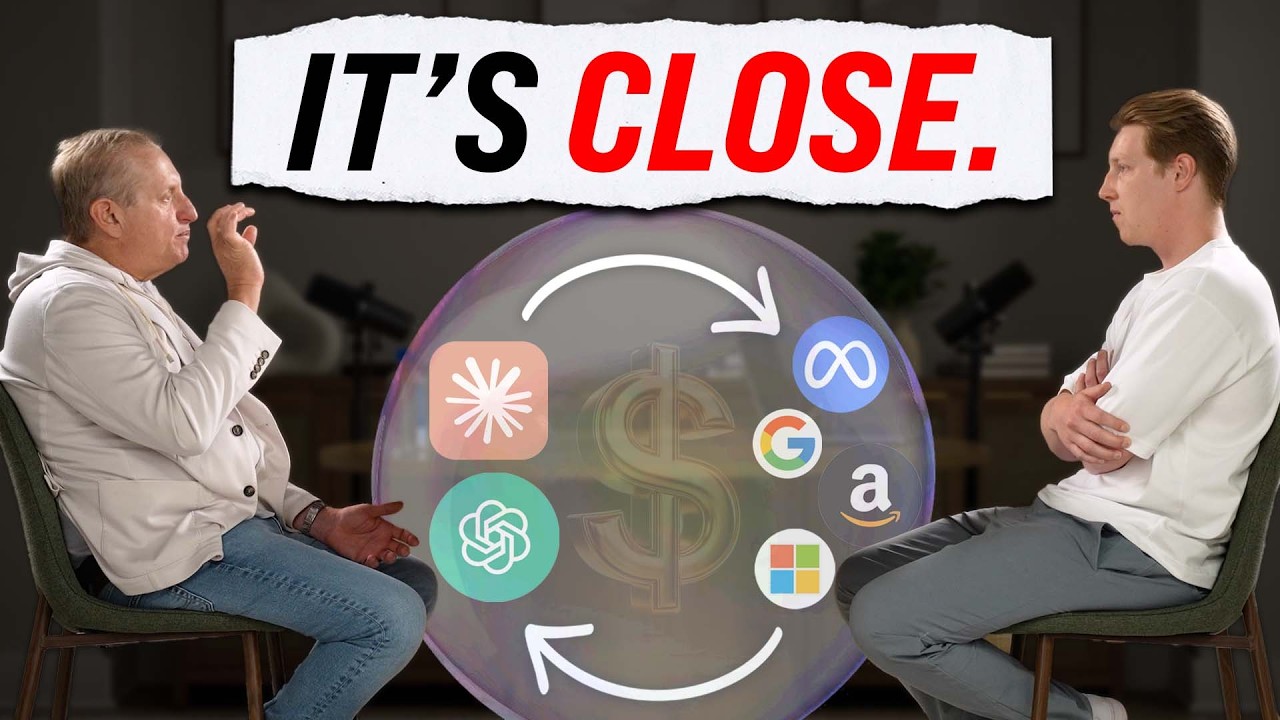
Steve Eisman, host of The Real Eisman Playbook and the investor whose character appeared in The Big Short, argues that the AI supply chain, from Nvidia through the hyperscalers to Oracle, rests on the finances of just two customers: OpenAI and Anthropic. If either falters, he says, the commitments behind hundreds of billions in spending could unwind.
His case is distinctive because it is built on filing footnotes and revenue mix rather than valuation multiples or doom narratives. It is also candid about its limits. Eisman says he lacks enough numbers to rank the two labs with confidence, cannot tell whether US power supply will bottleneck, and will not say whether this resembles 1999.
Nvidia's hidden concentration — ▶ 1:57
Nvidia's revenue growth of roughly 110% (Eisman's recollection) looks like proof the AI story is working. Note 7 of the 10-Q shows that 70% of accounts receivable at the end of July came from five customers. Eisman, who owns the stock, calls it a warning flag, not the end of the world. His frame is a simple test: an established software company with thousands of customers is healthy, while one with two customers can be killed by a single bad event.
Hyperscalers lean on two labs — ▶ 2:55
Eisman says that for Microsoft, Amazon and Google, 70% of AI revenue, equal to 25-30% of total cloud revenue, comes from Anthropic and OpenAI alone. Oracle's remaining performance obligations (a form of backlog) jumped from about $150 billion to about $400 billion in three months. Sell-side analysts found roughly 50% was from OpenAI. The backlog now exceeds $600 billion, still about 50% OpenAI. If the 70% figure were 10%, he says, it would be a different conversation.
OpenAI's upside-down economics — ▶ 5:24
Citing Wall Street Journal reporting, Eisman says OpenAI had about $6.5 billion of second-quarter revenue against costs of about $12 billion. Over three months its revenue rose about $1 billion while costs rose about $3 billion. Revenue grew 18%, versus over 100% for Anthropic, which was above 11 billion. That makes OpenAI the weaker entity, though he concedes the numbers are insufficient. An OpenAI failure, he says, would send the US into recession overnight, and diversification will take time.
Circular financing holds, for now — ▶ 7:35
Eisman expected venture capital to be the main funder of the labs and found otherwise: most of the money has come from Amazon, Google, Microsoft, Nvidia and SoftBank. The host noted the circularity, with commitments flowing to hyperscalers and equity flowing back, and the Big Short CDO comparison followed. Eisman sees some similarities but says the chain holds as long as both labs keep growing very rapidly and investors keep funding them. He does not know whether the backers will keep paying in.
Token maxing ends, moats absent — ▶ 11:23
Last year OpenAI and Anthropic undercharged so heavily it was killing them, then raised prices. Companies that had told staff to use AI constantly, token maxing, faced real bills. Eisman says Uber blew through its AI budget in three or four months, and another firm spent $500 million before realizing it. Customers now reserve frontier models for important tasks and use cheaper open-weight models like Kimi for the rest. With no switching costs, Eisman concludes the industry has no moats, unlike Google search, which once held about 90% usage.
Doom talk as regulatory strategy — ▶ 13:48
Eisman's self-described conspiracy theory is that talk of AI ending the world is a subterfuge. Nervous labs, he says, are manufacturing hysteria to prompt regulation that could ban Chinese models and create a duopoly, a legal moat that does not exist today. His test is behavioral: if Dario Amodei truly believed his product was dangerous, he would postpone his IPO, and Anthropic is not doing so. He cites Elon Musk mocking the same contradiction. The evidence is inference about motive, not documented intent.
Hyperscaler moats, lost cash flow — ▶ 16:16
Hyperscalers have a moat in capital, since few can spend $100 billion on data centers, but their cloud businesses depend on customers with no moats. Eisman adds that Microsoft, Amazon and Google once threw off so much cash they bought back stock; now cash flow is gone, in some cases negative. Google raised $85 billion in equity, which he says he would have called insane two years ago. Oracle's stock went from 230 to 330, then down to 150, with S&P rating its debt triple B minus, which he describes as perhaps one level above junk.
Burry's depreciation critique, dismissed — ▶ 22:07
Michael Burry noted that hyperscalers extended chip depreciation from 3-4 years to 5-6 years, lowering reported expense, while newer chips make old ones obsolete. Eisman grants the accounting effect is enormous but calls the argument too academic. For now, demand is strong enough that older chips are still sought and their prices have risen. More importantly, if the labs grow, the schedule won't matter; if OpenAI fails, the resulting correction would have nothing to do with it.
Power winners, unknown bottleneck — ▶ 24:23
On Elon Musk's claim that the US has a power problem, Eisman says nobody knows how binding it is. He does know who benefits. GE Vernova, which one sell-side analyst valued at negative $3 billion before its spin-off, makes the gas turbines that mostly power data centers. US electricity is growing 3-4% a year, equivalent to two large cities, and Vernova's orders rose about 85% last quarter. Musk's Memphis Colossus site used 35 portable gas turbines because the grid was too slow.
Picks, shovels, agent disruption — ▶ 31:07
Eisman would avoid LLM developers and be wary of hyperscalers, preferring companies collecting the cash: Nvidia, Micron, GE Vernova, Arista, Cisco and Eaton. In software, an AI agent such as Meta's Muse that books flights makes the agent the customer, which could cut the value of travel sites and make payments dicey. Deeply embedded enterprise software is probably safe. He calls the travel case a little early but a possibility, and says some software companies will have problems.
Five percent as the Rubicon — ▶ 37:43
Eisman says the Fed funds rate matters less than the 10-year Treasury yield, which sets what people actually borrow at. His guess is that 5% is the Rubicon for the market: he first guessed 4.5% and was wrong. The yield was 4.98 at the time, after topping 5% the day before. Breaking through, he says, would bring a correction. He doubts a US debt spiral because Treasuries underpin global repo markets, though he would like the deficit smaller.
Eisman's central claim is structural rather than predictive: the AI buildout is a single chain, and most of its weight sits on two companies, OpenAI and Anthropic. He gets there by applying a simple test. A software company with thousands of customers is healthy; one with two customers is fragile, because one bad event can kill it. Applied to AI, the test starts with Nvidia. Its revenue growth of roughly 110% in the latest quarter, by Eisman's recollection, looks like a triumph. Yet Note 7 of its 10-Q shows that 70% of accounts receivable at the end of July came from five customers. Eisman, who owns the stock, calls that a warning flag, not the end of the world.
The concentration deepens further down the chain. Eisman says that for Microsoft, Amazon and Google, 70% of AI revenue, equivalent to 25-30% of total cloud revenue, comes from Anthropic and OpenAI alone. Oracle's backlog rose from about $150 billion to about $400 billion in three months, and sell-side analysts found roughly half of it came from OpenAI. It now exceeds $600 billion, with the share still near 50%. His conclusion is that Nvidia's orders, the hyperscalers' data centers and Oracle's backlog all trace back to commitments made by the two labs. If those commitments cannot be paid, the chain slows. Had the 70% figure been 10%, he says, this would be a different conversation.
The labs' ability to pay is where the argument becomes uncomfortable. Eisman cites Wall Street Journal reporting, which he assumes is accurate, that OpenAI had about $6.5 billion in second-quarter revenue against costs of about $12 billion. Over three months its revenue rose about $1 billion while its costs rose about $3 billion, a trajectory he calls upside down. Its revenue grew 18% in the quarter; Anthropic's, at more than 11 billion, grew over 100%. That makes OpenAI the weaker of the two, though Eisman concedes the numbers are thin and the ranking could change. An OpenAI failure, he says, would put the United States into recession overnight.
How the labs fund themselves adds a second layer. Eisman assumed venture capital was the main source and found it was not; most of the money has come from Amazon, Google, Microsoft, Nvidia and SoftBank. The host observed that this looks like a circle, with commitments flowing to the hyperscalers and equity flowing back, and the comparison to stacked CDOs from The Big Short followed. Eisman accepts some similarities but defends the structure on narrow grounds. The chain holds so long as the two labs keep growing very rapidly and investors keep writing checks. It fails if one stumbles and money is pulled. He says he does not know whether the backers want to keep funding, and that unanswered question is the hinge of the thesis.
Eisman's second pillar explains why the labs are vulnerable even if demand is large: he says the industry has no moats. A moat, in his definition, is an advantage that is eternal or at least very long-lasting. Nvidia has one because nobody else really makes GPUs. Salesforce and ServiceNow have one because customers cannot function without them and switching is brutal. LLM providers have neither. A developer using Claude will move the day a better model arrives. Pricing reinforced the point. Last year, he says, OpenAI and Anthropic undercharged so badly it was killing them, then raised prices. Customers told to use AI around the clock, token maxing, met real bills, and Uber reportedly burned through its AI budget in three or four months. Companies now reserve frontier models for important tasks and use cheaper open-weight models for the rest.
From this follows his most provocative claim, which he labels a conspiracy theory: the warnings that AI could end the world are a subterfuge. In his reading, nervous labs facing no moats, the end of token maxing and Chinese open-weight models gaining share are manufacturing hysteria so that government will regulate, perhaps banning Chinese models as too risky. That would create a legal moat and a duopoly. His supporting evidence is behavioral. If Dario Amodei really believed his product was dangerous, Eisman says, he would postpone his IPO, and Anthropic is not doing so. This is an inference about motive, not proof. As an editorial caution, a company could sincerely hold safety concerns and also welcome favorable regulation, so the IPO test does not by itself separate the two.
The hyperscalers sit in an awkward position. They have a moat in capital, since few can spend $100 billion on data centers, and the host cited an estimated $700 billion of hyperscaler AI capex this year. But their cloud businesses depend on customers with no moats, which Eisman calls their weakness. The cash machines have also changed. Three or four years ago, Microsoft, Amazon and Google threw off so much cash they bought back stock; now their cash flow is gone, and in some cases negative. Google raised $85 billion in equity, which Eisman says he would have called insane two years ago. Oracle shows the market's nerves: after rising from 230 to 330, its stock fell to 150, and S&P rates its debt triple B minus.
Eisman is selective about which risks he treats as material. Michael Burry's point that hyperscalers stretched chip depreciation from 3-4 years to 5-6 years, flattering profits while chips age faster, produces what Eisman admits is an enormous accounting boost. He still calls it too academic. If the labs grow, the schedule won't matter, and if OpenAI fails, the correction would have nothing to do with it. Power is different, because here he claims ignorance. Asked about Elon Musk's view that the US has a power problem, he says nobody knows how binding the constraint is. What he does know is who profits. GE Vernova's gas turbine orders rose about 85% last quarter, while data centers push US electricity growth to 3-4% a year, the equivalent of two large cities.
The practical conclusion is to own the companies collecting the cash. Eisman would avoid LLM developers and be wary of hyperscalers, favoring Nvidia, Micron, GE Vernova, Arista, Cisco and Eaton. Software is split. When an agent like Meta's Muse books a flight and hotel, the agent becomes the customer, and intermediaries such as online travel sites lose value because users no longer visit them directly. He calls this a little early but a possibility. Deeply embedded enterprise software is probably fine. The macro overlay is the 10-year Treasury yield. He guesses that 5% is the Rubicon, having first guessed 4.5% and been wrong, and a sustained break above it would, he says, bring a correction.
What Eisman declines to claim is as instructive as what he asserts. He will not say whether this is 1999 again. It is too early, he says, and if OpenAI or Anthropic fail, a real correction would follow and a new generation would pick up the pieces. His case is diagnostic, not a forecast, and it depends on figures he admits are incomplete. One tension in his own account deserves attention. He expects customer diversification to eventually reduce concentration, yet he also says loyalty is nonexistent and cheap open-weight models are taking share. It follows, as editorial inference rather than his statement, that broader demand may arrive by flowing away from the two labs whose revenue the whole chain presupposes. Whether growth can be diversified without being displaced is the question the thesis leaves open.
The open question. Can OpenAI and Anthropic close the gap between revenue and costs before their strategic backers lose appetite? Eisman concedes the available numbers are insufficient, cannot say whether Amazon, Google, Microsoft, Nvidia and SoftBank will keep funding, and gives no timeline beyond the labs needing to stay healthy for roughly the next year. His thesis turns on that unobserved behavior.
Watch the full video at https://www.youtube.com/watch?v=Zw0I7kb6zg4.
Comments ()