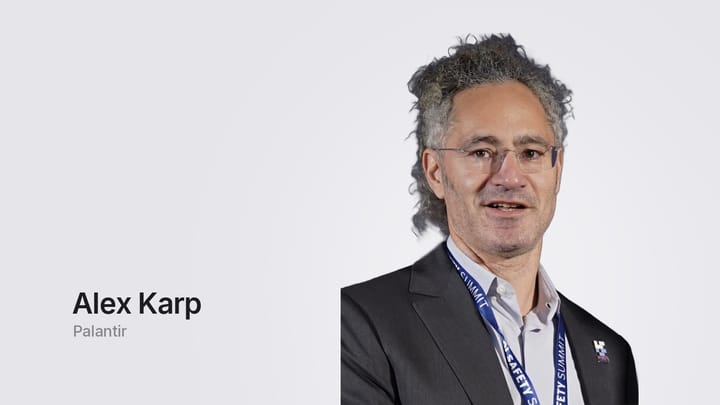

Recorded 13 July 2026 · 64 min
Alex Karp argues that Europe's moral case against Palantir is "way downstream of the competence problem." Europe has no application layer of its own, so it attacks the company that has one instead of building a rival.
The conversation is a long, friendly argument with an old friend who runs Axel Springer and has known Karp since 2003. The friend sees no change in him, only in how he is described. Karp calls himself a 1970s progressive. He says the Darth Vader image is a media construct and that ordinary Germans are fans.
The tension is trust. Karp says politicians and Silicon Valley both tell people not to believe their lying eyes, on migration and on AI, and voters answer with protest votes. He also declines to promise that AI's gains will be shared evenly, and will not bet on who beats China.
Why Europe attacks Palantir — ▶ 5:40
Karp says the "media version" of him differs from the street, and that he gets 100 times more fan mail than hate. He claims the product has "stopped hundreds and hundreds of terror attacks." Europe can afford to attack Palantir for two reasons. The product works so well that terror is no longer feared, and remaining attacks are read as an immigration problem. And Palantir plays a major role in Ukraine, where Russia "doesn't appear to be winning." The company is attacked because it is powerful enough to be attacked safely.
Buyers at war versus buyers at peace — ▶ 7:23
American businesses "believe they're at war all the time." A demonstrably better product there triggers practical questions: how does it work, does it transform my business, is it stealing my IP? In Europe those questions cannot be afforded, because honest answers mean a significant part of the infrastructure has to be imported from America. Karp says moral outrage is the cheaper substitute for asking. It also explains why the same product gets opposite receptions on either side of the Atlantic.
Application layer as sovereignty — ▶ 10:21
Karp says Palantir's application layer protects data from being abused by large language model providers. He calls Europe's resistance the work of "technically illiterate bureaucrats." Real surveillance, in his definition, is European IP and indigenous know-how migrating to a non-European company with no interest in protecting privacy or data purging rights. He names the products: PG, used by police and intelligence services, and Foundry with ontology, used in Ukraine. He says they are the only ones at scale that he knows of. The moral question, he says, sits downstream of competence.
Rights, Calvinism and Lutheranism — ▶ 12:55
Americans hold moral rights against government, the First, Second and Fourth Amendments. Europeans hold economic rights, and each side finds the other's gap vexing. Karp still calls himself a "classic progressive": he wants better treatment of the poor and defends the rights of people he dislikes. He calls Germany Lutheran, skeptical of great success earned in one lifetime, and America Calvinist, tempted to read wealth as moral success. Both have flaws. The excess of moralizing in Europe, he says, comes from not wanting to solve problems.
Can Germany afford not to learn — ▶ 16:34
Karp calls the German treatment of Peter Thiel "atrocious" and says the right question is whether Germany can afford not to learn from him. He is reading books on Mao and Deng Xiaoping and agrees with Mao on nothing. He describes Thiel as heterodox right, never a neocon, and not a believer in classic Republican economics. Germany's tech scene was once number one and should be number two. Siemens is its largest company by market cap, and Palantir is significantly larger. His charge is that critics block a person instead of studying him.
The AfD as protest vote — ▶ 22:30
Karp says extreme parties' rise was "super predictable" once large-scale migration arrived without the buy-in of Germans or an honest discussion of its consequences. He says the AfD is stronger than it looks. Former Social Democrat friends now vote for it, and at 40% polling another 10 points would join if it weren't the AfD. It is a protest vote because nobody believes mainstream parties will take migration seriously. He would not vote for it. The host pressed twice for a direct view, and Karp deflected before agreeing with the host's objections.
Declare a crisis — ▶ 30:17
Nothing works, Karp says, until a chancellor declares a crisis. Germany then needs an economic zone where competition looks like America, China or Israel. It must bring in builders like Tobi Lütke, Philip Schindler or Thiel in significant roles, because "you can't rebuild with people who've never done this before." Tech needs people dedicated around the clock for years, and teams must be able to move people out. He says he has told every important politician for 10-15 years that it's "talent not money," and that Europe makes the problem harder every day.
Uranium and the stack — ▶ 32:31
Karp compares large language models to uranium: useful, but they must be processed, and touching them raw is a bad idea. He lays out four layers: GPUs, data integration, the application layer or ontology, and closed and open models. Europe cannot lead every layer, so it must pick the components that advance its industry. Sovereignty is "a completely technical issue." He says Europe's bureaucrats instead start from protecting the market against American companies, and everything else follows from that.
AI as the only growth route — ▶ 38:36
Karp says without AI systems "Russia would have won," and without pre-AI tools, terror attacks would be rampant. Germany must rebuild how it makes cars and processes chemicals to compete with China. It has a limited workforce, failing immigration and strict laws, and energy fixes will take long. He says one technology can raise GDP under those constraints. He counts "two and a half countries" embracing it: America, China and Israel. Germany is an export culture whose products must beat everyone else's, so he says its health depends on products, not diplomacy.
Wealth decoupling and lying eyes — ▶ 43:17
Karp expects most people to do better from AI. A worker's salary might rise 50% or double over 10 years, while he could become 20 times wealthier. That wealth would go to "oddly shaped IQ specimens" ordinary people don't relate to, in a society he already calls "separate but non-equal." Lab leaders tell the public its jobs will vanish while getting rich. He says Silicon Valley's claim that AI carries no dangers is not credible. Telling people "don't believe your lying eyes" on migration, nuclear or AI produces protest votes.
China's edge is political — ▶ 52:10
Karp reframes the race: solving the moral issue often exposes a technical one, which is why Ukraine and Israel overperformed with Palantir. He grants China medical data on 700 million people, though he thinks battlefield data is about equal. China's edge is political. The West's heavy hardware programs employ millions and have constituencies that resist shifting budgets. China is run by an engineering class, and the best open models are now Chinese. He declines the 10-year bet as too far out. The West's chief weakness, he says, is political, not technical.
The surveillance charge gets the technology backwards. Karp's case is that the products Europe's critics want to ban are the ones that prevent surveillance in the sense that matters. Palantir sits in the application layer, between a company's data and the large language model providers, and that layer keeps the data from being abused by those providers. Police and intelligence services in Europe run on PG. Ukraine runs on Foundry and ontology. Karp says these are the only products at scale he is aware of that do the job. In his definition, real surveillance is European IP and indigenous know-how migrating to a non-European company that has no interest in European rights, including the right to have data purged. Take away the application layer and you do not get privacy. You get dependence.
Why, then, the hostility? Karp offers a functional answer, not a moral one. The product works too well. He says it has stopped hundreds of terror attacks, and the attacks that still happen are read as an immigration problem, not a terror problem. In Ukraine, Russia does not appear to be winning. Europe feels safe enough to attack the thing that made it safe. A second mechanism sits underneath. American firms believe they are at war all the time, so a demonstrably better product triggers practical questions. Does it work? Does it transform my business? Is it stealing my IP? European buyers cannot afford those questions. An honest answer would mean importing a significant part of their infrastructure from America. Moralizing is the cheaper alternative to asking.
He applies the same logic to Germany's treatment of Peter Thiel. A serious country asks whether it can afford not to learn from someone, whatever it thinks of him. Karp is reading books on Mao and Deng Xiaoping and agrees with Mao on nothing. Germany's tech scene was once the best in the world and should now be second. Its largest company by market cap is Siemens, and Palantir is significantly larger. His diagnosis is cultural. Germany is Lutheran and distrusts great success earned in one lifetime. America is Calvinist and tempted to read wealth as moral success. Both have flaws. But Europe's excess of moralizing, he says, comes from not wanting to solve problems.
The fix he prescribes is political first and financial second. A chancellor has to stand up and declare a crisis. Germany then needs an economic zone where competition looks like America, China or Israel, and it must bring in builders like Tobi Lütke, Philip Schindler or Thiel in significant roles. "You can't rebuild with people who've never done this before." Tech runs on people dedicated around the clock for years, and teams must be able to move people out. Karp says he has said this to every important politician for 10-15 years. It is talent, not money. Meanwhile Europe makes another decision every day that makes the repair harder.
The stakes are not optional. Germany must rebuild how it makes cars and processes chemicals to compete with China, with a limited workforce and failing migration. Karp says only one set of technologies can raise GDP under those constraints. He counts two and a half countries that have embraced them: America, China and Israel. Sovereignty does not mean owning every layer. The stack runs from GPUs to data integration to the application layer to open and closed models, and no European player can lead all of it. Europe has to choose the components that matter. He calls sovereignty a completely technical issue.
The same mechanism explains the politics. When elites tell people not to believe "your lying eyes" on migration, nuclear or AI, voters do not comply. They protest vote. Karp says the AfD's rise was predictable once large-scale migration arrived without buy-in or an honest discussion. It polls at 40%, he says, with another 10 points who would vote for it if it were not the AfD. He would not vote for it himself. Silicon Valley, he warns, is repeating the error. Most people will probably do better from AI, with a salary up 50% or doubled over 10 years. But the same decade could make him 20 times wealthier, through people most voters would not want at dinner, in a society he says already lives separate but non-equal. Add lab leaders telling the public its jobs will vanish while they get rich, and the fear is rational. He calls the claim that AI carries no dangers not credible.
The obvious objection is that the framework cannot lose. If critics are right, they are sincere. If they are wrong, they are incompetent or protecting a market. Karp says the case against Palantir falls apart in five minutes on Google. He answers the surveillance charge by redefining surveillance. He does not say who audits what government customers do with the platform. Pressed twice on the AfD, he talked first about migration and history, and only later said he agreed with the host's objections. On China he is more candid. In the West, heavy hardware programs employ millions and have political constituencies, which makes shifting budgets harder. China is run by an engineering class and fields the best open models. The West's chief weakness, he says, is political, not technical. Asked to bet on the next 10 years, he declines. It is too far out.
Asked finally whether the open society is ending or renewing, Karp answers neither. "We don't know the answer," he says, and the West has to "fight like hell." He sees the far right and far left as structurally similar and as functional allies of adversaries. That leaves the claim he cannot test. If Europe fixed its competence gap, would the moral objection dissolve? Europe would have to build the layer before it could find out.
The open question. Karp's central claim is that moral objections to Palantir are merely a symptom of Europe's tech gap. He never takes the objection on its own terms: who oversees what government and intelligence customers do with the platform. He redefines surveillance as the migration of European IP and know-how. He also rejects the 10-year US-versus-China bet as too far out. The test is his own prescription. Does any European leader declare a crisis and import the talent he describes, and does the hostility fade if one does?
Watch the full video at https://www.youtube.com/watch?v=xm0rGvvxVOM.
Comments ()