Recorded 7 October 2026 · 69 min
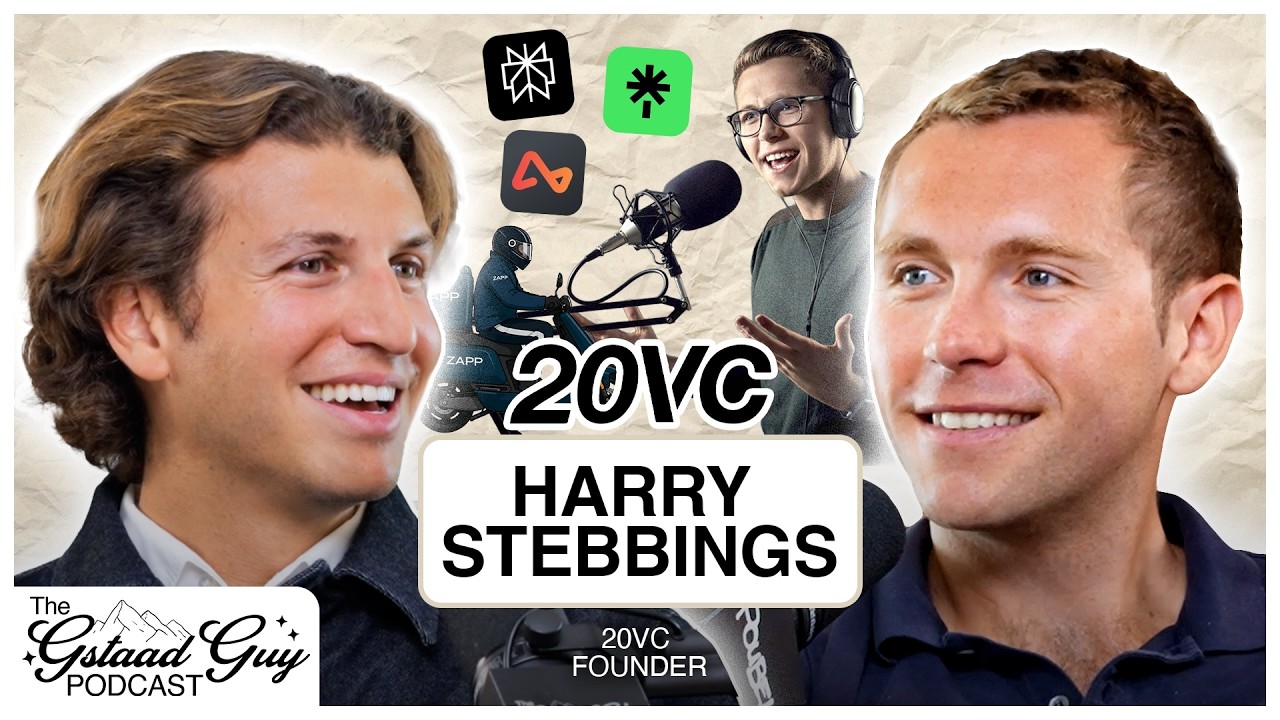
Harry Stebbings, founder of venture firm 20VC, argues that venture capital is commoditizing and that owning a media platform is what now differentiates an investor. His podcast, with millions of listeners, sits beside roughly $1 billion under management, and he says the show still earns more than the fund. The conversation, led by a fellow podcaster, tests how that bet connects to his belief that markets reward only the category leader.
The tension is personal as much as strategic. Stebbings calls himself intensely insecure and short of time, yet insists he enjoys every day and would refuse a shortcut to success. His host challenges whether a life of optimization can coexist with enjoying process. Stebbings concedes that extreme success carries costs he will not fully pay, while arguing that AI demand and concentration will define the next decade.
Consumer private equity play — ▶ 3:23
Stebbings tells the host she should raise a $500 million consumer private equity fund, back the fastest-growing consumer brands, and run a lead-generation content business alongside it. His premise is that investing's biggest problem is an excess supply of capital: too much money chasing too few good assets, so everyone hunts for a differentiator. A large media platform is that differentiator. He later adds that consumer private equity is more commoditized than venture and that a fund offers longevity, because content is fickle and shallow.
Insight developments and media — ▶ 4:32
Stebbings says the best companies are built on insight developments, seeing something others miss. His own was that venture would commoditize and media would differentiate. He traces the ambition to a scene in The Social Network, seen at 13, in which Peter Thiel's fund backs Mark Zuckerberg. He started with no university and a B in GCSE maths. For later-stage companies with $100 million or more in revenue, he says the podcast doubles as diligence: he asks the questions he would ask in a meeting and watches how founders respond.
Three revenue streams — ▶ 6:51
Stebbings names three income sources: podcast advertising, management fees on roughly $1 billion under management, and carry. The standard terms he cites are a 2% annual fee and 20% of gains, so a $100 million gain yields $20 million to the firm. Today the podcast earns far more than the other two, and he expects carry to dwarf everything in the long term. He also notes that you cannot know you are good at investing for about 10 years. Editorially, media income funds the period before that proof arrives.
Founder signals beyond resilience — ▶ 9:07
Stebbings dismisses resilience and discipline as fluffy signals and offers specific ones. First, high-level gaming, which forces repeated experiments, A/B testing, resource allocation and leadership. Second, a struggled parent relationship, which often creates a chip on the shoulder. Third, starting young: he sold phones on eBay at 10, and says no great founder leaves Bain or McKinsey and starts at 26. He adds esoteric passions, citing the Collisons and Brian Chesky's interest in medieval inns, and moving around in childhood. The evidence is anecdotal, and his absolutes are strong.
Insecurity as engine — ▶ 16:22
Asked why he moves so fast, Stebbings answers that he is intensely insecure and feels a desperate lack of time. He argues founders must be at peace with dissatisfaction, and that contentment might signal they should stop. He advises making a first meaningful amount of money before pursuing impact. Early on he passed out from exhaustion and was found by his brother on the kitchen floor. He concedes this is unhealthy. When tired, he pictures another 30-year-old willing to work the extra mile, because he thinks competition is higher than ever.
Rejecting the cheat code — ▶ 21:43
Asked whether he would skip the process and get the outcome, Stebbings says absolutely not: it is not about eating the fish, it is about fishing. He cancels shows he does not want to do. He blames algorithm-driven content for a twisted creator-platform relationship, with a viral hit followed by starvation, and says 90% of the time there is no cheat code. The host counters that his hyper-optimized life looks like shortcutting process. He replies that he is either on or off, and off for perhaps two to three hours a day.
Be Uber, not Lyft — ▶ 25:52
Stebbings wants to be number one, citing an enterprise value gap of about $100 billion between Uber and Lyft and saying the leader usually takes 80-90% of a category. The host objects that followers avoid first-mover mistakes. He argues venture's bar has risen to $1 billion revenue companies and decacorns, citing Cursor selling for $60 billion in four years. His Europe bet rests on less competition than in the US, and on his claim that Donald Trump is "the CMO of Europe," motivating young founders to build at home.
Four hobs, two lit — ▶ 33:08
The host says tremendous success versus quite success is not worth the cost, and Stebbings agrees: he guarantees friends worth $100 million are happier than those worth $1 billion. He says he will not be a bad parent, so he will not found a multi-decacorn. He thinks life has four hobs, friends, family, work and health, and only two can be lit well. His workaround is to merge them: his mother and brother work for him, and his best friends are business partners. He still feels he is failing at things.
Slow adoption, sharp tipping points — ▶ 43:31
Stebbings expects AI to reshape 90% of how things are done, with real discomfort in the transition. He cites an image-editing update that put a generation of editors out of work. He also thinks companies adopt slowly, European ones especially, so permeation of the biggest organizations may take 10 years. The key question is each industry's tipping point. In law, he says, firms that do not use AI will lose contracts because clients are asking for it. His investing job is to identify the tipping point and then the post-tipping-point winners.
Demand outruns compute — ▶ 45:21
Stebbings rejects the bubble framing: a bubble implies excess supply, whereas demand far exceeds compute. His worry is concentration, since the global economy has never rested on two companies, OpenAI and Anthropic. If they cut spending on data centers, energy or compute, he says the party could unravel quickly. Big tech can fund capex from free cash flow in the hundreds of billions. His forecasts, offered without supporting analysis, are Nvidia at $10 trillion, OpenAI and Anthropic at $5 trillion each, and Chinese open-source models carrying most traffic but at low economic value.
Retraining as the bottleneck — ▶ 48:55
Stebbings expects smaller teams and the removal of arbitrary work such as expense reporting. He cites Sam Altman's claim that young people use AI as an operating system for life, and urges people to become AI-native fast. He would invest millions in centers that teach complex workflows, and imagines a two-week AI school before analysts start at banks such as Goldman Sachs, since learning on the side does not happen. He says UK curriculum changes take 3 years and expects YouTube and ChatGPT to win education as horizontal platforms.
Harry Stebbings organizes his career, his firm and his view of AI around one premise: outcomes are concentrated, and the gap between first and second place is so large that almost any intensity is rational. In his telling, the leader in a category usually captures 80-90% of it, and he points to an enterprise value gap of about $100 billion between Uber and Lyft. Venture has absorbed that logic. A unicorn is no longer enough, he says; funds need $1 billion revenue businesses and decacorns. He cites Cursor, which he says sold for $60 billion in four years, as the benchmark his investors now hold him to.
If winners take so much, the scarce resource for an investor is not capital but access and signal. Stebbings argues that capital is oversupplied, that venture is commoditizing, and that the only durable differentiator is an audience. His podcast does several jobs at once. It sources founders. For later-stage companies with $100 million or more in revenue, it works as public diligence, because he asks the questions he would ask in a meeting and watches the answers. It also funds the business: the podcast earns more than anything else today, while management fees on roughly $1 billion and eventual carry are meant to dwarf it.
The weak point is the gap between distribution and judgment. Stebbings says plainly that you do not know whether you are good at investing for about 10 years. An audience can prove that founders will take your call, which is a real advantage, but it cannot show that you pick winners. He also calls content fickle and shallow, and he urges his host to convert attention into a fund for exactly that reason. The structure he describes is a durable asset, a fund, built on a perishable one, attention. Whether the first reliably carries the second through a full investing cycle is unproven.
His selection criteria carry a similar boldness. He dismisses resilience and discipline as fluffy and prefers signals such as elite gaming, a strained relationship with a parent, starting something at a young age, and unusual passions. The gaming argument has a mechanism: games force repeated experiments, A/B testing and resource allocation. The others rest on anecdote, such as eBay phone sales at 10 and the Collisons' interest in history. He claims no great founder leaves Bain or McKinsey and starts at 26. By his own estimate he has met around 12,000 founders, which is a large sample, but he offers no counter-sample of those who failed.
The personal cost of this worldview is something Stebbings states without decoration. He says he is intensely insecure, feels a desperate lack of time, and treats dissatisfaction as a skill founders must accept. He recalls passing out from exhaustion in the early days, and he says he motivates himself by imagining another 30-year-old willing to work the extra mile. The competitive logic is the same concentration argument applied to himself: if you will not do everything it takes, someone else will. He is careful to say this is not healthy, and he does not advertise it as a model.
The host presses on the most interesting contradiction. Stebbings says he would refuse a cheat code and loves every day, citing the idea that it is about fishing rather than eating the fish. Yet he describes a morning shake, the same dinner every night and a life that is either on or off. His resolution appears to be that he optimizes logistics but not the work he loves, and that he cancels anything he does not want to do. That distinction is plausible, though it is his own account. The strongest challenge is his agreement that friends worth $100 million are happier than those worth $1 billion while he still wants to be number one.
He resolves that by drawing a line at parenthood. Stebbings thinks life has four hobs, friends, family, work and health, and that only two can be lit well. His workaround is to merge categories: his mother and brother work for him, and his closest friends are his business partners. He will not found a multi-decacorn, because he believes that is incompatible with being a good father, with Daniel Ek as the rare exception. Editorially, this suggests his actual strategy is to be number one in a category he can win while staying below the extreme cost. Europe fits: he says it is less crowded than the US and has tens or hundreds of billions at stake.
His AI views follow the same pattern. He rejects the bubble thesis because demand exceeds compute supply and every internal metric he sees points up and to the right. Big tech can finance the buildout from free cash flow in the hundreds of billions. The vulnerability he names is concentration: never before has so much of the global economy rested on two companies, OpenAI and Anthropic. If they pull back on data centers, energy or compute, he says, the unwinding could be fast. His forecasts of $10 trillion for Nvidia and $5 trillion each for the two labs come without supporting analysis, and they sit uneasily beside that warning.
On adoption, he separates capability from organizational speed. Companies are slow and disorganized, European ones especially, so he expects around 10 years for AI to permeate the largest. What matters is each industry's tipping point, and he points to law, where clients now expect AI. The practical consequence he draws is retraining: AI schools before day one at big banks, because learning on the side does not happen, and a UK curriculum that takes 3 years to change. The pain, he warns, will arrive faster than most people admit.
The two concentrations in his argument share a fragility. The AI economy, as he describes it, depends on two buyers continuing to spend. His own model depends on one audience continuing to listen, in a business he admits could be hot today and cold tomorrow. He treats the first as a risk to watch and the second as a reason to build a fund. The test of the thesis is whether a concentrated edge can last long enough to turn into outcomes that cannot be taken away.
The open question. Stebbings says nobody knows whether they are good at investing for 10 years, and that the podcast currently earns more than anything else. Does the audience advantage translate into better selection and returns, or only into deal flow and fee income? He also calls content fickle. Whether an edge built on attention can underwrite a decade-long fund is the assumption his model rests on, and the evidence he offers is his own trajectory so far.
Watch the full video at https://www.youtube.com/watch?v=lAkbNDbd4ak.
Comments ()