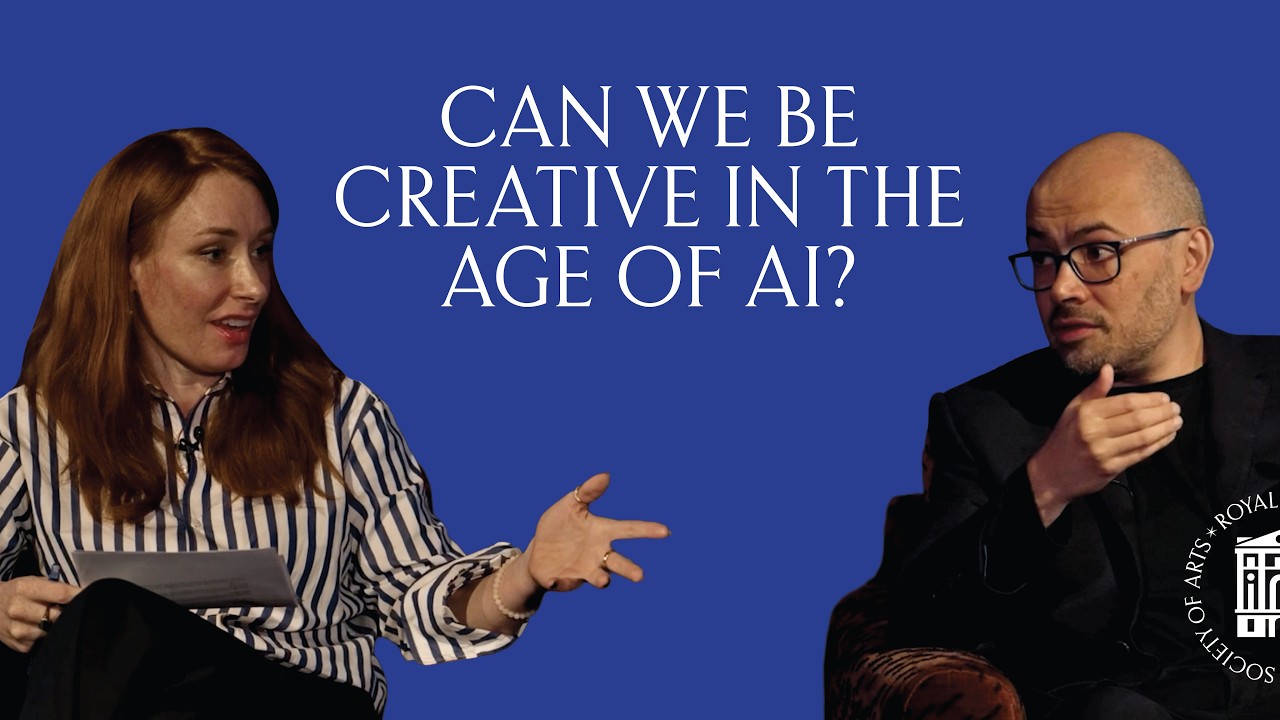
Recorded 11 September 2026 · 63 min
Demis Hassabis argues that AI may deliver roughly 10 times the impact of the Industrial Revolution, unfolding about 10 times faster, and that the hardest questions it raises are not technical. Speaking at the Royal Society of Arts after receiving its Albert Medal, he says what society values, how the gains are shared and what purpose means must be answered by the arts, humanities and social sciences, because technologists are not best placed to answer them.
The tension is between inevitability and agency. Hassabis says the technology will not go back in a box, and that China and the US will build it whatever Britain does. He also says the future is not written. The discussion tests how an AI lab leader reconciles those claims, and what he concedes about economics, creative value and commercial pressure along the way.
AlphaFold's 262 million structures — ▶ 6:49
Proteins are the body's machines, and each one's function depends on its shape. Understanding a disease or designing a drug therefore requires the shape, and determining a single structure could take a scientist years or a whole career. According to RSA chief executive David Joseph, AlphaFold has now produced 262 million of them and given every one free to researchers worldwide. Joseph frames it as a problem researchers attacked the same way for 50 years until someone looked at it differently. Hassabis later cites AlphaFold and the spin-out Isomorphic as his route to accelerating drug discovery.
Games funded and shaped AI — ▶ 14:36
Hassabis says the 1990s games industry, driven by the creative goal of making something fun for millions, was inventing 3D graphics and pushing AI ahead of academia. The GPUs used for AI were originally built for 3D graphics, and everything is a matrix multiplication, as he puts it. His lesson is that an ambitious, multidisciplinary goal pursued for its own sake produces ancillary benefits nobody could have planned. At Elixir Studios he also used games as a Trojan horse to fund AI research that was unfundable in the early 1990s.
Intuition separates great scientists — ▶ 16:52
Professional scientists are technically brilliant by definition, Hassabis argues, so intuitive leaps are what separate the great from the good. He draws a parallel with game design, where the question is when the game will be fun and no one can guarantee the answer. If you knew, it would be neither research nor creative. The best designers resembled the best scientists he had met, relying on taste, intuition and faith, underpinned by engineering. He credits multidisciplinary teams, where engineering informs research and vice versa, for the success of AlphaFold and AlphaGo.
10x the Industrial Revolution, 10x faster — ▶ 17:34
Hassabis predicts AI will be at least as big as electricity, the telephone, the internet and mobile, perhaps 10 times the impact of the Industrial Revolution, unfolding over a decade instead of a century. That revolution brought modern medicine and falling child mortality, but also required new institutions to handle its downsides. He puts full AGI a few years away and says society is not ready. Questions of value, purpose, and the difference between craft and the soul of a creative piece belong, in his view, to the arts and humanities. These are estimates offered without a supporting mechanism.
Why a neuroscience PhD — ▶ 30:16
By his early 20s, in the mid-1990s and before the neural network revolution, Hassabis felt he had pushed AI as far as it was then known. In the early 2000s he sought an orthogonal source of information about intelligence: the brain, with fMRI newly mainstream. He chose imagination because almost no one had studied it, and because it underlies planning, as in chess, yet no one knew how to do it with AI. A third motive was learning how frontier research works, which he says many technologist colleagues misunderstand because it differs from engineering.
Tools co-designed with artists — ▶ 35:38
Unlike some competitors, DeepMind says it builds creative tools early in partnership with top artists, musicians and game designers, including the Icelandic company behind Eve Online. Hassabis sees a split between AI slop, designed to hook audiences for a few seconds, and prototyping uses. Leading artists can iterate through more ideas before committing resources and attempt projects that would otherwise lack funding. Emerging creators can show a prototype or short trailer rather than a slide deck. Which direction dominates, he says, is up to the creative community and society.
Creative flourishing, then a value problem — ▶ 39:10
Hassabis expects roughly 10 years in which the best creators use AI tools to 10x their output. Beyond that, if the tools grow more autonomous, he guesses, and flags it as a guess, that human connection, craft and soul will matter more, as old masters are still prized over copies. The complication is that value has been tied to the effort behind a great pianist, chess player or mathematician. If a shortcut exists, effort can no longer define worth, so society must decide what it treats as a virtue.
Capitalism needs an overlay — ▶ 41:10
Left to the technology, Hassabis says, development goes wherever capitalism takes it. He cites social media's addictive silos as the warning and calls capitalism amazing but in need of a societal and philosophical overlay. Even if the technology works, three problems remain: safety as systems become more autonomous, economics so everyone shares in the gains, and philosophy about purpose and value. He says the future is not written, and that any technologist who claims to know it is lying or has ulterior motives.
Computability, Turing and Penrose — ▶ 46:56
Whether human storytelling contains non-computable elements is, Hassabis says, an empirical question. Roger Penrose argues for quantum effects in the brain, which would put some capacities beyond classical computers. Hassabis sees no evidence so far and sides with Alan Turing that most human abilities will prove computable. But creativity has no linear notion of better, as chess and Go do, so AI work will simply be different. Meaning will depend on human connection, he argues, as with stories based on a true story or Van Gogh's visible pain.
Shape it, or have it shaped — ▶ 54:10
Hassabis compares AI to the tide: assume it works. The UK cannot hold it back, since China and the US will proceed regardless, so the choice is between having it shaped for you and shaping it to your values. He recalls MIT professors dismissing learning-based AI when he set up DeepMind, and judges their arguments boiled down to dogma. Debate hardens ideas, he says, but you just got to show it. At worst, he reasoned, the approach would fail in an interesting new way.
Inverting the classroom — ▶ 58:34
Hassabis says a roughly 50-year-old post-war education system caters to the middle, leaving talented and struggling children underserved. Children should grow up AI-native, he argues, as skipping computers and the internet in the 1990s would have left them behind. He proposes inverting the classroom. Personalised AI tutors and videos from the best teachers handle first-pass learning outside class, ending the duplication of every maths teacher producing the same materials. Class time goes to project work, teamwork and entrepreneurialism, in the manner of Montessori or Oxbridge supervisions. It is a recommendation; he offers no evidence on children's cognitive development.
Demis Hassabis holds two positions that can look opposed. AI, he says, is coming fast, will not go back in a box, and could have "maybe something like" 10 times the impact of the Industrial Revolution, arriving about 10 times faster, over a decade rather than a century. Yet he also insists that "the future is really not written." The reconciliation is the spine of his talk. The technology is a given, but what it is used for is not. Capability, in his framing, opens many paths and defines none of them. Choosing among them is a question for societies, and he says plainly that technologists are not best placed to answer it.
His case for inevitability is competitive rather than technical. Britain, he argues, cannot hold back the tide, because China and the US will build AI whatever it does. The real choice is between having AI shaped for you and leaning in to shape it to your own values. He admits the path has been messier than he planned. He expected to do more scientific work in the vein of AlphaFold before chatbots, but AI became commercial earlier than he thought. The result, he says, is faster advances and faster risks. The admission suggests the pace is partly set by market forces rather than the sequencing a scientist would choose.
His confidence that ambitious goals pay off comes from his own history. In the 1990s, he says, the games industry was inventing 3D graphics and pushing AI beyond what academia was doing, and the GPUs now used for AI were first built for 3D graphics. He notes that everything is a matrix multiplication, "it turns out." The lesson he draws is that a big, multidisciplinary goal pursued for its own sake yields benefits nobody could have planned. He also used game development at Elixir Studios as a "Trojan horse" to fund AI research that was unfundable in the early 1990s. It is a persuasive pattern, but a retrospective one. The hardware example shows serendipity, not that serendipity can be engineered to order.
Behind that pattern lies a particular view of research. Hassabis argues that great scientists, like great game designers, are separated from merely competent ones by taste, intuition and faith under uncertainty, all underpinned by strong engineering. If you could guarantee when a game would be fun, or when a breakthrough would arrive, it would not be creative or research. He credits AlphaFold and AlphaGo to teams in which engineering informs research and research informs the next engineering step. RSA chief executive David Joseph supplies the output: 262 million protein structures, given away free, against years of effort for a single one. Hassabis adds a reason to trust unpopular bets. MIT professors told him learning-based AI would never work, and he judged their arguments "boiled down to dogma".
The argument turns on what happens after the technology works. Hassabis names three layers of difficulty. The first is technical: keeping systems safe as they become more autonomous. The second is economic: whether everyone shares in the gains. The third is philosophical: what society values and what purpose means. His cautionary example is social media. Left to the technology, he says, development goes wherever capitalism takes it, which he calls amazing but in need of an overlay of societal intent. One alternative is wholesome, connecting products; the other is "addictive silos". His best-case vision includes terrible diseases solved, new energy sources and abundance. It therefore leaves economics and philosophy as the biggest challenges, in his own words.
The creative industries are where he sees the first concrete test. DeepMind, he says, builds tools with top artists, musicians and game designers early in the process, including the Icelandic company behind Eve Online. He sees both AI slop, built to hook audiences for a few seconds, and real uses. Artists can iterate through more ideas before committing resources, attempt projects that would not otherwise be funded, and emerging creators can show a prototype rather than a slide deck. His timeline has two phases. Over roughly 10 years, the best creators use the tools to 10x their output. After that, if the tools become more autonomous, he guesses, without claiming to know, that human connection and craft matter more.
The sharper difficulty is how value gets assigned. Society has prized the discipline behind a great pianist, chess player or mathematician. If a shortcut exists, effort can no longer be the measure. Hassabis answers with provenance and connection. Stories are marketed as "based on a true story" because it matters that a person lived them, and Van Gogh's pain is visible in the brushstrokes in a way an AI robot's probably would not be. He also thinks creativity has no linear notion of better, unlike chess or Go, so AI output will be different rather than superior. On whether storytelling contains anything non-computable, he calls it an empirical question. He sides with Alan Turing over Roger Penrose's quantum-consciousness view, citing the lack of evidence so far.
His one operational proposal concerns schools. He wants children to grow up AI-native, comparing the alternative to not training them on computers or the internet in the 1990s. The classroom would be inverted. Personalised AI tutors and videos from the best teachers handle the first pass of learning outside class, ending the duplication of every maths teacher producing the same materials. Class time goes to project work, teamwork, creativity and entrepreneurialism, in the manner of Montessori or Oxbridge supervisions. The gap is evidence. A member of the House of Lords asked about children's cognitive development, and his reply offered a design principle rather than a demonstration that it protects it.
The argument contains tensions Hassabis does not resolve. He says no one knows what will happen and that anyone claiming to is lying or has ulterior motives. Yet he also says full AGI is a few years away and offers 10x multiples without a supporting mechanism. A second tension is agency. He urges Britain and Europe to embrace "the ambition and the optimism", yet his own account is that the US and China will proceed regardless and that commercial pressure accelerated the timeline. The transcript does not show how a convening institution gains leverage over that pace. An editor might infer that influence follows capability more than debate. His own career, built on showing rather than arguing, points the same way.
The unresolved issue is timing. Hassabis says the debate should have started "yesterday" and that the foothills of the singularity are only years away. Yet the questions he assigns to the arts and humanities are ones societies have historically answered slowly. They include what to value when effort stops signalling worth, and how the gains are shared. His own comparison is the Industrial Revolution, which needed new institutions to handle its downsides over a century. He is proposing a decade. If creative flourishing arrives first, as he predicts, the tools may shape norms of value before anyone has defined craft or soul. Whether the arts can set the terms before the market does is the real test of his optimism.
The open question. Hassabis says the debate should have started yesterday and that full AGI is only a few years away. The questions he assigns to the arts and humanities are what to value once effort stops signalling worth, and how everyone shares in the gains. Societies have historically answered such questions slowly. If creative tools flourish first, as he predicts, will norms of value be set by the market before anyone has defined craft or soul? The transcript does not say how the arts would gain that leverage.
Watch the full video at https://www.youtube.com/watch?v=rDteJAuKiBI.
Comments ()