Recorded 4 October 2026 · 26 min
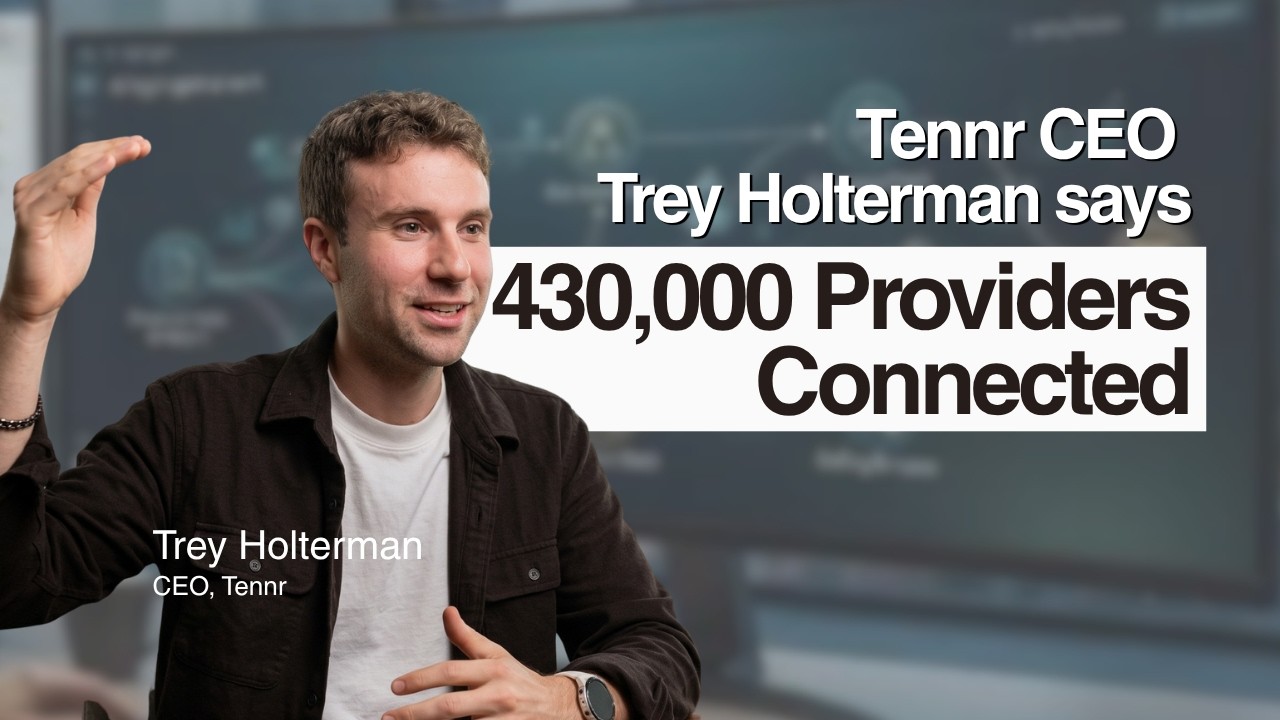
Trey Holterman, CEO of Tener, argues that the binding constraint on healthcare AI is no longer model capability but human behavior and incentives. Tener's agents match complex insurance guidelines against patient histories, which he gives as 400 pages in his example, across a network of more than 430,000 referring providers. Even so, he rates getting patients and referral sources to act as "difficulty 10 out of 10."
Recorded live at the New York Stock Exchange with host Sophia, the conversation turns on a tension. Holterman is bullish that agents can clear referral backlogs. He also expects chatbots to push more patients toward specialists, and he argues that almost any incentive structure can be gamed. His figures come from a vendor with stated growth targets, not from independent data.
Agentic means chained judgment — ▶ 1:00
Holterman defines agentic work not as simple automation but as multiple steps of nondeterministic reasoning tied together toward an end outcome. Getting a patient onto a complex therapy, a device or even a first appointment involves a series of steps, each needing judgment, thinking and tool use. Tener's approach was to put that process on rails. He relays that an early investor said in 2024 that Tener was the first agentic healthcare application running at scale. That is an investor's characterization, not an independently established fact.
Agents work behind the patient — ▶ 4:06
Technology, Holterman says, moves far faster than consumer behavior. Tener's average patient is a 67-year-old woman in the Midwest who is delighted by a call that knows the next step in her journey and is probably not using consumer agents herself. Tener handles the coordination behind the scenes and texts or calls her only when she must act. Because every action must be tightly controlled, he does not expect providers to deploy fully rogue personal-assistant concierges soon. He expects them to adopt the technology selectively.
Reading is solved; people are not — ▶ 5:25
The first blocker is matching a complex corpus of insurance guidelines against a 400-page medical history to decide whether a provider can take a patient. Holterman calls it made for language models. Tasks once pre-codified, such as chasing missing referral documentation, calling payers or coordinating benefits across three payers, can now run as long-running agents. The hard parts are integration in a non-integrated environment, escalation rails to clinicians and administrators, and the behavior of payers and patients. Referral sources are not always incentivized to follow up, and patients have a million things going on.
EMR subsidies distorted adoption — ▶ 8:51
In what he calls a hot take, Holterman blames healthcare's reputation as a technology laggard on government money. About 20 years ago, funds were paid to providers to adopt EMR software. They were paid to buy expensive software, not because paper was hurting them. He says this produced an unnatural adoption cycle, a bifurcated long-tail market, poor products and miserable workflows. Tools that work on top of those systems and deliver a 10x better experience, he argues, move even difficult procurement cycles. This is his interpretation, and the transcript offers no supporting data.
Any incentive can be gamed — ▶ 14:41
Holterman says nearly every incentive scheme gets gamed. He cites states handing Medicaid patients to large payers and says more than 50% of patients have moved from Medicare to Medicare Advantage; the passage blends the two programs. In his hypothetical, a payer prepaid $20 billion to manage a state's plan would approve claims until it reaches what it was paid to dispense, then deny. His counterexample is ChenMed in Florida, which does not earn more from extra treatments but wants patients to stay healthy. He would fund primary care much more aggressively than the current five minutes per patient allows.
Chatbots may swamp specialists — ▶ 17:30
Holterman predicts that many healthcare inquiries will run through chatbots, which he considers trigger-happy about referrals. In his downside scenario, a 3-month wait to see a rheumatologist stretches to 5 months, and low-acuity visits displace urgent ones. He notes that overburdened medical assistants and coordinators already struggle to tell high-acuity patients from someone seeking a fourth opinion after reading something online. His bet is that provider-side models will triage effectively and that telehealth will absorb patients who need only a specialized opinion. The forecast is a prediction and comes with no supporting data.
Scale targets and K-shaped market — ▶ 20:47
Tener has about 300 people in New York and processes patients for about one in five providers. It wants to reach about 50%. Holterman cites an Arizona group where patients went 30 days without contact and says the status quo is 18 to 21 days. He wants oncology referrals contacted the same day within 12 to 18 months. He expects a more K-shaped, consolidated market in a year. In 10 years he expects real-time patient flow, like an order exchange where nobody wonders whether a trade will confirm in 4 days or 40.
Holterman's central claim is that the technical half of healthcare referrals is now tractable and the human half is not. Tener began, he says, with his mother, a family practitioner in the Bay Area, who felt that sending a patient out was like sending them into a black hole. Those patients are the lifeblood of an imaging center or an oncology practice, yet they fell through the cracks and nobody contacted them. The first obstacle was informational. Insurance guidelines are complex, and a patient may arrive with 400 pages of medical history. Deciding whether a provider can take the patient means reading both. Holterman calls this a use case made for language models, and says Tener now serves a network of more than 430,000 referring providers.
Agents extend that capability from reading to acting. Holterman defines agentic work as multiple steps of nondeterministic reasoning chained toward an outcome, with judgment and tool use at each step. Tasks that once had to be pre-codified can now run as long-lived agents. Examples include chasing missing documentation from a referral source, calling a payer and coordinating benefits across three payers. The architecture is conservative. Tener operates in a highly non-integrated environment, so it invests heavily in integration teams. It also builds rails that escalate to a clinician or an administrator when a journey looks likely to go off course. Every action, he says, has to be tightly controlled.
What remains hard is people. Holterman rates the challenge of getting a patient to answer the phone and supply missing paperwork as "difficulty 10 out of 10." Referral sources are not always incentivized to follow up, and patients have a million things going on. Tener's average patient is a 67-year-old woman in the Midwest who is delighted by a call that knows her next step. That is why he thinks technology moves faster than consumer behavior. His stated stakes are concrete. He describes an Arizona group where patients went 30 days without contact and says the status quo is 18 to 21 days. Tener aims for same-day contact on oncology referrals within 12 to 18 months.
Incentives are the thread Holterman keeps returning to. He argues that about 20 years ago, government money to move providers from paper to EMR software produced an unnatural adoption cycle. Providers were paid to buy expensive software instead of choosing it because paper hurt. In his telling, the result was a bifurcated, long-tail market of poor products, and that explains healthcare's reputation for slow adoption. Tools that sit on top of those systems and deliver a 10x better experience, he says, can move even difficult procurement cycles. The same logic governs payment design. Prepaying payers to manage care invites approval until the money is spent and denial afterward, as in his hypothetical $20 billion state plan. ChenMed, which does not earn more from extra treatments, is his counterexample.
His demand forecast is less comfortable. If more people consult chatbots, which he describes as trigger-happy about referrals, specialty demand rises. In his downside scenario a 3-month wait for a rheumatologist becomes 5 months, and low-acuity visits crowd out urgent ones. Overburdened medical assistants and coordinators already struggle to separate a high-acuity patient from someone seeking a fourth opinion. His bet is that provider-side models will triage and that telehealth will absorb patients who need only a specialized opinion. An editorial inference follows. Tener sits on both sides of the problem, because the referral volume it processes would grow with the same strain its triage tools must manage.
The evidence for these claims is thin. The EMR history, the Medicare Advantage figure, which blends two programs in the transcript, and the wait-time forecast are assertions, not data. Tener's own numbers are targets. They go from about one in five providers to roughly 50%, and from an 18 to 21 day status quo to same-day contact. No conversion or outcome data is offered, though Holterman says the test of technology is whether it moves conversion. The transcript also does not address how an orchestration vendor that works on behalf of providers keeps its incentives aligned with patients. That omission matters, given his view that nearly any incentive can be gamed.
Holterman's long view is a market that polarizes before it improves. Within a year he expects a more K-shaped, consolidated sector. Some firms bring retail best practices and create strong patient experiences, while hardworking providers cannot serve or grow. In 10 years he expects real-time patient flow, like an order exchange where nobody wonders whether a trade will confirm in 4 days or 40. The unresolved issue is sequence. If agents reach well-capitalized, consolidated groups first, real-time flow may arrive for some patients years before others. The human incentives he calls the hardest problem would then decide who waits.
The open question. Can agents make referral follow-up reliable when the obstacle, in Holterman's own telling, is that referral sources and patients lack the incentive to act? Tener offers targets, not outcome data: from one in five providers to about 50%, and from an 18 to 21 day status quo to same-day contact. It is also unclear whether a chatbot-driven surge in specialty demand can be absorbed by the triage tools he expects providers to adopt.
Watch the full video at https://www.youtube.com/watch?v=sCBeRJlxT6w.
Comments ()