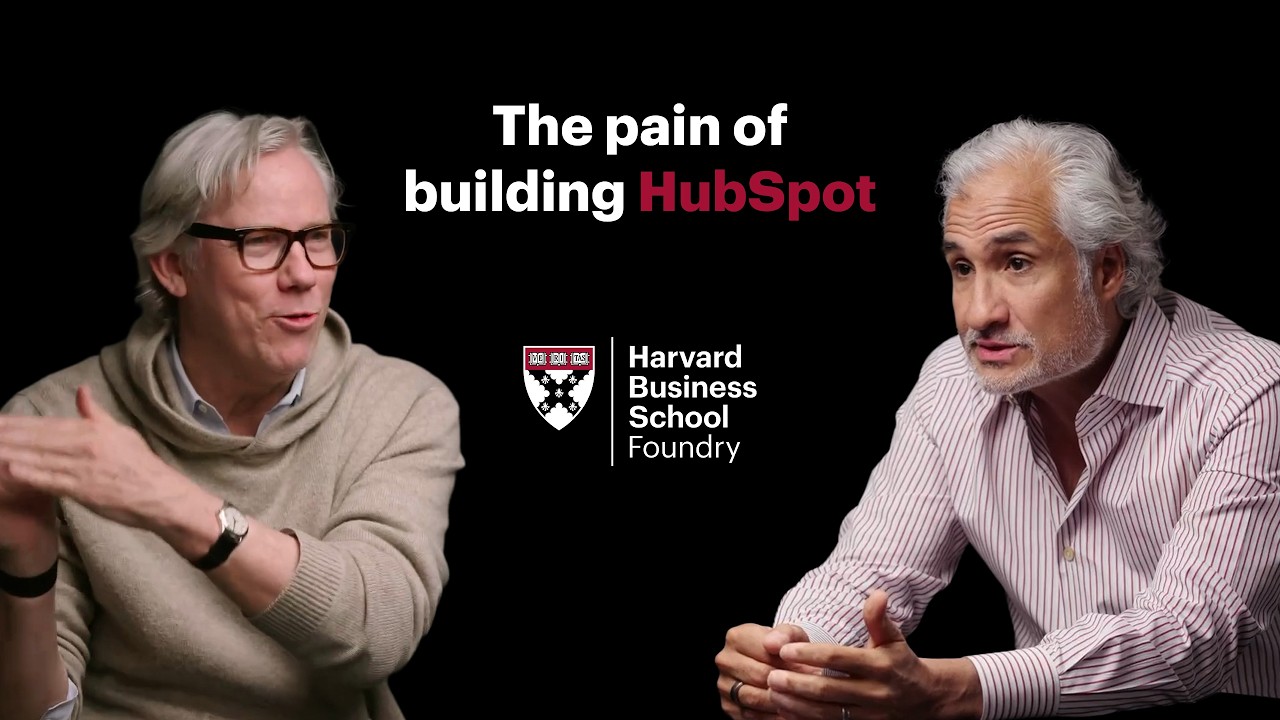
Recorded 7 October 2026 · 52 min
Brian Halligan, who co-founded HubSpot and is now a partner at Sequoia, argues that founders are bred, not born. A sales executive with no founder archetype around him, he built a company generating more than $3 billion in annual revenue by tolerating pain, committing fully and betting against consensus.
Host Raza Sachu, who says he has taught founding for 25 years, presses on a tension. A founder's confidence must exceed their capability to produce judgment, but not by so much that arrogance takes over. The conversation tests that thesis against a near-fatal 2021 snowmobile accident and Halligan's view that AI will change how companies are organized.
Founders without a template — ▶ 2:17
Halligan disputes the narrative that top tech founders are immigrants or came from poverty. By his recollection, of the founders behind $10 trillion outcomes, three were immigrants and most of the rest were well-fed, upper-middle-class kids. His own childhood in Westwood, Massachusetts, was ordinary. Neighbors' fathers were executives at Wang, Data General and Digital, not founders, so his goal was to be a vice president on Route 128. He had no archetype for founding, and he can only say he was born a worker.
Obsession over anomalies — ▶ 5:10
Following the Grateful Dead, Halligan noticed that their business model, fan community and ticket buying differed sharply from bands like the Who or the Rolling Stones. He says he notices pattern breaks and obsesses over problems until they are fixed. He declines to call this a superpower, since he thinks many people share it. What he credits instead is obsession, from the Dead to his 10 years at PTC. Sachu's point is that spotting an anomaly matters less than staying with it despite uncertainty about being wrong.
Deep dips, large returns — ▶ 7:36
In 1993 PTC, which Halligan calls the fastest-growing company ever at that point, sent him to Japan a week after a colleague with four children declined. He landed at Narita knowing neither the language nor anyone there, and stayed in Asia seven years. He frames the pain through Seth Godin's The Dip: deep dips, endured through grinding obsession, yield large returns, while shallow ones rarely pay well. Sachu adds that founding returns can be exponential precisely because failure is likely, and pain is where founders learn to calibrate whether to persevere.
Lowering the risk of founding — ▶ 15:26
Halligan's first spark of belief came from Sam Adams founder Jim Koch, a relatable speaker at business school. Later he weighed three paths: head of sales at a top startup, CEO of a weaker one, or founding. His view is that to run a great company, you have to start it, because founders don't leave. A co-founder, without whom he would not have founded, and business school hurdles such as a $100K business plan competition lowered the risk through outside feedback. He still says he would have put the odds of HubSpot's outcome as exceptionally low.
Inbound from two data sets — ▶ 24:00
Advising a venture capital firm's go-to-market teams, Halligan saw companies buying lists, cold calling, spamming and paying for trade shows. Buyers now resisted this with ad blockers and caller ID. Comparing Google Analytics with his blogger co-founder, he found that the blog drew roughly 1,000 times more interest than his well-funded ventures' marketing, by his recollection. The conclusion was to match marketing to how people actually buy. He says no one was talking about it, and that his go-to-market background suited him to the problem.
Against consensus, repeatedly — ▶ 28:20
Halligan describes himself as allergic to conventional wisdom, which cost time on trivia such as building the company's own tables but paid off on culture, value proposition and choice of competitors. HubSpot took five venture rounds. It bet on marketing software, on SMBs rather than enterprise and on Boston, giving investors many reasons to decline. He says every top VC declined the round Sequoia then backed, and he attributes this to groupthink. The Series D with Sequoia, Salesforce.com and Google felt like validation. The IPO, at about a $1 billion market cap that day, was the easiest round.
The AI-centered org chart — ▶ 36:02
Halligan argues the triangular org chart, descended from the Roman legion, garbles information as it moves up and down. The CEOs he advises, many leading recently founded companies, instead picture an AI system as a circle with humans around it, training it and supplying context. It makes about 1% of decisions now, a share he expects to grow. Humans remain as context givers and as judgment and taste people. His example: asking AI what to build would have yielded marketing automation, the old category done slightly better, not what HubSpot built.
Obsession, not DNA — ▶ 38:41
Asked whether founders are born or bred, Halligan says he was bred. The one innate trait he sees in nearly every founder is deep obsession with something, visible early, that later turns into total commitment to a company. He says there is no work-life balance in building a company like HubSpot, and that he repeatedly sacrificed personal matters. Sachu, who has taught founding for 25 years, says he would have wasted that time if the capability were only DNA. Neither offers evidence beyond experience.
Near-death resets the CEO role — ▶ 40:05
In 2021 Halligan drove a snowmobile off a cliff in Vermont with his son, falling about half a mile with no phone signal. For roughly an hour he expected to die. He decided that if he survived, he would quit as CEO, a role he had held for 15 years at a company then worth $25 billion with 8,000 people. He called it adult daycare and said he is a startup guy. After about a year of recovery he stepped down, pulled family closer, pruned his friends and now counts about 6,000 healthy days left.
Contrarian, but checked — ▶ 48:50
Halligan's advice is to be right about something many think you're wrong about, but to check yourself if you alone believe it. He recommends mentors, customers and above all a co-founder, and he treats a solo pitch as a flag. The validation he cites is modest: about 80% of people they pitched said they were all wet, and about 20% saw potential. He frames the upside as the idea becoming a company, money and ego, while Sachu argues people overestimate downside and underestimate upside.
Brian Halligan's central claim is that founding ability is assembled rather than inherited. The one trait he thinks nearly every founder is born with is a deep obsession, visible early in something like basketball, which later hardens into total commitment to a company. Everything else, including the confidence to trust one's own judgment, accumulates through decisions made under uncertainty. His own record supports the reading. He was a sales executive, a profile he says nobody mines for founders, and when he entered business school he put the chance of starting a company at maybe 1%. The interview keeps returning to one question: how does someone with that starting point build enough conviction to act?
Pedigree explains little, in his telling. Halligan pushes back on the narrative that top tech founders are immigrants or come from poverty. Of the founders behind $10 trillion outcomes, he says, three were immigrants, and most of the rest were well-fed, upper-middle-class kids. These are his recollections, not figures he sourced. His childhood in Westwood, Massachusetts, makes a quieter version of the point. The neighbors' fathers were executives at Wang, Data General and Digital, not founders, so his ambition was to become a vice president on Route 128. He had no archetype for founding, and on where his work ethic came from he can offer only that he was born a worker.
The mechanism he emphasizes next is pain, specifically the right kind. In 1993 PTC, which he describes as the fastest-growing company ever at that point, sent him to Japan a week after a colleague with four children declined the posting. He flew into Narita knowing neither the language nor anyone there, and stayed in Asia for seven years. He frames this through Seth Godin's book The Dip: a deep dip, endured through grinding obsession, leads to large returns, while a shallow dip rarely pays much. Raza Sachu extends the logic. Founding returns can be exponential precisely because failure is likely, and the pain is where founders learn to calibrate risk and decide whether to persevere.
Confidence, in Halligan's account, arrived through risk reduction rather than a leap of faith. A talk by Jim Koch, the Sam Adams founder, whom he found relatable rather than extraordinary, produced his first thought that he might do it too. Later he faced three options: head of sales at a top startup, CEO of a weaker one, or founding. He reasons that anyone who wants to run a great company has to start it, because founders do not leave. A co-founder, without whom he says he would not have founded, and business school hurdles such as a $100K business plan competition lowered the risk by supplying outside feedback. Even so, he says he would have put the odds of HubSpot's outcome as exceptionally low.
The idea itself came from comparing two data sets. While advising a venture capital firm's go-to-market teams, Halligan saw companies buying lists, cold calling, spamming and paying for trade shows. These were tactics that had once worked for him but that buyers now resisted with ad blockers and caller ID. Then he and his co-founder compared Google Analytics, and the co-founder's small blog, by Halligan's recollection, drew roughly 1,000 times more interest than the marketing of his well-funded ventures. The insight was therefore less a vision than an observation of data from two vantage points: market the way people actually buy. He says no one was talking about it.
Being early looked like being wrong. HubSpot took five rounds of venture capital, and Halligan says every top venture firm turned down the round that Sequoia eventually backed. The company was betting on transforming marketing software, on small and mid-sized businesses rather than enterprises, and on Boston rather than Silicon Valley. Each gave an investor a reason to decline. Halligan attributes this to groupthink on Sand Hill Road, a claim resting on his own account. What kept him going, he says, was that no objection fundamentally shook his confidence, and that as the heaviest user of the product he could see it improving. The Series D, with Sequoia, Salesforce.com and Google, felt like validation. The IPO, at roughly a $1 billion market cap that day, was the easiest round.
The difficulty is that conviction and stubbornness look identical from the inside, and Halligan acknowledges as much. Being allergic to conventional wisdom helped on culture, the value proposition and whom to compete with, but cost him time on trivia such as designing the company's own tables. His advice is to be right about something many think you're wrong about, but to check yourself if you are the only believer: find a mentor, a customer and, above all, a co-founder. The check he describes is modest, though. About 80% of the people they pitched said they were all wet, and about 20% saw something. That is a thin signal for telling prescience from error.
Commitment also has costs that Halligan does not discount. He says there is no work-life balance in building a company like HubSpot, and that he repeatedly put work ahead of personal matters. In 2021, after 15 years as CEO of a company then worth $25 billion, he drove a snowmobile off a cliff in Vermont with his son. They fell about half a mile, had no phone signal and waited roughly an hour not knowing whether they would survive. He resolved to quit the CEO role if he lived, calling a company of 8,000 people adult daycare. The episode suggests the work he loves, starting things, differs from running them at scale.
Halligan's most forward-looking argument concerns how to run a company rather than found one. The classic org chart is a triangle, descended from the Roman legion, in which information degrades moving up and down. The CEOs he advises, many leading recently founded companies, picture a circle instead, with an AI system at the center and humans around it training the system and giving it context. Today the system makes about 1% of decisions, a share he expects to grow as models improve. Humans remain as context givers and as people of judgment and taste. His example of taste: asking AI what to build would have produced marketing automation, the old category done slightly better.
That model sits uneasily with Sachu's thesis, which Halligan endorses, that judgment is the skill worth building because founders build it by making many consequential decisions, even about office leases. If AI absorbs a growing share of decisions, the repetitions that formed Halligan's judgment become scarcer for the people who most need them. Halligan's own formation involved a posting to Japan, years of rejection and five funding rounds, none of which an AI system would make easier to endure. Neither speaker addresses how a founder trains judgment when the system around them is increasingly deciding. That is an inference from their arguments, not a point either made.
The open question. Sachu argues that judgment is built by making many consequential decisions, and Halligan agrees humans will remain the source of judgment and taste. Yet Halligan also expects AI to take a growing share of decisions, from about 1% today. If so, where will the next generation of founders get the repetitions that built his own judgment? Neither speaker addresses it, and the answer bears directly on the thesis that founders can be made.
Watch the full video at https://www.youtube.com/watch?v=NPyUZFXPUGI.
Comments ()