Recorded 4 October 2026 · 22 min
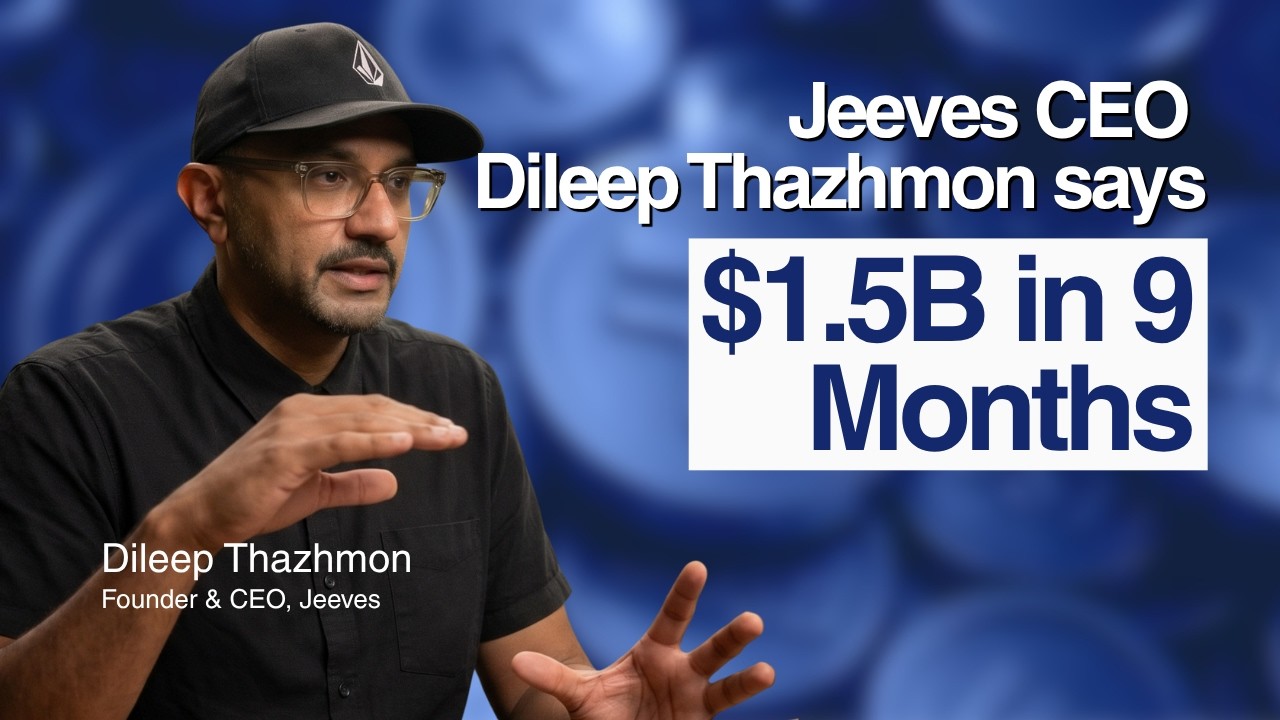
Dip Tasman, CEO of Jeeves, argues that stablecoins win in the enterprise only when customers never have to think about them. Jeeves launched its stablecoin product in January and says it has crossed $1.5 billion in annualized total payment volume (TPV) in 8 to 9 months. Tasman attributes much of that to bundling the rails into corporate cards, payments, and accounts that clients already trust.
The tension lies in what that bet implies. If off-ramp and FX fees are compressing toward zero, the rails themselves are not the business. Workflow automation is. Tasman also concedes open problems: pricing very small agent transactions, giving CFOs enough context to trust agents with money, and the scarcity of liquid local-currency stablecoins outside the dollar.
Owning the stack — ▶ 2:17
Jeeves sells a financial operating system that replaces separate bank accounts, cards, and payment rails in each country with one platform. It now covers 35 countries after adding 10, following a $110 million Series C1 aimed at expanding the stablecoin product. The origin was personal. As COO of a two-country company, Tasman needed 30 days to learn last month's spend. Fixing that meant owning the infrastructure, so Jeeves spent its first 2-3 years building the stack and obtaining licenses. The result is a real-time "god view" of spend across currencies, now extended to AI token spend.
Agents need digitized money — ▶ 4:20
Tasman splits agentic payments into two problems: agents accessing payment rails, and money that can be divided into very small pieces, which requires a digitized form. Brazil's Pix, with 80-90% adoption, shows how advanced some national systems already are. Jeeves offers APIs that spin up agents with no human in the loop, giving them stablecoin or Pix access. Two problems remain unsolved. Pricing does not drop linearly between one-cent and $1 transactions, and CFOs need more context before trusting agents with money. His forecast of agents buying on stablecoin within 3 years comes without supporting evidence.
Downside protection sells — ▶ 5:56
Most fintechs sell either to small businesses or to PSPs, fintechs, and banks. Jeeves sells stablecoin payments directly to enterprise CFOs. Tasman argues CFOs weigh downside protection, not savings or speed: can I trust you, and will the money arrive? A failed experiment means explaining it to the CEO. The approach works for two reasons. Stablecoin is fully abstracted inside the product, and clients have banked with Jeeves for 2-4 years. Stablecoin arrives as an add-on to an existing relationship rather than as a standalone product.
Corridors and the sandwich — ▶ 8:12
Adoption is strongest where currency volatility or banking friction is highest. Tasman says about 60% of Argentina's population uses stablecoins, which shortened enterprise adoption cycles there. Jeeves sees heavy volume on the Mexico-US trade corridor and between Latin America and Europe. In the latter, stablecoin replaces 1-2 correspondent banks and 1-2 days of settlement with 1-2 hours. The method is a "stable coin sandwich": collect in one currency, release stablecoin, pay out in the other. This underpins the $1.5 billion annualized TPV, reached 8-9 months after the January launch.
Fees will compress — ▶ 10:23
About 80% of Jeeves customers use more than one product line. Roughly 60% of stablecoin volume comes from existing customers trying it, and 40% from net new customers for whom stablecoin is the wedge. Tasman does not think companies can win on fees. Off-ramping from USDC or USDT to USD once cost 1% and has fallen to a few basis points (the transcript wording is garbled), with zero expected next. FX is compressing similarly. Jeeves instead monetizes workflow, such as pulling invoices from a Mexican tax ID and pre-filling payments, which lets it price the final money movement cheaply.
Regulation sets the perimeter — ▶ 13:42
Tasman calls the Genius Act a game changer for bringing stablecoin into core banking, and says it prompted other countries to define their own approaches. He cites Brazil's central bank as clear and progressive. Wider adoption, he argues, needs similar clarity across multiple countries where stablecoin's status remains ambiguous. Enterprises set a higher bar than consumers, so Jeeves avoids markets that could jeopardize its ecosystem. It covers 190 countries using local fiat rails where needed. Some clients still request Swift because the MT103 message confirms delivery, which is how they run their business.
Local stablecoins lack liquidity — ▶ 16:34
Dollar stablecoins leave a gap. Money stored in USD must still convert into, for example, Mexican pesos, returning the user to fiat. Local-currency stablecoins would improve Jeeves's offering, but their liquidity and pool access trail the dollar's. Tasman thinks the push must come from central banks backing coins with reserves. He points to recent Brazilian resolutions and central initiatives for a Brazilian stablecoin. Adoption by fintechs and banks is also required, since country-led attempts without usage have struggled. In his view, only two USD stablecoins have really succeeded despite many attempts.
Tasman's central claim is that stablecoins become a mainstream enterprise product by disappearing. Jeeves does not sell a protocol. It sells a financial operating system that collapses the bank accounts, corporate cards, and payment rails a multinational needs in each country into one platform. Stablecoin is a layer inside that box, and Tasman says enterprise customers "don't know or care that it's stable coin." The product launched in January and, by his account, has crossed $1.5 billion in annualized TPV in 8 to 9 months. That is a company-reported figure, but the mechanism behind it deserves scrutiny.
The mechanism is distribution through trust. About 80% of Jeeves customers use more than one product line, and roughly 60% of stablecoin volume comes from existing customers testing it, with 40% from net new customers for whom stablecoin is the opening offer. Tasman's explanation of the buyer is revealing. A CFO is not shopping for savings or speed. The questions are whether the provider can be trusted and whether the money will arrive, because a failed experiment means explaining it to the CEO. Clients who have banked with Jeeves for 2-4 years face a small step, not a leap. Editorially, that suggests incumbency in a relationship, not the technology, is the real moat.
The technology still delivers a concrete advantage in specific corridors. Between Latin America and Europe, payments that once passed through 1-2 correspondent banks and took 1-2 days now settle in 1-2 hours using what Tasman calls a stablecoin sandwich: collect in one currency, release stablecoin, pay out in the other. Demand is strongest where currency volatility is brutal. Tasman says about 60% of Argentina's population uses stablecoins, which shortened enterprise sales cycles because buyers already understood the product. In the US, he notes, a dollar-denominated coin offers little reason to switch.
Yet Tasman is explicit that the rails themselves are not where profit lies. Off-ramping from USDC or USDT to USD once cost 1%, he says, and has already fallen to a sliver of that, with zero expected next. FX margins are compressing as money moves more easily across borders. Jeeves's answer is to charge for workflow. In Mexico, a customer enters a tax ID, the system downloads invoices and fills in payment details, and the final money movement carries a fee that can be set low because the value was captured earlier. He did not disclose how Jeeves's own margins hold up under this model, so the claim is a strategic argument, not a demonstrated result.
The same logic extends to AI. Jeeves has launched an AI spend tracker, so a CFO can see token costs in pesos on OpenAI and pounds on Claude alongside card spend. On agentic payments, Tasman argues that Brazil's Pix, with 80-90% adoption, shows that digitized money is the prerequisite for agents moving small amounts. Jeeves offers APIs that spin up agents without a human in the loop. His forecast that agents will be making purchases on stablecoin rails within 3 years is a prediction, not an observation, and he supports it with no evidence beyond the Pix example.
He is candid about what remains unsolved. Pricing does not fall linearly between a one-cent and a $1 transaction, and nobody has worked out the right structure. CFOs also need context before they let agents touch money, a different problem from an individual using an agent tool. Regulation adds another constraint. Tasman calls the Genius Act a game changer and expects other countries to follow, but enterprises set a higher bar than consumers. Jeeves avoids markets where compliance clarity is missing, and some clients still request Swift because its MT103 message confirms delivery.
The deepest unresolved issue is currency. Dollar stablecoins still force a conversion back into fiat for a Mexican supplier, and Tasman says Jeeves's offering would be much better with local stablecoins. But he concedes that liquidity lags the dollar, that central banks would have to lead, and that country-led attempts have struggled without bank and fintech usage. That creates a loop. Local coins need liquidity, liquidity needs usage, and usage depends on products like Jeeves's that make the coin invisible. Whether invisible infrastructure can break that loop is the open test of his thesis.
The open question. Can enterprise trust in a bundled provider extend to autonomous agents? Tasman admits two unsolved problems: pricing that does not fall linearly for one-cent versus $1 transactions, and giving CFOs enough context to let agents spend. His 3-year forecast that agents will buy things on stablecoin rails assumes both get solved, but he offers no evidence on how. If rail fees fall to zero, it is also unclear whether anyone other than bundlers like Jeeves captures the value.
Watch the full video at https://www.youtube.com/watch?v=JQKoo3kXRhU.
Comments ()