Recorded 11 October 2026 · 12 min
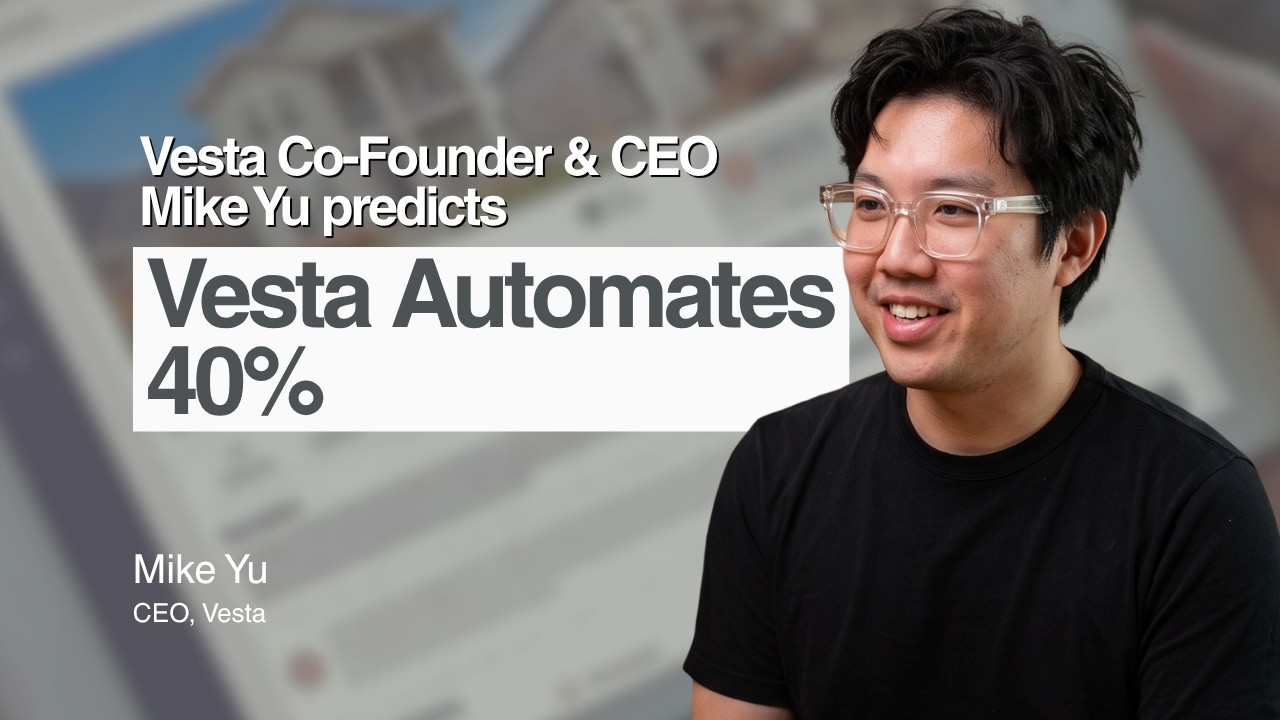
Mike Woo, co-founder and CEO of Vesta, argues that mortgage origination became ripe for AI agents because it combines complex knowledge work with verification already required by regulation and a cost structure lenders track loan by loan. Vesta's system lets agents and people work the same loan file. It announced a $30 million Series B led by Conversion Capital, with several customers investing, and reports growth of more than 12x over the past year.
The tension is between the speed of adoption and how much work is actually automated. The host cites about 40% of tasks as fully handled by agents, and Woo says people still manage the process and talk to consumers. He also asserts that agents are more reliable than people, but offers no error-rate data. That claim carries the weight of the story, in an industry he describes as risk-averse.
Two-sided inflection point — ▶ 0:36
Woo attributes the surge to two conditions arriving together. Mortgage lenders, traditionally big and risk-averse enterprises, now see Vesta's new system as mature enough to adopt. And the models are good enough that lenders are confident AI is probably better than people, and that Vesta's agents are more reliable at origination work. Reported results include more than 12x growth in a year, rising revenue and pipeline, and heavy hiring funded by the Series B. The reliability claim is Woo's own assertion; no error rates or comparisons were offered.
Three-property test for automation — ▶ 1:42
Woo says labor shifts to agents fastest where work is complex knowledge work, easy to verify, and tied to measurable ROI. Coding agents took off because code is checkable through unit testing and review. Mortgage has verification built in by regulation: lenders must do manual sampling and QC, so AI can replace labor without a new human-in-the-loop process. Lenders also manage cost to originate, translating processor and underwriter hours into dollars, so replaced line items in cost per loan are directly visible.
Atomic tasks limit errors — ▶ 4:01
Reliability comes from decomposition: small, atomic tasks leave agents fewer degrees of freedom to err. Every consumer document gets an agent first pass using a combination of models. The agent confirms it is the right document, then extracts data. A signed purchase contract can yield roughly 50-100 fields, depending on jurisdiction, such as closing date, price, property, and seller credits. Agents also message title companies and ask appraisers to reconsider valuations. The host cited about 40% of tasks as fully handled by agents; Woo did not detail what remains manual.
Agents call deterministic tools — ▶ 5:02
Vesta does not let LLMs compute income by hand. That mirrors lender practice, where humans use spreadsheets and complex rules-based calculators rather than working it out manually. Instead, agents invoke rules-based systems Vesta built, and the same pattern covers redisclosing a loan and calculating assets that qualify against cash to close. Woo says these tools let agents do far more than LLM reasoning alone. The editorial implication is that reliability here comes partly from architecture around the models, not only from model quality.
Customers as shareholders — ▶ 6:06
Several customers invested in the Series B, which the host had not seen before. Woo's rationale is alignment in a concentrated market: only a couple hundred sizable lenders do significant volume, so Vesta must sign most of them to build the business it wants. Becoming system of record for a top-five lender is, he says, among the most important strategic partnerships on both sides. Equity ties the two interests together, and Vesta offered the opportunity to many customers for fairness. Woo does not discuss any downsides of the arrangement.
Roughly 5% of market — ▶ 7:19
Lenders moving to Vesta, including those already invested, do about $100 billion in loans a year, against a market of about 2 trillion annually. That is roughly 5% by editorial arithmetic, and the phrasing suggests lenders are still converting rather than fully live. Woo's focus for the next year is growing the customer base and helping lenders convert, including rethinking how they originate mortgages from data, workflow, and agent perspectives. His framing is that most of the market remains to be won.
Assistants for agent swarms — ▶ 7:59
Vesta spins up an agent for each task, and some loans have hundreds of agents running on them. That can overwhelm the people who still manage the work and talk to consumers. Woo's next product direction is a personal assistant that manages task-level agents and helps staff make sense of them. The editorial inference is that the bottleneck is shifting from performing tasks to supervising them. Woo gave no timeline or evidence on how well this would work.
Vesta's growth story is less about AI capability in general than about where that capability lands. Woo's thesis is that labor moves to agents fastest in domains with three properties: complex knowledge work, easy verification, and costs that already translate into dollars. Mortgage origination, he says, has all three. The work is people at computers reviewing documents, talking to third parties, and coordinating tasks. The reported result is a sharp inflection: more than 12x growth in a year, rising pipeline, and a $30 million Series B. In Woo's account, lenders crossed two thresholds at once. They now trust the new system, and they trust the models.
The verification argument is the most distinctive part of the case. Coding agents took off, Woo says, because code is easy to check through testing and review. Mortgage has an analogue that comes from regulation. Lenders must already do manual sampling and QC, so replacing labor with agents does not require inventing a human-in-the-loop verification process from scratch. An editorial inference follows: that lowers the cost of adopting agents in a conservative industry, because the safety net exists before the first agent is deployed.
The second structural advantage is measurement. Lenders have long managed against their cost to originate, tracking the hours processors and underwriters spend on each task. In a period when enterprises are asking what return they get from AI, Woo notes that mortgage buyers can see the specific line items in cost per loan that agents replace. The sales case becomes substitution of a known cost rather than a speculative productivity gain. This is Woo's framing, and the transcript gives no customer-level savings figures to test it.
How the agents work matters as much as where they are deployed. Woo's design principle is to make tasks small and atomic, so the agent has fewer degrees of freedom to err. Every consumer document gets a first pass: is it the right document, and what data does it contain? A purchase contract can yield roughly 50-100 fields. Agents also coordinate with title companies and appraisers. For income calculation, Vesta does not let the LLM do the math. Agents call rules-based tools, much as human processors use calculators and spreadsheets. Reliability, in this design, comes from the scaffolding around the models as well as from the models themselves.
Market structure shapes the commercial strategy. Only a couple hundred sizable lenders do significant volume, so Vesta must win most of them. Woo says becoming system of record for a top-five lender is a strategic partnership for both sides. That is the logic behind customers investing in the Series B: shareholder status aligns incentives with a customer base that cannot easily be replaced. Lenders moving to Vesta already do about $100 billion in loans a year, roughly 5% of a market of about $2 trillion. The runway is large if conversion continues, though the transcript does not say how much of that volume is live.
The strongest claim is also the least supported. Woo says lenders are confident that AI is probably better than people and that Vesta's agents are more reliable at origination work. No error rates or comparisons accompany this. The cited 40% of tasks fully handled by agents implies that most work still involves people. The built-in QC that accelerates adoption also supplies only sampling, which provides some assurance but does not show that agents outperform humans. Whether sampling designed around human workflows suits agent errors is an open question the discussion does not address.
Woo's own roadmap hints at the next constraint. Because Vesta spins up an agent for every task, some loans run with hundreds of agents, which he acknowledges can overwhelm the people still managing them. His answer is a personal assistant layer that organizes the task-level agents. If agents take over the doing, the scarce resource becomes human attention for supervising, and a layer of assistants may reduce that burden or add another thing to verify.
The open question. Is the claim that Vesta's agents are more reliable than people actually tested? Woo cites lender confidence, not error rates or head-to-head comparisons. If existing sampling and QC checks were built around human work, do they catch the kinds of mistakes agents make? And if 40% of tasks are fully automated today, can the remainder follow without a sharp rise in the supervision burden?
Watch the full video at https://www.youtube.com/watch?v=ZmDGJHdoD9A.
Comments ()