Recorded 5 June 2026 · 60 min
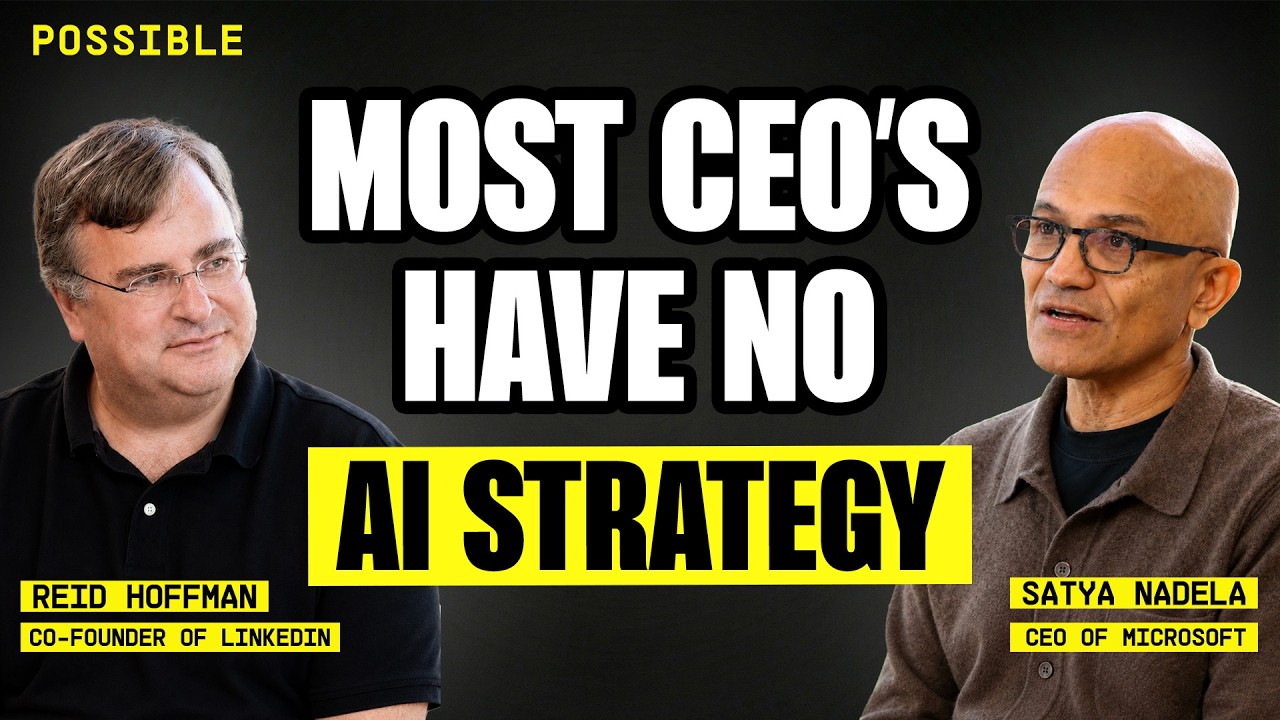
Satya Nadella, chairman and CEO of Microsoft, argues that AI is not a technology but the future of the firm, and that the decisive corporate asset is now tacit knowledge. That is the judgment and taste currently held by employees, which models can extract from human work trajectories and encode in weights. In conversation with Reid Hoffman, a Microsoft board member, he says firms must keep that learning inside systems they control or lose it irreversibly.
The tension runs through everything else. Firms need frontier capability, yet dependence on a single frontier model forfeits sovereignty, for a company or a country. Nadella links this to agent governance, Microsoft's silicon strategy, and the erosion of public social permission for AI.
Hill-climbing machine — ▶ 5:23
Nadella names the hill-climbing machine as the AI-era equivalent of Microsoft's first product, a BASIC interpreter. It takes an objective, outcome or eval and learns to achieve it from data and a reinforcement reward. Build was framed not around a new frontier model but around helping every developer and company, AI-native or enterprise, build their own such machine to operate at the frontier. The new IP, in his account, is knowing which data to train on and how to reward the model. Everything else, he says, is largely mechanical.
Tacit knowledge is leaking — ▶ 7:07
Nadella says the economy will be shaped by human capital and token capital. Tacit knowledge, meaning a firm's judgment, taste and ways of operating, sits mostly in people and appears on no balance sheet. Models can extract it from human trajectories and encode it in weights. He claims it is already leaking: model companies build reward gyms that employ people who worked at the firms being learned from. Leakage is a one-way door. His remedy is to let models hill-climb inside a machine the firm controls, feeding its own data and collecting human-agent traces in a continuous loop.
Coding previews knowledge work — ▶ 11:14
Coding moved from code completion to chat, to agent mode, to fire-and-forget agents that deliver a full pull request. Nadella expects the same arc across knowledge work, citing Copilot's Scout and Autopilot. He pictures 20,000 Microsoft employees alongside 2 million or 20 million agents and admits the resulting work is not yet conceptually understood. The new bottleneck is human attention: he runs 100 command-line agent sessions, which motivated GitHub's inbox-style agentic development environment and its canvas features, such as Kanban boards. He also wants models that are steerable, not merely instruction-following.
Governing agent fleets — ▶ 16:24
Beyond the experience layer and the hill-climbing machine, Nadella names manageability and security as the third requirement. Agent 365 starts with an inventory, since Microsoft alone may run 20 million agents, and makes their reasoning traces inspectable and auditable. Because agents can generate and execute code, they get identities, sandboxes and policies, built by extending Entra, Defender and Purview. Foundry adds asserts, which constrain a long-running agent's execution path at runtime rather than relying on a classifier-style guardrail. Confidence in agents, he says, comes from containment, observability and manageability.
Future of the firm — ▶ 19:29
A tech CEO must be deep in the tech stack, Nadella says, but he is also changing his prior on non-tech CEOs, who used to rely on technology advisers. He is perplexed that many still issue a press release with a tech company and point to eight agents as an AI strategy. His test is whether a CEO can say that last night's work became knowledge, as context, a skill or weights, that the firm owns, controls and compounds. Unlike the mobile, PC or cloud eras, an IT department managing vendors is not enough.
Platform trust as strategy — ▶ 23:28
Nadella calls a platform whose users create far more value than the platform captures the only long-term stable position for Microsoft. It is also the basis of trust, because partners know it is not a zero-sum game of subsidizing them for 2 or 3 years and then eating their lunch. He predicts that within a year the world will be consumed by the question of its AI supply chain, and how it helps a firm compound returns it can uniquely claim. The forecast is stated without supporting evidence.
Cognitive coverage, token efficiency — ▶ 29:37
A colleague wrote a Copilot skill called cognitive coverage: after an agent works, it generates a quiz so the human learns what was done, like test coverage for understanding. Nadella treats deductive understanding of agent work as an important human skill. Under token abundance, he says, value goes to those who spend tokens efficiently, which depends on rubrics that capture the firm's taste. His dictum is not to use frontier models for non-frontier problems. For trade-promotion claims, he says a small model trained on the firm's traces can outperform a prompted frontier model, though no data is offered.
Sovereignty, one firm at a time — ▶ 35:31
Nadella shifted his focus to companies because they exist everywhere. Countries that pursue sovereignty abstractly risk eroding the comparative advantage embodied in their companies, so preserving company thriving is the best form of sovereignty. He does not dismiss firewalls, data residency or domestic chips. Falling off the frontier makes no sense, he says, but depending on one frontier model means a country is not sovereign either. His answer is to use models to hill-climb on a country's own firms, one at a time, while governments make data centers, the conversion of electrons into tokens, cheap, good and clean.
Systems company, partner silicon — ▶ 38:44
Nadella describes Microsoft as a systems company that optimizes the whole stack for new at-scale workloads, from power distribution to silicon, while using general-purpose technology from partners. Nvidia GPUs, including older chips, now accelerate the Fabric data warehouse, extending the fleet's economic life. Agent runtimes have call patterns that did not exist at scale 3 years ago. Maia is co-designed with the MAI and OpenAI models, and the Arm-based Cobalt is designed using GitHub's agentic traces. He claims large latency and performance gains without figures, and says relying entirely on in-house chips would be wrong.
Scarcity-driven learning anxiety — ▶ 42:51
Nadella ranks child safety alongside cyber, bioweapon and alignment risks, citing chatbot conversations that could persuade children and undermine their agency. The larger question is what childhood means under token abundance. The anxiety he felt about learning, he says, was an artifact of scarce opportunities and scarce good teaching, and may not hold going forward. If expertise is abundant, the scarce thing is a person's cognitive coverage of it. He argues that education cannot stay the same or value the same credentials, and that the tech industry cannot abrogate responsibility for the next generation.
Earning social permission — ▶ 47:11
Nadella cites Pope Leo's encyclical and Joel Mokyr's Two Paths to Prosperity, as he paraphrases it, to argue that the West prospered when morality, markets, democracy and science reinforced each other. Without that cycle, AI will lose social permission. He blames industry rhetoric about vanishing white-collar jobs for the backlash, citing a booed commencement speaker. His remedy is tangible proof: data centers that improve local tax bases, schools and electricity prices, named new jobs with stated wages, and firms that take part in the frontier rather than merely feeding data to foundation models.
Nadella's central claim is that AI changes what a company is, not merely what it uses. "AI is not a technology. It's the future of the firm." In earlier platform shifts, such as mobile, PC and cloud, an IT department that managed vendors and trimmed costs was an adequate response. This time, he says, the question is structural: what happens to an industry when AI knows everything it needs to know about operating in it. The asset at stake is tacit knowledge, meaning the judgment, taste and distinctive ways of working that a firm may have built over 100 years. No balance sheet carries a line item for it, he notes, because firms assume they have it simply by employing people.
The mechanism is extraction. A model can learn tacit knowledge from the trajectories of humans working alongside a firm's digital estate and encode it in weights. Nadella argues this is already happening: model companies build reward environments, which he calls gyms, staffed by people who previously worked at the companies being learned from. Leakage, in his telling, is a one-way door. His prescription reverses the direction of travel. Models should come inside and hill-climb within a system the firm controls, fed by its own data as context, with traces of human and agent work collected in a continuous loop. The test he proposes is concrete: can a CEO say what last night's work added to the firm's token capital, and show that the firm owns and controls it?
This is why he calls the hill-climbing machine the modern equivalent of Microsoft's first product, a BASIC interpreter. The machine takes an objective, learns to achieve it from data and a reward signal, and improves. If that loop is the engine, differentiation moves to its inputs: the evals, the rubrics, and the data a firm chooses to train on. Nadella says everything else is largely mechanical, and that rubrics must capture a high taste that only the firm can define. The same logic governs cost. His dictum is "don't use frontier models for non-frontier problems." For a consumer goods company processing trade-promotion claims, a repeatable, deterministic workflow, he says a small model trained on the firm's own traces can outperform even a prompted frontier model. That is his definition of token efficiency, though he offers no benchmark figures.
Work itself will be reorganized around that loop. Nadella imagines a Microsoft with 20,000 employees and 2 million or 20 million agents, and admits the shared understanding of what that produces, including the tacit knowledge and artifacts moving between agents and humans, has not yet been worked out. Coding offers a preview. It progressed from code completion to chat to agent mode to fire-and-forget agents that deliver a full pull request, and he expects the same arc across knowledge work, citing Copilot's Scout and Autopilot launches. The new bottleneck is human attention. He describes running 100 command-line agent sessions, which led GitHub to build an inbox-style agentic development environment for what he calls the "micro steering of the macro delegation."
Supervision also demands a human skill and a governance layer. A colleague wrote a Copilot skill called cognitive coverage: after an agent finishes, it generates a quiz so the human learns what was done, analogous to test coverage in software. Nadella extends the idea to children, whose learning anxiety he calls an artifact of scarce opportunities. If expertise becomes abundant, the scarce thing is a person's cognitive coverage of it. The corporate counterpart is Agent 365, which inventories agents, makes reasoning traces auditable, and gives agents identities, sandboxes and policies through extensions to Entra, Defender and Purview. Foundry's asserts constrain a long-running agent's execution path at runtime, rather than relying on a classifier guardrail.
The pattern of owning the loop while staying open to outside components appears in Microsoft's own strategy. Nadella says Microsoft aims to be a platform whose customers capture far more value than it does, which he presents as the foundation of trust: no subsidizing a partner for 2 or 3 years before eating its lunch. On silicon, he describes a systems company that uses general-purpose Nvidia and AMD technology, including older Nvidia chips to accelerate the Fabric data warehouse. It also co-designs Maia with the MAI and OpenAI models and builds the Arm-based Cobalt around GitHub's agentic traces, because agent runtimes have call patterns that did not exist at scale 3 years ago. He claims large latency and performance gains but gives no figures, and says everything will be benchmarked.
Nadella applies the same framework to countries. Sovereignty, he argues, is best preserved by protecting the comparative advantage embodied in a country's companies, not by firewalls or data residency, which he does not dismiss. A country that falls off the frontier loses ground, but one dependent on a single frontier model is not sovereign either. His resolution is that firms use models to hill-climb on their own, one at a time, so the aggregate economy operates at the frontier. Governments, meanwhile, should be the cheapest, best and cleanest producers of what he calls the electrons-to-tokens conversion that data centers perform. The same argument underlies his objection to firms becoming mere data feeders for foundation models, which he describes as losing sovereignty and dignity simultaneously.
Social permission is where he thinks the project is most exposed. He cites a commencement speaker booed for talking up AI, and blames the industry for announcing the end of white-collar work while professing excitement about building the technology. His remedy is tangible proof: data centers that visibly improve a community's tax base, schools, water use and electricity prices, and specific answers about which new jobs exist and what they pay, rather than invoking the lump-of-labor fallacy. He also draws on Joel Mokyr's Two Paths to Prosperity, as he paraphrases it. The West prospered, in this reading, because morality, markets, democracy and science reinforced one another, and without that cycle, permission is lost.
The strongest case against the argument is how much of it rests on assertion. The leakage claim is supported by one observation, that labs employ former employees in reward gyms, and by no estimate of what has leaked or what it is worth. The 20 million agents are a thought experiment, the small-model result is described without data, and the predicted turn toward AI supply chains within a year is a forecast. There is also an editorial observation to make: nearly every prescription, from agent identity to observability, runtime asserts and hill-climbing infrastructure, maps onto products Microsoft sells. That does not make the diagnosis wrong, and Nadella ties Microsoft's success to its customers' success. It does mean the diagnosis and the product line are hard to separate using the transcript alone.
The deeper unresolved problem is measurement. Nadella says nobody has a line item for tacit knowledge, yet his test for CEOs requires them to identify, own and compound what AI-assisted work creates, whether in context, skills or weights. If firms cannot value that asset, they cannot tell whether a model partnership is protecting it or draining it. The question also bites at the boundary of his own prescription. He wants models invited inside systems that firms control, but the transcript does not say on what terms the largest model providers would agree to learn only within those walls. Until firms can quantify what they own, the choice between leaking and compounding may be one they discover only after the door has closed.
The open question. Nadella says no balance sheet has a line item for tacit knowledge, yet his test for CEOs requires them to identify, own and compound what AI-assisted work creates. Without a way to value that asset, firms cannot tell whether a model partnership protects it or drains it. The transcript also does not say on what terms the largest model providers would agree to learn only inside systems that firms control.
Watch the full video at https://www.youtube.com/watch?v=BKx0Dp8y-6g.
Comments ()