
Recorded 10 September 2026 · 51 min
OpenAI is paying today for compute it needs in 2030-2035, and CFO Sarah Friar says demand already justifies it. Compute bought a year ago would resell at 3-5x, and OpenAI is still short. The bet rests on agents being priced against payroll, not against software licences.
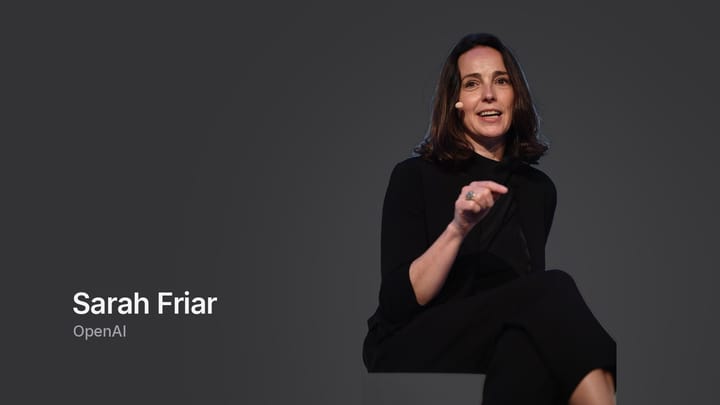
Friar talks with Declan Kelly of Consello in OpenAI's library. She covers the $122 billion raise, the eras of AI from chat to reasoning to agents, and what happens to SaaS vendors, jobs and cybersecurity. Most of the evidence comes from OpenAI customers and from her own working habits.
The tension is between speed and what endures. Friar says "hope's not a strategy" and insists the demand is real, yet the money is committed years ahead of the revenue. She hedges on causation, sidesteps whether governments can keep up, and holds that human judgment is the one thing she will not hand to ChatGPT.
Enduring beats popular — ▶ 3:14
Fast change forces a recentre on a North Star: "AGI for the benefit of humanity." Friar borrows Philip Graham's line that markets are popularity machines short-term and weighing machines long-term. She names three things that must endure. The mission, which means broad access, not only humanity that can pay or is deployed on Azure. Customers, from her mom to governments. And trust, which "will be the thing that makes or breaks us." She recentres on this almost daily.
Old jobs as pattern recognition — ▶ 5:58
Friar co-authored a report called "Fear the Penguin" on Linux arriving 20 years ago, and used that pattern when debating open source and ads inside ChatGPT. She spent seven years building a hard ad model at Nextdoor. The Nextdoor lesson applies to a new Georgia Power deal: don't tell communities what they need. They told her food security, specifically kids getting school dinners, which she received herself as a child. Each zig-zag was a building block.
From asking to doing — ▶ 8:51
ChatGPT just became ChatGPT Work, and for the first time over a billion people will experience agentic behaviour. The shift is "from asking to doing", such as booking a dinner for 12 two weeks out. She says we have only found the light switch on electricity. Customer proof: BBVA is rolling it out across roughly 120,000 employees who save hours every week, and Cisco's developers are 3-10x more productive.
Eras, and an earnings hedge — ▶ 12:04
Three eras in quick succession. 2022 was call-and-response chat, the end of 2024 brought reasoning, and 2025 brought agents. She says reinforcement learning has largely removed hallucinations. Coding came first, and there are more developers than two years ago. Her public customers furthest along beat analyst earnings expectations, though "I don't know if it's causation or correlation." Analysts reverted to the mean, which she reads as upside. Capacity is bought against demand she sees today: "hope's not a strategy."
Cyber, and a dodged question — ▶ 14:13
Cyber is the next obvious area. She has dealt with five breach announcements in a couple of weeks and the market barely reacts. Nimda and Code Red birthed antivirus, and she sees a similar moment now. She does not expect an apocalypse but wants mission-critical infrastructure locked down against nation-state actors. Asked whether government can ever catch up, she answers with partnership: customers include countries, and state and local trust is won or lost. The electricity analogy: insulate the wire, don't ban it.
Keep the system of record — ▶ 17:21
Anyone can code now, and finance people on her team are doing it. Deterministic packaged software still holds data and controls. The user-facing layer on top becomes a "Cambrian explosion". OpenAI keeps its procurement vendor, which covers about 80,000 vendors, for data and delegation of authority up to her, Greg or Sam. On top it customises heavily and uses agents for credit checks. Great vendors are moving toward headless APIs that let others customise on top.
Compute resells at 3-5x — ▶ 20:21
Reaction to the record $122 billion raise has evolved. Last fall, arguing for the compute needed to serve every customer was "heavy sliding", and OpenAI is now judged more prescient, at least in hindsight. The compute she bought a year ago could be sold today for 3-5x. The catch is that OpenAI is still short, so she should have bought more. Her future still needs "higher fidelity".
Railroads and the $250,000 tool — ▶ 21:07
Unlike the internet era this is true capex, with capacity needed one to three years out. Friar is spending much of her team's brain power on 2030-2035 and must show a revenue and operating income curve now. A year ago investors underwrote consumer ChatGPT but doubted agents. Her team had assumed about $1,000 a month per developer. Buyers now reason that if an engineer costs $250,000 and the tool yields three engineers' output, the tool is worth another $250,000 a year.
Automate, augment, judgment — ▶ 25:30
Friar expects a chunk of jobs to be automated, and says the world should often celebrate that. A good 50%-plus in the torso, jobs like hers, are augmented. New roles such as prompt engineer and forward deployed engineer are emerging. A consulting CEO halved his back office and moved the same number into the front office, so the firm has not shrunk and entry-level roles may have grown. The durable asset is "a moat called judgment", with growing pains attached.
Why culture, smarts first — ▶ 36:51
She is still a perfectionist, but separates one-way doors, which get rigour, from two-way doors, which get speed. OpenAI's culture is curiosity, first-principles thinking and humanity. It is "a why culture", usually five whys minimum, even for a 401(k). Her hiring order: smarts first, loyalty with grit second, experience a distant third. Judgment shows up as deciding when a human stays in the loop versus handing work back to agents.
Ikigai as career test — ▶ 40:10
Ikigai asks four overlapping questions: what you are good at, what you are passionate about, what you can be paid for, and what the world needs. At Goldman she had three of four but lacked passion, and after the financial crisis doubted the world needed her research. Square aligned all four, producing flow and low cortisol. The cost is workaholism: a Sunday-morning pop-in becomes 3 o'clock. She uses it on golden-handcuffed mentees, pointing to an actuarial 22.8 years left.
Agents will be priced against payroll, not against software licences, and that changes how large the market is. It is the move that makes OpenAI's capital plan add up. A year ago Friar's team sized the coding opportunity the way finance people size any market. Count the software developers in the world, guess a monthly price, multiply. They assumed about $1,000 a month, or $12,000 a year per engineer. Investors rolled their eyes. They underwrote consumer ChatGPT, on the strength of subscriptions and an ad model. On agents, the answer was "I don't know." Buyers now reason differently. A company paying an engineer $250,000 a year that gets three engineers' output for the price of one will pay another $250,000 for the tool. Friar's verdict on her own forecast: "shame on us, we didn't think big enough."
That reasoning is what makes the spending defensible. Friar is blunt that this is not the internet era. It is true capex, shovels in the ground, capacity that has to exist one, two and three years from now. She says she and her team spend much of their brain power on 2030 through 2035. They pay for it today and must show a curve of revenue and operating income to match. Her evidence that the demand is not made up is concrete. Compute she bought a year ago could be sold in the market today for 3-5x. OpenAI is still short, so she says she should have bought more. Capital markets have shifted with her. When OpenAI first argued last fall for the compute needed to serve every customer who wanted intelligence, the reception was heavy sliding. Now, at least in hindsight, the company is judged more prescient.
Underneath the demand sits a technical sequence she describes in three steps. 2022 was call-and-response chat, and people worried about hallucinations. The end of 2024 brought reasoning, and she says reinforcement learning has largely removed hallucinations. 2025 brought agents. Coding came first because, in Brett Taylor's phrase, it was humans acting like machines. Now the same shift reaches knowledge workers. ChatGPT Work puts agentic behaviour in front of more than a billion people for the first time. BBVA has rolled it out to roughly 120,000 employees who save hours each week. Cisco's developers are 3-10x more productive. Friar's own agent triages her inbox, Slack and spreadsheets before she is out of bed, then turns the overnight Wall Street emails into a five-minute podcast.
The obvious objection is that a CFO saying demand is real proves little. Her best evidence is customer earnings. Public customers furthest along beat what analysts expected coming into last year. Then she hedges: "I don't know if it's causation or correlation, but there's something there." Analysts have since reverted to the mean on those companies, which she reads as upside still to come. That is a suggestive pattern, and she claims no more than that.
The same logic hits software. Friar does not predict that SaaS dies. She says deterministic packaged software keeps its place where data is captured and controls are managed. OpenAI's own procurement system covers about 80,000 vendors. It keeps the vendor for data and for delegation of authority, the chain of approvals that runs up to her, Greg or Sam. What changes is the layer where users actually work. There anyone can code, and OpenAI customises heavily and has agents run credit checks. The vendors she respects are moving toward headless APIs, exposing their capabilities so others can build on top. Value migrates from the interface to the record and the controls behind it. Intelligence itself becomes a commodity.
Labour follows the same pattern, and here she is careful. A chunk of jobs will be automated, and she thinks the world should often celebrate that. A good 50%-plus, jobs like hers, will be augmented. New roles are appearing, and nobody can see what work looks like in five to ten years. Her evidence is a single anecdote from a consulting CEO. He halved his back office but moved the same number of people into the front office, so the firm did not shrink, and entry-level jobs may have grown. There are also more developers than two years ago. What remains scarce is judgment, which she calls "a moat called judgment". She uses ChatGPT for the homework before a performance review and keeps the conversation human. About 70% of her day is still spent with people. She concedes there are growing pains.
The weakest answers come where risk is hardest to price. Asked whether government can ever keep pace with technology that moves this fast, Friar answers a different question. OpenAI should be a good partner, because its customers now include countries. Governments must secure their own systems. Local officials need to bring constituents along, as with insulating the wire rather than banning electricity. On cyber, Kelly calls the combination with AI potentially apocalyptic. She disagrees, but only after naming nation-state actors and saying critical infrastructure must be locked down fast. Her precedent is Nimda and Code Red, which birthed the antivirus industry. That implies a new industry will form, and it does not say how soon or who pays.
What holds this together is the mission, not the forecast. Friar repeats that the work must be enduring: the mission, the customers, the trust. She cites Graham's weighing machine for a reason. Markets reward the popular in the short run, and her spending is aimed at what the scales will say later. The test arrives in 2030 to 2035. The bills arrive sooner.
The open question. The pricing logic rests on thin ground. Friar's case that agents are worth a second $250,000 a year per engineer comes from what buyers now say, and her proof that customers profit is an earnings beat she admits might be correlation. The jobs claim leans on one consulting CEO's anecdote. Watch whether the 2030-2035 revenue curve forms before the capex comes due.
Watch the full video at https://www.youtube.com/watch?v=kaMStJ-E2KU.
Comments ()