Recorded 7 October 2026 · 25 min
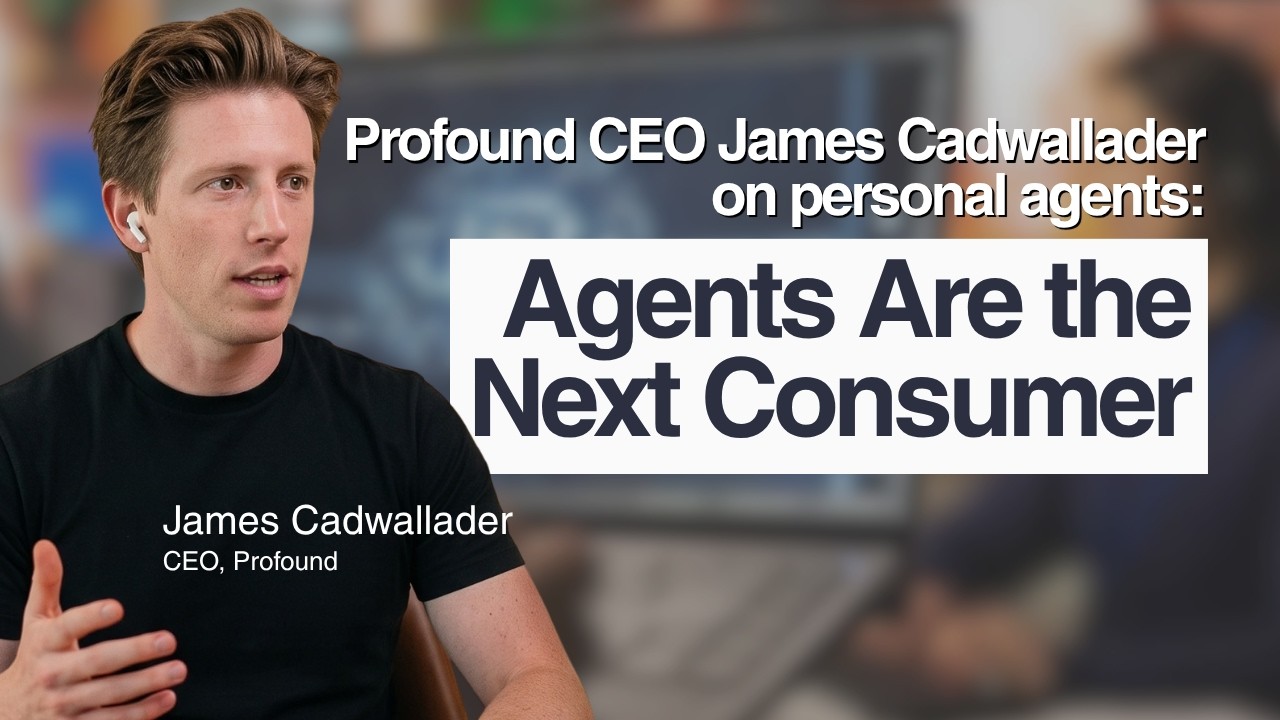
James Cadwallader, co-founder and CEO of Profound, predicts that humans will stop manually browsing the web and that AI agents will instead select products on their behalf. In conversation with host Sophia, he argues this makes agents the next consumer every brand must serve, and that marketing must be rebuilt around them. Profound recently raised $180 million at a $1.8 billion valuation. It began by measuring how brands appear in AI answers and is expanding into agents that do marketing work.
The tension lies in what it means to influence a machine. Cadwallader insists the work is accurate, information-dense persuasion rather than gaming, and he cites customer cases as support. But those cases are anecdotal and the customers largely unnamed. When the host raised manipulation, his answer was partly redirected.
Agents as customers — ▶ 3:01
Profound started by asking how a brand shows up in ChatGPT, Gemini, Grok and Claude. Over the last couple of months, personal agents such as Grokbot and dots from OpenAI convinced Cadwallader that this is the next S-curve. His forecast is that humans will not browse manually as they have for 20 years. Agents will browse and choose according to user preferences. He says he held this belief two years ago and has doubled down on it recently. It remains a prediction, though the company already serves a third of the Fortune 100, including Estee Lauder, Comcast and Ramp.
The marketing vertical thesis — ▶ 4:50
Cadwallader rejects the idea that one general-purpose company will own the application layer across all verticals. He expects each vertical to produce a giant, naming Harvey in legal, Sierra in customer support, and Rogo or Ramp in finance. Marketing, a top-three line item for every business, should belong to Profound. The product vision is a workbench where enterprise marketers manage and measure everything with agents, replacing what he calls prehistoric tools like Adobe and Photoshop. He later says building a company as big as Adobe would be a blessing. The framing is a competitive positioning claim, not an established outcome.
Persuading machines differently — ▶ 7:52
Cadwallader frames marketing as persuasion without a one-on-one conversation, a craft refined on humans for a couple of hundred years. Agents change the requirements. A person might glance at a steamer photo and a five-star review. An agent examines price points, compares against 500 other products, and weighs details like how recent the information is. He calls the result a new agent-first marketing, best produced with agents. Asked about fake products and articles written only for agents, he said his enterprise customers do not do that and that he is sure some of it happens elsewhere, without addressing the practice directly.
Product marketing moves center — ▶ 11:06
Following the logic far enough, Cadwallader says, product marketing becomes extremely important. Its traditional role is to express a product's differentiators in terms of customer demand, as with Nike highlighting performance for runners. Product marketers must now work out what agents care about within their category. They must also work with product teams so the product actually serves that role and its differentiation reaches agents. Asked whether this improves the products themselves, he answered yes, but his examples concerned describing products accurately rather than changing them. The product-feedback loop is asserted more than demonstrated.
Correcting the models' record — ▶ 13:13
A large Japanese consumer electronics company used Profound agents to update 1,000 product display pages in days. Agents visit those pages non-stop, and doing it manually would take an army of marketers. A CRM company found models misstating its software pricing, which Cadwallader says damaged its bottom line. Because models reveal their sources, Profound traced the errors, and the company built content addressing them directly. Cadwallader says the models later corrected themselves. He stresses limits: nothing changes overnight, and Nike could not flood the web with posts claiming to beat Adidas and expect models to repeat them. The customers are unnamed and no measurements are given.
Different content per crawler — ▶ 20:00
Cadwallader says OpenAI and Google agents crawl the web well, so format makes little difference, whether markdown or heavily structured. What Profound can do is detect when a specific agent visits a site and serve it a different variation of content. The integration sits at the CDN level, so it happens at the edge. If OpenAI's crawlers favor extremely information-dense pages, Profound can serve that. Using analytics, it can also emphasize points OpenAI's models underhighlight. Profound has no partnership with the labs and sits adjacent to them. Cadwallader claims the byproduct is better consumer answers because models have more information to draw on.
10x-100x more marketing — ▶ 21:42
An agent researching a purchase pulls roughly an order of magnitude more information than a human, running through perhaps 20, 30 or 50 pages where a person visits one or two. Cadwallader calls this an insatiable new demand that marketers must satisfy with differentiated, broad yet specific content. He dismisses the AEO and GEO labels as a red herring whose similarities stop at the rhyming acronyms. In his view the whole marketing stack becomes marketing to agents. His forecast is that marketers will need to create maybe 10x to 100x more marketing by this time next year. He gave no decade-out view despite being asked.
Cadwallader's central claim is that the audience for marketing is shifting from a human who skims to a machine that reads everything. He does not see people continuing to browse manually as they have for 20 years. In his forecast, personal agents will browse on their behalf and make selection decisions based on their preferences, which he says changes what it means to be a marketer. He has held this view for two years and says it hardened over the last two months as personal agents emerged. Profound's path reflects it: the company began by tracking how brands appear in ChatGPT, Gemini, Grok and Claude, and now sells agents that do marketing work. He says it supports a third of the Fortune 100. He also runs a company whose product depends on this thesis being true, which is worth keeping in mind.
The logic rests on how the two readers behave. A person buying a steamer glances at a photo, skims a five-star review and visits perhaps one or two pages. An agent researching the same purchase may work through 20, 30 or 50 sources, compare the price against 500 other products and check how recently each piece of information was published. Cadwallader calls this an insatiable new demand that marketers must meet with differentiated content that is both broad and specific. His sharpest forecast follows: to stay relevant, marketers will need to produce roughly 10x to 100x more marketing within a year. He dismisses the AEO and GEO labels as a red herring, arguing that the entire marketing stack, not a niche discipline, is now about marketing to agents. Asked for a decade-out view as well, he did not offer one.
Volume is not the whole strategy, though. The evidence he offers centers on accuracy. A CRM company found that AI models kept misstating its software pricing, which he says was damaging its bottom line. Profound's tooling traced where the errors originated, since models disclose their sources, and the company built content that addressed the inaccuracies head on. That content was absorbed, he says, and the models have since corrected themselves. A large Japanese consumer electronics company updated 1,000 product display pages in a few days, work he says would otherwise take an army of marketers, because agents visit those pages non-stop. The pattern is maintaining facts at scale, which is why he argues agents are needed on the supply side too. But these are customer anecdotes. Neither customer is named, and no before-and-after measurements are given.
If agents become the audience, the organizational center of gravity moves. Cadwallader argues that product marketing becomes extremely important. Its traditional job is to express a product's differentiators in terms of what customers want, such as the performance that runners buying Nike care about. Now product marketers must discover what agents care about within their category and work with the product team so the product serves that role. Asked whether this feeds back into products, he said it does without a shadow of a doubt. Yet his examples concerned describing existing products accurately, not changing them. The loop from agent behavior to product design is asserted rather than shown. His commercial ambition is plain: he wants Profound to be the place an enterprise marketer logs in to manage and measure work, displacing tools like Adobe.
The hardest question is where optimization ends and manipulation begins. Asked about fake products and articles written only for agents, Cadwallader said his enterprise customers are not in that business, conceded that he is sure some of it happens, and reframed marketing as persuasion. He does supply real limits. Perception cannot be changed overnight, and Nike could not publish thousands of posts claiming superiority over Adidas and expect models to repeat them. Accuracy is the condition. Yet Profound also detects when a particular agent visits a site, through an integration at the CDN level, and serves it tailored content. One example is material on points that OpenAI's models underemphasize, according to Profound's analytics. That is the same capability a less scrupulous brand could use. The guardrail he describes is the judgment of the models, not the tooling.
The unresolved issue is whether truthful volume remains an advantage once everyone supplies it. Cadwallader argues the byproduct of this work is better answers for consumers, since models gain more information to draw on and can choose whether to absorb it. But if every brand produces 10x to 100x more agent-facing content, differentiation shifts to how models weigh sources and how quickly they absorb corrections. He says only that absorption happens over time if the work is done effectively. The conversation offers no data on that speed, on how models handle competing accurate claims, or on how often tailored content fails. Until it does, the thesis that agents are the next consumer is better supported than the claim that marketers can reliably steer them.
The open question. Does truthful volume stay an advantage once every brand supplies it? If marketers produce 10x to 100x more agent-facing content, differentiation depends on how models weigh sources and how fast they absorb corrections. Cadwallader says only that absorption happens over time if the work is done well. The conversation offers no data on that speed, on how models handle competing accurate claims, or on how often tailored content fails.
Watch the full video at https://www.youtube.com/watch?v=xn9AWB9n5ho.
Comments ()