Recorded 18 October 2026 · 12 min
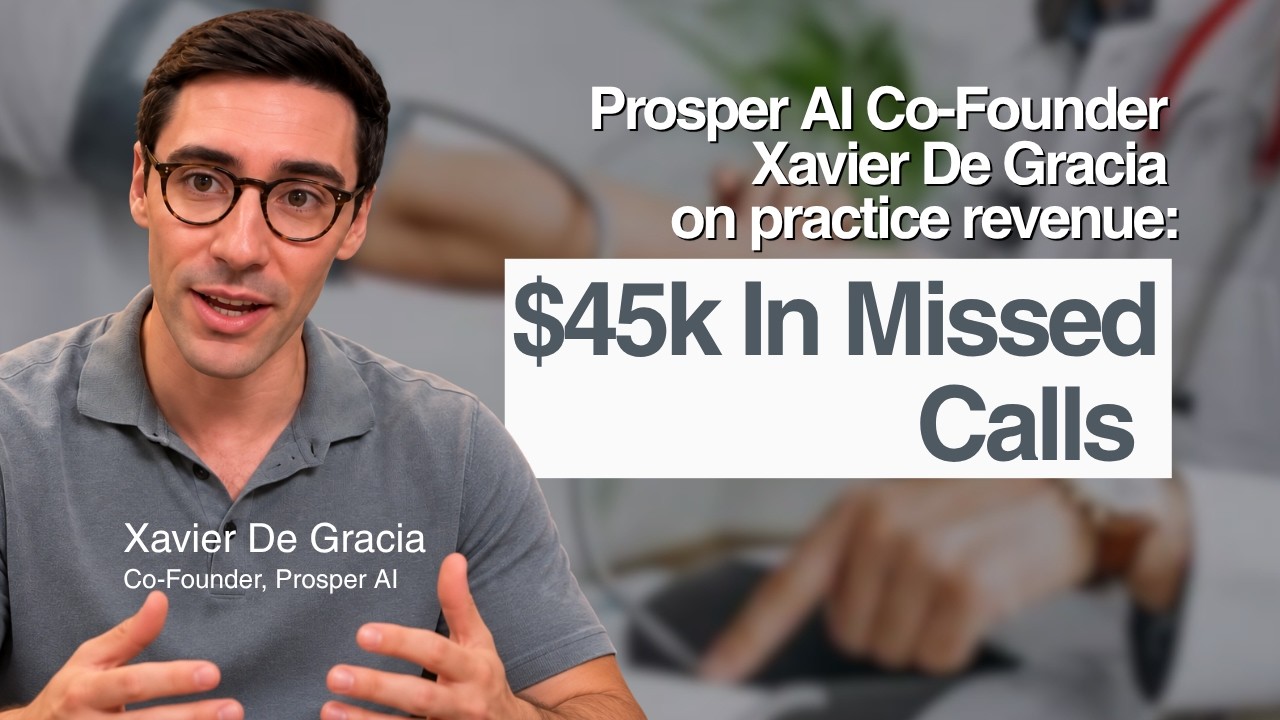
Xavier de Garcia, co-founder of Prosper AI, argues that healthcare's most valuable AI opportunity is not cost reduction but fixing the coordination failures that make practices lose revenue. A report released the day of the interview, built on a survey of more than 2,000 outpatient groups plus Prosper's proprietary data, estimates up to $108 billion in annual recoverable revenue, or up to $125,000 per physician.
The tension lies between a compelling mechanism and self-interested evidence. Missed calls, benefit checks and prior authorizations plainly create friction, and de Garcia frames insurers and practices as a coordination problem rather than an arms race. Yet the figures are ceilings from a vendor selling the solution, and the interview does not test them.
Revenue, not cost cutting — ▶ 1:00
Specialty practices face a squeeze: Medicare is reducing reimbursements by up to 9% in dermatology, de Garcia says, while daily operating costs rise. He argues AI is usually framed as substitution and cost reduction, whereas Prosper focuses on executing patient-facing processes better. The report, based on a survey of more than 2,000 outpatient groups plus proprietary data, finds up to $125,000 per physician per year in recoverable revenue. His implication is that operational control through AI lets practices stay independent.
The phone is the bottleneck — ▶ 1:54
80% of patients seeking an appointment still call, and de Garcia says up to one in six calls goes unanswered. Answering is only the first step. Staff must check benefits and eligibility, confirm insurance will cover the visit, sometimes file a prior authorization and wait for approval, and then bill. He calls this a multi-day coordination problem among patient, insurer and provider. AI can answer 24/7 and check benefits consistently, which he says also prevents claims denials caused by administrative errors.
Why booking still needs humans — ▶ 3:35
De Garcia's explanation for why patients still call in 2026 is complexity. A dermatology practice may have more than 200 appointment types, each potentially tied to a different doctor and different insurance coverage. Until now, only a human could map a caller to the right slot, which is why most visit types lack an OpenTable-style booking experience. He claims AI can now interpret that complexity and schedule patients end to end without a human on the phone. The transcript offers no accuracy data.
Coordination, not arms race — ▶ 4:53
De Garcia concedes some validity to the framing of insurers versus providers: UnitedHealthcare, which he calls a $300 billion company, against small practices, a dynamic he says has existed for 50 years. Prosper treats it as a coordination issue instead. Insurers use AI to deny prior authorizations, he says, but are simply trying to be efficient, while practices lack tools to match that speed. The argument assumes automation on both sides reduces friction; he does not address cases where the parties' interests genuinely conflict.
Lost demand worth $45,000 — ▶ 6:41
Unanswered calls are lost demand, de Garcia argues: patients who cannot book simply go to another practice. Because Prosper picks up consistently, he reports an increase of up to $45,000 per physician per year from new appointments. The mechanism is straightforward, but the figure is an upper bound, and it implicitly relies on capturing patients who would otherwise choose competitors. The transcript gives no information on how many calls convert or what baseline answer rates practices start from.
Re-engaging lapsed patients — ▶ 7:11
54% of patients due for a recurring visit, such as an annual skin check, do not return on schedule, de Garcia says, because they forget or do not know insurance will cover it. Prosper's AI agents tell patients they are eligible for visits such as skin checks or mammographies, producing around $40,000 incremental revenue per physician per year. Combined with the $45,000 from new appointments, that itemizes $85,000 of the $125,000 headline; the remainder is not broken out in the interview.
Price transparency as next target — ▶ 8:25
De Garcia predicts that in three to five years, most manual work in healthcare practices will be done by AI, and Prosper aims to be the AI workforce for healthcare operations. He identifies price opacity as a core problem: 300 million Americans see a doctor each year without knowing whether the visit will cost $20 or $3,000. Prosper intends to coordinate patients, insurers and providers to provide visibility. No mechanism or timeline for producing reliable cost estimates is described.
Xavier de Garcia's central claim is that AI's most underrated value in healthcare lies in revenue recovery rather than cost substitution. Specialty practices are under a squeeze, he says: Medicare is cutting reimbursements by up to 9% in dermatology, for example, while daily operating costs rise. The usual AI pitch is to reduce headcount. Prosper AI's pitch is that the processes surrounding a patient visit are poorly executed, and that doing them better brings in money practices are currently losing. Prosper's report, published on the day of the interview, puts the potential at up to $108 billion a year across practices and up to $125,000 per physician.
The mechanism starts with the telephone. According to de Garcia, 80% of patients who want an appointment still call, and up to one in six of those calls goes unanswered. Answering is only the first step. Staff must identify the visit type, check benefits and eligibility, confirm coverage, and sometimes file a prior authorization and wait for approval before the provider can bill. De Garcia describes this as a multi-day coordination problem among patient, insurer and provider. Phone scheduling persists, he argues, because a dermatology practice may have more than 200 appointment types, each with its own doctor and coverage rules, so only humans could navigate it. AI, he says, can now do the work end to end.
Two revenue streams carry most of the numbers he cites. The first is lost demand. If one in six calls is not picked up, he says, those patients go to other practices, and consistent answering recovers up to $45,000 per physician per year in new appointments. The second is lapsed patients. He says 54% of patients due for recurring visits, such as annual skin checks, do not return, often because they forget or do not know insurance will cover the visit. AI agents that tell patients they are eligible bring in around $40,000 more per physician annually. The same logic extends to claims: consistent benefit checks, he argues, reduce denials caused by administrative errors.
These figures deserve scrutiny. The two itemized streams total $85,000, leaving roughly $40,000 of the $125,000 headline unexplained in the interview. It presumably reflects billing, though de Garcia does not say so. Every number is framed as up to, which makes it a ceiling rather than an expected result. The sources are a survey of more than 2,000 outpatient groups and Prosper's proprietary data, neither of which the interview examines, and the report was produced by a company selling the remedy. The interviewer asks nothing about implementation costs, accuracy, or how many practices actually reach the top of the range. None of this makes the mechanism wrong. It means the size of the prize is asserted, not demonstrated.
There is also a competitive wrinkle the conversation does not address. The $45,000 figure rests on capturing patients who would otherwise go to another practice. For a single early adopter, that is a gain in share. If every practice adopted the same tools, the same callers would be spread across practices that all answer, and the gain would shrink. That is an editorial inference rather than a claim made in the interview. The re-engagement stream looks sturdier in this respect, because it draws on a practice's own patients rather than competitors' callers. De Garcia's argument about independence, that operational control is one of the few levers practices have as costs rise and reimbursements fall, implicitly assumes adopters keep the benefit.
His treatment of insurers is the most contestable part of the framing. He acknowledges the imbalance: UnitedHealthcare, which he calls a $300 billion company, against small practices focused on seeing patients, with insurers using AI to deny prior authorizations. But he resists the arms-race description, though he concedes it has some validity and has existed for 50 years. Prosper sees a coordination issue. Insurers, he says, are simply trying to be efficient, and practices lack the tools to match that speed. The implication is that comparable automation on both sides reduces friction for everyone. That is plausible for administrative errors. He does not address cases where an insurer's interest in denying a claim is opposed to a practice's interest in being paid.
The longer-term ambition is broader. De Garcia predicts that within three to five years, most manual work in healthcare practices will be done by AI, and Prosper wants to supply that workforce. The more ambitious target is price visibility: he notes that 300 million Americans see a doctor each year without knowing whether the visit will cost $20 or $3,000. Solving that requires the same eligibility and benefit coordination already central to Prosper's product, but the interview offers no detail on how estimates would be produced or who would be accountable for their accuracy. Whether AI that speeds up coordination also makes costs legible, rather than simply making existing processes faster, remains untested.
The open question. How much of the up-to $125,000 per physician is realized in practice, and how much is a one-time share gain? The $45,000 new-appointment figure depends on capturing callers who would otherwise go to another practice. If competitors also answer every call, that advantage should shrink (an editorial inference). The interview also leaves roughly $40,000 of the headline figure unitemized and offers no independent validation of the $108 billion estimate.
Watch the full video at https://www.youtube.com/watch?v=flDKcTUZyVQ.
Comments ()