Recorded 14 July 2026 · 44 min
Sal Khan, founder of Khan Academy, argues that AI-driven job dislocation will begin in earnest within four to five years, and that society has no plan for it. Discussing his forthcoming book Job Shock, Khan, who describes himself as usually optimistic, points to an automated call center, Waymo's rollout, and the changing shape of software and product roles.
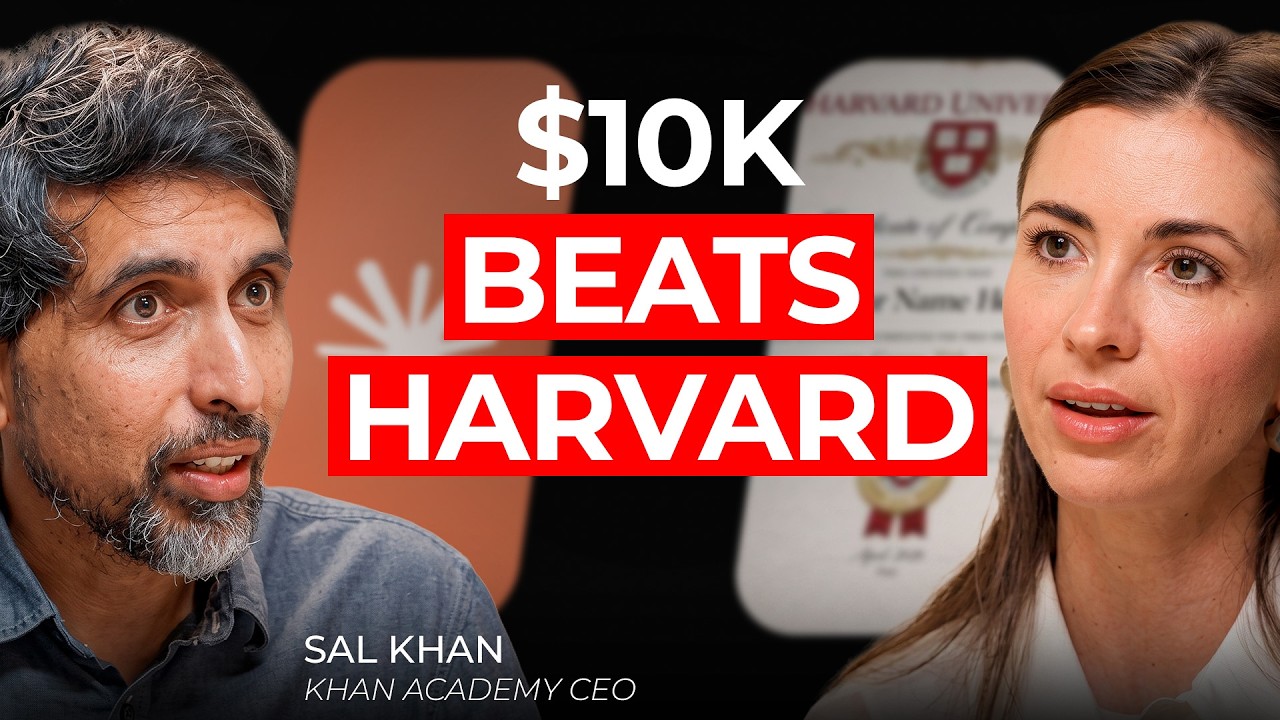
The tension is one of calibration. Khan does not predict mass unemployment, but expects pockets of 4-5% unemployment in some sectors and believes AI's exponential pace makes complacency risky. His response is practical: Khan Academy's own aggressive adoption, and Constellation Institute, a planned degree capped at $10,000 that certifies durable skills through simulations. Whether employers will honor that signal remains untested.
Call center precedent — ▶ 2:47
A venture capitalist friend told Khan that one of his portfolio companies had automated 80% of the workforce at a Philippines call center using generative AI. Khan did not know the exact number but recalled it as hundreds if not thousands of people. The exposure is national: depending on how it is measured, 5-7% of the Philippines' GDP is tied to business process outsourcing, mostly call centers. Khan expects the trend to spread over the next 3-5 years, and the friend began considering putting 1% of his firm's profits into reskilling. The figure is secondhand and approximate.
Why history isn't reassuring — ▶ 4:36
Khan rejects the argument that the Industrial Revolution ultimately produced more jobs, noting it also brought wars and that the 20th century was the bloodiest. He expects ride-share to take a real dent in 5-10 years, slower than AI evangelists claim but fast by the measure of a childhood. Driving is among the largest employers of men globally, and his prediction is that jobless, angry people drive polarization and push politics toward extremes. He opposes universal basic income, arguing people need a sense of contribution, but offers no worked-out alternative.
Layoffs and blending roles — ▶ 8:51
Khan Academy has 350 employees, two-thirds in product. Asked whether 3x productivity means laying off two-thirds, Khan says an organization with the budget of a large high school would simply do 3x more; layoffs would come from a philanthropy or revenue shortfall, not AI. Designers and product managers now get full development environments to submit pull requests, and some engineers are becoming more customer-facing. Tool adoption is in the career rubric. Editorially, the no-layoff logic presumes unmet demand for the organization's output, which may not hold at every firm.
Human connection as moat — ▶ 11:38
Khan sees teaching, nursing, hospitality and sales as safest because they rest on relationships. Teachers have long been moving from sage on the stage to planners, architects and coaches. His sales argument is mechanistic: AI sales agents cost so little to deploy that everyone will be spammed and the agents will largely cancel each other out. What retains value is the trusted advisor who will say a product is not the best fit. Work done purely on a computer, without communication, persuasion, listening and collaboration, is more exposed.
Token economics of agents — ▶ 14:39
Khan Academy's Anthropic bill runs at about $1.2 million a year and is growing fast. One engineer spent $3,000 in a day and finished in a few hours work that would normally take three or four months. Khan's arithmetic: $1-3 million of tokens a year yields output that once would have cost $20-30 million. A game-like feature that might have waited for next school year was vibe coded in a day at a hackathon and shipped in about a month. His estimate that the organization is 50-100% faster is a feeling, not a measurement.
AI as chief of staff — ▶ 17:51
Khan has connected AI tools to Slack, Gmail and Docs and asks one daily what is falling through the cracks; he says 20-30% of requests to him previously did. His rules: keep a human in the loop, let AI draft emails but not send them, never let it post to social media. A first draft of a funding proposal now exists within 10 minutes of a meeting, work that took a week or two. For financial literacy videos, he uses AI to probe edge cases but demands a verifying source, such as IRS.gov, before publishing.
Defensibility beyond code — ▶ 20:40
Khan admits an ego-driven worry that within 3-5 years someone could vibe code something resembling Khan Academy. His claimed protection is friction: efficacy data, school data-privacy agreements and millions of existing users. His considered view is that a nonprofit should be glad if someone matches or beats it. He sees opportunity in assessment, where real psychometric validation takes years and few VCs or private equity firms would fund an AI-enabled standardized test. He would be surprised if markets alone solve credentials, diplomas and pathways into jobs.
Constellation Institute design — ▶ 23:58
Constellation Institute, announced at TED with ETS involvement, is pursuing accreditation for bachelor's and master's degrees. Mostly online, it combines an academic component with group simulations, such as building a business in 4 hours, followed by peer review of communication, collaboration and creativity. Six corporate partners, McKinsey, Bain, Google, Microsoft, Repl.it and Accenture, are co-designing tasks but have made no hiring commitment. About 3,000 people registered interest within two or three weeks, most of them already holding degrees and fearing for their relevance.
Rebuilding the hiring signal — ▶ 28:35
A 3.9 GPA from Stanford tells Khan a candidate is probably smart but little about leadership; he searches for YouTube videos of candidates, and interviews offer only a few hours of evidence. Constellation students would complete 20-50 projects, producing rated portfolios, video artifacts and feedback from 50-100 people. The pitch is that a top-10% performer on communication and collaboration should be treated like a top-10% elite graduate. Higher education, he says, is polarized: elite schools carry the signal but little capacity, while online programs lack the signal.
Degree as luxury good — ▶ 32:31
The degree is capped at $10,000, and Khan expects the real figure to be well below that. Because it is competency-based, it might take 2 years, leaving 2 more years of earnings, against $400,000-500,000 at elite universities. He calls the elite college experience a luxury he hopes his son can afford, but notes most students attend transactionally. His example: a student with a full ride at San Jose State could add Constellation for about $5,000 instead of a family paying roughly $500,000 for Stanford to get McKinsey recruiting.
Pockets, not mass unemployment — ▶ 37:09
Khan expects pockets, not mass unemployment, in 3-4 years; even 4-5% unemployment in certain sectors would be painful and affect politics. He does not dismiss speed because coding went from 20-30% assistance to a threshold where AI became how code is written, and the pattern is spreading into knowledge work. For individuals, he stresses overcoming activation energy and automating repeated copy-paste workflows. He warns that models flatter users, even when asked to be critical. For a 22-year-old, he advises seeking the emptiest lanes and boring industries.
Sal Khan's central claim in Job Shock is not that mass unemployment is imminent. It is that a specific kind of dislocation will begin within four or five years, and that no institution is ready for it. He is explicit about the calibration. He does not expect mass unemployment in the next three or four years, but he does expect pockets, with 4-5% unemployment in certain sectors, which he calls very painful. His evidence is anecdotal but concrete. A venture capitalist friend told him that one portfolio company had automated 80% of the workforce at a Philippines call center using generative AI. Khan recalled the workforce as hundreds if not thousands of people. By his account, business process outsourcing accounts for roughly 5-7% of the Philippines' GDP, depending on how it is measured.
Khan distrusts the standard reassurance that earlier technological shifts eventually created more jobs. The Industrial Revolution, he notes, also brought wars, and the 20th century was the bloodiest. His worry is political as much as economic. Driving is among the largest employers of men globally, and in his view jobless, angry people push politics toward extremes. He expects ride-share to take a real dent in 5-10 years, slower than AI evangelists claim but fast by the standards of a childhood. His own uncle drives for Uber in New Orleans, a job Khan says is usually people's last choice. He rejects universal basic income, arguing that people need a sense of contribution, but offers no finished alternative.
The evidence that the technology is working comes from inside Khan Academy, and it concerns economics as much as capability. The organization's Anthropic bill runs at about $1.2 million a year and is growing fast. One engineer spent $3,000 in a day and, Khan learned, finished in a few hours something that would normally take three or four months. His arithmetic is that $1-3 million of tokens a year buys output that would once have cost $20-30 million. A game-like feature that might have waited for next school year was vibe coded in a day at a hackathon and shipped in about a month. Khan puts the organization's speedup at 50-100% over two or three years, but labels that a feeling, not a measurement.
When building gets cheap, the sequence of work changes. Khan says the old advice was to spend as much time as possible on design because engineering was hard. His new view is to build quickly and test the thesis, with exceptions for things that must work before release. Roles blend accordingly. Khan Academy is giving designers and product managers full development environments so they can submit pull requests, while some engineers become more customer-facing. He promises that AI will not be the catalyst for layoffs: with the budget of a large high school, 3x productivity means 3x more output. That reasoning rests on unmet demand for the organization's work, an editorial observation rather than Khan's own claim. A firm with fixed demand would face different arithmetic, and Khan says he is genuinely unsure how product jobs elsewhere will fare.
Where does human work keep its value? Khan points to relationship-heavy jobs: teachers, nursing, hospitality and sales. His reasoning on sales is the sharpest. AI sales agents cost so little to deploy that everyone will be spammed, and the agents will largely cancel one another out. What survives is the trusted advisor who will say a product is not right for you. That creates a problem Khan treats as the real bottleneck. Durable human skills are valuable yet nearly invisible on a resume. A Stanford 3.9 GPA tells him a candidate is probably smart, but little about leadership. He now looks for YouTube videos of candidates, and interviews offer only a few hours of evidence.
Constellation Institute is built around that gap. Khan intends it to be accredited, offering bachelor's and master's degrees, mostly online. Beyond an academic component, students would complete group simulations, such as 4 hours to build a business with a prototype, a plan and customer surveys, followed by peer review of communication, collaboration and creativity. McKinsey, Bain, Google, Microsoft, Repl.it and Accenture are co-designing the tasks. Students would complete 20-50 such projects, producing rated portfolios and video artifacts, with feedback from 50-100 people rather than a single interviewer. The degree is capped at $10,000, and Khan says the real figure should be well below that. About 3,000 people expressed interest within two or three weeks, mostly people who already hold degrees.
Khan frames the market as polarized. By his rough figures, Harvard might see 70,000-80,000 applicants, of whom 50,000 could succeed, and accept 2,000. Online programs such as Western Governors University and Southern New Hampshire University serve people who missed the traditional route, but rarely carry the same signal. Constellation aims for the gap, with the goal that a top-10% graduate is treated at least like a top-10% Stanford graduate. The same logic explains why a nonprofit is doing this. Validation takes years, and Khan says few venture or private equity firms would fund an AI-enabled standardized test for that reason. He concedes that vibe coding could eventually produce something resembling Khan Academy, but argues that efficacy data, school privacy agreements and scale are slow to copy.
The evidence has clear limits. Employers have not committed to hiring graduates; Khan says no one can promise that, and the first graduates are about two years away. The claim that simulated portfolios will be treated like an elite credential is an intention, not a result. The productivity gains are impressions, the call center figure is secondhand, and the ride-share timeline is a judgment. Khan himself grants that technology normally changes more slowly than forecast, and says he hopes the interviewer's more sanguine view is right. His counter is that this technology follows an exponential curve. In coding, AI assistance went from a 20-30% boost to a threshold at which it became how code is written, and he sees the pattern moving into knowledge work.
For individuals, Khan's advice is unglamorous: get over the activation energy. Install the tool, find a workflow in which you repeatedly copy and paste output, and build an agent for it, in a sandbox if necessary. For a 22-year-old, he would avoid where everyone is running and look for the emptiest lanes, the most boring industries ripe for these technologies. He compares today to 1996, when merely having a webpage differentiated a job applicant; the modern equivalent might be a portfolio of automated workflows. He also warns that models flatter. One told him he was spotting what others missed, and even when asked to push back it sometimes praised him for being humble. Using AI well, in his telling, includes distrusting it.
The unresolved issue is timing. Khan expects the first real dislocation in four or five years, while the first Constellation graduates are two years out and, by his own account, credible signals take years to validate. If employers are slow to treat simulation-based portfolios as credentials, the program could be a good product that arrives without the market that gives it value. His argument also leaves a gap between its opening and its remedy. The displaced workers he starts with are call center agents and drivers, yet he describes early interest as coming mostly from people who already hold degrees. The conversation does not say how Constellation would reach the people most exposed.
The open question. Will employers treat simulation-based portfolios as a credential equal to an elite degree before dislocation arrives? Khan expects the first real disruption in four or five years, yet the first Constellation graduates are about two years out, no employer has promised to hire them, and he says credible validation takes years. The conversation also leaves open how the program would reach displaced call center agents and drivers rather than existing degree holders.
Watch the full video at https://www.youtube.com/watch?v=s-Iz-lLAhdg.
Comments ()