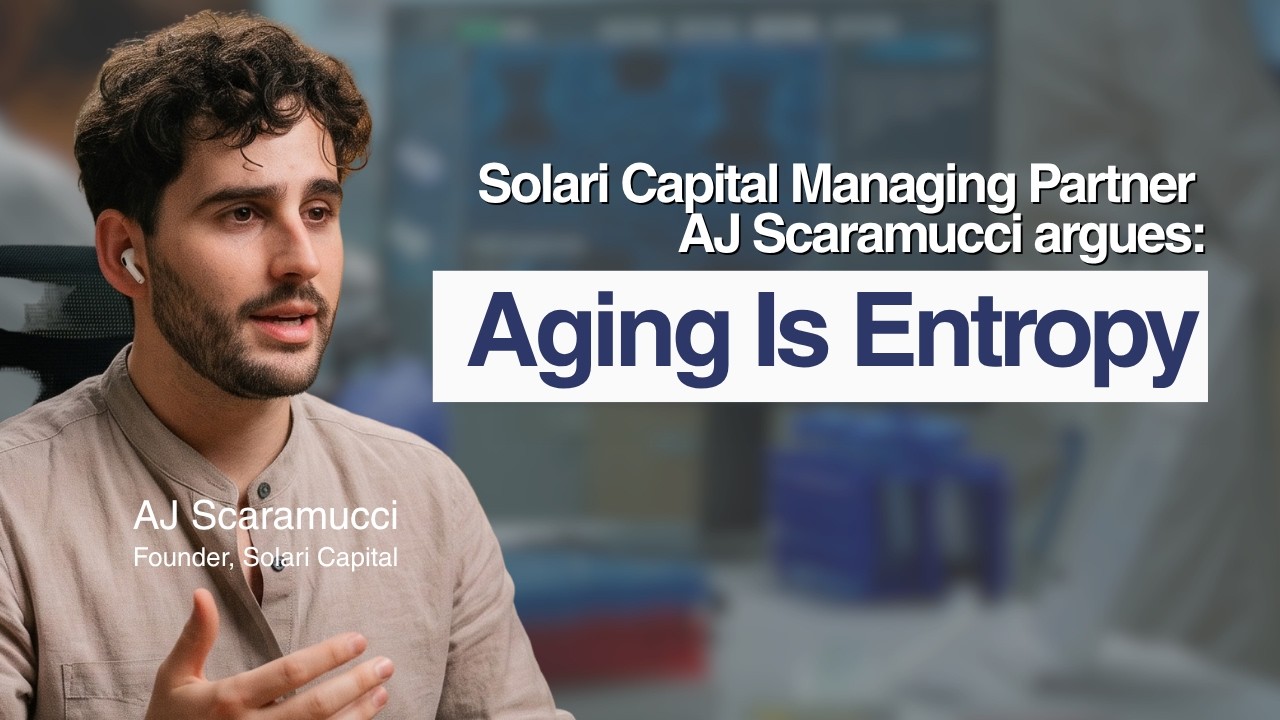
Recorded 10 October 2026 · 23 min
AJ Scaramucci, founder of Solari Capital, holds two theses at once: AI and biology will make much of the economy abundant, and that abundance will send value toward scarce assets. He spoke a week after Solari emerged from stealth with $350 million across AI, biology, aerospace and finance. He frames the first thesis as a programmable-reality worldview shaped by Ray Kurzweil and Peter Diamandis, and the second as a contrarian forecast.
The tension lies in how the two connect. His case for abundance rests on mechanisms: recursive self-improvement reaching science, and Silicon Valley companies learning the legacy systems of healthcare and education. His case for scarcity rests largely on a handful of price comparisons, in a market where Solari is also building a company. The conversation never settles whether one trend causes the other.
Programmable reality thesis — ▶ 1:17
Solari's founding premise is that reality is inherently programmable, a view Scaramucci traces to Kurzweil's law of accelerating returns, an extrapolation of Moore's law. He sees the clearest near-term application in programmable biology, where the field is moving from reading biology to writing it, citing Moderna's cancer vaccines and computational drug discovery. He treats aging as a process of decay and entropy that can be nudged, and expects systematic eradication of diseases from neurodegenerative to cancer. These are stated convictions; no timeline or evidence is offered.
Recursive improvement reaches science — ▶ 4:46
Scaramucci argues that recursive self-improvement, now visible in AI research and in Solari's portfolio, is trickling upstream into the scientific method itself. His example is Physical Superintelligence, which is working on "net new physics." Philanthropic foundations have aggregated large datasets across biology, chemistry and physics, and he expects new money for accelerated science from AI labs' philanthropy, venture capital and growth equity. The implication is that funding, not just technology, becomes a lever on the pace of discovery.
Application layer isn't wrappers — ▶ 6:15
The early meme that application-layer startups are mere wrappers on foundation models has not held up, Scaramucci says, particularly in regulated sectors. Kira Learning offers students an AI tutor, teachers a curriculum designer and grader, and administrators a municipality-wide view. General Medicine, founded by PillPack's Elliot Cohen and TJ Parker, builds AI-enabled primary care, and Andreessen Horowitz led its Series B. He notes there has been no $100 billion-plus venture-backed outcome in education or healthcare, and predicts the first will come.
Legacy systems as the moat — ▶ 9:33
"The future is here, it's just not evenly distributed" is Scaramucci's framing of the central obstacle. Healthcare has layers of stakeholders, including PBMs, specialty pharmacies, physicians and insurers, all trying to get up to speed on AI. His claim is that Silicon Valley-native companies that take the time to understand these systems will be big winners over the next three or four years. The implied edge comes from domain patience rather than model access, though he offers no data on adoption rates.
Abundance as memetic North Star — ▶ 13:06
Scaramucci treats Silicon Valley's vocabulary, singularity, event horizon and abundance, as a memetic loop that aligns the industry's resources. Citing Sam Altman, Demis Hassabis and Dario Amodei as users of the word abundance, he describes the optimistic case as people gaining basic access to food, water and shelter and then self-actualizing at scale, moving up Maslow's hierarchy. He concedes there is "a lot of treachery" in getting there. Peter Diamandis shaped his habit of asking what could go right with a given investment.
Cures rather than Band-Aids — ▶ 14:38
Solari incubates companies using team members' operating backgrounds. In mental health, Scaramucci cites 43 million Americans on antidepressants, 35 million diagnosed with treatment-resistant depression and 13 million with PTSD, figures he states without sourcing. His argument is that new modalities are fundamental cures rather than Band-Aids: transcranial magnetic stimulation, J&J's nasal ketamine product Spravato, and what he calls amazing trial data for MDMA and psilocybin analogs. The company built a vertically integrated provider network, and he expects about half a dozen more therapies in coming years.
The scarcity trade — ▶ 18:27
Scaramucci's closing prediction is that AI will dematerialize, democratize and demonetize parts of the economy, driving more extreme value accrual to scarce assets. His evidence: the average currency lasts 26 years, M2 is up 35x since 1971, a T-Rex fossil sold for $51 million, and the LA Lakers for $12 billion. He claims gold and Bitcoin have created more market cap since 2008 than the Mag 7, or a Mag 10 adding Anthropic, OpenAI and SpaceX. He is building Treasure Trove, a collectibles company, around this thesis.
Scaramucci's investment worldview is a deliberate pairing: technology will make large parts of the economy abundant, and that abundance will push value toward whatever remains scarce. Solari Capital, which emerged from stealth with $350 million across AI, biology, aerospace and finance, is built to hold both positions. The first is a conviction that reality is programmable, inherited from Ray Kurzweil's law of accelerating returns and Peter Diamandis's optimism. The second, offered as his closing prediction, is that an AI supercycle will "dematerialize, democratize, and demonetize" facets of the global economy while scarce assets appreciate. He calls these "the abundance thread and the scarcity thread."
The abundance case rests on a specific mechanism. Scaramucci argues that recursive self-improvement, already visible in AI research and in Solari's portfolio companies, is trickling upstream into the scientific method itself. His example is Physical Superintelligence, which is working on "net new physics." Philanthropic foundations have already aggregated data across biology, chemistry and physics, and he expects fresh capital for accelerated science from AI labs, venture capital and growth equity. In biology he describes a move from reading to writing, from Moderna's cancer vaccines to computational drug discovery. He treats aging as entropy that can be nudged, but presents that as belief, not demonstrated trajectory.
Abundance does not diffuse on its own, and his most operational claim concerns why. The early dismissal of application-layer startups as wrappers on foundation models has, in his telling, not survived contact with regulated sectors. Kira Learning gives students a tutor, teachers a curriculum designer and grader, and administrators a district-level view. General Medicine, founded by PillPack's Elliot Cohen and TJ Parker, pursues AI-enabled primary care and had its Series B led by Andreessen Horowitz. The obstacle is layers of stakeholders: PBMs, specialty pharmacies, physicians and insurers. His conclusion is that companies willing to learn those systems will win over the next three or four years.
He also expects education and healthcare to produce their first $100 billion-plus venture-backed outcomes. The Series B is a signal of investor interest, not of outcomes, and the transcript offers no revenue or adoption data to test the prediction. The same pattern appears in mental health, where Scaramucci's company built a vertically integrated provider network around newer therapies. He cites 43 million Americans on antidepressants, 35 million with treatment-resistant depression and 13 million with PTSD, without sources. His case is that transcranial magnetic stimulation, Spravato and psychedelic analogs are cures rather than Band-Aids. The reasoning rests on his reading of trial data and patient accounts, not on figures presented in the conversation.
The scarcity half is more distinctive, and more commercially loaded. Scaramucci notes that the average currency lasts 26 years and that M2 money supply has risen 35x since 1971. If AI demonetizes much of the economy, he argues, value will concentrate even more in scarce assets. He points to a T-Rex fossil selling for $51 million and the LA Lakers for $12 billion. He adds that since 2008 gold and Bitcoin have created more market capitalization than the Mag 7 combined, and more than a Mag 10 that included Anthropic, OpenAI and SpaceX. His own venture, Treasure Trove, aims to build a "cultural store of value" in collectibles.
The evidence here is thinner than the confidence. The gold and Bitcoin comparison depends on a 2008 starting snapshot, and no figures are given to test it. The fossil and the Lakers are single transactions that fit a debasement story but are equally consistent with ordinary wealth accumulation. Scaramucci does not explain why AI specifically drives a scarcity premium. He does not call the AI boom overvalued either, saying the sprint toward it is justified. That makes the claim a comparison of past value creation, which he then uses for a forecast. The prediction also happens to align with a company Solari is building, a fact he states openly.
The unresolved issue is causal. Abundance and scarcity can both be true without one producing the other. If AI demonetizes much of the economy, the thesis predicts capital rotating toward assets that cannot be replicated. If it merely accelerates growth, scarce assets might appreciate for older reasons, or not at all. Scaramucci concedes there is "a lot of treachery" on the way to abundance, and says "the future is here, it's just not evenly distributed." On one reading, that unevenness is the gap in which both the AI bets and the scarcity bets could profit. Whether that gap persists is exactly what the conversation leaves untested.
The open question. Does AI-driven abundance actually push value toward scarce assets, or are the two trends merely coincident? Scaramucci supports the scarcity thesis with past price comparisons (gold, Bitcoin, a fossil, a sports franchise) and no causal link to AI. What evidence would separate a debasement trade from ordinary wealth accumulation, and what would a falsifying outcome look like?
Watch the full video at https://www.youtube.com/watch?v=GcaUTp15Bt8.
Comments ()