Recorded 2 October 2026 · 35 min
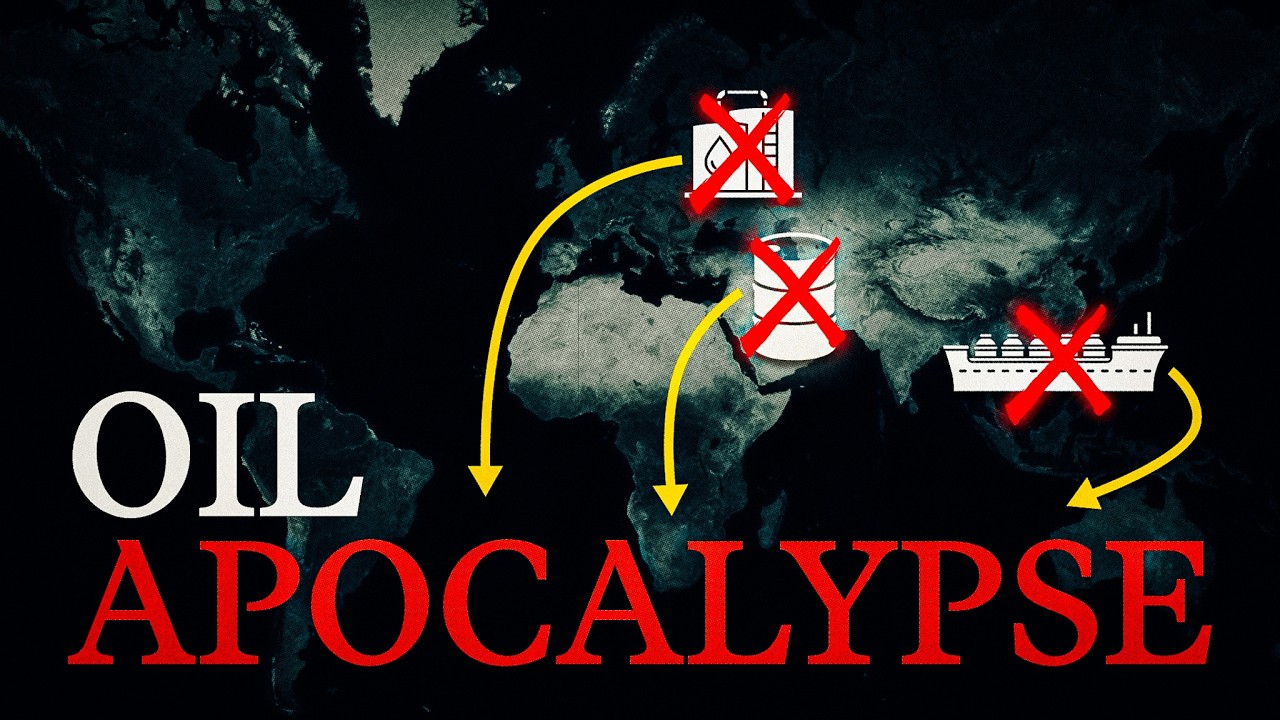
The worst consequence of the oil shock described here is not crude or gasoline but diesel, which the host says has risen from $85 to $210 a barrel as three crises converge: lost Middle East supply, a collapse in tanker capacity, and attacks on refineries. The host, named only as Max in a transcript caption, builds the case on a scenario that begins with a war on Iran in February 2026.
The tension is between a system that nearly absorbed the first blow and one that did not. Pipelines, stockpiles and Chinese import cuts held the shortfall to 5 million barrels a day until September, when Houthi and militia attacks removed the workarounds and China began buying again. Almost every figure comes from the host's own board, and he admits he cannot explain China's reversal.
Zero slack, bearable shortfall — ▶ 2:03
The host frames oil as one global market with about 100 million barrels produced and consumed daily and no slack, so any disruption reaches everyone. His tally: closing the Strait of Hormuz removed 20 million barrels a day. Pipelines around it added back 7 million, emergency stockpiles 2.5 million, and a 5.5 million cut in Chinese imports covered most of the rest. That left a 5 million barrel shortfall by September 1, which he calls painful but bearable, with higher power bills and cancelled flights but no collapse.
Workarounds recover two-thirds — ▶ 4:46
Three bypasses restored much of the lost flow. The UAE's 300-mile pipeline carries 1.5 million barrels a day. Saudi Arabia's East-West pipeline carries 5.5 million across 750 miles to the Red Sea. Ship-to-ship transfers add about 6.5 million: small vessels hug Oman's coast, harder to detect and a more tolerable risk for owners, loading tankers anchored in safe water. Together that is 13.5 million barrels, two-thirds of normal Hormuz volume, though the host says the transfer route depends on how good the Iranian Navy's eyesight is that day.
Houthis dismantle the bypass — ▶ 7:30
In September the Houthis, fighting Saudi Arabia in Yemen's 12-year civil war and allied with Iran, seized coastline including the Bab al-Mandab strait and closed it. Their rockets then knocked out Saudi Arabia's main refinery at the pipeline's endpoint, and Iran-backed Iraqi militias used drones to destroy three pumping stations. The East-West pipeline went offline, removing 5.5 million barrels a day. Regional exports fell from 20 million barrels a day before the war to 8 million. Each bypass had been a single point of failure.
China stops absorbing the shock — ▶ 11:46
Shanghai crude futures tracked WTI until September 1. After that China paid $135 a barrel against about $105 elsewhere. The host reads this as a buying spree: China now cuts imports by 2.5 million barrels a day instead of 5.5 million, lifting the global shortfall to 7 million. He does not know why, since Beijing is not saying, and guesses it expects something worse. The price gap is evidence of the buying. The stockpiling motive is his conjecture.
Cape route doubles freight costs — ▶ 15:11
With Bab al-Mandab closed, Suez is the only reliable exit for Gulf oil, leaving no direct route to Asia. Tankers must round the Cape of Good Hope: 48 days instead of 19. A ship completes a third to a quarter as many deliveries, which the host equates to losing two of every three tankers. Supertanker rates have gone from about $30,000 a day pre-war, and about $250,000 at the pandemic peak, to $1.2 million. Shipping rises from $3 to $26 a barrel, adding $23, which he says matches the Iran war's own price shock.
Diesel's inelastic demand — ▶ 20:29
Of roughly 100 million barrels a day, the host assigns 25 million to gasoline, 8 million to jet fuel, 37 million to other products and 30 million to diesel. Diesel runs trains, farm and construction equipment, ships, generators and above all trucks. Its weakness is inelastic demand: gasoline buyers can carpool or take trains, but a farmer cannot park a tractor mid-harvest. When supply tightens, diesel therefore produces outright shortages rather than just higher prices, and buyers who can find it pay whatever is asked.
Refinery wars remove 10% — ▶ 21:24
Three refinery conflicts have cut about 3 million barrels a day of diesel, 10% of the 30 million supply. Ukraine has hit 28 of Russia's 32 biggest refineries, halving Russian refining and removing about 1 million barrels. Iran and Gulf states trading refinery strikes removed 1.5 million. China cut diesel exports by about 500,000. The host rejects Trump's claim that Ukraine caused the global shortage: the strikes ran a year or two while supply was mostly fine. The Iran war tightened supply enough for them to matter.
Refiningless countries pay twice — ▶ 24:36
Countries without refineries pay shipping costs twice. The host's example is Australia: oil leaves the Gulf via the East-West pipeline, crosses Suez and the Atlantic, rounds Africa, passes India and the Strait of Malacca to reach South Korea's refineries, and the resulting diesel then travels south to Australia. At about $1 million a day per tanker, the cost compounds over each leg. He says Europe, much of Latin America and parts of Africa and Asia face the same double passage, which pushes up the price of refined fuel specifically.
Crack spread tripling diesel — ▶ 27:42
The crack spread, the gap between crude and refined fuel prices, measures the cost of turning crude into usable product. Diesel's spread was mostly below $20 a barrel and briefly hit $100 when Russia invaded Ukraine. The host says it is now $110 and rising, a record. A year ago, $65 crude plus a $20 spread gave diesel at $85. Today $100 crude plus $110 gives $210. He describes this as a 60% crude rise producing a 250% diesel rise, though the figures imply diesel now costs roughly 2.5 times as much.
Diesel cascades through the economy — ▶ 30:54
Trucking accounts for about half of global diesel use, so the host reasons that tripled diesel means tripled trucking costs, feeding into lumber, construction and housing. Transport is about 10% of food cost, so by his rough math groceries rise about 20%, possibly more given diesel-powered farm equipment. Airline fuel bills are up 40%, which he expects to reach ticket prices and push some carriers toward insolvency. Ocean freight costs three times as much. These are back-of-envelope estimates assuming full pass-through, not modeled forecasts.
Export ban would backfire — ▶ 33:55
The host says Trump is promoting a US diesel export ban, which he argues every energy economist, left, right or center, would say does worse than nothing: it would raise global prices and so, he says, US fuel prices too. No economist is cited in the transcript, so this is his assertion. He also attributes the crisis to the leaders who started the Iran war and calls them too embarrassed to stop. His practical advice is that stockpiling fuel probably does not matter, but people should not accept the prices as normal.
The headline number in this account of the oil shock is not the price of crude. It is the price of diesel, which the host says has risen from $85 a barrel a year ago to $210, while oil moved from $65 to $100. That gap is the argument. Extraction, shipping and refining have each been damaged, and the damage compounds at every handoff between them. By the time a barrel becomes fuel for a truck, a roughly 60% rise in crude, by the host's rounding, has become a diesel price about 2.5 times higher. Gasoline queues, he says, are a distraction from this.
The first stage is crude supply, and the host's tally shows how narrowly it was holding. The world produces and consumes about 100 million barrels a day with no slack, so any loss reaches every buyer. Closing the Strait of Hormuz removed 20 million barrels a day. Pipelines around the strait added back 7 million, emergency stockpiles 2.5 million, and a 5.5 million cut in Chinese imports covered most of the rest. The shortfall by September 1 was 5 million barrels a day. That was painful, with higher power bills and cancelled flights, but in his words "It's bearable."
What made the shortfall bearable was a handful of workarounds, and each turned out to be a single point of failure. The UAE's 300-mile pipeline carries 1.5 million barrels a day. Saudi Arabia's East-West pipeline carries 5.5 million. Ship-to-ship transfers, in which small vessels slip along Oman's coast to load tankers anchored in safe water, add about 6.5 million. Together they recovered 13.5 million of the 20 million barrels, two-thirds. Then the Houthis took Yemeni coastline including the Bab al-Mandab strait, rockets hit the Saudi refinery at the pipeline's end, and Iran-backed militias in Iraq used drones to destroy three pumping stations. Regional exports fell to 8 million barrels a day.
China complicates the picture, because it was the system's shock absorber and then stopped being one. The host shows Shanghai crude futures tracking WTI until September 1, after which China pays $135 a barrel against about $105 elsewhere. He reads the gap as a buying spree: China now cuts imports by 2.5 million barrels a day instead of 5.5 million, lifting the global shortfall to 7 million. China also trimmed diesel exports by about 500,000 barrels a day. Why? The host's answer is "we don't know, they're not saying", and his guess is that Beijing is stockpiling ahead of something worse. The price gap is evidence of the behavior. The motive is conjecture.
The second stage, shipping, doubles the damage through simple arithmetic. With Bab al-Mandab closed, the only reliable exit for Gulf oil is the Suez Canal, which serves Europe but leaves no direct path to Asia, the largest consuming region. Tankers must round the Cape of Good Hope, a 48-day trip rather than 19. Because a ship now completes a third to a quarter as many deliveries, the host says, it is as though two of every three tankers had vanished. Supertanker rates have gone from about $30,000 a day before the war, and about $250,000 at the pandemic peak, to $1.2 million. Shipping now costs $26 a barrel instead of $3, adding $23, which he equates to the war's own price shock.
Refining is where these shocks meet a product that cannot adjust. Of the 100 million barrels, the host assigns 25 million to gasoline, 8 million to jet fuel, 37 million to plastics, asphalt and other products, and 30 million to diesel, which moves trains, tractors, construction equipment, ships and above all trucks. Diesel's strength is energy density. Its weakness is inelastic demand. When gasoline gets expensive, drivers carpool or take trains and the market clears. A farmer cannot park a tractor mid-harvest. So when supply tightens, diesel produces actual shortages and not merely higher prices, and buyers who can find it pay whatever is asked.
Three separate refinery conflicts have removed about 3 million barrels a day of diesel, or 10% of supply. Ukraine has hit 28 of Russia's 32 biggest refineries, halving a core Russian industry and removing roughly 1 million barrels. Attacks between Iran and Gulf states took out 1.5 million. China's export cut accounts for about 500,000. The host uses this to rebut Trump's claim that Ukraine caused the global shortage: the strikes have run for a year or two while supplies stayed mostly fine. The Iran war made supply tight enough that the same strikes now matter. The more general lesson, an editorial inference, is that in a system with no slack, old disruptions become new crises.
The crack spread, the gap between crude and the price of a refined fuel, captures the combined effect. Diesel's spread was mostly below $20 a barrel for a long time and touched $100 briefly when Russia invaded Ukraine. The host says it is now $110 and rising, a record. Add it to $100 crude and diesel costs $210, against $85 a year ago. Geography adds a further penalty. Australia has no refineries, so in his example oil travels from the Gulf via Suez and the Atlantic to South Korea, is refined there, and then ships down to Australia, paying tanker rates of about $1 million a day on each leg. Europe, much of Latin America, Africa and Asia face the same double passage.
Downstream effects follow from diesel's role in physical commerce. Trucking uses about half of global diesel, so the host reasons that tripled diesel means tripled trucking costs, and that construction materials, equipment and housing follow. For food, transport is about 10% of cost, so a tripling implies roughly 20% higher grocery prices, with farm equipment pushing it higher. Airlines face a 40% rise in fuel bills, which he expects to reach ticket prices, with some carriers near insolvency. Ocean freight costs three times as much. Treat these as back-of-envelope: the host calls his food figure "rough math," and it assumes full pass-through of a price increase that, by his own earlier numbers, is closer to 2.5 times than 3 times.
The host closes with policy and advice. Trump has floated a diesel export ban, which the host says every energy economist, left, right or center, would call worse than useless, because it would raise global prices and, through them, US fuel prices. No economist is named or quoted in the transcript, so this is his assertion. His framing is also openly political: he attributes the crisis to Netanyahu and Trump and says the leaders who started it are too embarrassed to stop. That is a position, not a finding, and it sits apart from the supply arithmetic. His practical advice is modest: stockpiling fuel probably does not matter, but people should not accept these prices as normal.
The unresolved matter is duration. The account describes a system that was nearly balanced by bypass infrastructure, which has since been broken piece by piece, and the host offers no timeline for repairing the East-West pumping stations or reopening Bab al-Mandab. Every figure comes from his own board, with no sources shown in the transcript, and several are rounded. If the structure of the argument is right, the decisive variables are the ones he cannot observe: how fast Saudi capacity returns, whether the Houthis hold the strait, and what China expects. Beijing's behavior is the only signal he has, and he reads it as an alarm. It may be one. It may equally be insurance.
The open question. How long can the shortfall last? The account describes a market that was nearly balanced by bypass infrastructure, then broken piece by piece, yet it offers no timeline for repairing the East-West pumping stations or reopening Bab al-Mandab. China, the actor with the best view of supply, has changed behavior without explanation. Whether it is hoarding against something worse or simply hedging determines how severe the diesel crunch becomes.
Watch the full video at https://www.youtube.com/watch?v=OETnuwwsv9U.
Comments ()