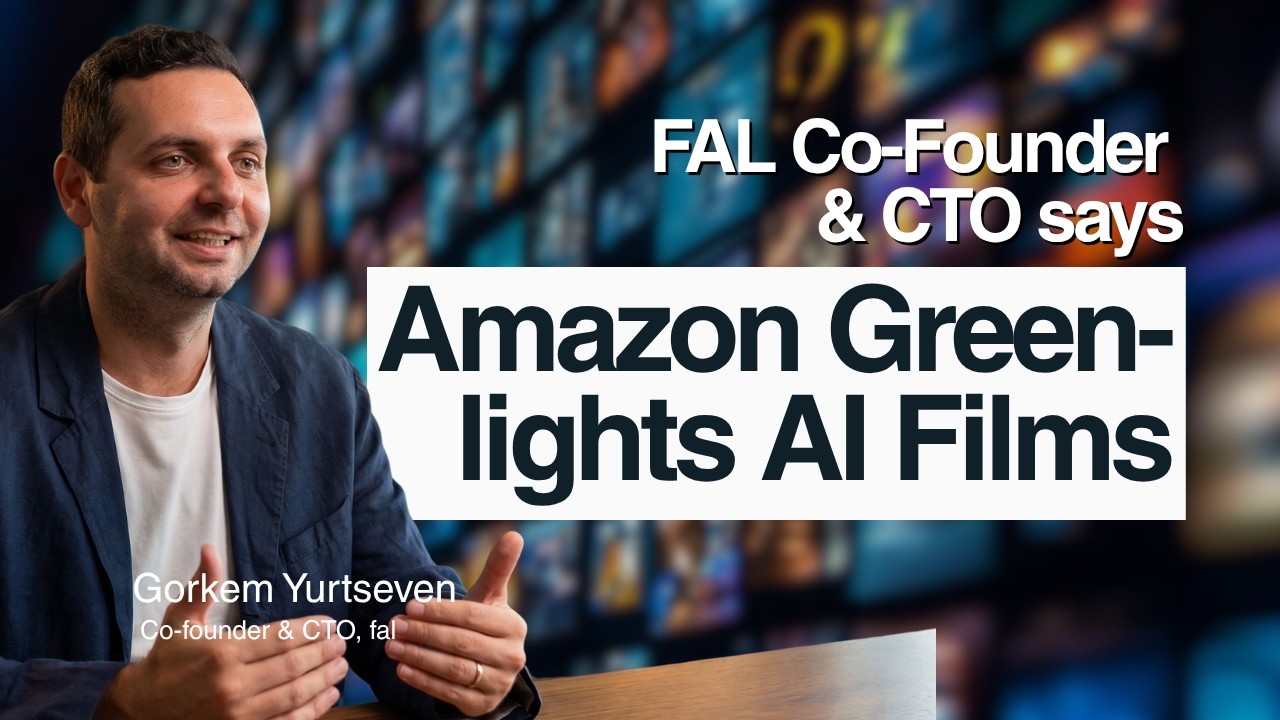
Recorded 25 September 2026 · 21 min
Sophia interviews Gorkin Yorks, CTO and co-founder of FAL, at the Generative Media Conference in San Francisco. His central claim is that generative media has reached what he calls "token market fit": a single professional can now productively spend large numbers of tokens in a working day, something he says only coding agents and video generation can do.
The tension lies in what has and has not changed. Better models, studio greenlights and falling costs have moved video from novelty clips toward professional pipelines. Yet Yorks concedes that controllability remains hard, that video is largely paywalled, and that no ChatGPT-style mass moment has arrived. His account of who benefits, whether small studios, incumbents or existing creators, rests more on assertion and anecdote than on measurement.
Token market fit — ▶ 2:18
Yorks defines token market fit as whether a single person can productively spend a lot of tokens doing their work. He says only coding agents and video generation meet that bar, because people now sit at a computer at work generating video all day. The mechanism is economic: it is still much cheaper than the alternative, and it creates a new medium that lets people do things they could not do before. Each incremental token then either finishes work or yields an economic benefit. This is Yorks's framing, offered without usage or cost figures.
Controllability beats slot machines — ▶ 3:23
Yorks calls controllability the hardest problem since the beginning: users do not want to treat models as slot machines. Giving them control complicates interaction, because prompts become long and acquire their own syntax, "almost like an API", while inputs grow more complex. A low-resolution Blender input is now commonly part of the prompt. FAL released an agent the same day, described as a creative harness meant to make working with video models easier. The product name is garbled in the transcript, so its details cannot be confirmed here.
Why professionals arrived now — ▶ 5:28
Yorks cites two shifts. First, the audience changed: Hollywood hesitated partly over legal problems it now handles better, and professional filmmakers bring budgets, skills and storytelling ideas. Second, models improved. This summer's releases added reference inputs, which increase controllability, and higher resolution, which he says matters in professional settings. He credits Amazon as the first studio to publicly greenlight several AI-only or AI-assisted projects at once, with others following. None of these shifts is quantified, and the Amazon characterization is his own.
Challengers bet on technology first — ▶ 9:23
Yorks argues large studios, with many stakeholders to align, rarely pioneer change. Smaller companies bet on technology instead: Pixar and DreamWorks on computer graphics, Netflix on streaming, where technology differentiated first and content came later. He expects IP to stay powerful and Disney to benefit, but sees openings for smaller studios. His evidence is anecdotal: new studios founded by veterans of big animation firms, including one started by former Disney Studios president Sean Bailey, and at least 10 he knows of that were recently funded. His investment thesis is pairing experienced storytellers with top technologists.
No ChatGPT moment yet — ▶ 13:18
Yorks does not think generative video has had its ChatGPT moment. ChatGPT was mostly free and open to anyone with a browser, whereas video generation remains expensive and almost every product sits behind a paywall. Sora came closest because it was more freely available, and many people tried video models for the first time through it. Since its release, he says, costs have fallen by perhaps a factor of 10, which may make it a good time to launch another social company built on video generation. Price, rather than capability, appears to be the gate on mass adoption.
Pipelines, not footage edits — ▶ 14:40
Asked about workflows built on existing footage, Yorks concedes a disconnect: combining realistic footage with AI edits still works poorly, and content almost needs to be animation or another type for edits to hold up. Hollywood's actual pattern, he says, is to treat the models as one piece of a pipeline, much as it uses VFX technology or a gaming engine. He frames adoption as a gradient rather than a binary of using AI or not, noting that some AI already sat inside VFX pipelines before generative tools.
Timeless film, limited ceiling — ▶ 15:40
Yorks's near-term milestone is a short or feature film, with AI as part of the toolkit, that does not look outdated six months to a year later. He calls this the biggest current problem, since impressive work looks dated within three months, and thinks a timeless film is about a year away. He also sets a ceiling: AI will not write mold-breaking stories like Memento, Seven or Good Will Hunting, though variations on existing stories will be easier. He answers "100%" when asked whether AI enhances rather than replaces creators. These are predictions, not findings.
Gorkin Yorks's central claim is that generative media has crossed a threshold he calls token market fit. The test is simple: can a single person productively spend a lot of tokens doing their work? Yorks says only coding agents and video generation pass it, because professionals now sit at a computer all day generating video. That is a different bar from the usual measures of AI traction. It does not ask whether a model is impressive or whether users sign up. It asks whether the marginal unit of consumption keeps paying for itself, so that heavy usage signals value rather than a cost to be contained.
The mechanism is economic. According to Yorks, spending on video generation is productive because it remains much cheaper than the alternative and because it creates a new medium, letting people do things they could not do before. Once that is true, each additional token either finishes a piece of work or yields an economic benefit on the other side, so usage compounds. Host Sophia makes the contrast explicit: a year or more ago, producing a short clip cost an arm and a leg and the result was poor. The argument is persuasive as logic. As evidence it is thin. Yorks offers no figures on how many tokens a professional consumes, what they cost, or what they replace.
Two changes, in his account, moved video generation across that line. The first is who has access. Hollywood was hesitant, partly because of legal problems it is now better at handling, and the professional filmmaking community brings budgets, skills and storytelling ideas. He credits Amazon with publicly greenlighting several AI-only or AI-assisted projects at once, with others following. The second is the models themselves. Releases this summer added reference inputs, which improve controllability, and higher resolution, which matters in professional settings. Neither change is quantified in the conversation, and the Amazon claim is Yorks's characterization rather than something the discussion verified.
Controllability is where the argument meets its hardest test. Yorks says people do not want to treat models as slot machines, but giving them control makes interaction harder. Prompts grow long and acquire their own syntax, becoming almost like an API, and inputs such as low-resolution Blender scenes become part of the prompt. FAL released an agent the same day, described as a creative harness, to ease this. There is a tension worth noting, offered here as editorial inference rather than Yorks's claim. If outputs are hard to steer, some token consumption may reflect repeated attempts rather than finished work. Token market fit, as defined, cannot distinguish between the two, and Yorks does not address the difference.
Yorks's view of industry structure follows from history. Large studios have many stakeholders who must work together, which makes them unlikely pioneers. Smaller companies have bet on technology instead: Pixar and DreamWorks on computer graphics, Netflix on streaming, which at first differentiated on technology with content coming later. He expects the same pattern now. IP remains powerful and Disney and the big studios will benefit, but smaller studios can take risks and differentiate. His evidence is anecdotal: new studios founded by veterans of large animation firms, Sean Bailey's among them, and at least 10 that he knows of recently funded by Silicon Valley. The investment thesis, in his telling, is to pair storytellers with the best technologists, a job he says venture capitalists do well.
Consumer reach is a separate question. Yorks does not think generative media has had its ChatGPT moment. ChatGPT was mostly free and open to anyone with a browser, whereas almost every video product sits behind a paywall because generation is still expensive. Sora came closest, being more freely available. Since its release, he says, costs have fallen by perhaps a factor of 10, which may make this a good time for another social company built on video generation. The implication is that price, not capability, gates mass adoption, and that professional use has run ahead of consumer use. Workflow is a second constraint. Combining realistic footage with AI edits remains disconnected, so Hollywood uses the models as a pipeline component, much as it uses VFX or game engines.
Yorks's near-term milestone is a timeless film. He wants a short or feature, with AI as part of the toolkit rather than generating everything, that still looks good six months to a year later, and he thinks that is a year away. The current problem is that impressive work looks outdated within three months. He is equally clear about the ceiling: AI, he says, will not make a film like Memento, Seven or Good Will Hunting, whose storytelling breaks the mold, though variations on existing stories will be easier. Asked whether AI enhances creators rather than replaces them, he answers "100%". That is a prediction, not a finding. The unresolved issue is whether token market fit, an input measure, ever translates into the output that would settle the matter: work that outlasts the model that made it.
The open question. Yorks defines token market fit but offers no measurements: how many tokens a professional actually spends, what that costs against traditional methods, or how much of it goes to finished work rather than repeated attempts at steering an uncontrollable model. If heavy spending can reflect either value or retries, usage alone cannot confirm the thesis. The test he proposes himself is a film made with AI that still holds up a year later, and that outcome is yet to be observed.
Watch the full video at https://www.youtube.com/watch?v=DOo7GcUyKeE.
Comments ()