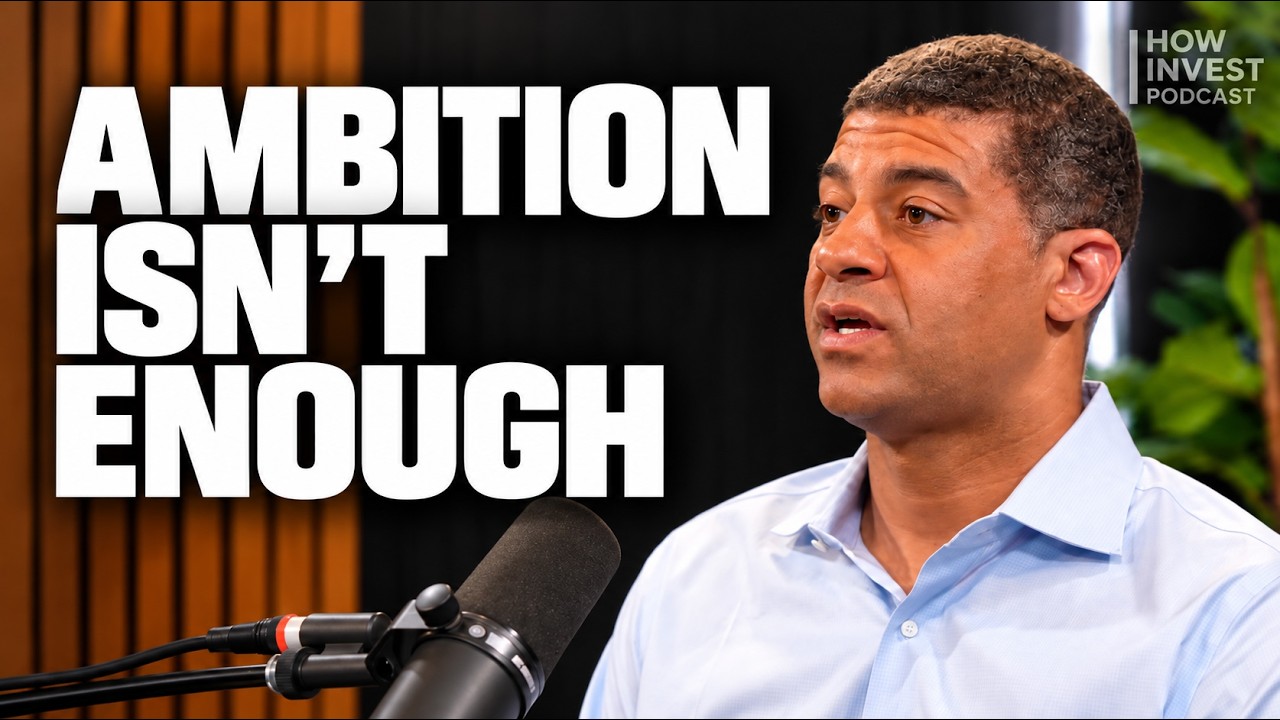
Recorded 30 September 2026 · 67 min
Nnamdi Okike, founder of 645 Ventures, argues that early-stage investing is a science rather than an instinct, but a science whose most predictive variables cannot be pulled from a database. Data can surface founders. Judging their motivation, their capacity to evolve, and the market change events that give a startup momentum still requires long conversations that are afterwards structured and quantified.
The tension runs through his exchange with the podcast host. Okike's firm began by copying Insight Partners' traction-driven sourcing, then found at seed that founder qualities mattered more than early metrics. He cites a capital loss ratio of roughly 4-5% as evidence the method reduces failure, yet concedes the harder question is whether it finds outliers, in a market where expected outcomes and round sizes keep inflating.
Data-led outbound sourcing — ▶ 0:51
Insight Partners, founded in the mid-1990s, was among the first firms to source outbound, using metrics such as customer adoption speed, average contract value and revenue growth to decide where to look. Okike's first job was phoning 15-20 founders a day. The payoff was off-the-path deals like ExactTarget: an Indianapolis, bootstrapped company with roughly $5 million of revenue heading toward $10 million, which never raised venture before Insight invested and Salesforce acquired it for almost $2 billion. 645 set out to apply that model earlier, to companies with a couple hundred thousand dollars of revenue.
Founder qualities beat traction — ▶ 3:42
645 first copied Insight's traction focus, tracking mobile app downloads and web traffic growth. Over time it learned that founder and team qualities mattered more: prior companies and their outcomes, previous work experience, and what Okike calls purity motivation, the missionary-versus-mercenary distinction. Missionaries, he argues, stick through slow or failing markets, and giving up is one of tech's biggest failure modes at every talent level. He favors non-central-casting founders, such as Scott Dorsey of ExactTarget in a smaller city, over the Stanford AI founder or the well-known repeat founder, whose obscurity and conviction let insights compound.
Quantifying what data misses — ▶ 9:19
645's analytics flag candidate founders by prior employers, experiences, skills and titles. Traits that matter most, such as handling adversity, insight into market evolution and the ability to pivot while keeping conviction, only emerge in conversation. Okike says four or five conversations give a reasonable sense of tendencies, and the team then tries to quantify these judgments rather than treat them as purely subjective. Follow-on decisions after about 2 years benefit from working alongside founders. He says the method yields fewer founders giving up, but whether it improves the ability to find outliers is, in his words, the biggest question.
Inflections as potential energy — ▶ 13:52
Borrowing from Mike Maples's book Pattern Breakers, Okike treats an inflection, a technological, regulatory, behavioral or societal change event, as the wave that gives a resourceless, brandless startup a reason for customers to switch from incumbents. Maples's surfing analogy: the best surfer cannot perform on a beach with tiny waves. 645 assesses the inflection's depth, how long it takes to manifest, how hard it is to capitalize on, and whether the founder understands it more deeply than others. That sets the startup's potential energy, before business-model sustainability is tested.
Squire and evolving models — ▶ 17:39
Okike names two failure modes: VCs assuming they represent the mass market, and assuming today's business model is permanent. At seed, 645 judged Squire, software for barber shops charging a small per-booking fee with no SaaS, as a TAM problem and passed. At Series A it had added a SaaS product and moved into barber-shop supply chain and sourcing, with contract values rising. Okike's lesson is that the founders' ability to evolve outweighed the early model. At seed he now defers to founders' insight, asking how pricing and products change, to avoid screening out companies unnecessarily.
The taller mountain — ▶ 25:48
Okike matches founder temperament to industry difficulty: the tougher and more cutthroat the market, the more personality a founder needs. He points to Travis Kalanick winning the US market for Uber, while conceding negative traits often come with such qualities. His own example is Snahal Fuzelli of Uptick, who sold Cloud Lending to Q2 for over $100 million, came from India's untouchable caste, and was the first in his family to go to school. Okike rejects childhood trauma as a requirement; chip-on-shoulder competitiveness, such as that built in athletics, can produce comparable drive.
Power law keeps escalating — ▶ 30:38
Okike observes that when he entered venture a $1 billion exit was great, whereas now trillion-dollar outcomes are discussed. He predicts, as a forecast, that Anthropic could reach that within roughly 7-8 years. Larger funds push toward ever larger outcomes, which he sees as having pros and cons: huge capital goes into companies, and a first-time founder's probability of building a $10 billion company is, he says, a fraction of a fraction, leaving collateral damage among those who raise heavily and fall short. He and the host nonetheless defend the drive for scale as capitalism's engine.
Stablecoins and programmable money — ▶ 33:57
Okike separates crypto's speculative first wave, which he dismisses as lacking intrinsic value and cash flows, from a second wave solving concrete problems. Stablecoins cut cross-border costs, which he says reached 5-10% plus delays via Western Union for his father's transfers to Nigeria, and let people hold dollar-backed value amid currency devaluation. Citing Circle founder Jeremy Allaire, he argues agentic commerce requires programmable money, which makes digital currency its substrate. 645 backs Sponge, ex-Stripe founders building agent wallets, and Uptick, which targets the entrenched core banking technology oligopoly. Its 2018-2021 crypto pitches were mostly passed on.
Pace, harvest and cycles — ▶ 46:53
In 2021, despite deploying gradually, 645 did Series A deals it would not repeat, and Okike sees elements of peak activity now in valuations, round sizes and growth-stage revenue multiples. Against the host's argument that early top-calling can be costly, he says funds are long games of 15-20 years where pace, ownership discipline, follow-ons and selling matter. In fund one, selling half a position returned about 35% of the fund; the company later sold for a fraction of that price, and selling all would have returned close to 70%. He calls the AI strategy of deploying everything in 1-2 years unwise.
Scarcity over giant seeds — ▶ 59:04
Okike says he would rather see large rounds at growth than at seed. Without product-market fit, a founder with plenty of money runs too many experiments, and a culture forms around salaries rather than mission. The host adds that hires then sit between founder and customer. Capital should reflect the business: True Anomaly must build satellites, so a hard floor exists in defense and deep tech. He mocks YC founders raising at similar prices and sizes despite differing needs, from an African fintech to a nuclear reactor builder. He prefers small rounds that create urgency before the next milestone.
Networks have a shelf life — ▶ 1:03:50
Okike's advice to his younger self is to assess one's real superpowers at each career stage. Mid-career he has wisdom and knowledge of failure modes, while his youngest investors better understand what younger people actually use. He argues investors overestimate their access to exceptional founders and that network quality erodes with age, so 645 insources young hires to refresh it. Understanding how rare power-law companies are, and whether one is moving closer or further from them, matters. High achievers also struggle with VC's frequent failure, which he calls a psychological challenge to adapt to while still chasing dramatic success.
Nnamdi Okike's claim that venture capital is "science at the end of the day" is easy to misread as a claim about spreadsheets. It is closer to a claim about decomposition. Good judgment, in his account, is the accumulated residue of experience, and that residue can be examined if you break "good founder" into its drivers rather than accept a verdict like great or not great. He is careful about the limits: the discipline is "not purely a ones and zeros game." What the founder of 645 Ventures describes is a division of labor between data, which finds candidates, and structured human judgment, which evaluates them.
The origins of that division sit at Insight Partners, where Okike began his career phoning 15-20 founders a day to ask about employees, revenue and growth. Outbound sourcing made the search wider than any referral network could. The showpiece is ExactTarget, a bootstrapped Indianapolis email-marketing company with roughly $5 million of revenue that no venture investor was watching, later acquired by Salesforce for almost $2 billion. Data's job was to find it. When 645 transplanted the model to seed, with app downloads and web traffic as proxies, it learned that traction was the wrong thing to measure that early.
What replaced traction was motivation. Okike sorts founders by what he calls purity motivation, and prefers missionaries to mercenaries, because a missionary is likelier to keep going when the market is slow or hostile. Giving up, he says, is one of the biggest failure modes in tech, and it afflicts talented and average founders alike. This preference fits his taste for founders who are not central casting: people in unfashionable markets, with conviction that compounds from experience. His example is Snahal Fuzelli of Uptick, whose upbringing in India's untouchable caste, Okike says, will drive him for life. The explanation is persuasive but experiential, and it is not presented with outcome data.
How do you quantify something that surfaces only in conversation? Okike's answer is staged. Analytics flag founders by past employers, experiences, skills and titles. Then come repeated conversations: after four or five, he says, you have a reasonable sense of what a founder will and will not do, including how they handle adversity and whether deep conviction coexists with a willingness to pivot. Follow-on decisions after about 2 years draw on actual work together. The editorial reading is that quantification here means structuring judgments, not measuring facts. The discipline is in forcing the same questions to be asked of every founder.
The second variable is external. Following Mike Maples, Okike looks for inflections, technological, regulatory, behavioral or societal changes that give a resource-poor startup a reason to be bought over an incumbent. Founder skill without a wave, in the surfing analogy, goes nowhere. Squire shows how the two variables interact with business models. 645 passed at seed because the per-booking model made the barber-shop market look too small. At Series A the founders had added SaaS and supply-chain products and contract values were rising. The lesson, that founders' ability to evolve can outrun an early TAM calculation, is a notable concession from a data-led investor, and it is why he now defers to founders' insight at seed.
Founder temperament is then matched to terrain. "The taller the mountain," Okike says, the more a founder needs gumption, and he cites Uber's win over the US market as traceable partly to Travis Kalanick's character, with the caveat that such traits can come with negative ones. The host pushed the logic further, toward spiky, overconfident founders in binary, high-beta bets, and Okike agreed with the direction while stressing that he looks under the hood for what drives a founder, not at the surface. Both treat ambition as nearly universal and willingness to endure as rare. The power law raises the stakes: Okike notes that a $1 billion exit once counted as great, while trillion-dollar outcomes are now discussed, and he warns of collateral damage when funds push companies toward outcomes they will not reach.
The fintech portfolio applies the same lens. Stablecoins matter, he argues, because they attack toll gates in payments, citing 5-10% Western Union fees plus delays and the protection holding dollar-backed balances gives against currency devaluation. He reads agentic commerce as dependent on programmable money, and backs infrastructure such as Sponge's agent payments. His crypto skepticism is explicit: as a value investor, he sees no intrinsic value in a store-of-value asset, and 645 largely passed on 2018-2021 pitches. The investment decisions follow from a consistent test, namely whether there is a concrete problem and a change event that lets a newcomer win.
The same reasoning extends to running a fund. Okike's 2021 admission, that disciplined pacing still produced Series A deals he would not repeat, anchors his view that investors must know where they are in the cycle. The host objected that top-calling can be expensive and that vintage diversification does the work. Okike's reply is that no one can sit out for 5 years, but a fund lasting 15-20 years offers real levers: pace, ownership discipline, follow-ons and sales. His sale of half a position in fund one, which returned about 35% of the fund while selling all would have returned close to 70%, cuts both ways: it shows harvesting matters, and that he was only half right.
His view of capital intensity is consistent with that discipline. Seed rounds as large as $50 million, he argues, invite superfluous experiments and a hiring-driven culture, and he prefers scarcity while product-market fit is still being sought. He grants exceptions where the product demands capital, as in True Anomaly's satellites, and mocks uniform YC pricing across unrelated businesses. The pattern across the conversation is matching: founder to mountain, capital to business, pace to cycle. It is a coherent philosophy, though its evidence is mostly illustrative rather than statistical.
That is where the argument is weakest. Okike's strongest evidence is a capital loss ratio of roughly 4-5% and a lower rate of founders quitting, and he says patience means "slow and precise versus fast and lucky," with fewer deals and more passes. Yet he also says the real test is whether the approach improves the ability to find outliers, and he admits other styles, including impatient high-volume ones, can do well. A method that reliably reduces losses may still miss the rare, disagreeable founder whose company defines a fund. The transcript leaves that trade-off unmeasured.
The open question. Okike's method appears to lower the rate at which founders quit, and he reports a capital loss ratio of roughly 4-5%. But venture returns depend on rare outliers, and he describes those founders as sometimes disagreeable, non-consensus and flawed. Does screening for persistence, patience and fewer deals improve the odds of finding the one company that returns a fund, or does it mainly cut losses? Okike names this as the biggest unanswered question, and the transcript offers no outlier evidence.
Watch the full video at https://www.youtube.com/watch?v=VenqKz8-ZKg.
Comments ()