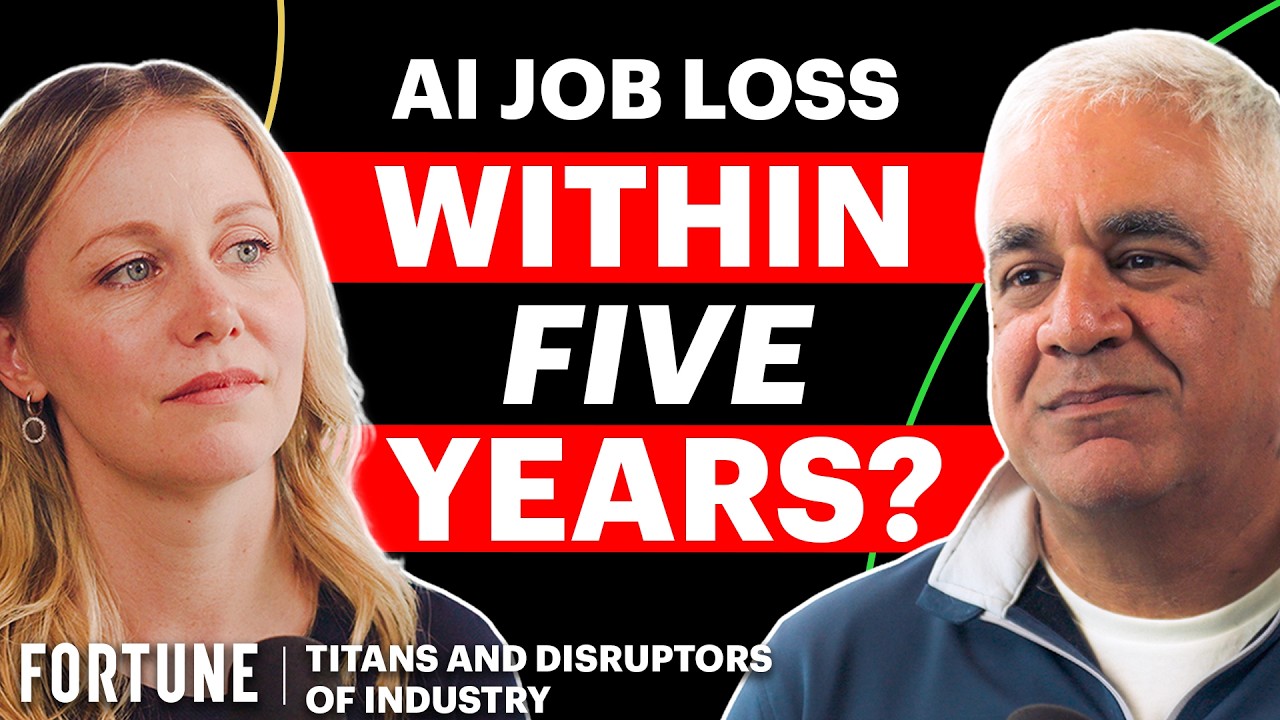
Recorded 14 October 2026 · 40 min
Aneel Bhusri, Workday co-founder and CEO again since February 10 after two years as executive chair, argues that AI is a probabilistic reasoning engine that cannot replace deterministic systems of record such as payroll. The winning products, he says, combine both. He is equally blunt that the same technology is already replacing labor, with significant displacement likely within five years.
The tension is that Workday sells to HR and finance departments, so it sits on both sides of the labor question. It is a Fortune 500 company with about $10 billion in revenue and 21,000 employees, and it is building agents that substitute for human work. Bhusri's reassurances about moats, jobs, and pricing deserve scrutiny against that position.
Agents are role-based technology — ▶ 4:04
Bhusri frames agents as role-based: one can look at a specific job and judge whether an agent does it as well as a human. Rote, repeatable work requiring little judgment is already being replaced "across the board," in his view, and he calls this both exciting and a little scary. He is optimistic that humans and agents will coexist in a mutually beneficial way, but concedes that outcome is "still to be determined." The best talent, he suggests, will be people who master AI tools, as Workday's best coders have.
Clean-sheet thinking for incumbents — ▶ 4:40
Bhusri observes that startups design their business models around AI, while large companies try to fit AI into existing ones. He does not expect Fortune 500 clients to change drastically or overnight, because brands and products persist. But each must still ask how it would look if it were a startup with a clean sheet of paper. Workday is applying that test to itself, treating AI as a native technology rather than a feature added onto the product already built.
Why AI forces a refounding — ▶ 7:23
Bhusri says he returned because AI makes "all bets are off." It is a reasoning engine doing probabilistic work, unlike the deterministic business-process platforms of the cloud era. AI applications also iterate almost daily, whereas a business application might change every six months, and models seem to change weekly. He cites Microsoft, Google, and Apple as companies that outlasted a single technology generation, and wants Workday to join them. He describes himself as a product-and-vision person, with a younger partner running products.
Jobs-style focus: 50 agents to 20 — ▶ 10:40
After studying Steve Jobs's return to Apple, Bhusri cut the agents under development from 50 to 20, judging each by what matters to the customer. Some lacked impact; others became features of other agents. He also found multiple owners of AI on the agent, API, and platform sides, and replaced them with one owner each for agents, the AI platform, and tools. The company now has three priorities: build the AI future with customers, get close to customers, and live its values.
Probabilistic models, deterministic processes — ▶ 15:06
Responding to the February selloff in SaaS stocks, Bhusri says AI predicts the next token, while payroll, HR, and finance processes must be right every time. An audit cannot be partly correct, and an error rate that shifts between two payroll runs is unworkable. The value lies in combining the technologies. He concedes that content-generation and workflow-orchestration vendors without a system of record may be more exposed. His evidence is that Google, Anthropic, and OpenAI run Workday, and that no customer in seven months has considered replacing it with something vibe-coded.
Displacement within five years — ▶ 18:08
Bhusri puts job displacement within the next five years and names examples from Workday's own products. A financial audit agent will replace junior auditors' work, and a contract intelligence agent replaces the work of at least a subset of lawyers. The first wave is low-level process automation that cloud never completed, such as step-by-step payroll. The logic is stated plainly: agents can do it more cheaply, companies will want that, and he is worried. He supports retraining through Raise U.S., warning of social issues without a plan.
Flat organizations, agent employees — ▶ 20:55
Internally, Workday is flattening because agents can handle much low-level management work, which Bhusri thinks benefits individual contributors with clearer decision lines. Commercially, Workday has merged its HR system of record with an agent system of record. Longer term, he says, an agent will be managed like an employee: assigned work, credentialed for security, limited to specific business processes, and added or removed from the workforce. Without these guardrails, he warns, rogue agents become a risk. He argues humans should manage agents, and doers will be fine.
Self-reported ROI, thin baselines — ▶ 24:17
Bhusri insists agent ROI must be real rather than soft. He reports better than 50% ROI on recruiting agents, and millions of dollars saved by procurement contract review that would take humans a year. The self-service agent, built on Sana's technology, deflects 25-30% of HR cases, and he expects 80-90% as it improves. A deployment agent should shrink the typical one-year implementation and its consultant bills. These are the CEO's figures, offered without baselines, and the 80-90% is an expectation, not a result.
Zero-copy data boundaries — ▶ 27:22
Asked about the risk of handing IP to model providers, Bhusri says Workday treats customer data as the customer's. Data does not leave Workday, in an approach he calls zero copy, and the AI companies have worked with Workday on it. Workday aggregates data to train models only where information is not company-specific, such as career paths or sector-wide wage data. He calls keeping IP from seeping out "the future of AI." The transcript offers no detail on how this is audited or enforced.
Finance as the bigger prize — ▶ 30:26
Bhusri sees finance as more interesting than HR. CFOs have long pursued lights-out finance, which cloud's process automation only partly delivered. Audit and test-suite agents could automate heavy audit work and control testing, allowing continuous closing of the books. Companies pay third parties for audits, and he expects them to spend less over time by bringing that work in-house. Finance departments will remain, he says, staffed by people driving the agents. He calls it almost a renaissance for finance.
Seats for humans, consumption for agents — ▶ 33:28
Workday will run a hybrid model: seat-based pricing tied to employee counts for HR, and consumption pricing for agent workloads, following AWS, Google Cloud, and Azure over the past decade. Bhusri says seats will never disappear for human employees, but the portion of work shifting to agents will move to consumption. This answers the interviewer's concern that per-seat revenue weakens if companies employ fewer people. He cites the cloud providers' consumption model as proof it works, but gives no figures on how the two will balance.
Aneel Bhusri's central argument rests on a distinction between two kinds of computing. Large language models, as he describes them, predict the next token: they are probabilistic, 90% likely to produce the right continuation. Workday's payroll, HR, and finance processes are deterministic. A payroll run starts and ends, and it cannot be mostly correct, least of all if the error rate changes between two runs. An audit cannot be partially right either. From this he concludes that the real value lies in combining the two technologies, with AI reasoning layered over systems of record that must be exact.
The argument matters because of what happened in February, when Workday and its competitors fell in what the interviewer called the SaaS apocalypse. Bhusri's response is that the market treated coding tools from OpenAI, Anthropic, and Cursor as a threat to incumbents, forgetting that incumbents use them too. He says roughly half of Workday's development is now driven by those tools. He also claims Google, Anthropic, and OpenAI all run Workday, and that in seven months he has met no customer planning to replace it with something vibe-coded. That is anecdotal, but it is consistent with his narrower concession: vendors built around content generation or workflow orchestration, rather than a system of record, may be more exposed.
Bhusri does not treat the moat as a reason to stand still. He calls the moment a refounding because AI applications are iterative and change almost daily, where a business application might change every six months. His observation that startups design business models around AI while incumbents bolt it on frames the discipline he is trying to impose. Using Steve Jobs's return to Apple as a template, he cut agents under development from 50 to 20, judged by customer value, and replaced overlapping ownership of agents, platform, and tools with a single owner of each. The lesson is that an incumbent's defense is partly organizational.
The product evidence he offers is mixed in quality. Recruiting agents deliver better than 50% ROI, he says. A procurement contract agent found overspending that would have taken humans a year to uncover. The self-service agent now deflects 25-30% of HR cases, with 80-90% expected as it improves. A deployment agent should shrink the one-year, consultant-heavy implementation. These are the CEO's own figures, presented without baselines or customer names, and the 80-90% is a forecast. Still, his insistence that each agent carry a specific ROI, and that those without it be dropped, is the more informative signal than any single number.
The same logic produces his candor about labor. Bhusri places significant displacement within five years and points to his own products. A financial audit agent replaces the work of junior auditors, and a contract intelligence agent replaces the work of at least a subset of lawyers. His reasoning is economic and unsentimental: an agent can do rote work at lower cost, companies will want that, and he worries about the consequences. Without a plan to retrain displaced workers, he warns, there will be social issues. Workday joined Raise U.S. as an early investor and runs its own programs, though the transcript gives no detail on outcomes.
His reassurance about who is safe sits uneasily with those examples. He says doers, the individual contributors doing front-line work, will be fine, and that the pain is a short in-between period like the industrial revolution but faster. Yet junior auditors are doers, and the first wave of automation targets exactly the repeatable work where junior employees start. That is editorial inference rather than Bhusri's statement, but it is a gap his framing does not resolve. His closing advice to workers is practical: embrace the tools, become expert in them, and use AI to learn quickly.
The organizational consequences he describes are more concrete. Workday is flattening, since agents can absorb much low-level management work. For customers, Workday has merged its HR system of record with an agent system of record, on the premise that agents will be managed like employees, with defined work, credentials, and permitted processes. Humans should manage agents, he says. The strategic implication, again our inference, is that the HR record becomes the control layer for a mixed workforce of people and software. That extends Workday's claim to the deterministic layer into the agent era.
Finance may be the bigger opportunity. Bhusri thinks audit and test-suite agents could finally deliver the lights-out finance CFOs have long wanted, with books closing continuously and some work now bought from third parties brought in-house. Over time, he expects companies to spend less on audits. This is a clear example of the pattern behind everything he says: the technology removes labor, whether internal or outsourced, and the question is who captures the value.
That question reaches Workday's own economics. Its pricing will be hybrid, with seats continuing for human employees and consumption pricing for agent workloads, modeled on AWS, Google Cloud, and Azure. The pivot is logical if agents substitute for headcount, because per-seat revenue is tied to the number of people a customer employs. Bhusri offers the cloud providers as proof that consumption models work, but he does not say how large the agent line must grow to offset seat erosion, or how customers will react to paying for work that formerly cost salaries.
The weakest point is the durability of the deterministic moat. Bhusri's own prescription, combining probabilistic and deterministic technologies, implies that the boundary between them will be engineered rather than fixed. He concedes that newer agents need six to twelve months of hardening before they are dependable. If agents inside constrained, permissioned environments become reliable enough, the value of a vendor that supplies the deterministic layer depends on whether customers still want to buy it from the same company that sells the agents. That, and whether retraining arrives before displacement, will test his thesis.
The open question. Bhusri's moat argument depends on determinism: deep business processes must be right every time, and AI is probabilistic. But his own pitch is to combine the two technologies, and he says newer agents need roughly 6 to 12 months of hardening. Will agents become reliable enough, inside constrained systems, that customers stop needing Workday to supply the deterministic layer? And if displacement arrives within five years, as he predicts, will retraining efforts like Raise U.S. be ready in time?
Watch the full video at https://www.youtube.com/watch?v=MhZK1bOqkE4.
Comments ()