Recorded 7 October 2026 · 22 min
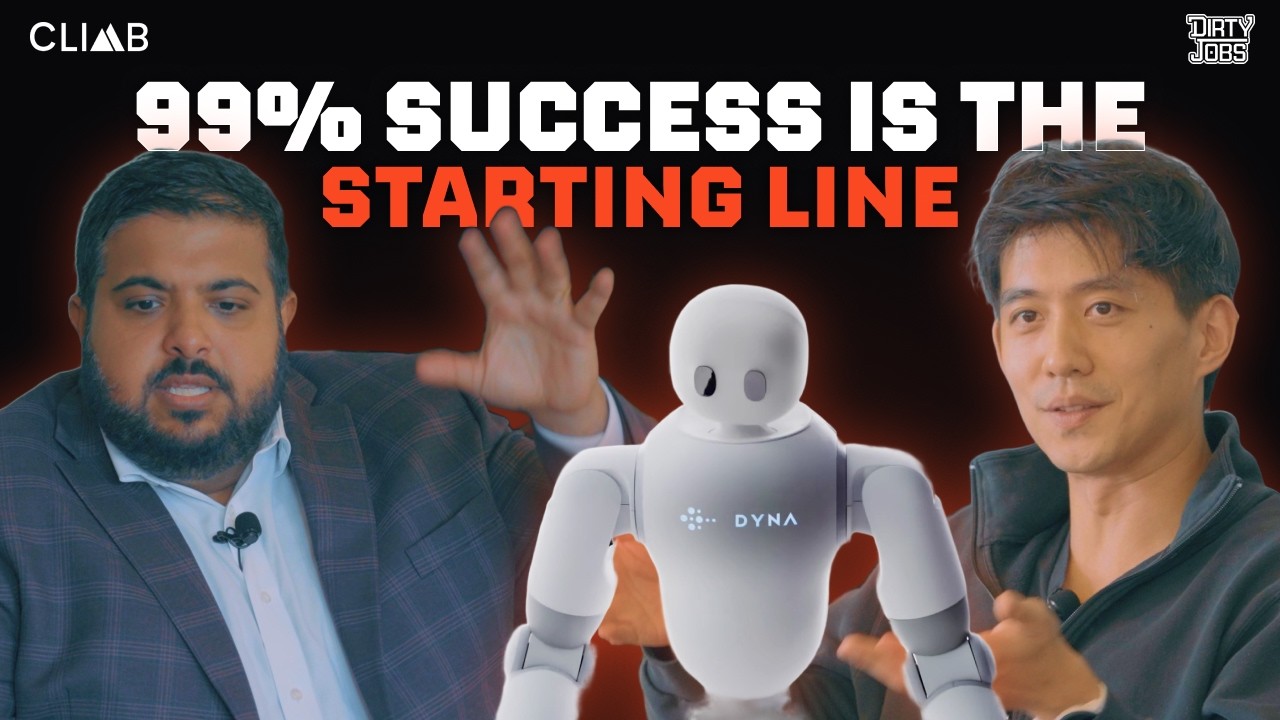
Lyndon Gao, founder of Dyna and previously of Caper, argues that a 99% task success rate is the entry ticket to robot deployment, not proof of readiness. Dyna hit 99.4% on napkin folding, 850 napkins a day, then found at customer sites that buyers cared about throughput, quality and autonomy. That finding drives his rejection of the "model company versus deployment company" distinction.
The tension lies between what research demos reward and what customers pay for. Gao says foundation-model pre-training and production specifications cannot be separated, yet his own team revised a core belief about data, moving from embodied teleoperation data toward labeled human video. The conversation leaves open how far scaling laws can substitute for reliable hardware.
A false paradigm — ▶ 2:12
Gao separates two questions. Vertical robotics on a traditional, rule-based ML stack is viable, more reliable and in some ways more efficient than foundation models. In the foundation-model context, though, he rejects the model-versus-deployment dichotomy: frontier labs pre-train, then post-train demos on a much smaller subset before shipping. A research company that ignores production specifications is incomplete, and so is a deployment company that ignores model barriers requiring research. He frames Dyna as building a robot product customers can buy and get to ROI.
99% as starting line — ▶ 5:02
Dyna 1 reached a 99.4% success rate and folded 850 napkins daily, which the team read as the cue to go make money. At customer sites, clients would not talk to Dyna below 99%, but above it they began demanding specific quality, speed and levels of intervention. Throughput and quality trade against each other, since faster models are more likely to produce substandard output. Gao says the industry treats 99% as the finish line to productionization, when it is only where commercial negotiation starts.
The robot babysitter problem — ▶ 6:14
Most demos, including Dyna's, are stationary with a human nearby, which Gao calls a robot babysitter. Dyna's napkin station could fold about 100 napkins in under an hour, but a human had to restock inputs and empty the output bin every 30-60 minutes. A forgotten robot idle for an hour after a lunch break can sink the day's KPI, and the constant attention creates churn for clients. Solutions engineering such as conveyor belts helps, but Gao argues general-purpose robots cannot depend on constant bespoke engineering.
Why own pre-training — ▶ 8:25
Gao allows that owning pre-training may become unnecessary within about 12 months, given strong open-source model activity. For now, off-the-shelf models lack generalization and language following. The latter matters because placing output correctly, such as orienting a component beside a bin, preserves the quality of the task just completed. He cites Chelsea Finn's remark that stacking folded boxes was harder than folding them. In-distribution priors in the pre-trained model also reduce post-training data needs and speed deployment. These are experience-based claims; no comparative figures were given.
Low-stakes wedge customers — ▶ 10:32
Gao contrasts robotics with self-driving, where 99.9% success would mean 1 in 1,000 people dying. Dyna chose folding as a wedge because it is resettable and has low throughput requirements. He prefers small and medium businesses to enterprises: they move faster, avoid a six-month sales cycle and forgive early errors. The underlying principle is the learning loop of building, deploying, getting feedback and iterating. A year-long enterprise cycle costs a year, while a loop established in a month compounds faster. The host cited a founder who avoided data centers over a roughly $750,000 outage liability.
Egocentric scaling law claim — ▶ 15:30
Dyna 2, which Gao calls the largest-scale pre-training in physical AI today, used more than 10 times the data of Dyna 1. He says it demonstrated an egocentric scaling law: if models can learn systematically from human video, progress becomes bottlenecked by data and compute rather than research. His belief had been that embodied data was the way to go. It changed when colleague Jason scaled data from a couple thousand hours to 50,000 hours and internal performance and benchmarks jumped. Data quality, Gao now argues, depends on labels.
Hardware is the bottleneck — ▶ 19:55
Asked what limits progress if data is not the constraint, Gao points to hardware. Dyna has tried a good majority of available arms and products, including off-the-shelf arms from Chinese manufacturers, and found reliable production hardware lacking. After two to three months, calibration drifts and model performance falls. Viable semi-humanoid robots for entire workflows barely exist. Gao says hardware reliability must improve by another notch before robots can deliver ROI over two years, which is why many deployment companies build their own hardware.
The robotics industry is optimizing a number that customers treat as a threshold. Lyndon Gao, founder of Dyna, says the 99% task success rate that labs and demo videos chase is the starting line for commercialization, not the finish. Dyna learned this firsthand. Its Dyna 1 model folded 850 napkins a day at a 99.4% success rate, which the team took as the signal to go make money. At customer sites, the meaning of the number changed. Buyers would not engage below 99%, but once the model cleared it, they began specifying the quality, speed and level of human intervention they would accept.
Gao's replacement metrics are throughput, quality and autonomy, and he stresses that they trade against one another. A model that moves faster is more likely to produce substandard output. Autonomy is the one he says nobody talks about. Most demos, including Dyna's, are stationary and staffed by what he calls a robot babysitter. In Dyna's napkin station, the robot could fold roughly 100 napkins in under an hour, but a human had to restock the input and empty the output bin every 30 to 60 minutes. A lunch break could leave the robot idle for an hour and sink the day's KPI. For the client, each interruption is churn.
The obvious fix, conveyor belts and other solutions engineering, keeps the robot moving. Gao argues it does not scale for general-purpose systems, because a company that is constantly solving bespoke engineering problems will never get there. That is the practical content of his rejection of the "model company versus deployment company" framing. He grants that vertical robotics on a traditional ML stack is viable and in some ways more reliable than foundation models. But in the foundation-model setting, every lab pre-trains and then post-trains a demo on a much smaller subset before shipping. Research without production specifications is blind, and deployment without research cannot clear model barriers.
Owning pre-training is where Gao is most specific, and also most qualified. He allows that within about 12 months it may not be necessary, given strong open-source activity. For now, he says, off-the-shelf models fall short on generalization and on language following. The second matters more than it sounds, because placing the output correctly, such as orienting a component beside a bin, can undo the quality of the task just completed. He cites Chelsea Finn's observation that stacking folded boxes was harder than folding them. In-distribution priors also reduce the data needed in post-training, which speeds deployment. These are claims from experience, and no comparative numbers were offered.
Gao's go-to-market logic follows from the same loop of build, deploy, get feedback and iterate. He contrasts robotics with self-driving, where 99.9% success would mean 1 in 1,000 people dying, whereas a badly folded towel harms no one. Dyna chose folding as a wedge because it is resettable and has low throughput requirements, so a failed fold will not make a BMW factory miss a delivery order. He prefers small and medium businesses to enterprise contracts because they move faster, skip a six-month sales cycle and forgive early errors. A year-long enterprise cycle costs a year, while a loop established in a month compounds quickly. The host added a founder's anecdote: a half-hour data-center outage would have meant roughly $750,000 of liability.
The most revealing admission concerns what Dyna got wrong. Gao's firm belief last year was that embodied data was the way to go. Dyna 2, which he calls the largest-scale pre-training in physical AI today, used more than 10 times the data and, he says, demonstrated an egocentric scaling law. If models can learn systematically from human video, he argues, improvement depends on data and compute rather than research, converting uncertainty into certainty. His mind changed when colleague Jason scaled data from a couple thousand hours to 50,000 hours and internal performance and benchmarks jumped. Gao now holds that data quality is a function of labels, and that human video with enough label context teaches physical priors.
The evidence for that argument is thin in this conversation. Gao would not revise the data pyramid, with teleoperation at the top and egocentric data close behind. He conceded there is no clear definition of whether 10 hours of egocentric data equals 1 hour of teleoperation, because the answer depends on whether the data is in or out of distribution. The scaling law is asserted rather than shown. He also places the binding constraint elsewhere. Off-the-shelf arms he tried showed calibration drift after two to three months, degrading model performance, and viable semi-humanoid robots for full workflows barely exist. If hardware must improve by a notch before robots deliver two years of reliable ROI, better pre-training alone may not decide who profits first. That would help explain why deployment companies end up building their own hardware.
The open question. Gao says the egocentric scaling law turns model improvement from a problem of research uncertainty into one of data and compute, but he also concedes there is no clear conversion ratio between human video and teleoperation data. If that ratio is unknown, and hardware that stays calibrated for two years does not yet exist, which constraint actually governs when physical AI becomes profitable: model capability, data economics or hardware reliability?
Watch the full video at https://www.youtube.com/watch?v=0uR5f2sRM7o.
Comments ()