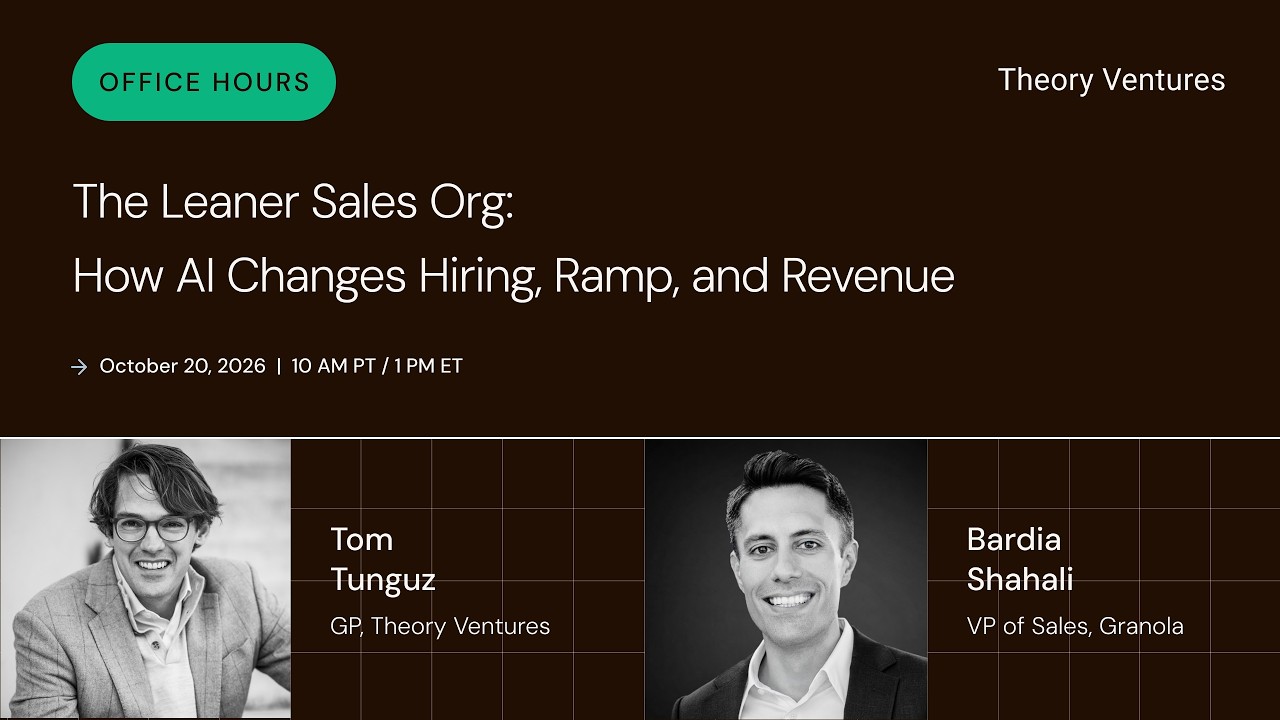
Recorded 22 October 2026 · 15 min
Bardia, VP of sales at Granola, argues that AI-era velocity, not deal size, is what has changed in selling. App-layer deals look much like they did in the SaaS era, but each rep can carry a quota that is multiples higher. The host draws on his time at Fireworks, which the host says grew from $3 million to about $400 million in revenue.
The tension is between speed and friction. Low-friction products and usage-based pricing compress cycles, yet legal and security reviews can still stretch enterprise deals to 6 months, and conditions move so fast that Bardia resets quotas every quarter. His conclusion is that commission rates must fall while the best reps are paid more, not less.
Velocity, not deal size — ▶ 0:54
Bardia separates infrastructure from applications. Fireworks sold usage-based contracts to AI-native companies that scale fast, so an eight-figure deal could close in 2 weeks, though every rival infra provider was chasing the same buyers. At Granola's app layer, deal sizes remain roughly similar to the SaaS era, but products need little onboarding. The result in both cases is that reps close far more, so quotas can be set at multiples of what they once were.
Enterprise legal still drags — ▶ 2:14
SMB and mid-market deals move quickly, especially with usage-based pricing. Enterprise is slower because Granola transcribes meetings across a company, which pulls in legal and security teams at public companies. Bardia calls the conversation contentious and says deals can take about 6 months, though accounts grow fast once landed. The host adds that buying shifted from leadership mandates late last year to multi-stakeholder committees in Q1 and Q2, and expects that discipline to persist.
Quarterly quotas, quota-free start — ▶ 4:12
Bardia advises new AI sales teams to put hires on full-comp-style plans for the first 3 to 6 months and not set quotas up front, because the first attempt will probably be wrong. After a quarter or two, real data exists. At Teleport he set comp annually. Now he sets targets every quarter, announcing them within the first days, because projecting four quarters ahead is nearly useless when conditions change this quickly and expansion books vary by rep.
Small teams and outbound — ▶ 5:43
On the audience's burnout question, Bardia argues that a small team closing lots of deals is energized rather than exhausted; burnout, in his view, comes from work people dislike. His larger concern is that a handful of reps would spend all day fielding inbound. Because he sees plenty of greenfield, he wants to scale the team deliberately, give everyone some outbound, and keep a little pressure on reps to open new opportunities. This is his experience, not tested evidence.
Forward deployed engineers scale first — ▶ 6:52
At infrastructure companies like Fireworks, evaluations hinge on hard performance requirements. Forward deployed engineers work in shared Slack channels to tune customer configurations, a stage where the rep adds little. Without enough of them, deals stall, so Bardia would scale them more aggressively than reps. A pod is an AE, an SE and an FDE, since FDEs are more technical than SEs. Granola has no FDEs but uses technical PMs, customer success and SDRs, and does much more with fewer people than his team at Teleport.
Agency replaces formal onboarding — ▶ 10:22
Bardia says new reps should expect little formal training at these companies. Instead, they query transcribed conversations in Granola about objections, and an internal agent connected to company data sources. The hiring filter becomes agency: reps who ask the right questions will be fine. The host adds that fast-moving companies also pause mid-day to reframe the product after news announcements, making short response times important. Both points are reported practice, not measured outcomes.
Lower rates, higher pay — ▶ 11:57
Enterprise OTE is roughly $300-350k as transcribed, about half variable. Enterprise quotas that were $1.2-1.5 million a year at a 10% rate are now perhaps $3-4 million, so commission rates must be lower. By editorial arithmetic, that implies roughly 4-6%. Bardia says SaaS veterans balk, but earnings can still be higher at this velocity. He also argues that with 3 or 4 neck-and-neck competitors per category, companies should pay top reps well, since 1 or 2 infra deals can make or break a company.
The variable that has changed in AI-era selling is speed, not deal size. Bardia, VP of sales at Granola, says app-layer deals are still roughly the size they were in the SaaS era. What differs is velocity. Products are so low-friction that reps need little onboarding to land customers, so each rep can close far more and carry a quota that is multiples higher. At the infrastructure layer, where he previously worked at Fireworks, usage-based pricing and fast-growing AI-native customers meant an eight-figure deal could close in 2 weeks, though every rival provider was chasing the same buyers.
Speed is not uniform, and Bardia is candid about where it breaks down. SMB and mid-market customers move fast, and usage-based pricing lets small deals expand quickly. Enterprise is different. Granola transcribes meetings across a company, which draws legal and security teams at public companies into what he calls a contentious conversation, and cycles can run about 6 months. Accounts then grow quickly once landed. The host's observation fits: late last year leaders simply mandated AI purchases, while Q1 and Q2 brought buying committees. The host expects that diligence to last, which suggests enterprise friction is structural rather than temporary.
Fast, unpredictable growth changes how a sales leader plans. Bardia would put early hires on full-comp-style plans for 3 to 6 months because first-draft quotas will probably be wrong, then use a quarter or two of data to set real targets. At Teleport he set comp annually. Now he does it every quarter, announced within the first days, because projecting four quarters ahead is nearly useless. The logic is straightforward: when the number a company will do is knowable only in aggregate and per-rep books vary with expansion, annual precision is false precision.
Team design differs by layer, and Bardia objects to online sales advice that lumps them together. Infrastructure evaluations come with hard performance requirements, and forward deployed engineers tune configurations alongside the customer, work in which the rep adds little. Starve that function and deals stall, so he would scale it faster than quota-carrying reps, with SEs still handling proof-of-concept discovery. Granola, an app company, has no FDEs. It relies on technical PMs, customer success and SDRs, and accomplishes far more per head than his earlier Teleport team, which was larger and did a quarter of the revenue. He declined to share Granola's revenue.
The same logic extends to ramping and burnout. Bardia says new reps get little formal training and are expected to query transcripts and an internal agent, so the scarce skill is initiative. On burnout, he argues that a small team closing many deals is energized, and that the real danger is a few reps drowning in inbound while greenfield outbound goes untouched. These are plausible operator views, but neither is backed by data. Burnout in particular is argued from his own experience of what energizes people, which may not generalize to teams whose deals stall.
Compensation is where the argument becomes most concrete. An enterprise rep earning roughly $300-350k OTE, half variable, once carried a $1.2-1.5 million quota at a 10% rate. With quotas now perhaps $3-4 million, the rate must fall. By our arithmetic, that implies something like 4-6%. Bardia says SaaS veterans balk, but he argues they can still earn more here. His business case is competition: where Figma once ran away with its category, he sees 3 or 4 rivals neck and neck in many categories, and 1 or 2 infra deals can decide a company's fate. He acknowledges a sales bias, so the instruction to pay the best reps is advocacy as much as analysis.
The weakest link is attribution. Bardia's account implies that rising quotas reflect rep productivity, but much of the velocity he describes comes from low-friction products, fast-growing customers and a market buying AI. If those tailwinds drive results, then lower commission rates are a bargain for reps only while growth lasts. His quarterly resets suggest he knows the numbers move. What the interview does not settle is what happens to a plan built on quotas of $3-4 million when the market cools, and whether the premium paid to top reps then buys an edge or merely rewards timing.
The open question. Can quarterly quota resets and lower commission rates hold up once growth normalizes? Bardia's case rests on the claim that velocity makes reps richer even at lower rates, but that velocity may come as much from product and market momentum as from rep skill. If three or four competitors really are neck and neck, it is unclear whether elite reps supply the edge or simply capture it.
Watch the full video at https://www.youtube.com/watch?v=GUmUA_jED-Y.
Comments ()