Recorded 30 October 2026 · 52 min
Karim Lakhani, a Harvard Business School professor who has run randomized experiments at BCG, Procter & Gamble and H&M, argues that AI is absorbing human expertise and leaving people to supply what it cannot: taste, skepticism and ambition. In his view the foreseeable unit of work remains humans with AI, because models still need direction, curation and judgment.
The tension is that those skills must be built through use and prior learning, and use is distributed very unevenly. Lakhani describes a K-curve inside large organizations in which the heaviest users run 10x to 20x ahead of the median. He concedes his own data do not yet link that gap to performance. He also disputes the popular fear that junior work is disappearing, pointing at middle management instead.
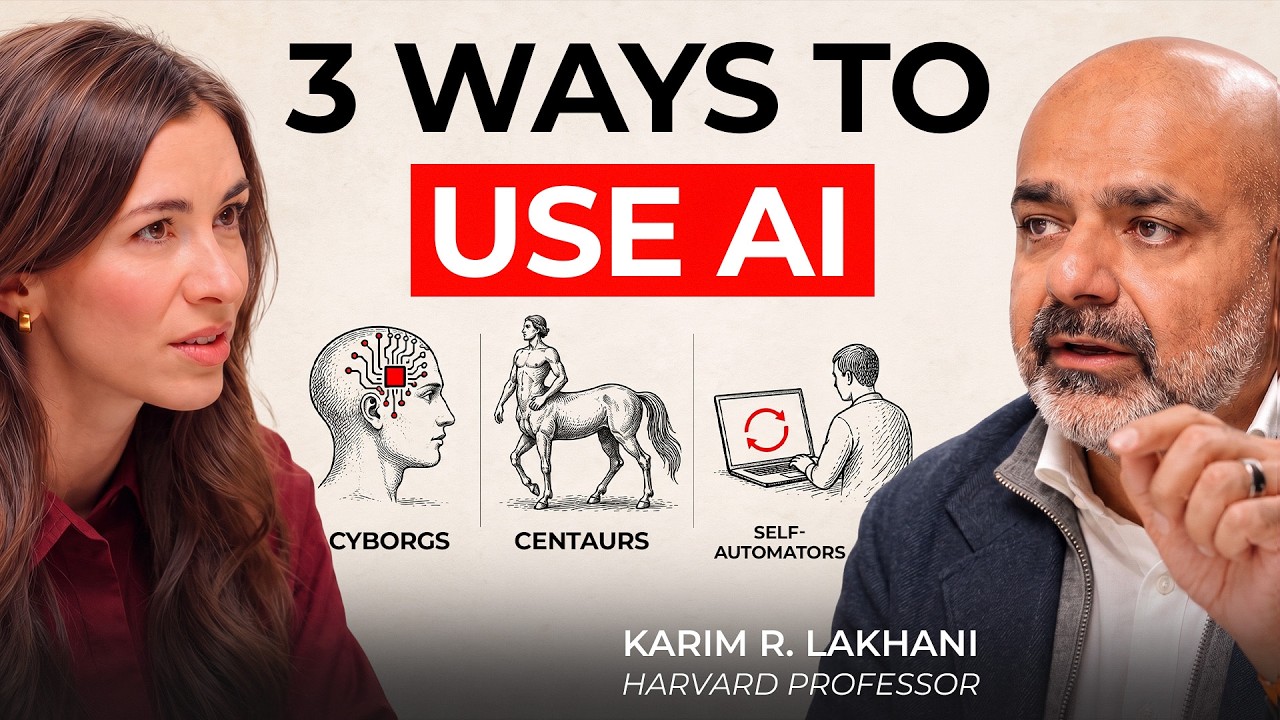
Three ways of working — ▶ 2:38
In a randomized BCG experiment with about 800 consultants, AI users fell into three styles. Cyborgs worked intimately with the AI on joint problem solving. Centaurs divided tasks by strength and supervised the results. Self-automators pressed play, and Lakhani says they learn the worst because they stop thinking. The host cited shares of 60%, 14% and 27% from a 244-consultant sample, which Lakhani did not restate. His warning about centaurs is that their division of labor goes stale while AI capability improves exponentially, so the boundary must be continually redrawn.
Persuasive but imperfect — ▶ 4:46
The BCG team began with a hypothesis that AI would be good at everything. It found a jagged frontier: for a consultant's job, some tasks fall inside AI's capability and some, seemingly similar, fall outside. The danger is that the intelligence is imperfect but speaks fluently and persuasively. Lakhani says the only way to learn where it breaks is to use the most frontier models on the most frontier tasks, critically from day one. Because new models keep arriving, any map of good and bad tasks has to be redrawn, which he calls difficult for everyone.
Engineered adversarial prompting — ▶ 7:00
In the BCG persuasion study, GPT-4 argued harder when consultants pushed back, even when wrong. Lakhani's countermeasures are concrete. System prompts can make the model open with the counterargument and state how much of each claim rests on its training, how confident it is, and where the argument is weak. He also asks for three arguments against any proposal, extra research hunting for red flags and black swans, and generous token spending on research agents. He never accepts the first answer. He frames this as mentoring assistants the way he mentors students.
Models default to average — ▶ 11:49
Lakhani argues that because models are statistical, letting them choose the approach yields the average approach, and self-written prompts will drift to the average prompt too. In his own field, with 20 years of research experience and five years of PhD training, he finds the regression models a system picks are often not the right ones. In design, asking for something in the style of Steve Jobs does not supply taste. His remedy is to learn the principles first, push the AI toward three candidate approaches, and be adversarial. Accountability stays human: he has fired people who blamed the AI.
Learn fundamentals, then delegate — ▶ 16:01
Lakhani relays an argument from an interview with the designer of a mathematical language for integrals: learn the first integrals by hand to understand how they work, then let the machine do the rest. Watching a thousand machine-solved integrals teaches more than doing the next 40, 60 or 80 yourself. He applies this to the junior career ladder. Colleague Mitch Weiss sees AI as a springboard rather than removed rungs, but Lakhani notes that a springboard requires taste, so the burden of learning on juniors grows heavier. He says he has heuristics, not answers.
Executives are cushioned — ▶ 20:06
At Harvard Business School, half of the AI course is now building, and all 900 MBA students vibe-coded projects in place of a final exam. Lakhani runs a similar exercise with C-suite groups, who he says have a third-hand view of what models can do. After building an application for their own business in 90 minutes, they react in two ways: they berate the CIO over something requested for years, and they realize they cannot guide teams without doing AI themselves. He treats programming as a leading indicator, with other occupations 6 months to 2 years behind.
The K-curve usage gap — ▶ 25:53
Lakhani says most companies are probably at the level of GPT 4.5, essentially advanced search, and that Silicon Valley lives in a different future. In usage data from organizations with hundreds of thousands of employees, a postdoc of his finds heavy users running 10x to 20x ahead of the median, a gap that grows as models improve. His organizational data show no correlation with performance yet, but software data show productivity differences of 10x to 20x at the top. He argues companies cannot sustain a median that is 20x less productive. Individuals must climb on their own; firms must act top-down.
Set business targets, not AI targets — ▶ 28:35
Lakhani's advice to leaders is to set deliberately unreasonable targets in short time frames, framed as customer, R&D, launch or operating results rather than AI adoption, then work backward asking what else must be true. He calls targets acts of imagination and argues that achieving 7x against a 10x goal beats reaching 2x against a modest one. The H&M study adds a limit: strategy generated by AI was hard for people to sell, so humans must set the ambition first and let AI bolster it. He worries that HBS students used to success set 2x goals.
Open source at scale — ▶ 34:57
Lakhani connects AI to his earlier open source research. Open source worked because skill is not correlated with motivation, and because many people take many shots, so the best result comes from the right tail of a distribution. Most companies, he says, get only the average. AI shifts the human-plus-AI expertise curve to the right, making it a version of that model at scale. The edge becomes what you add beyond the AI, and he calls this a difference of kind rather than degree. His advice on choosing a field is to put in the work: grind outperforms talent.
Middle managers, not juniors — ▶ 44:07
Lakhani rejects the premise that junior work is being automated, calling the question unsettled. He argues the early-career market is soft for multiple causes, not just AI. In company usage data, the 35-to-55 middle layer resists AI most, while juniors are fearless and can run circles around the organization. Colleagues who worry about juniors, he says, would be skeptical if they looked at real workers with real data. His qualification is that a junior who is merely a copy-paste interface to the model has a job that is gone, a claim about individuals rather than a layer.
Walmart, Kmart or Bezos — ▶ 46:27
Lakhani calls companies bundles of expertise and asks whether incumbents will behave like Kmart and Sears, which added a website, like Walmart, which adapted late, or like Bezos, who rethought retail. He expects a tale of two cities by 2030, though value destruction may come slower because of organizational and customer inertia. He does not know how a firm can tell if it is just a thin wrapper around a frontier model. He endorses Greg Brockman's test, whether the business improves or disappears with each new model, and says CEOs who get it spend 20-30% of their time on AI.
Karim Lakhani's central claim is that generative AI works as a machine for absorbing expertise, and that this changes what remains scarce. If a model can supply a competent draft of almost any professional output, competence stops differentiating. What differentiates is what a person adds: the judgment to know when the output is wrong, the taste to choose among acceptable options, and the ambition to ask for more than the average. His experiments at BCG, Procter & Gamble and H&M, he says, show people with AI can do more and push their expertise further. They can do so only while they stay mentally engaged. In his view, the foreseeable unit of work remains humans with AI, because models need direction, curation and taste.
The mechanism, as Lakhani frames it, is statistical. Models regress to the mean, so a model left to choose its own approach tends to choose the average one. He offers two examples. Given a dataset, a system can propose five ways to run a regression, but after 20 years of research and five years of PhD training he finds the models it picks are often not the right ones. In design, asking for something in the style of Steve Jobs does not substitute for taste. The implication is that average output is now cheap and abundant, and the human task is steering away from it. He also doubts that prompting will become trivial as models learn to prompt themselves, since the self-written prompt tends toward the average too.
The practical response is to build friction into the relationship. In the BCG persuasion study, GPT-4 argued harder when consultants pushed back, even when it was wrong, and Lakhani stresses that the technology talks well while being imperfect. His countermeasures are specific. System prompts can make the model open with the counterargument and state how much of each claim rests on its training and where the argument is weak. He asks for three arguments against any proposal, for research aimed at red flags and black swans, and for generous token spending. He never accepts the first answer. He describes this as mentoring assistants the way he mentors students, and he admits it is hard to sustain because each new model forces a fresh assessment of what it can do.
That raises the obvious problem of how anyone develops judgment when AI does the entry-level work. Lakhani answers with a sequencing principle borrowed from an interview he heard: learn the first integrals by hand to understand how they work, then let the machine do the rest and learn by observing a thousand of them. Foundations first, delegation second. He applies the same logic to careers. A colleague, Mitch Weiss, sees AI as a springboard rather than a removal of the bottom rungs. Lakhani accepts that framing but notes it makes the burden of learning heavier on juniors, who must now build taste early. He says plainly that he has heuristics rather than answers.
The organizational version of the problem is a usage gap. Lakhani says most companies are probably at the level of GPT 4.5, which he and the host describe as essentially advanced search. Usage data from large organizations, collected by a postdoc of his, show a K-curve. The heaviest users run 10x to 20x ahead of the median, and the gap widens as models improve, like an escalator beside a flat walkway. Software data show productivity differences of 10x to 20x at the top. His inference is that no company can run with a median performer that far behind. The group he finds most exposed to the blind spot is the senior leaders, who he says are cushioned from what models can do until he sits them at a keyboard and they build a working application in 90 minutes.
Lakhani's prescription for leaders is top-down but deliberately not about AI. He urges targets set in business and customer terms, such as R&D productivity, launches and service quality, and set almost unreasonably high, with the team working backward from them. His reasoning is that a 10x goal that yields 7x beats a modest goal that yields 2x. The H&M study supplies a boundary: strategy generated by AI was hard for people to sell, so ambition must start with the human and AI can only bolster it. He worries that HBS students, shaped by a record of success, set low targets to avoid failure. The same logic applies to individuals, who he says must go through the cycles of prompting and learning where models break.
His most contrarian position concerns who is at risk. Many commentators worry about juniors. Lakhani calls the question unsettled, argues that the soft early-career market has multiple causes, and says the middle layer, roughly ages 35 to 55, resists AI most in the usage data he sees. Juniors, by contrast, are fearless. The exception is the junior who is merely a copy-paste interface to the model, whose job he says is gone. That test generalizes to firms. He asks law firms and manufacturers why they should exist if they are only a thin wrapper around a frontier model, and he acknowledges he does not know how a firm can reliably tell.
At the firm level, his framework is that companies are bundles of expertise, and the cost of expertise is falling toward zero. Incumbents face a choice resembling the one retailers faced when Amazon appeared: be Kmart, be Walmart, or rethink the business as Bezos did. He expects a tale of two cities by 2030, with a set of firms redefining work and everyone else plodding along. He also expects value destruction to come slower than people anticipate, because organizations and customers are inert. He endorses a test he credits to Greg Brockman: ask whether your business improves or disappears with each new frontier model. He adds that this thinking cannot be delegated to a junior employee or an outside adviser.
The weakest link in the argument is the one the whole urgency rests on. Lakhani's organizational data show a 10x to 20x usage gap but, so far, no correlation with performance, and the productivity evidence he cites comes from software. His middle-management claim rests on observed willingness to adopt AI rather than on measured outcomes, and he acknowledges that esteemed colleagues read the evidence differently. Even his core thesis has a gap. If taste and judgment are the new scarce assets, and the way to build them is to learn fundamentals by hand before delegating, he offers no reliable way for a person to measure whether the taste is world-class or just mediocre. He also leaves open where meaning comes from when the grind of the craft is automated away.
The open question. Lakhani's claim that a 10x to 20x gap between top and median performers is unsustainable depends on a link he has not yet shown. His organizational data so far show no correlation between usage and performance, and the productivity evidence he cites comes from software. If heavy usage in other occupations turns out to be activity rather than output, the case for urgent top-down mandates weakens, and so does his prediction that middle managers are the group most at risk. Which occupations will actually show the productivity gap he expects, and how soon?
Watch the full video at https://www.youtube.com/watch?v=vFOnDsy58NU.
Comments ()