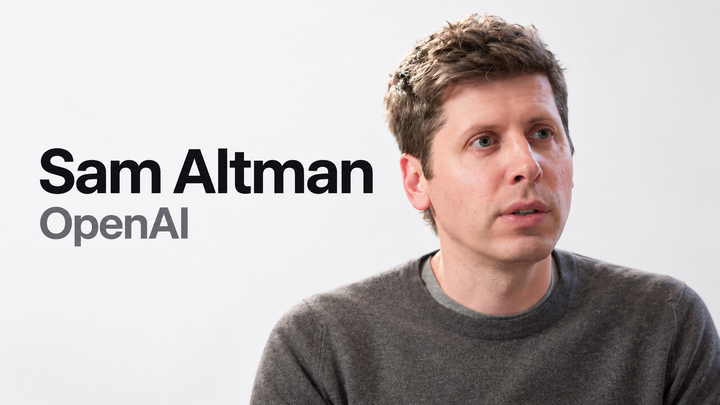
Recorded 23 August 2026 · 78 min
The models are ahead of the products, and the products are ahead of human habit. Sam Altman, CEO of OpenAI, admits he still clicks through email and to-do lists the way he did 20 years ago, even with Codex on his machine. He calls that "mostly a product failure". He puts today at the pre-iPhone stage: every technical piece exists, but nobody has yet changed how people interface with it.
The host reads founder biographies for a living and keeps steering toward history and habit: Blockbuster, Bell Labs, Claude Shannon, Y Combinator. The tension is that Altman diagnoses a product gap while spending most of his time on research and compute. He has also killed Sora and the Atlas browser to protect scarce compute. He disagrees with Shopify's Toby Lütke on timing, arguing the economy's inertia will make the transition slower than anyone expects.
Underneath runs a political claim: AI should empower people rather than concentrate power, and the field has been selling the opposite.
Hands-on CEO benchmark — ▶ 0:02
Toby Lütke is the CEO Altman sees furthest ahead. At every point on AI's curve he has been "the most forward-leaning": writing software himself, sending extremely detailed feedback on model capabilities, and declaring early that Shopify would not be "an NPC company". Altman puts him six to eight months ahead of any other CEO. Lütke also says 2026 is the year every business is up for grabs, and at night he rebuilds Shopify AI-native from scratch. Altman's point is that the feel comes only from doing the work personally, not from teams managing implementation.
Inertia beats capability — ▶ 3:34
Altman disagrees with Lütke on timing. Not every business is up for grabs: authentic, non-technological experiences like sports teams gain value as AI improves. Many software businesses are exposed, though. After GPT-4 in 2023 he expected fast disruption and was wrong, because "the economy just has so much inertia." People keep buying from the same companies and using tools the same way. He calls that a positive, since it makes the transition smoother and slower, but concludes that everyone has been too ambitious on timelines.
Revealed-preference confession — ▶ 6:07
The thing Altman finds most psychologically inconsistent about himself: after 20 years of using computers one way, he has Codex and still clicks around, pastes between messaging apps, scrolls email and keeps a to-do list. He says he would never claim to like working that way, and would mean it. Yet "by revealed preference" he does. His guess is that rote tasks are encoded in his head as what work and productivity mean. He does not know what will change that, and suspects it has to happen gradually.
Pre-iPhone product gap — ▶ 7:39
Altman calls the gap "mostly a product failure". Users straddle two worlds, the old computer and Codex operating it in a new way, unsure which to use when. He compares now to smartphones before the iPhone, when he was an early adopter of a Palm device around 2003 or 2004. The technology was mostly there, and what was missing was the product ideas. Today all the technological pieces exist, but the iPhone moment of completely changing how someone interfaces with technology has not arrived.
Compute is the lever — ▶ 9:56
Asked how he approaches product, Altman says most of his effort is on research and compute, and he would love more time on product. His bet: create smart models and run them efficiently and abundantly, and "everything else will follow." Compute is a complex supply chain, a financing challenge for what is probably already or soon the most expensive infrastructure project in history, and a technical problem from custom chips to fabs, racks and power. He also finds managing a research program the closest thing to startup investing in his career.
Power law, non-standard people — ▶ 11:56
Research and investing share a power law: the best bet outperforms all the others put together. In late 2015, the field's "intellectual giants" hammered OpenAI for chasing AGI, then again for large language models. Altman wants non-standard people who hold unpopular convictions, not a "thin veneer" on the common idea. In 2015 there were a handful of AGI efforts and thousands of photo-sharing app founders. Today many want to start AI labs, while perhaps 2-3 people are doing something truly new that does not yet look like a good idea.
People still want people — ▶ 28:09
Asked whether people would care if two AIs made a better podcast than two humans, Altman says stuff about people's connection to people becomes more valuable in a post-AI world, not less. Other jobs face significant transition. He thinks only a tiny share of humanity, a subset of "weirdos", prefers communicating with computers over humans. His conclusion is that the world will be less different than expected even with superintelligence, because people stay wired to care about other people.
Control versus concentration — ▶ 30:15
Altman's two biggest AI worries sit in tension: loss of control to AI, and power concentrating in one company, model or person. He calls both anti-human. His caricature of a pitch some in the field make: a cure for all disease and cheap goods, in exchange for people giving up autonomy, with rampant inequality and a "pretty good everything" for the rest. He calls it a terrible sales pitch. He attributes it to fear and power, with safety arguments used to justify power-seeking.
Safety through contact — ▶ 33:20
At OpenAI's start, Altman says, two views dominated: nothing AGI-like within 10 years, and if it came, it could not be made safe. A decade on, the first is wrong and the world-ending predictions have not happened. He keeps the doomers' caution but rejects that the problem is unsolvable. His method is to ship, watch where it breaks and publish postmortems, modeled on FAA accident reporting. ChatGPT is under 4 years old with a billion users. He concedes it gets harder from here, with decisions about when to delay development.
The field's messaging failure — ▶ 40:13
Why does everybody use AI and many hate it? Altman blames the people building it: they have talked about a 25% chance of destroying the world and half of jobs vanishing, and rarely explained benefits or mitigations. Universal basic income talk ignores autonomy, which most people prize. The "benevolent dictators" pitch is scary to them. His counter is that AI will power the greatest boom in small-business formation ever, something the field, OpenAI included, has not talked about enough or built enough products to accelerate.
Context over intelligence — ▶ 46:13
The latest models are pretty smart, Altman says, but he feels limited by how much useful context the AI has on him. He will not read every internal Slack post, every customer story of ChatGPT working or failing, or every research paper. An agent can read tens of thousands of pages in seconds and bring them to bear on a decision, which no person can. He says product work has focused so much on model intelligence that it has not thought enough about this, and expects a very different way of working soon.
Platform, not everything — ▶ 49:53
OpenAI merged ChatGPT and Codex into one interface, with one API underneath, and aims to sell the best AI at every point on the cost-performance curve. Altman does not want to compete with customers or subsume the economy. He wants 100 million new businesses and 8 billion people building on it. To protect scarce compute and people, OpenAI killed Sora, which used a lot of compute, and the Atlas browser, which he thinks was the best browser. He admits entrepreneurs are terrible at killing good ideas, himself included.
Thiel's text-box call — ▶ 56:34
About 2 months after ChatGPT launched, growth was fast but looked unstable, and many at OpenAI wanted to pursue 5 or 6 other things. Peter Thiel called it an obvious mistake to do anything but this. Its power was the Google text box: type anything and it does the right thing. It had no feeds, no network effects and no lock-in, everything Silicon Valley wisdom demanded, and that was why people worried. Altman calls it simple genius. OpenAI went all-in on ChatGPT.
Learn from wins — ▶ 1:04:05
Altman's first startup did not work out, and he says failure teaches less than success. Most things fail for many reasons, so causation is hard to untangle, and lessons from failure came out generic or got in the way. Lessons from what really worked at Y Combinator and OpenAI have been far more useful. When the host argues that the value is in constant reminders, like church, Altman agrees, but prefers reminders of the positives: talk to users, ship earlier, hold a higher hiring bar.
Research without customers — ▶ 1:09:45
OpenAI took 4.5 years from founding to first product, the opposite of YC advice. Altman had no pattern for replacing customer signal. What worked: a public leaderboard during the Dota 2 work, and demos for eminent people researchers wanted to impress. Fake deadlines did not. On the first day in January 2016, 11 or 12 people met in Greg Brockman's apartment, fetched a whiteboard and had no idea what to do. There was no Bell Labs-style cash machine; he mostly remembers failing to raise money.
Adoption is the slow variable. Sam Altman learned that the hard way. When GPT-4 arrived in 2023, he expected software businesses to be up for grabs almost at once. They were not. "The economy just has so much inertia," he says. People keep buying from the same companies and using their tools the same way. He keeps Blockbuster in his head as the example: after Netflix started mailing DVDs, people still drove to the store. Changing behavior is harder than technologists assume. He thinks the drag is mostly a gift, because it makes the transition smoother and slower. But it means everyone has been too ambitious on timelines, even with a technology he ranks among the most incredible humanity has invented.
That is why he parts ways with Toby Lütke. The Shopify CEO calls 2026 the year every business is up for grabs, and at night he tries to rebuild Shopify as an AI-native company from scratch. Altman rates him the most forward-leaning CEO he knows: someone who writes the software himself, sends detailed product feedback, and runs six to eight months ahead of his peers. Altman admires the spirit. He rejects the date, and he rejects "every". Businesses built on authentic, non-technological experience, like sports teams, should get stronger as AI gets better. Many software businesses are genuinely exposed. They are exposed on a longer clock than Lütke assumes.
The inertia is not only out there. It is in Altman's own habits. He has Codex and still clicks between messaging apps, scrolls his email and keeps a to-do list, exactly as he has for 20 years. Ask him and he would say he dislikes working that way, and he would mean it. By revealed preference, he likes it. He does not read this as a failure of will. He reads it as "mostly a product failure". Users straddle two worlds: the old computer, and an agent that can operate it, with no clear rule for which to use when. He compares the moment to smartphones before the iPhone. The pieces existed. The product ideas were missing. Today the technology pieces exist again, and nobody has yet changed how a person interfaces with them.
What would that change look like? Altman's best guess is context, not intelligence. The latest models are pretty smart. He feels limited by how much useful context the AI has about him. He will not read every post on the internal Slack, every customer story about where ChatGPT worked or failed, or every research paper. An agent can read tens of thousands of pages in seconds and bring them to bear on a decision. No person competes on that axis. He says the product side has been so focused on model intelligence that it has not thought enough about this. He expects the chat interface to drift toward a persistent agent that runs on whatever you need.
The obvious objection is that a CEO who diagnoses a product gap should be working on product. Altman says most of his effort goes to research and compute, and he would love to spend more time on product. His reasoning is that models and compute are the high-leverage, difficult problems that continue the exponential. Get those right and everything else follows. Compute also suits him. It is a complex supply chain. It is a financing challenge for what he thinks is already, or soon will be, the most expensive infrastructure project in history. It is a design problem that runs from chips to fabs to racks to power. And running a research program is the closest thing to startup investing he has found, which is where his instincts come from.
That priority has a cost, and he names it. OpenAI killed Sora, a good product that burned a lot of compute. It killed its Atlas browser, which he thinks was the best browser. Both lost to Codex, because with limited compute and people, general intelligence for knowledge work, and eventually science, comes first. He admits entrepreneurs are terrible at killing good ideas and that he is too. What survives is a platform. ChatGPT and Codex are now merged into one interface, with one API underneath, and the pitch is the best AI at every point on the cost-performance curve. He does not want to compete with customers or swallow the economy. He wants 100 million new businesses and 8 billion people building on it.
The discipline behind those cuts came partly from Peter Thiel. About 2 months after ChatGPT launched, usage was growing fast but looked unstable, and people inside the company wanted to pursue 5 or 6 other things. Thiel told Altman it would be an obvious mistake to do anything but this. The power was the Google text box: type anything and it does the right thing. ChatGPT had no feeds, no network effects and no lock-in, everything Silicon Valley wisdom said it needed, and that was exactly why people worried. Altman applies the same logic to his own past. Lessons from success have served him better than lessons from failure, which came out generic or got in the way. Most things fail for many reasons, so causation is hard to untangle.
The same contrarian streak explains why OpenAI exists. Altman says research and startup investing share a power law, where the best bet outperforms all the others put together. In late 2015, the intellectual giants of the field hammered OpenAI for chasing AGI, then hammered it again for betting on large language models. He wants non-standard people who hold unpopular convictions and may well be wrong, not a thin veneer on the idea everyone else has. In 2015 there were a handful of AGI efforts and thousands of founders building photo-sharing apps. Today many want to start AI labs, and perhaps 2 or 3 people are doing something truly new that does not yet look like a good idea. Those are the people he would fund.
The price of that bet was a company with no customers. OpenAI took 4.5 years from founding to first product, the opposite of the Y Combinator advice he credits so heavily. It had to simulate customer signal. A public leaderboard during the Dota 2 work let people see which ideas performed. Demos for eminent people the researchers wanted to impress worked. Fake deadlines did not. On the first morning in January 2016, 11 or 12 people met in Greg Brockman's apartment, fetched a whiteboard, and then had no idea what to do next. He also says YC's changes to the ecosystem, more leverage for young technical founders and capital without a proven resume, are why OpenAI was possible at all.
He applies the same bet on contact with reality to safety. At the start of OpenAI, he says, two views were widely held: nothing AGI-like would exist within 10 years, and if it did, it could not be made safe. A decade on, the first is wrong and the predictions of the world ending have not come true. He keeps the doomers' caution and rejects their claim that the problem is unsolvable. His method is to ship, watch where it breaks, and publish postmortems, modeled on how the FAA investigates accidents. ChatGPT is under 4 years old and a billion people use it for sensitive matters. He says a lab thinking in isolation could never have got there.
There is a political claim underneath. Altman's two biggest worries are loss of control and power concentrating in one company, model or person, and he calls both anti-human. He mocks the pitch some in his field make: a cure for disease and cheap goods in exchange for autonomy and rampant inequality, with "benevolent dictators" in charge. He thinks it is driven by fear and by power. It also explains a puzzle: everybody uses AI and many people hate it. The field has talked about a 25% chance of destroying the world and half of jobs disappearing, and almost never about people's freedom to shape their own future. His counter-offer is the biggest boom in small-business formation ever seen. He also bets people stay wired to care about other people. Asked whether audiences would prefer two AIs with a better conversation, he says anything about human connection gains value in a post-AI world.
The thinnest part of the argument is where its two halves meet. Iterative deployment works by learning from what goes wrong. Altman concedes it gets harder from here. Models are about to match the smartest people, the unknown unknowns look larger in absolute terms, and OpenAI will face difficult decisions about when to delay development and wait longer to study a model. He does not say what would trigger a delay, or who decides. The same gap shows in product. A platform that refuses to build every category leaves open who builds the interface that finally breaks people's habits. He says the missing piece is product, and he is spending his own time elsewhere.
For now, the best data point on how slow this transition will be is the man building it, still working the old way.
The open question. Altman diagnoses the adoption bottleneck as a product failure, yet says most of his own time goes to research and compute, and he killed two products to protect that compute. If the missing piece is an iPhone-style interface, who at OpenAI owns it? Does a platform strategy that refuses to build every category leave that interface to someone else? Watch what the merged ChatGPT-Codex becomes, and whether the persistent, context-rich agent he sketched ships before anyone else's.
Watch the full video at https://www.youtube.com/watch?v=kG8AoExkX40.
Comments ()