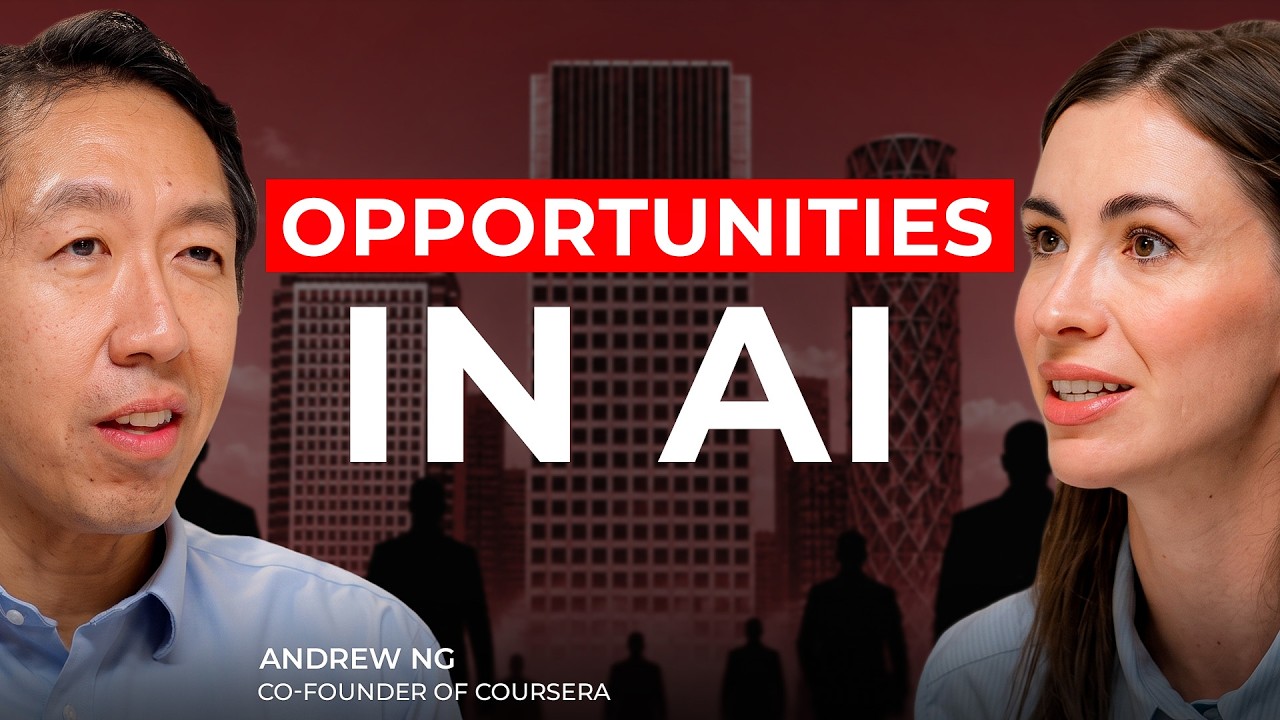
Recorded 28 August 2026 · 38 min
Andrew Ng, who co-founded Google Brain and Coursera, argues that the current wave of public pessimism about AI is partly manufactured. In his account, a handful of leading AI companies have amplified fear to win regulation that would burden open-weight competitors and protect incumbents. The interviewer, a podcaster who has watched sentiment sour on social media, presses him on jobs, education, privacy, and loss of control.
Ng is not an uncritical booster. He says AI is not good enough to replace most jobs, but he calls the way most people use AI models terrible for learning, and he is careful about where sensitive data goes. The tension is that his regulatory-capture claim is an inference about motive with no evidence offered, while his practical advice rests on observations from his own teams.
Fear as regulatory capture — ▶ 1:14
Ng attributes the negative mood on AI to a PR and regulatory-capture effort that began two to three years ago. His reasoning is economic: a model that cost billions to train loses value if someone else releases a comparable one free. Fear-based messaging, he says, is meant to produce regulation that tilts the field toward incumbents and makes everyone pay a toll. He calls the nuclear-weapons analogy baseless and says claims about data-center water use are exaggerated. This is his interpretation of motive; he names no company and offers no specific evidence, and he says the result is slower American adoption.
Tasks, not jobs — ▶ 3:04
Citing task-level analysis by economists such as Erik Brynjolfsson and Andy McAfee, Ng says AI might do maybe 30-40% of many jobs. The remaining 60% becomes more valuable as an economic complement to the cheaper portion. The realistic displacement, he argues, is of people who do not use AI by people who do, not the 50% job loss he dismisses. Software engineering, the most affected profession, shows job openings up and good engineers busier than ever, though he cites no data. Engineers still coding as in 2022 are in trouble.
Universities teach 2022 — ▶ 5:31
Academia adapts slowly: faculty must master new skills, create courses, win curriculum committee approval, and get a faculty senate vote, which takes years. Ng says many universities still prepare students for 2022 jobs when they should target 2028 and beyond. Employers, meanwhile, struggle to find skilled people at any seniority level. His interns, including one high school student, are productive because they are AI native. His advice is to work hard in class and fill curriculum gaps online, naming Coursera, DeepLearning.AI, and Udemy.
The human context advantage — ▶ 12:02
Ng says AI brainstorming yields one or two good ideas, two or three mediocre ones, and four atrocious ones. The reason humans outperform it is context: years of experience, a customer's facial expression, a manager's stated priorities. He argues the plumbing to give AI such context does not exist and will not for the foreseeable future. He recasts human taste and judgment, often called fuzzy, as precisely this advantage. Because he sees it as long-lived, he concludes the economy needs more people with judgment to complement AI. The durability is his judgment, not demonstrated.
AI undermines learning — ▶ 14:04
Ng says that when students use AI, homework scores rise but long-term retention is much worse, because the AI does the work. He cites studies without naming them and offers his own example: he forgot a front-end and back-end solution within 6 months and had to ask again. Offloading is useful for getting work done but defeats learning. He allows that good uses exist. He now leads Learn Vector, which aims for one-to-one rather than one-to-many learning; the interviewer says Coursera is investing $100 million, and Ng expects more to show by early next year.
Software as harbinger — ▶ 16:43
Ng treats software engineering as a forerunner for other disciplines. Front-end and back-end developers have become full-stack because AI widens their scope, and he sees early signs of marketing coordinators becoming full-cycle marketers and recruiters doing end-to-end recruiting. Stepping up requires both AI skills and the underlying discipline. This is why he worries about fear messaging: he describes a prospective college student asking whether everything he learns would be obsolete in 4 years. Ng says it will not, and that persuading people to give up is among the worst outcomes of this era.
Agency and embedded engineers — ▶ 20:13
Ng's team's AI engineering skills map shows more job descriptions asking for a high sense of agency, since AI lets individuals spot problems and build solutions. He predicts businesses that encourage learning AI, building fast and responsibly, and talking to customers will beat hierarchical silos. In his organizations, all marketers have built software, which he asks about in interviews. A finance team scripted routine document checks, and recruiting teams embed professional engineers. He adds that this suggests there is so much valuable engineering work that he is not worried about running out of it.
Privacy follows business model — ▶ 25:23
Ng trusts the largest hyperscalers to follow their terms of service, reasoning that a breach would damage their long-term business model. He is wary of an unnamed AI company that changes its terms to retain or train on user data, hoping users click the wrong button. For material nonpublic information, he will not use the cloud at all, doing the task manually or with a local model. Many banks, he says, run models in a virtual private cloud or on premises. Open-weight models approaching frontier capability can now run locally, and he advises not getting stuck on one model.
Airplane analogy for control — ▶ 29:01
Responding to Yoshua Bengio's scenario, as relayed by the interviewer, of humans losing control of smarter AI, Ng compares AI with airplanes. Neither can be perfectly controlled, and early airplane crashes killed people, but lessons improved safety. AI outputs are somewhat random, yet engineers grow capabilities carefully in a controlled environment, measure what is wrong, and shape behavior. Ng says AI will never be perfectly controlled but is controlled well enough that loss of control does not feel like science fiction. The analogy addresses incremental mishaps; it does not directly engage the premise of systems smarter than humans.
Product management bottleneck — ▶ 33:11
With the cost of building down sharply, Ng says the challenge shifts to deciding what to build, which he calls the product management bottleneck. Founders, engineers, and product managers who talk to customers and exercise judgment will be best placed. He builds something nearly every weekend, last weekend using frontier models to analyze business metrics while checking their data retention policies. But a weekend produces an application, not a company. Meaningful businesses still need technical depth or deep customer insight, so he favors sampling widely and then going deep in a couple of sectors.
AGI depends on definition — ▶ 36:08
Ng defines AGI as AI that can do any intellectual task a human can, such as writing a PhD thesis or learning to drive a truck through a dense rainforest after tens of minutes of practice. By that bar he sees a long list of things AI cannot do, putting AGI decades away, and he hopes only decades. A lower bar could count AGI as reached already, or 30 years ago. He adds that OpenAI had an economic incentive, via an agreement with Microsoft since renegotiated, to declare AGI early.
Andrew Ng's central claim is that public mood on AI has been shaped less by the technology than by a story about it, and that the story has a sponsor. He says a handful of leading AI companies began a PR and regulatory-capture effort two to three years ago. The logic is economic. Training a giant model costs billions of dollars, which makes it inconvenient when someone else trains one and gives it away. Regulation justified by fear would impose a toll on everyone using AI while hobbling researchers and companies releasing open-weight models. Ng offers this as his reading of motive, not as demonstrated fact, and he names no company. But the mechanism is coherent, and it explains why he treats fear messaging as a competitive issue rather than a passing mood.
The second half of his argument is that the fear is also wrong on the merits. Ng says AI does not work well enough to do everything a human does, and he wishes it worked better. He leans on task-level analysis by economists he names, Erik Brynjolfsson and Andy McAfee: break jobs into tasks, and AI might do 30-40% of many of them. The remaining 60% becomes more valuable because it is an economic complement to the cheaper 30-40%. On this view, the realistic displacement is of people who do not use AI by people who do. His evidence is software engineering, the profession he says is most affected, where he reports job openings are up and good engineers are busier than ever. He cites no dataset for that.
Why would the gap persist? Ng's answer is context. An AI brainstorming partner, he says, produces one or two good ideas, two or three mediocre ones and four atrocious ones, and sometimes proposes things any person would see as awful. Humans carry years of accumulated knowledge: a customer's facial expression, a manager's stated priorities, what a past project taught them. The plumbing to give AI that context does not exist, in his view, and he does not expect it to for the foreseeable future. He also reframes taste and judgment, often described as vague, as this same context advantage. That turns a soft claim into a technical one, and it is the load-bearing assumption of his optimism about jobs.
The cost of the fear narrative, in Ng's telling, falls first on people deciding what to learn. He describes an email from a student about to enter college who wondered whether everything he studied would be obsolete in 4 years. Ng's answer was no, but he argues that such messaging makes people hesitate to build skills, and that making people give up is among the worst outcomes of this era. Fresh graduates face a second, institutional problem. Faculty must master new skills, courses need curriculum committee approval, and a faculty senate must vote, so universities take years to adapt while AI moves faster. Many, he says, still prepare students for 2022 jobs rather than 2028 and beyond, even as employers struggle to find skilled people at any seniority.
Ng is not uniformly positive, and his sharpest concession concerns learning. He calls the way most people use AI models terrible for learning. Students score higher on homework with AI, he says, but long-term retention is much worse because the model does the work; he cites studies without naming them. His own experience matches: he had AI build a front-end and back-end component, then 6 months later had to ask again. The distinction is between getting work done, where cognitive offloading is how society advances, and acquiring knowledge, where it defeats the purpose. He says good ways to use AI for learning exist. He now leads Learn Vector, which the interviewer says Coursera is backing with $100 million, to build one-to-one learning experiences.
If building is easier, the unit of work changes. Ng sees software engineering as a forerunner: front-end and back-end developers have become full-stack, and he sees early signs of marketing coordinators moving toward full-cycle marketing and recruiters toward end-to-end recruiting. Stepping into the broader role takes both AI skills and the underlying discipline. He says job descriptions increasingly ask for a high sense of agency, a finding from his team's AI engineering skills map. In his organizations, marketers are expected to have built software, finance teams script document checks, and recruiting teams embed professional engineers. The bottleneck, he argues, shifts to deciding what to build, which he calls the product management bottleneck. Building a company, though, remains hard and rewards focus.
Ng treats the other risks as engineering and governance problems with bounded solutions. On privacy, his test is business model. He trusts the largest hyperscalers to follow their terms of service because breaching them would damage their long-term business, but he is wary of an unnamed company that changes terms to retain or train on user data. For material nonpublic information he will not use the cloud at all, and many banks, he says, run models in a virtual private cloud or on premises. Open-weight models approaching frontier capability can now run locally. On control, he compares AI with airplanes: never perfectly controllable, but improved through measured capability growth and lessons from failures. He also wants non-consensual intimate deepfakes outlawed and heavily penalized.
Ng applies an incentive lens to AGI as well. His definition is AI that can do any intellectual task a human can, such as writing a PhD thesis or learning to drive a truck through a dense rainforest after tens of minutes of practice. By that bar he sees a long list of things AI cannot do, putting AGI decades away. Lower the bar, he says, and one could declare AGI reached already, or even 30 years ago. He adds that OpenAI had an economic incentive, through an agreement with Microsoft since renegotiated, to declare it early. His own reasoning about incentives applies to him too. He recommends learning AI through platforms such as Coursera, which he co-founded, and leads a venture it is reportedly funding. That does not make him wrong, but it is part of how to weigh his claims.
The argument has gaps. The regulatory-capture motive is inferred, not shown; Ng names no company and no specific regulatory effort. The job-market claims rest on his description of openings and on economists' task estimates that he hedges with a maybe. The airplane analogy answers the practical question of mishaps and incremental safety, but it does not engage the scenario the interviewer relayed from Yoshua Bengio, which concerns systems smarter than humans. Ng says only that current control makes loss of control feel less like science fiction. His claim that the context gap will last is likewise a judgment, offered with the remark that no one will solve it in a few years. Parts of the conversation, such as the retention gap and the data-handling rules, are more concrete.
The unresolved issue is what happens to the optimism if the context advantage narrows. Ng's structure, from complementary labor to the need for more people with judgment, rests on it, and he says it will hold for the foreseeable future. Where it collides with the university lag is worth watching. If curricula take years to adapt and the skills that matter shift faster, the people most exposed are not those who refuse AI but those who learn it too slowly. His prescription is to learn online and build constantly. Whether that is enough for graduates who have not yet accumulated years of context is a question his framework raises but does not answer.
The open question. Ng's optimism about labor rests on one assumption: that humans keep a durable context advantage over AI, which he says no one will solve in a few years. If that gap narrows faster than expected, complementarity weakens. It also leaves open how fresh graduates, who have not yet accumulated years of context, are meant to compete while universities lag.
Watch the full video at https://www.youtube.com/watch?v=o-wv_szZ0V0.
Comments ()