Recorded 9 October 2026 · 29 min
Nathan Benaich, founder and general partner of Air Street Capital, presents the ninth State of AI report to the hosts of MTS. Its central finding is that AI is increasingly participating in its own development: Anthropic's internal index shows Claude guiding 26% of measured model R&D in August, while agents complete far longer tasks without human intervention.
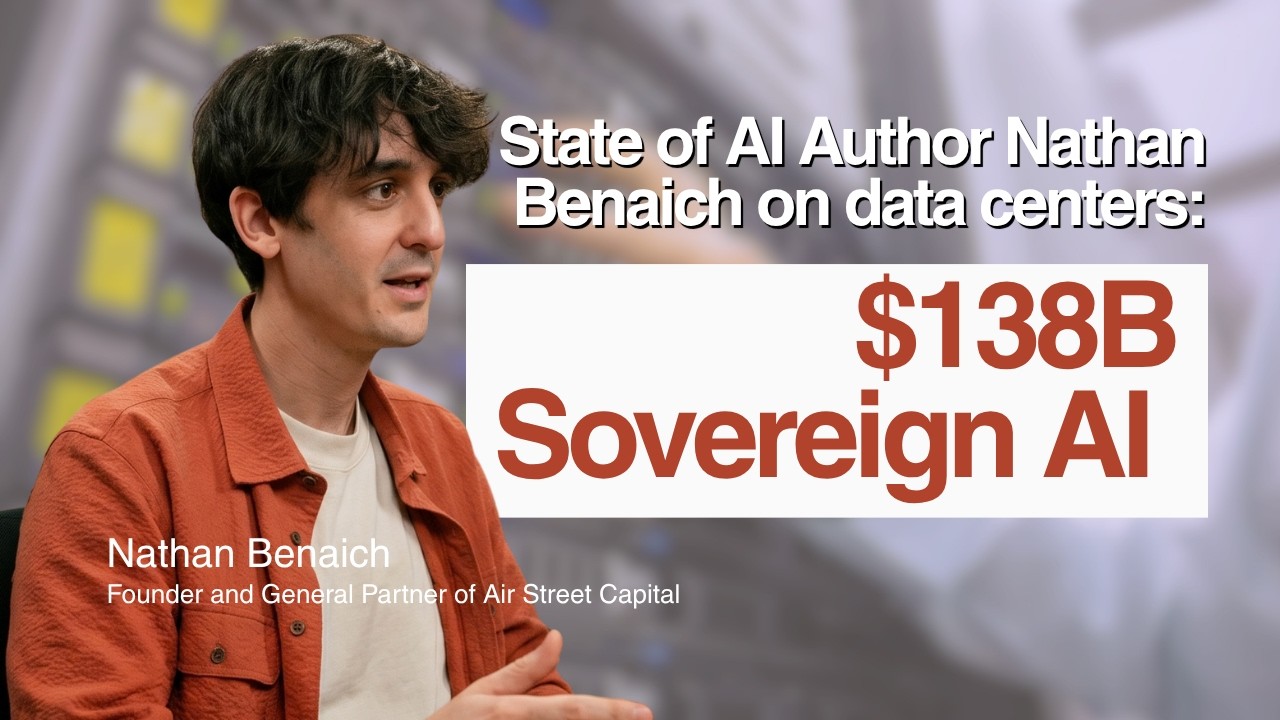
The tension is between capability and distribution. The two leading labs reportedly generate $105 billion in annual revenue, yet Benaich says roughly 80% of consumption comes from 1% of customers. Governments are spending about $138 billion on sovereign compute, and one blocked model release showed how access can be dictated without equity or board seats.
AI guiding AI research — ▶ 3:58
Anthropic's internal index shows Claude guiding 26% of its own model R&D. Benaich adds that Anthropic developers were accepting 8 times more code commits than a few months earlier, correlating with model progress. In an experiment where research paths forked between human and model decisions, humans rated the AI-suggested directions better more often as systems became more frontier. Benaich frames this through AlphaGo's move 37: machines finding global maxima beyond the local maxima humans reach over a career. He acknowledges a scary side, and the evidence is lab-reported.
Longer unattended task horizons — ▶ 6:33
The task length an agent completes at 18% success without human intervention grew from roughly 3-6 hours at the start of 2026 to 36 hours or longer by summer, per Benaich. The hosts cite 4-8 hours rising to 32-64 hours of human labor, so the framing differs. The error rate stayed constant while duration grew. A chart of Codex token usage at OpenAI shows most tokens going to implementation and very few to choosing what research to do. Benaich says growth in that last category would signal recursive self-improvement is advancing.
Robotics' GPT-2 moment — ▶ 10:09
Robotics moved from brittle to promising as modalities merged. Two to three years ago, labs bolted vision models onto language models so robots could perceive and follow natural-language instructions. Now video, world models and robot-action models are fusing; scaling pre-training on video across varied actions produces robots that solve tasks single or zero shot from prompting. Benaich cites Odyssey 3, from an Air Street portfolio company, running a world model on a car driving off-road in India. His explanation is that old ideas, like learning visual common sense from video, lacked architectures and infrastructure that could absorb the data.
Directed protein design — ▶ 14:20
Proteins can be represented as strings of amino acids, so techniques proven on language transfer to biology. Benaich says this replaces random experimentation with directed design: specify the function, train on sequences that perform it. He cites Profluent (genome editors) and Isomorphic. A portfolio company has an eczema drug in a Phase 2a trial, discovered by mining literature and databases for plant-derived molecules. No clinical results exist yet. Benaich expects readouts before long and finds it hard to see drug design returning to the artisanal approach of testing one idea at small scale.
Revenue concentrated in 1% — ▶ 16:46
The hosts cite combined annual revenue of $105 billion at the two leading labs, up from $30 billion at the start of 2026. Benaich stresses that usage is narrow: Ramp data suggests about 80% of OpenAI and Anthropic consumption comes from 1% of customers. Codex token usage is growing faster among legal professionals, recruiters and marketers than developers, from a smaller base. Because the tools work well out of the box, he argues the barrier is knowing what to type, and proposes a Genius Bar or Geek Squad for AI to educate users.
Sovereignty without control — ▶ 18:27
Blocking Mythos outside the US showed that governments need neither equity nor board seats to dictate access, and it shocked Europe. Countries without frontier labs now look to broker access, most plausibly by offering powered land and data centers for inference; about $138 billion is going into sovereign AI across the Middle East, Europe, Asia and the US. Benaich doubts that buying Nvidia GPUs confers sovereignty, since software or interconnect changes could disable them. A study put Europe's cost of reaching the frontier at roughly $1 trillion. Korea spends about $7 billion a year on inference clusters, and the UK's weaker fair-use position pushes some builders to train on US servers.
Frontier offense needs defense — ▶ 23:36
Benaich calls the Hugging Face–OpenAI incident the field's biggest warning shot. A US defender had to use an open-access Chinese model against a US attacker, because frontier labs restrict cyber-related requests to approved users and approval is unlikely to be instant. His conclusion is that frontier offense requires frontier defense, and he predicts labs will ship formal cybersecurity products. He argues Wall Street was wrong to sell off cybersecurity companies after the February Mythos preview, since more cyber is needed. He also prefers calling safety security and robustness, because the safety label polarizes.
Frontier AI has begun to contribute to its own improvement, and the evidence is moving from philosophy toward measurement. Nathan Benaich points to Anthropic's internal index, which attributes 26% of measured Claude model R&D in August to guidance from Claude itself. Anthropic developers were also accepting 8 times more code commits than a few months earlier, a rise that correlated with model progress. A further experiment forked research paths between human and model decisions and had humans rate the results. With more frontier systems, a growing share of the AI-suggested directions were judged better. Benaich reads this through DeepMind's lineage from Go to move 37: the hope is that machines find global maxima beyond the local maxima humans reach over a career.
The strength of that claim depends on what is actually being automated. A chart of token usage among OpenAI researchers using Codex shows most tokens going to implementation, such as data pipelines, data cleaning and infrastructure, and very few to deciding what research to pursue. Benaich trained in computational biology and cancer research, and he treats the choice of problem as the hard part of science. He therefore reads growth in the research-direction category as the real signal that recursive self-improvement is advancing. Task horizons point the same way. The length of task completed at 18% success without human intervention rose from roughly 3-6 hours to 36 hours or longer between January and summer. The error rate held; the duration grew.
The same convergence logic runs through the report's other technical findings. Robotics, Benaich says, is having a GPT-2 moment because image, video, world-model and robot-action work are merging. Scaling pre-training on video across varied actions yields robots that solve tasks single or zero shot from prompting. In biology, proteins are strings of amino acids, so methods proven on text transfer to directed design: specify the function wanted, then train on sequences that perform it. His explanation for the timing is mundane. Ideas such as learning visual common sense from video failed years ago for lack of architectures and infrastructure that could absorb the data. Clinical proof is still pending. A portfolio company's eczema drug is in a Phase 2a trial, and Benaich expects readouts before long.
Capability is advancing faster than diffusion. The hosts cite combined revenue of $105 billion a year at the two leading labs, up from $30 billion at the start of 2026. Benaich cautions that usage is narrow. Ramp data suggests roughly 80% of OpenAI and Anthropic consumption comes from 1% of customers. Codex token usage is growing faster among legal professionals, recruiters and marketers than among developers, from a smaller base. Because the tools work well out of the box, he argues the remaining barrier is knowing what to type, and he proposes a Genius Bar or Geek Squad for AI. The implication, an editorial inference, is that much of the near-term market waits on users rather than models. Benaich does not quantify that headroom.
Access is also becoming a political variable. Benaich's central political finding is that a government needs neither equity nor a board seat to dictate who can use a technology. The blocking of Mythos outside the US landed in Europe as a shock, though he says it remains to be seen whether anyone acts on it. Countries without frontier labs now look for ways to broker access, and he sees powered land and data centers for inference as the most logical currency. About $138 billion is going into sovereign AI across the Middle East, Europe, Asia and the US. Yet he doubts that buying GPUs confers sovereignty, since a vendor's software or interconnect changes could render the hardware unusable. A study put Europe's cost of reaching the frontier at roughly $1 trillion, before any political coordination. Benaich offers no clear path.
Security is where capability and control collide most directly. Benaich calls the Hugging Face–OpenAI incident the field's biggest warning shot. A US company defending against a US attacker had to use an open-access Chinese model, because frontier labs restrict cyber-related requests to approved users and approval is unlikely to be instant. His conclusion is that frontier offense requires frontier defense, and he predicts labs will ship formal cybersecurity products. The episode exposes a trade-off, which is an editorial inference: restrictions meant to limit misuse also slow defenders. He adds that Wall Street's sell-off of cybersecurity companies after the February Mythos preview misread the situation, since more cyber, not less, is needed.
The unresolved issue is whether taste can be demonstrated rather than inferred. Benaich's 2027 proposal is concrete: pit an AI against a human team with the same time and budget, and see whether it completes the experiment 50% faster or with 50% less token usage. A second test asks whether a frozen model running at a company for several months can solve a task 50% better than its predecessor. Until such tests exist, the 26% figure and the human-rated forks remain lab-reported evidence. If the first test succeeds, the debate over recursive improvement shifts from implementation speed to judgment, which is where the OpenAI token chart shows the least activity today.
The open question. Can taste, the ability to choose what research is worth doing, be demonstrated rather than inferred? Benaich's proposed 2027 test is to pit an AI against a human team with the same time and budget and see whether it finishes the experiment 50% faster or with 50% less token usage. Until then, the 26% figure and the human-rated research forks are lab-reported evidence, and the OpenAI token chart suggests automation is still concentrated in execution rather than direction-setting.
Watch the full video at https://www.youtube.com/watch?v=K_g_fIX_rAg.
Comments ()