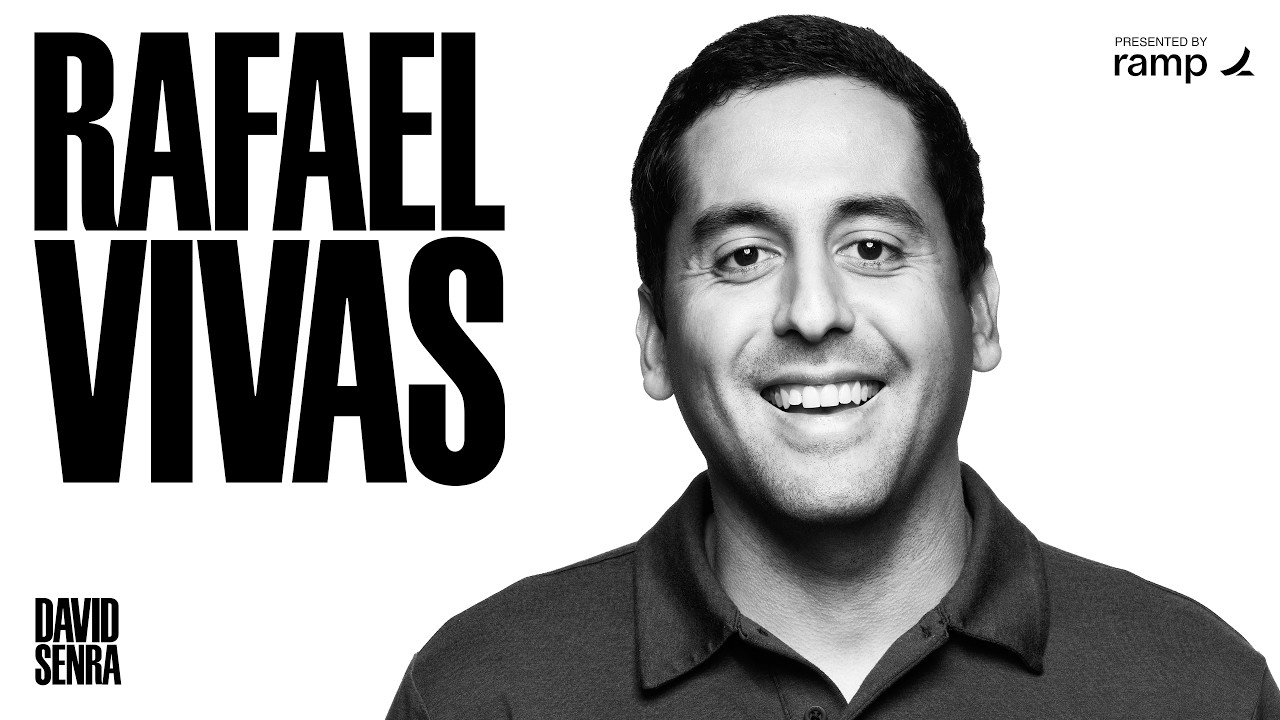
Recorded 1 November 2026 · 67 min
Rafael Vivas, an early AppLovin hire who left school at 16 and moved into the company's office, argues that the company beat funded, credentialed competitors by being more hands-on and more detail-obsessed than anyone else. Founders, he says, should not delegate away the work that determines results, and a team can win by treating every dollar and every small customer account as a performance problem.
The conversation is a founder's own account, so its claims are self-reported and often moral as much as analytical. The tension is between a culture of confrontation, thin management layers and permanent urgency, and Vivas's stated ambition to build a company that outlives him. It also shows how rejection by investors and an outsider's résumé became strategic advantages.
Schooling as bad arithmetic — ▶ 1:27
Vivas started performance media buying at 14 while interning for his older brother's company. He saw colleagues making $20,000-30,000 a day in profit while his teacher earned $25,000 a year, and concluded that school's upside was far lower than putting full effort into performance marketing. He stopped attending classes, worked around the clock, and at about 16 was told to move out by his father, who called his bluff. The decision was a return calculation, not a rebellion, and the same logic reappears in how he later thinks about airfare and headcount.
Deliver value, skip the ladder — ▶ 4:10
Vivas rejects the linear climb of analyst, manager and senior manager as a path that limits both personal growth and the value delivered to a company. His alternative is to ask what matters most to the business and what he can do about it, which he says exposes people to opportunities a ladder would not. He draws the analogy from video games and sports, where merit determines who gets the ball. The claim is untested beyond his own career, but it explains his choices at every stage of the story.
Banned, then building a platform — ▶ 6:49
At about 17, Vivas was banned by an ad platform that saw his team as competitive. He responded by building a rival, Appenda, with engineers his brother supplied. Adam, then buying traffic from him, later launched a competing mobile ad platform, then recruited him instead. Vivas negotiated a stake well above the typical quarter of a percent and one condition: living in the office. With no VC funding and a goofy name, he reasoned, the team could only win by out-hustling everyone, so he moved in and slept in IKEA bunk beds.
Technology beat sales and pedigree — ▶ 15:55
Vivas says Adam understood that technology mattered more than sales. Rivals had hundreds of advertisers and premium publishers but often relied on manual optimization, while AppLovin used rules and regression learning, not state-of-the-art machine learning. Head to head, Vivas says AppLovin often monetized at about double a competitor and would guarantee that in writing. Even though AppLovin was already profitable, a VC pitch to sell 25% for $1 million failed. Vivas attributes this to rivals having Facebook, Google and AdMob résumés while his team came from arbitrage performance marketing. That is his interpretation, not established fact.
Anti-delegation as operating principle — ▶ 21:01
Vivas argues that great leaders must stay in the weeds, citing Michael Jordan getting the ball because he made the shot, not because of seniority. His claim is that heavy delegation forces leaders to invent work for the people they hire, pulling attention to tasks that do not move the needle. AppLovin screens candidates by asking whether they would set up campaigns, upload ads and generate creative ideas. Internally, the team leads with bad news. Customers, he says, call the company competent but arrogant, which he attributes to being opinionated about what advertisers should change.
Persistence means repeated value — ▶ 24:45
Vivas distinguishes useful persistence from spamming. He spent 2 years trying to reach a Miami apps-company founder, Nadeer Khan, and every message offered a concrete way to earn more revenue, such as optimizing a level or fixing a market. Khan's team joked about wanting someone like Vivas, and the relationship eventually turned into substantial business. The same logic explains why a billionaire chases a customer's extra $5,000 a day. Vivas says it signals seriousness and rests on a growth thesis: AppLovin is on pace for $20 billion in advertiser spend, against about half a trillion dollars across the two largest platforms.
Lion Studios: vertical integration — ▶ 30:26
After Cheetah Mobile, a major publisher partner, repeatedly broke an agreement and squeezed AppLovin, Vivas pushed to build a games business to reduce dependence. He cites Netflix and Asian gaming groups such as Tencent and NetEase, which also own distribution. Lion Studios reached over 250 million in revenue within 2 years, profitably, with partners such as Game 5 Mobile and its game Happy Glass, which Vivas says earned close to $100 million. Customers saw AppLovin as a competitor, but Vivas says the data improved the machine learning model. He also admits his motive included wanting to destroy Cheetah.
Needed no more, he left — ▶ 38:41
After roughly 2 years of waking at 4:00 a.m. and working until midnight, Vivas noticed that the game publishing business no longer needed him. He listed where he was a bottleneck, then marked each item off until the business ran without him. He told Adam on his birthday that he wanted time off, at age 28, intending to leave for good. Within 3 months he was building products for fun and found the life purposeless because he didn't care about the products or the people. He returned after AppLovin's IPO stock drop, saying he would have stayed away if the business hadn't needed him.
Buyback while stock collapsed — ▶ 45:34
After the IPO, shares fell from a market cap the host put around $28 billion to roughly $3.8 billion while revenue kept rising. With about $1 billion in cash flow, per the host, AppLovin bought back stock instead of waiting for buyers, and Vivas said they considered taking the company private as Michael Dell did. The host put the eventual windfall at $50 billion, and Vivas agreed. Vivas says he stayed calm because his lifestyle never crept upward and because he frames decisions as return on investment. His example is choosing the 10x cheaper option when both get you to the same place.
Small teams as forcing function — ▶ 48:24
AppLovin keeps headcount low on purpose: managing weaker staff is a distraction, and fewer people forces focus. Vivas says approval layers are minimal and everyone is a doer, even the CTO, who pushes code while managing a 100-person engineering organization. When employees are overloaded, the response is to automate or drop unimportant work, not hire. He traces this to constraint: AppLovin lacked cash and pedigree to hire large teams, so it took available people and had to torture them into greatness. Adam's pressure, he says, is individually tailored, and Vivas has now internalized it.
Mark Rosner's perfection standard — ▶ 1:01:00
Mark Rosner joined as chief revenue officer after redlining the NDA that Adam handed him, a move Vivas first read as untrustworthy and Adam read as diligence. Rosner then mentored Vivas, who says Rosner did over 200 agreements and was burned on only one. When Vivas sent out a deal signed by both sides while his grandmother was in hospital, Rosner caught an error of about 1% or 2% and asked whether he wanted to be Michael Jordan or Tiger Woods. Vivas says he renegotiated the deal, and the episode is the origin of his attention to detail.
Rafael Vivas's account of AppLovin rests on one proposition: in a market where rivals had pedigree, venture backing and large sales forces, the decisive advantage was getting the details right and staying personally close to the work. He offers this as a general philosophy, running from his teenage decision to quit school to his refusal to delegate as an executive. The evidence is self-reported, and there are few outside data points. But the mechanisms he describes are specific enough to examine, and they fit together better than most founder mythology does.
The philosophy starts with arithmetic. At 14, Vivas was interning at his older brother's performance-marketing company, where colleagues made $20,000-30,000 a day in profit while his teacher made $25,000 a year. He concluded that school offered a far smaller upside than full effort in marketing, and he dropped out. He applies the same test to careers generally. The linear climb from analyst to manager to senior manager, he says, limits growth, and the better question is what is most valuable to the business and what he can contribute. The logic is a return calculation, and it recurs throughout the story.
Constraint did much of the strategic work. Banned from an ad platform at about 17 because his team was competitive, Vivas built a rival. When Adam recruited him, AppLovin was pre-revenue, with no venture funding, and Vivas made living in the office a condition of joining, reasoning that out-hustling rivals was the only route to winning. Asked why AppLovin and a similar company led by another founder arrived at saturating young talent with work, he said they lacked the cash to hire large teams and the pedigree to hire the best people, so they had to torture them into greatness. His explanation presents a handicap as the origin of the method.
The competitive bet was technology, not sales. Vivas says Adam saw that rivals leaned on hundreds of advertisers and premium publishers while relying on manual optimization. AppLovin used rules and regression learning rather than state-of-the-art machine learning, and Vivas says it often monetized at about double a competitor. He would guarantee that in writing. Despite profitability and fast growth, an attempt to sell 25% of the company for $1 million was refused. Vivas's explanation is that investors favored résumés from Facebook, Google and AdMob over performance marketers who had run arbitrage businesses. That is an interpretation, but it suggests credentials were a poor proxy for the advantage that mattered.
The operating model follows from the same logic. Vivas is openly against delegation. A leader in the weeds understands what customers need, he argues, whereas a leader who hires to delegate must find work for the people hired, and that work tends not to matter. AppLovin interviews candidates by asking whether they would set up a campaign or upload ads, and it leads internal discussion with bad news. The approach fits a business whose central metric is return on ad spend, where Vivas says data shows right and wrong decisions. He concedes that customers call AppLovin competent but arrogant. How well it transfers to businesses without such a clear scoreboard is untested.
He also reframes persistence as repeated value delivery. His example is a Miami apps founder, Nadeer Khan, who took 2 years to reach. Each message offered a concrete way to earn more revenue, and Khan's team eventually joked about wanting a Vivas of their own. The same mindset explains why a billionaire chases a customer for an additional $5,000 a day. Vivas says it signals seriousness, and he links it to a growth thesis: AppLovin is on pace for $20 billion in advertiser spend, while the two largest platforms together handle about half a trillion dollars. On that framing, small accounts are the path to share, not a distraction.
Two of the company's expansions began with a partner mistreating him, and Vivas is candid that the second was personal. A publisher partner, Cheetah Mobile, broke agreements, and he pushed for a games business to reduce dependence and build economics like Tencent and NetEase. The business reached over 250 million in revenue in 2 years. But he also says his purpose at that point was to destroy Cheetah. The strategic rationale was sound on its own terms, yet its timing and intensity came from anger. Vivas's own sabbatical suggests a pattern: his drive depends on being needed and attached to people, not on money.
That pattern clarifies why he left and why he returned. After 2 years of 4:00 a.m. starts, he made himself unnecessary by listing where he was a bottleneck and clearing the list. Free time, however, proved purposeless, and the businesses he built had neither a mission he cared about nor people he cared about. He returned when the post-IPO stock slump showed the company needed him. The buyback, in which the host put a $50 billion windfall on cash flow of about $1 billion invested in the stock at about $3.8 billion market cap, shows the same temperament. Vivas stayed calm, he says, because he lives cheaply and thinks in returns.
The model has an obvious limitation. Vivas says outsiders see an ad platform outperforming its peers and conclude it must be a scam or fraud. His reply is that scrutiny reveals attention to detail, and AppLovin plans to tell customer founders' stories to make that visible. That response is an assertion of culture, not a demonstration of results, and the transcript gives little data beyond early claims of roughly double monetization. A company's operating philosophy can be genuine and still leave a skeptic unpersuaded.
The larger tension lies in durability. Vivas says he wants AppLovin to outlive him and to be known well beyond the industry. Yet the company he describes depends on founders in the weeds, on a CTO who writes code, on Adam's individually tailored pressure, and on Vivas himself, who says that once the pressure is internalized it no longer needs to come from outside. These are strengths of a founder-led company. They are also the traits least likely to survive growth to the scale he describes. Whether the culture can outlive the founders is the question the conversation leaves open.
The open question. Vivas says AppLovin's results come from small details compounding, yet he also reports that outsiders see an ad platform outperforming its peers and assume a scam or fraud. The conversation offers no data to settle that, beyond early claims of monetizing at roughly double rivals. It also leaves open whether a model built on founders in the weeds, taskmaster pressure and almost no pure managers can survive at the scale he envisions, and without the founders themselves.
Watch the full video at https://www.youtube.com/watch?v=IdvsD61Rmmk.
Comments ()