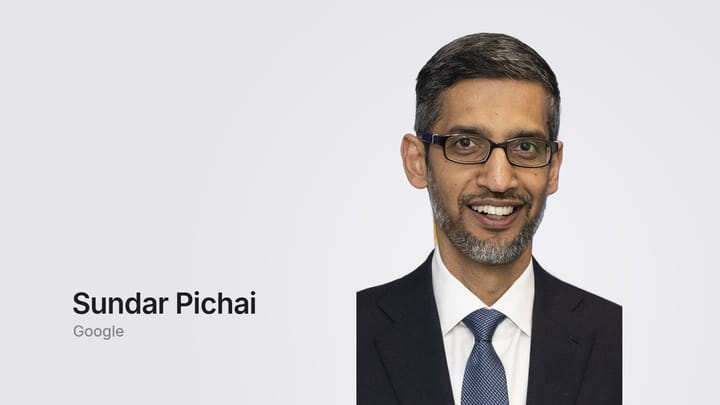

Recorded 21 October 2026 · 59 min
Sundar Pichai says Google lives with compute decisions it made two years ago, before the agentic coding liftoff, and is still capacity-constrained. Gemini 4 Argon drew almost 25 trillion tokens in its first 72 hours, about 3x what Gemini 3.0 managed. His answer is to keep spending on signals he can measure, not on a view about market exuberance.
Alex Heath of Sources interviews him a week after Argon's wider release. Argon is large and expensive to serve, so access is staged while distilled versions are built, and safety testing ran longer than for earlier models. Around that sit agents, Waymo, Wing, space data centers, regulation and quantum.
The tension is speed against restraint. Pichai wants a faster release cadence, deeper agentic capability and a build-out big enough to push free cash flow negative. He also insists that monitoring and safety are what let enterprises deploy at all. He concedes volatility is coming, yet declines to say when compute stops being scarce.
- Demand outruns capacity — ▶ 0:45Argon pulled almost 25 trillion tokens in its first 72 hours, about 3x Gemini 3.0, and Google is still capacity-constrained. Access is staged: Ultra subscribers first, then Pro tier and the Antigravity app. The release valve is distillation. Google can produce versions "nearly as capable but much more efficient," and those are being built for the 4.0 series to widen access. Coding remains the named area to improve, with behavioral refinements coming from user feedback on Argon.
- Safety means monitoring — ▶ 4:25Argon codes well and acts agentically for enterprise customers at scale, so safety testing ran longer than for earlier models. Alignment is only part of it. The bigger investment is compute and systems that watch models while they run: sandboxing, real-time monitoring for early signals that something is off, and telemetry so customers know where an agent runs and what access it has. Pichai notes that monitoring is itself compute-intensive. External testing included a program with the US government and early access for cyber researchers.
- Argon on millions of lines — ▶ 9:07Since Argon rolled out internally, Pichai sees a "step change" in productivity. The example is Chromium: letting a user drag a tab out and into an AI experience without reloading cuts through every layer of a codebase with millions of lines, and historically that stalled teams. Argon can be pointed at it and work through it persistently. He calls 2027 a "golden age" of that productivity frontier. He expects dedicated compute to deliver progress in any verifiable domain, citing recent OpenAI mathematics results.
- Models improving models — ▶ 11:52Humans stay in the loop on recursive self-improvement, partly for safety, but researchers co-work with models that suggest training recipes and evaluate next checkpoints. Some pipeline stages are closer to RSI than others, and the whole continuum is shifting. He expects the next 12 months to show continued acceleration. This also explains 3.5 Pro: Google hill-climbed agentic coding on smaller Flash for more iterative loops, going 3.5 to 3.8 in about 3 months. Argon pre-training finished first, so those lessons went into Argon post-training.
- Compute lags by two years — ▶ 21:26Google builds its own compute, with long lead times, so it lives with decisions made 2 years ago. A year ago the agentic coding liftoff had not happened. Critics judge with today's perfect information, and Pichai says no company would claim it got the call right two years back. Land and power planning already reaches 2028-2029. Google went free cash flow negative over the summer and guided 2027 capex up. The stance is "a long-term optimistic view" with aggressive investment.
- Signals, not hope — ▶ 23:27Resolve comes from stacked signals: demand across consumer and enterprise, Google's own internal adoption, independent reads of the capability curve through scaling behavior and internal evals, research that makes Gemini 5.0 clearly better than Argon, and long-term contracts with committed revenue. On bubble fears, he concedes volatility is inherent but says this is "not fiber" because capacity is used for real value today. He focuses on what Google controls, not exuberance, and hesitated to say when compute constraints end.
- One box for agents — ▶ 36:06Consumer and enterprise Gemini agents share the same model, harness and runtime. Only the context differs. Enterprise tasks run in a provisioned microVM with 24/7 monitoring, governance and auditability, and Google is bringing that to consumers. The vision is "one box," where the line between chat and task blurs. Agentic queries are a steadily rising share of Gemini usage. He answers the Search-Gemini merger question the same way: the cloud-running agent layer, holding your context, unifies the products rather than product convergence.
- Protocols versus browsers — ▶ 39:21Browser and computer use is an elegant interim route because it mirrors what a user does and keeps humans in the loop. Protocols such as MCP and payment protocol UCP scale better, working anywhere instantly, but take longer and will see "chaotic evolution" first. On protecting the ads and engagement interface, he answers on principle: put users first. He points to real estate, which the internet was supposed to transform overnight and which mostly works as it did 20 years ago. Expect "micro equilibriums."
- Partnership-led scale — ▶ 48:08Waymo just crossed 500,000 paid rides per week, with 10 new cities this year, Toronto next, and a stated 95% fewer serious crashes than regular driving. Pichai calls it far from zero-sum with Uber and other partners, and expects the next 12 months to be pure scaling. Selling cars to consumers is not being worked on, but "never say never." Wing's drone delivery follows the same partnerships-led path, with deliveries meaningfully scaled in 2027 and extended to new categories.
- Standards over patchwork — ▶ 53:01Frontier labs now submit models to the US government for testing, voluntarily, which was not true a year ago. Pichai wants the next step to be standardized evals and independent evaluators, modeled on accounting standards and audit firms. He warns that anything codified now could be "just wrong" in 12 months, so he favors building competency and industry standards groups. His firm ask is uniform national rules over a state-by-state patchwork, which he says makes the industry inherently less safe. He argues companies that raise their safety bar gain a competitive advantage.
- Quantum in five years — ▶ 56:27Google's quantum team is tracking or exceeding internal milestones set over nearly 10 years. Pichai sees practical commercial applications within 5 years, and expects Google Cloud to be negotiating quantum deployments at some scale, much as it sells TPU pods today. He admits the long-run possibilities are vast but uncertain, and says the more time you spend with quantum, the less you understand it.
Google is sizing its compute against a capability curve it can measure, not a market mood it cannot. That is the logic holding the build-out together. Pichai describes several independent reads on the curve. One is how new models compare with old ones. Another is the complexity of tasks they can now handle, tracked on internal evals. A third is research breakthroughs. Asked whether Gemini 5.0 will be much better than Argon, he answers yes without qualification. Demand is one signal among these, not the first.
Demand is also unusually well sampled. Google sees consumers, enterprises, its own internal adoption and Cloud customers at once. Add long-term contracts with committed revenue, and Pichai's summary is that the spending is "not just hope." The interviewer suggested Google has more signal than any company on earth. Pichai allowed that you could make the case.
The signals matter because of lead time. Google builds its own compute, so it is always living with decisions from 2 years ago. Planning for land and power already reaches 2028 and 2029. Google went free cash flow negative over the summer and guided 2027 capex higher. Outsiders judge those moves with today's perfect information. Pichai notes that no company would claim it got its own call right two years back. So the posture is to lean in, optimistically and aggressively, and accept what hindsight says later.
Inside Google, the curve looks like this. Since Argon rolled out internally, Pichai sees a step change in productivity. His example is Chromium. Letting a user drag a tab out and into an AI experience without reloading cuts through every layer of a codebase with millions of lines. Teams historically struggled with a feature like that. Argon can be pointed at it and work through it persistently. He calls 2027 a "golden age" of that productivity frontier. He expects dedicated compute to move progress in any verifiable domain, with humans in the loop elsewhere.
The compounding mechanism is models building models. Researchers now co-work with them. The models suggest training recipes and evaluate the next checkpoints. Some pipeline stages sit closer to recursive self-improvement than others, and humans remain in the loop partly for safety. Pichai expects the next 12 months to bring continued acceleration. The cadence is already visible. Google ran from 3.5 to 3.8 Flash in about 3 months by using the smaller model for more iterative loops on agentic coding. By the time that was done, Argon's pre-training had finished. Pro's lessons went into Argon's post-training instead.
Scarcity shapes safety too. Argon is large and expensive to serve, so access is staged: Ultra first, then Pro and the Antigravity app. Distilled versions, "nearly as capable but much more efficient," are coming with the 4.0 series. Pichai says the heavier safety investment is not only alignment. It is the systems that watch models while they run: sandboxing, real-time monitoring, and telemetry so customers know where an agent runs and what it can access. That monitoring is compute-intensive. In his framing, safety is the deployment layer enterprises need, and companies that raise the bar will hold a competitive advantage.
That framing explains his regulatory stance. Labs now submit models to the US government for testing, voluntarily, which was not true a year ago. He wants the next step to be standard evals and independent evaluators, like accounting standards and audit firms. He is wary of codifying too early, since anything written now might be "just wrong" in 12 months. His firm demand is one national standard instead of a patchwork of state rules, which he says would make the industry inherently less safe.
Agents then reshape the product surface. Consumer and enterprise agents run the same model, harness and runtime, and the vision is one box where chat and task blur. Agentic queries are a steadily rising share of Gemini usage. This is also his answer to whether Search and Gemini merge. The agent layer unifies them, not product convergence. On the open web, he expects browser use and protocols to coexist. Protocols scale better but take longer. On what agents do to ad-driven interfaces, he reaches for history. The internet was supposed to transform real estate overnight, and most of it still works as it did 20 years ago.
The strongest objection is the one Pichai steps around. Almost everything above is evidence about Google's own position. Asked about neocloud fears and brittle financing, he concedes volatility is inherent but says "this is not fiber." Capacity is fully used, for real value, today. Then he separates two questions. Whether Google is well placed is one. Whether the industry overshoots is another. He puts his energy on the first and less on whether there is too much exuberance. That is coherent for a company that controls its own inputs. It is less comforting to anyone pricing the whole system.
He was just as careful when asked if he can see a point where Google is no longer compute constrained. He hesitated, worried that "everyone will freak out," and then said no smooth path is promised. There is a second gap. Utilization measures only today, while the commitments run to 2028 and 2029. And the independent read on the capability curve is built partly from Google's own evals.
The long bets run on the same logic and ask for the same patience. Waymo passed 500,000 paid rides per week and Pichai cites 95% fewer serious crashes. Space-based compute is a moonshot he compares to starting Waymo. Quantum, he expects, reaches commercial deals within 5 years. All are views of 10 to 20 years. What stays unresolved is whether the signals he trusts lead the market or simply reflect Google's own spending.
The open question. Pichai's confidence rests on signals that are mostly Google's own: its internal evals, its internal adoption, its own contracts. His case that this is "not fiber" is that capacity is fully used today, but utilization only measures the present, while the commitments he describes reach 2028 and 2029. He deliberately separates "is Google well placed" from "does the industry overshoot," and answers only the first. The second, including neocloud financing, is exactly where a shock would come from. Watch whether the capex guide and committed-revenue backlog keep rising together.
Watch the full video at https://www.youtube.com/watch?v=fJBSNEFdm8c.
Comments ()