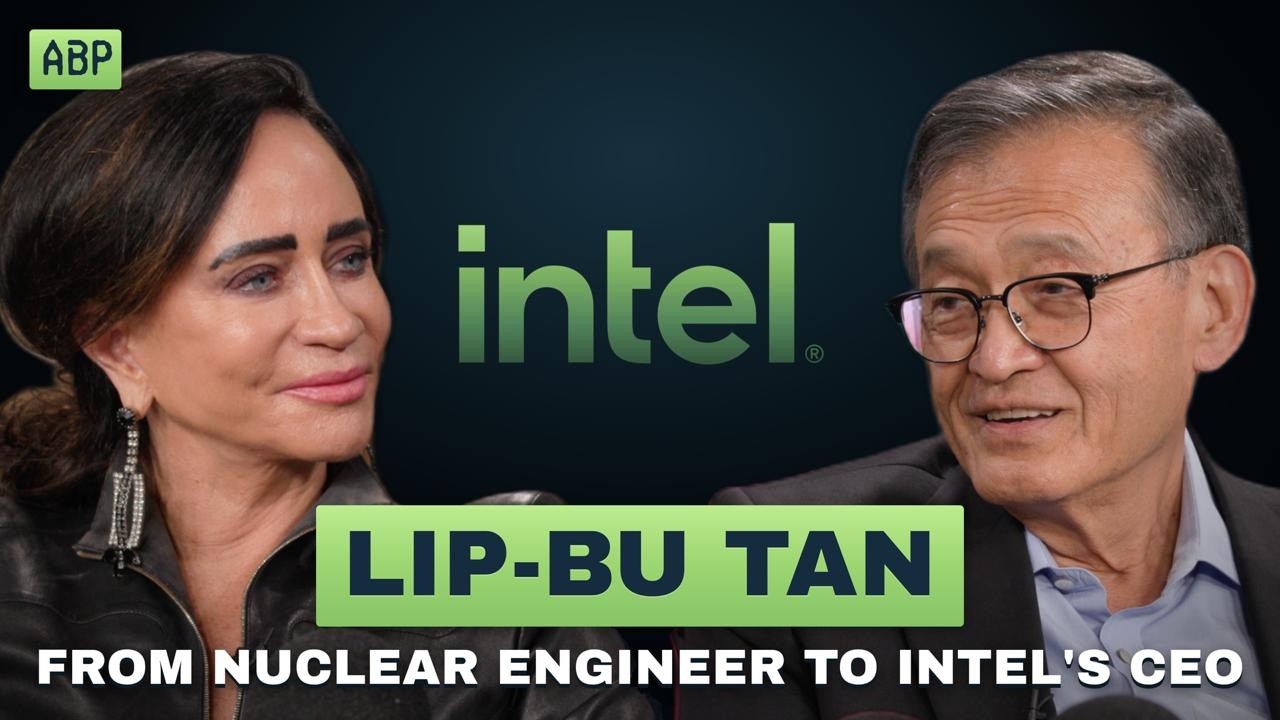
Recorded 25 September 2026 · 63 min
Lip-Bu Tan, CEO of Intel, says his leadership rests on preparation, work ethic and calculated risk rather than force of personality, and that he treats supposed rivals as partners. The sharpest test came when President Trump asked him to resign over his past China-related venture investments. Within days, Tan says, he was negotiating a deal that would make the US government an Intel shareholder.
The host, a longtime friend, presses on a contrast: a reserved, gentle man who has spent decades making tough calls at Walden International, Cadence and now Intel. The tension is whether a consensus-seeking style can carry one of the industry's hardest turnarounds. Nearly all evidence comes from Tan himself, and the interview is personal rather than operational.
Respect as management tool — ▶ 2:38
Tan attributes his quiet manner partly to an Asian upbringing and says he speaks only when he can add value. On hard calls he relies on gut and experience, then addresses people respectfully. Some executives he removed as a VC remain friends, and some now approach him as investors because he explained his reasoning. He says he seldom gets angry; betrayal or dishonesty prompts him to correct the facts without being offensive. These accounts are self-reported, but they show a style built on candor rather than intimidation.
Unpaid start at Walden — ▶ 21:10
After a nuclear analysis job and a startup, Echo Energy, where he became CFO after taking an evening MBA course in finance, Tan sought a venture job. About 12 firms gave him no offer. Walden Capital agreed to give him space after he said he would not need pay and would supply his own money. He started with roughly $3 million from friends, family and his father-in-law, and says he built Walden International to about $5-6 billion under management.
Signal, noise, and 10x — ▶ 25:07
Tan evaluates founders first: honest, coachable, with stamina for the near-death episodes he says every startup faces, and a team around them. He distrusts founders who brag about strengths and hide weaknesses, and runs his own reference checks. Over time he added market discipline from working with top-tier VCs: a big market, customers willing to pay, and in semiconductors at least a 10x performance gain, since 2x is not worth the bother. He wants hyperscale customers such as Amazon, Microsoft and Google. He says he has lost fewer than 10% of his companies, a self-reported figure.
Bets on AI bottlenecks — ▶ 27:52
Tan names the areas he is investing in as those that will drive AI growth: quantum computing, where he backs three startups, one already public; high-speed optical connectivity, including Celestial AI, which has been sold; microfluidic cooling; and frontier-model software. He is also investing in AI for medicine, and joined the UCSF board partly for that, funding three startups from UCSF faculty. The list reflects interest rather than evidence. He offers no returns, though the focus on interconnect and cooling matches the infrastructure constraints he treats as central.
Leadership can be learned — ▶ 31:45
Tan argues leaders are developed, not born. A personality test first rated him an ultra introvert and, five years later, an ultra extrovert. He took the Cadence CEO job with no CEO experience and no EDA knowledge. He read three books, including CEO for dummies, told an all-hands meeting he was a first-time CEO, and answered every employee email, several hundred a day. Some employees taught him the tools. His stated edge is lack of bias, fast learning and effort: nobody will work harder than him.
The 70% rule — ▶ 34:33
At Cadence, Tan lost sleep for his first three weeks, fearing mistakes affecting so many employees. Mentor Mushi, a former Cadence executive who later became CEO of another company, told him that getting 70% of decisions right makes a damn good CEO. Tan says it lightened his load. The hardest part of the turnaround was changing culture and, sometimes, leadership. A professor's parting advice, to keep his eyes open and take calculated risks, also shaped his choices. He drove 1.5 hours each way to Santa Clara for 15 years.
Mission, tested by friends — ▶ 38:46
A chief-architect friend texted Tan to save Intel before retiring. A wife's veto had stopped an earlier candidacy five years ago; she later urged him to quit Intel's board because he could not sleep, then backed the CEO role. A customer-friend came for two hours to dissuade him, then checked that his motives were pure: not money, not power, not publicity. Tan says that conversation mattered. Friends called the task impossible. Five months of discussions followed, including how he would turn Intel around.
Removing himself from the equation — ▶ 43:58
Tan says Trump asked him to resign over a conflict: his past China investments, at a time when China had become the main competitor and Intel was close to government. He notes four or five other big venture institutions faced similar questions. After a disrupted 5:00 a.m. call, he told himself the issue was not about him and he did not need the job. He prepared communications and arranged a Monday 4:00 meeting, where he stressed he never lived in China and had been a US citizen for 40-plus years.
Government stake as infrastructure — ▶ 48:18
Trump asked how long a turnaround would take. Tan said two years, then was asked whether he would like the US government as shareholder. He had prepared an answer: Taiwan's government owned 48% of TSMC at its start, and Singapore and Japan hold stakes in chip makers. He framed fabs as infrastructure, like roads and bridges, and argued leading-edge design and manufacturing must be developed in the US, with Intel the best platform. Trump agreed, and Tan had four days to negotiate a deal for a Friday announcement.
Partners, not competitors — ▶ 51:18
Tan says he does not view people as competitors, and business is not zero-sum despite his competitive nature. Jensen, whom outsiders saw as a rival, invested $5 billion in Intel and works with it on R&D. Lisa Su bought three of Tan's venture companies. He remains a top-10 TSMC customer, and says TSMC's CC Wei told him he cannot build enough capacity for the AI boom and wants Intel to succeed in foundry. Tan, citing Jensen, says he aims to create his own market and niche.
Shared load, single audience — ▶ 55:17
Tan says his greatest encouragement is that customers, and even competitors, want Intel to succeed, and that talent he recruited now shares the load. Early on he held 22 meetings a day; he now has 10-12. He says faith, accountable to one audience, relieves quarterly-earnings stress, though shareholder value remains the CEO's first responsibility. His model is team-building: as captain of a last-place basketball team, he says, it became champion by graduation. He reports that his sons and grandsons do not see him as Intel's CEO.
Lip-Bu Tan's account of himself rests on a claim that sounds modest: his quiet manner and his appetite for hard decisions share a source, which is preparation. He reads the background of anyone he meets and asks for a one-page sketch or a few slides in advance. Then he zooms in on the questions he wants answered, so a meeting can run half an hour rather than work through a deck. When a decision is difficult, he asks for a night and says he spends it working rather than sleeping. His own summary is that "nobody will work harder than me." Respect, in his telling, follows from effort, and authority follows from respect.
The pattern repeats across his career. As a young nuclear engineer he spent six months of nights and weekends on statistical work to prove a design correct to his employer's biggest customer. He says that saved the company, and colleagues later recruited him into a startup. There he became CFO after starting an evening MBA course in finance. At Cadence he had no CEO experience and, by his own admission, no knowledge of electronic design automation. He read three books, including one titled CEO for dummies, told an all-hands meeting he was a first-time CEO, and answered every one of the few hundred emails he received daily. He also argues temperament is not fixed: a personality test that first labeled him an ultra introvert labeled him an ultra extrovert five years later.
His venture filters are the same method applied to other people. He starts with what he calls signal and noise: is the founder honest and coachable, does he understand what he is doing, does he have the stamina for the near-death episodes Tan says every startup endures, and has he built a team rather than a personal showcase. Founders who brag about strengths while hiding weaknesses fail the test, and he runs his own reference checks rather than trusting the ones supplied. The second filter is market. In semiconductors he wants at least a 10x improvement, not 2x, and customers willing to pay, ideally hyperscalers such as Amazon, Microsoft and Google. He says he has lost fewer than 10% of his companies, a self-reported figure the interview does not define.
The same screening was turned on Tan when he considered Intel. A friend who was also a customer came to his house for two hours and told him not to take the job. He then tested Tan's motives: Tan did not need the money, was not power-hungry, and disliked publicity, which Intel would bring in volume. Having checked, the friend concluded Tan had already decided. Another friend had texted him a line he kept: before you retire, save Intel. His wife had vetoed an earlier candidacy five years before, citing a new grandson. Tan says her consent was the last hurdle and that he would not have proceeded without it. Earlier advice from a mentor, that getting 70% of decisions right makes "a damn good CEO," had taught him to accept error as the cost of deciding.
The sharpest test of that temperament was the president's call. By Tan's account, Trump asked him to resign because his past investments in Chinese semiconductors created a conflict at a company close to the government. He notes that four or five other large venture institutions faced similar questions. The call came at 5:00 a.m. on a Thursday and disrupted his routine of swimming and the gym. His response was procedural. He told himself the issue was not about him and that he did not need the job. Then he prepared how to communicate and how to secure a meeting, which took place Monday at 4:00. There he stated the facts: he never lived in China, grew up in Singapore, and had been a US citizen for 40-plus years.
The meeting turned on a question Tan says he had prepared for: would he like the US government to be a shareholder? His answer reframed state ownership as precedent. He cited Taiwan's government owning 48% of TSMC at its start, and stakes held by the Singapore and Japanese governments in chip makers. He called fabs infrastructure, like roads and bridges, and argued the most complex process nodes must be developed in the US, with Intel as the best platform. Trump announced he wanted a deal by Friday, leaving four days. The editorial point is that Tan converted a political vulnerability into a strategic argument. The transcript does not give the deal's terms, so how it benefits Intel beyond Tan's assertion remains unstated.
Partnership is the other pillar of Tan's self-description. He says he never views people as competitors, and cites his experience as a basketball and volleyball player who likes to win but does not see business as zero-sum. Jensen, whom outsiders considered a rival, invested $5 billion in Intel and works with it on R&D. Lisa Su bought three of Tan's venture companies. He says TSMC, widely assumed to be his chief adversary, is a partner, noting he is still a top-10 TSMC customer and describing a recent lunch with Morris Chang. Tan relays that CC Wei told him he cannot build enough capacity for the AI boom and would like to see Intel succeed in foundry. Tan's stated strategy is to create his own market and niche.
The limits of the evidence are material. The host is a longtime friend and the interview is deliberately personal, so most claims about decisions, partnerships and investment record go unchallenged. The turnaround itself receives little operational detail. Beyond the two-year estimate Tan gave the president, and the host's observation of seven quarters of beating expectations and the best growth rate in 15 years, the transcript offers no figures. The partnership framing also sits uneasily with the competition it describes. Tan told Jensen he is a partner, not a competitor, yet both an investor and a foundry customer relationship require Intel to win business that TSMC currently serves. Tan treats those facts as compatible; the conversation does not test whether they are.
What sustains the effort, he says, is a mix of encouragement and discipline. He cites customers and competitors who want Intel to succeed, and talent recruited who share the load. He has cut his early schedule of 22 meetings a day to 10-12, with one dinner. He says faith frees him from worrying about outcomes, even quarterly earnings, while shareholder value remains the CEO's number one responsibility. His model is the team, from the basketball side he captained from last place to champion. The unresolved issue is whether stated goodwill can become committed volume, and whether a style built on respect and a tolerance for 30% error is enough for manufacturing decisions where the stakes are far higher.
The open question. Tan says customers, competitors and former colleagues all want Intel to succeed, and he cites that goodwill as his greatest encouragement. Goodwill is not the same as orders. If TSMC cannot build enough capacity and wants Intel to succeed in foundry, will customers actually move work to Intel? The interview does not show how Tan's non-zero-sum framing survives that competition. It also offers no detail on how he plans to deliver the two-year turnaround he promised the president.
Watch the full video at https://www.youtube.com/watch?v=Nz2e-RJdRso.
Comments ()