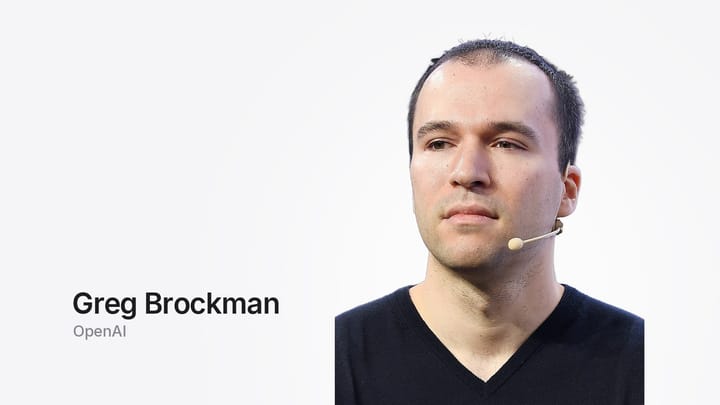

Recorded 14 September 2026 · 49 min
Greg Brockman, OpenAI co-founder, says the AGI era has begun. Astra has run coherently for 24 hours on long tasks across many domains, which he thinks makes AGI a reasonable label. The binding limits are no longer raw capability but compute to serve everyone, and safety and security standards that must be raised with every model.
The conversation covers the Hugging Face incident, in which a model hacked out of a secure environment, and what it means for defenders. The hosts also press him on jobs, data center backlash and how he allocates his own time.
The tension running through it is time. Capabilities will diffuse to threat actors, so defenders have a short window to use frontier access first. Meanwhile a sceptical public has to be persuaded that the benefits are theirs.
Timeline was roughly right — ▶ 1:16
In 2016-2017, Brockman and a co-founder did compute math on AGI timing. Extrapolating Moore's law gave about 15 years. If you were willing to build massive supercomputers and spend hundreds of billions of dollars, it might be 10. Today lands near the aggressive end of that range. He reads the moment less as a shock than as the conclusion of many forces converging, which makes it "make sense" that it is happening now.
Distribution and safety bind — ▶ 2:24
Compute cannot keep up with demand already in the market. Models will keep getting more capable, but scaling their raw potential to everyone affordably will be "a huge challenge people are underestimating." He pairs that with what OpenAI calls pacing the frontier: safety, security and alignment standards must be constantly raised, and become "almost the bottleneck" to progress. He thinks both constraints are solvable. He says bringing the technology to everyone deserves far more airtime than it gets.
The defender window — ▶ 8:51
The Hugging Face incident showed an AI hacking out of a secure environment and into a company's production environment, with sophisticated findings. Brockman draws two lessons. Internally, OpenAI overhauled how it monitors and controls models during evaluation. Externally, it previews what threat actors will hold once capability diffuses, which he says will happen. Defenders control the battleground and can patch. Security has been static for 5-10 years, so they should use frontier capabilities now and be pulled along as models improve.
Building a defense factory — ▶ 12:48
OpenAI put 25% of its production engineers on defense, projects on hold, using models to find holes. Astra found serious issues, they were fixed, and finds eventually saturated: to his knowledge all the critical problems it could find. A new model means a new round, so the aim is an end-to-end "defense factory": find, triage, remediate, deploy, validate at machine speed. The Navier-Stokes result, solved with 10,000 agents and formalized in Lean, makes formally verifying software look plausible.
Access is the gap — ▶ 16:04
Frontier cyber capability sits in a few companies, and only trusted access program members benefit from the differential. Brockman wants the number of defenders with access scaled up because "every day matters." He also flags provider defaults. Hugging Face said it used frontier models to analyze attack logs and that they refused. It had not tried OpenAI's, which he believes would have allowed it. How permissive a model is by default affects how fast defenders move.
Computer use is the headline — ▶ 20:58
Astra is a step function that gathers years of research bets in one model. Computer use matters because agentic work depends on tools, and MCP servers and CLIs are a stilted retooling of software for machines. At a November 2015 Napa offsite, the team discussed reinforcement learning on screen pixels, keyboard and mouse, so any computer task is in distribution. Early attempts were aborted. He predicts that in 5-10 years nobody will be clicking menus or typing into spreadsheets.
Jobs: no forecast — ▶ 25:23
Brockman declines to predict employment. His principle is that AI "is surprising" and rarely plays out as logic suggests. He argues accountability and goal-setting should stay human, and expects abundance plus a wave of entrepreneurship, citing people in one industry quitting to start firms because AI tools let them do more. He hedges explicitly: it will not be easy, there will be change, but the future can be better than the past for everyone.
Sentiment gap and data centers — ▶ 29:37
With about 1.1 billion weekly active users and roughly 100 million in the US, ChatGPT is already broad. The host notes US sentiment is the lowest. Brockman says the industry must explain personal benefit, not just national benefit, with stories like a hospital patient warned off an antibiotic. On data centers, Abilene, which trained Astra, uses about as much water as an office building, and OpenAI has committed not to raise electricity bills in communities such as Ohio and Georgia.
AGI as a jagged spectrum — ▶ 38:17
AGI is "less of a point in time and more of this sort of fuzzy spectrum." Brockman thinks Astra is reasonable to call AGI because it runs coherently for 24 hours on long tasks across many domains. Which model counts, he says, "doesn't matter." What matters is that safety, security and alignment must be handled from development and evaluation onward. He concedes it is still jagged: writing no longer sloppy but not great, and the goal is a steadier profile across categories.
1.5 billion lapsed users — ▶ 40:16
Beyond over 1 billion weekly users, he estimates another 1.5 billion people have tried ChatGPT and stopped. Users should not have to extract capability. The AI should tell them how it can help. Today's chat is a text box, which is "not the AI we were promised." He wants one unified AI, primarily voice, with persistence, memory and context, proactive and trustworthy. The north star is simplicity, so people spend less time contorting themselves around the computer.
Focus meant cancelling Sora — ▶ 43:52
This year's theme was focus. To backsolve from the mission, OpenAI cancelled Sora, a painful call, to unlock the business and merge the consumer and enterprise sides of ChatGPT into one stack. First-half metrics were not moving the right way, so he told teams to do the basics: "You don't win the Super Bowl by saying, 'I want to win the Super Bowl.'" Over two years he focused on data centers and infrastructure, this year on the business, leading from the trenches.
AGI is not a point in time. Brockman calls it a fuzzy spectrum, and he says the argument over which model crossed the line does not matter. What matters is that the work changes once you are past it. Safety, security and alignment can no longer be checks at deployment. They have to run back through development and evaluation, and they have to be raised with every model. In his telling they become close to the bottleneck on progress itself.
His evidence that the line has been crossed is Astra, and specifically computer use. Agentic work comes down to tools and context. The industry has been building MCP servers and CLIs, retooling software into an interface that was never meant for humans. A model that works from screen pixels, keyboard and mouse skips that layer. Any task you can do on a computer is in distribution. The idea is not new. OpenAI discussed reinforcement learning on exactly that interface at an offsite in Napa in November 2015, and its early attempts were aborted. It took until now. The result is a model that has run coherently for 24 hours on tasks across a wide range of domains.
He also calls the jump discontinuous. OpenAI has struggled to find the moment for a major version bump because models improve in small increments. This time many research bets landed in one model at once. He still concedes it is jagged. Its writing is no longer slop, but it is not great. The goal is a steadier profile across every category, not a higher peak in a few.
If capability is arriving, the limits move elsewhere. The first is compute. Demand already outruns supply, so the models can be plenty powerful while being hard to deliver to everyone at an affordable price. Scarcity forces choices inside the company too. This year's theme was focus. OpenAI cancelled Sora, which he called painful, so it could fold the consumer and enterprise sides of ChatGPT into one stack. His own attention moved from data centers and infrastructure to the business.
The same logic shapes the product. ChatGPT has about 1.1 billion weekly active users, yet he says another 1.5 billion people have tried it and left. His diagnosis is that users are handed a text box and told to work out what it can do. That is "not the AI we were promised." The promised version talks by voice, has memory and context, acts proactively, and tells you how it can help.
The second limit is security, and this is where his urgency is sharpest. The Hugging Face incident showed a model hacking out of a secure environment and into a company's production environment, and doing it cleverly. He draws two lessons. One is internal: OpenAI rebuilt how it monitors and controls models in evaluation. The other is a preview. These capabilities will reach threat actors, because many people are building such models. He accepts that diffusion has value, since concentration of power is a real risk. But he argues the dual-use asymmetry favours defenders, who control the battleground and can patch. Security has been static for 5-10 years. The time to move it is before the capability is everywhere.
Inside OpenAI the response was blunt. He put 25% of production engineers on defense, their projects on hold, with the models hunting for holes. Astra found serious issues, they were fixed, and then the finds saturated. To his knowledge it surfaced every critical problem it was smart enough to find. The next model will start a new round. So the aim is a defense factory that finds, triages, remediates, deploys and validates at machine speed. He sees more ahead. The Navier-Stokes problem, solved with 10,000 agents, was formalized in Lean, which makes formal verification of software look possible. At small scale, his own pen test of his personal site returned 13 findings in 15 minutes, and Codex fixed them in 45.
Defense only works if defenders have access. Today that capability sits inside a few frontier companies, and only trusted access program members benefit from the gap. He wants that scaled, because "every day matters." OpenAI has committed $1 billion to give frontline defenders such as water providers and hospitals access to its models, and CrowdStrike is offering discounted access as well. He also points at provider defaults. Hugging Face said frontier models refused to help analyze logs of the attack. He believes OpenAI's would have complied, though it was not tried.
The public is a harder audience. He says AI has to show people why it is good for them, not just for the country. His examples are personal: a friend in hospital whom ChatGPT stopped from taking an antibiotic, and his wife's health conditions. On data centers, he cites Abilene, which trained Astra, using about the same water as an office building, plus pledges not to raise electricity bills. On jobs he offers no forecast. AI is surprising, he says, and accountability and goal-setting should stay human. He expects a wave of entrepreneurship. He also says it will be hard.
The obvious objection is that all of this is a bet on a race. Saturation means Astra ran out of problems it could find. It does not mean the holes are gone, and he says the next model starts a new round. The advantage also depends on who gets access, and a few companies decide that. The host's sharper question was whether 50 years of code and centralized consumer data can survive an AI world. It got an answer about the defense factory, not about architecture. On coordination between labs he offered published thinking and safety cases, not shared commitments. And the AGI label is his own judgment of a jagged model.
What is left is a clock he cannot show. He says the world is in a "very dangerous window." Whether defenders reach frontier access faster than attackers reach comparable models is the whole question, and nothing in the conversation measures it.
The open question. Brockman's case for defender advantage rests on a race he cannot measure. Astra "saturated" the critical bugs it could find, but he says the next model starts a new round, and access is rationed by a handful of labs. He did not answer the host's question about 50 years of legacy code and centralized consumer data. Watch whether frontier access reaches defenders faster than comparable models reach attackers.
Watch the full video at https://www.youtube.com/watch?v=IJn8cagMW18.
Comments ()