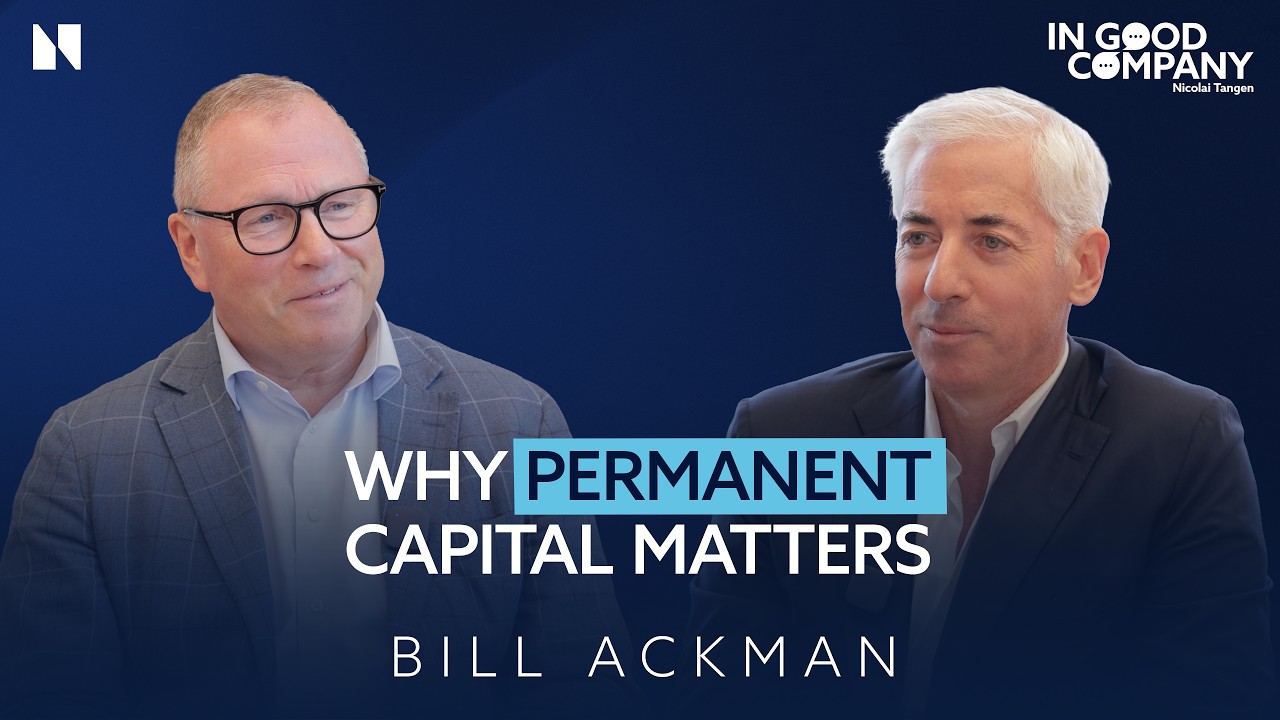
Recorded 28 October 2026 · 53 min
Bill Ackman, founder of Pershing Square, runs a portfolio of 12-14 investments and argues that his decisive edge is structural rather than analytical: permanent capital that lets him own great businesses when short-term holders are forced to sell. Interviewer Nicolai Tangen, who runs Norway's sovereign wealth fund, credits him with compounding at 16% over a long period.
The tension is that Ackman sees AI, indexation and leveraged short-term money making markets more volatile, which creates the discounts his strategy feeds on. He also expects AI to turn intelligence into a commodity. The conversation also covers how he tests conviction, his shift away from combative activism, and a personal turn toward brain-recovery research.
Structure over sector — ▶ 1:02
Ackman defines a great business as one he could own through a 20-year market closure with enormous certainty that it would still be valuable. The ideal resembles a royalty collector or annuity: it grows at a high rate for a long time and does not need its cash reinvested. He says structure matters more than industry. McDonald's is a restaurant business, but also a real estate business and a franchising operation. He estimates only a couple hundred to 300 truly great businesses exist. They rarely trade at a great price, which is why Pershing Square concentrates and writes large checks.
Predictability as the filter — ▶ 7:34
Pershing Square converted its principles into a checklist. The first test is whether the firm can model a business over 10, 15 or 20 years, because value is the present value of lifetime cash flows. If it cannot model the business, it does not look at it. It also wants a moat and avoids exposure to commodity, interest-rate and regulatory factors it cannot control. Ackman contrasts this with funds that trade on earnings beats and misses or expected news events, which the firm deliberately ignores.
No individual P&Ls — ▶ 9:07
The firm has 48 people, nine of them investment professionals, and one portfolio of 12-14 investments. Nobody is paid on an individual P&L. Ackman argues the typical hedge fund rewards analysts for winning capital, which pushes them to lean into their own ideas. At Pershing, two people do the deep work, two do partial work, and the rest of the team has nothing invested before judging a presentation. Objections trigger more diligence. Ackman has the final say but cannot recall an investment in the last decade without a collective view.
AI shortens market horizons — ▶ 13:48
Ackman says AI is making market participants shorter-term: a 10-K can be read instantly, and a great deal of capital is hunting for a short-term edge. His response has been to buy after sell-offs tied to spending. He bought Amazon after Trump's tariff announcements, and Meta and Microsoft after they disappointed investors by committing more capex than expected, in Microsoft's case citing demand it could not otherwise meet. Those holdings are about a third of the portfolio. He adds that every business is AI-related, or should be, or will be disrupted by AI.
Intelligence as commodity — ▶ 15:08
Ackman expects AI to give almost everyone access to very low-cost, very high intelligence. If intelligence is a competitive advantage and becomes a commodity, he argues, creativity is what remains for humans. He doubts AI can be creative yet: nothing read before Einstein would have yielded relativity. He also predicts abundance, with an explosion of entrepreneurship and of global GDP growth. These are forecasts supported by an illustration rather than evidence, and the timing and mechanism of the growth are not specified.
Activism without breaking doors — ▶ 17:00
Ackman's last activist investment launched in 2016. He says CEOs now often send thank-you notes when he takes a stake, where once he might not have received a return call. He credits activism's broader acceptance, his firm's reputation and his familiarity with every CEO in America. He also says market structure changed: indexation reduces float and leveraged short-term capital adds volatility, so a quality business that once fell 3-4% on a miss can now fall 30-40%. That makes durable growth companies available at a discount, and he is content as a quiet owner.
Founder control and succession — ▶ 23:10
Ackman believes founder-controlled companies, citing Warren Buffett, Sam Walton and Elon Musk, can make smarter long-term decisions in a short-term market. He doubts the next generation should inherit that control, prefers one share, one vote, and generally avoids controlled companies unless the controller is a phenomenal CEO. He also ranks CEO quality below business quality, growth and durability, since a weak CEO can be replaced. Great businesses usually reach attractive prices, in his experience, because management has made a series of mistakes.
Permanent capital as arbitrage — ▶ 25:45
Ackman says Buffett, in 1969, gave up a right to 25% of profits over a 6% return, returned investor capital, and took control of a textile business on a $100,000 salary with no incentive fee. His reading is that Buffett concluded capital that could vanish would impair compounding. Ackman says Pershing's permanent capital let it deploy aggressively during COVID without worrying about month-end redemptions. He calls the result "time arbitrage", and says outside sovereign wealth funds very little capital in asset management is permanent.
Howard Hughes becomes insurer — ▶ 28:36
Ackman calls Howard Hughes his version of Buffett's textile business: a good real estate operation, but one where the market assigns a high cost of capital that is hard to exceed. The plan is to shift capital out and into insurance, aiming for a company that is 80%+ insurance and about 20% real estate in a decade. He distinguishes the approach from Apollo's levered spread model. His insurer underwrites property-casualty risk with much lower leverage, holds float in short-term Treasuries, and invests part of the equity in common stocks.
Steelman before conviction — ▶ 34:21
Ackman's test for investment conviction is to find the best short seller of something he owns and try to rebut each argument. If he can, he can be more confident. He applies the same rule to other beliefs, using X, where he follows about 1,000 people, to find the most articulate voices on each side of an issue. He argues that media owners shape coverage and that engagement-driven social platforms push people toward their existing views. He would like a button that surfaces the best counterargument to any post.
Brain recovery as a bet — ▶ 40:09
After his 26-year-old daughter suffered a brain hemorrhage, Ackman concluded the field of brain rehabilitation is underserved, partly because many neurosurgeons and neurologists are, in his word, nihilists. His daughter is regaining function, though he says she has lost roughly 98% of her vision. He has assembled a 3.4 acre New York site with a 400,000 foot biotech building and is recruiting to run an institute. He predicts that AI, better signal interpretation and brain-computer interfaces will let the blind see and paraplegics walk in years, not months.
Bill Ackman's central claim is that an investor's edge today lies less in information than in time horizon, and that horizon is set by who owns your capital. He observes that most asset-management money can be pulled daily, quarterly or annually, which makes it hard to hold the dispassionate view of volatility that good investing requires. Pershing Square, by his account, has permanent capital, and he describes the consequence concretely: when COVID hit and markets were melting down, the firm could deploy aggressively because it was not worried about month-end redemptions. Much of what he describes, from the companies he buys to how his team is paid, reads as a consequence of that single structural advantage.
Ackman traces the logic to Warren Buffett. In 1969, he says, Buffett was running a hedge fund with a right to 25% of profits over a 6% return. He returned the capital, gave up that promote, and took control of a struggling textile business on a $100,000 salary with no incentive fee. Ackman's reading is that Buffett did the compounding math and concluded his ability to create value would be impaired by capital that could disappear overnight. Buffett accepted far worse economics in exchange for permanence. Ackman stresses how rare that is: outside sovereign wealth funds, he says, very little capital in the industry is permanent.
He argues that this edge is becoming more valuable because market structure is changing. AI can read a 10-K the moment it is published, and he says a huge amount of capital is chasing short-term advantage. Indexation reduces float, and leveraged short-term money adds volatility. His evidence is anecdotal but specific: a high-quality business that disappointed might once have fallen 3-4%, while today a miss can send the stock down 30-40%. The result, in his telling, is that durable growth companies occasionally go on sale. He bought Amazon after the tariff announcements, and Meta and Microsoft after they raised capex. Together they are about a third of the portfolio. The causal chain is his inference, not a demonstrated finding.
What he buys is defined by structure rather than sector. Ackman wants businesses that resemble royalty collectors or annuities, growing at a high rate for a long time without needing the cash reinvested. McDonald's, he says, is a restaurant business but also a real estate business and a franchising operation. He estimates there are only a couple hundred to 300 truly great businesses and that they rarely trade at a price that makes them great investments, which explains the concentration. The checklist adds a demand for predictability: if he cannot model a business 10, 15 or 20 years out, he sees no basis for valuing it. He avoids commodity, interest-rate and regulatory exposure and ignores quarterly beats and misses.
The organization mirrors the portfolio. Pershing Square has 48 people, nine of them investment professionals, and one portfolio of 12-14 investments. Nobody is paid on an individual P&L. Ackman contrasts this with the typical hedge fund, where analysts are rewarded for winning capital, which he says pushes them to lean into their own ideas. At Pershing, two people do the deep work, two do partial work, and the rest of the team has nothing invested in the idea before judging a presentation. Objections trigger more diligence. Ackman has the final say but cannot recall an investment in the last decade without a collective view. Brookfield took several months of diligence, built on a relationship dating to the General Growth restructuring.
Activism has become a different activity. Ackman says his last activist investment launched in 2016, and that CEOs now often send thank-you notes when he takes a stake, where once he might not have received a return call. He credits the broader acceptance of activism, his own reputation, and the fact that he knows every CEO in America directly or one person removed. His views on control are less tidy. He admires founder-controlled companies for their long-term decisions, citing Buffett, Sam Walton and Elon Musk, but worries about succession and generally avoids controlled companies, preferring one share, one vote. He also rates CEO quality below business quality, reasoning that a weak CEO can be replaced.
The Howard Hughes transformation is his attempt to copy Buffett's next step. He calls the real estate developer his version of the textile business: a good business, but one where the market assigns a high cost of capital that is hard to exceed. The plan is to pull capital out, make the real estate operation asset-light and redeploy into a specialty insurer, so that in a decade the company is 80% or more insurance and perhaps 20% real estate. Ackman distinguishes this from Apollo, which he describes as using annuity liabilities as cheap financing for leveraged private credit. His insurer underwrites property-casualty risk at much lower leverage. The interview offers no results yet; the insurer deal closed in June.
Ackman's intellectual method is to seek out the strongest opposition. His test for conviction is to find the best short seller of something he owns and try to rebut each argument. He applies the same rule to other beliefs, and uses X, where he follows roughly 1,000 people, to find the most articulate person on each side of an issue. He argues that media owners tend to shape coverage and that engagement-driven social platforms push people toward the views they arrived with. He would like a button that surfaces the best counterargument to any post. The method depends on the reader's honesty: Ackman concedes most people prefer to hear agreement, and says he likes it too. His claim that X users run a week or two ahead of conventional media is unquantified.
AI figures in his thinking in two roles. As an investor he sees it shortening market horizons. As an observer he expects it to give nearly everyone cheap, high intelligence, leaving creativity as the scarce human input. He doubts AI can be creative yet, arguing that nothing it had read before Einstein would have produced relativity, and still expects an explosion of entrepreneurship and faster global growth. These are forecasts supported by an illustration rather than evidence. The same technology underlies his most personal bet. After his 26-year-old daughter suffered a brain hemorrhage, he assembled a 3.4 acre New York site with a 400,000 foot biotech building for a brain recovery institute. He predicts that AI-aided interpretation of brain signals will let the blind see and paraplegics walk, in years rather than months.
The tension in the argument is whether the checklist survives the technology Ackman describes. His framework requires predictability across 10-20 years, yet he says every business is either AI-related or will be disrupted by AI, and a third of the portfolio sits in three companies spending heavily on it. A second dependency is subtler. The discounts that feed his strategy come, by his own account, from the short-term, leveraged and indexed capital he regards as the problem. If that behavior keeps growing, the opportunity widens. If it eases, or if more investors acquire permanent capital, the edge narrows. The interview tests neither possibility.
The open question. Ackman's framework demands businesses he can model 10-20 years out, yet he says every company is either AI-related or will be disrupted by AI, and about a third of his portfolio sits in three firms spending heavily on it. The interview does not reconcile these claims. It also does not examine whether his discounts depend on the short-term, leveraged capital he criticizes, and what happens to the opportunity if that behavior changes or permanent capital becomes less scarce.
Watch the full video at https://www.youtube.com/watch?v=T8nHLUlRGkg.
Comments ()