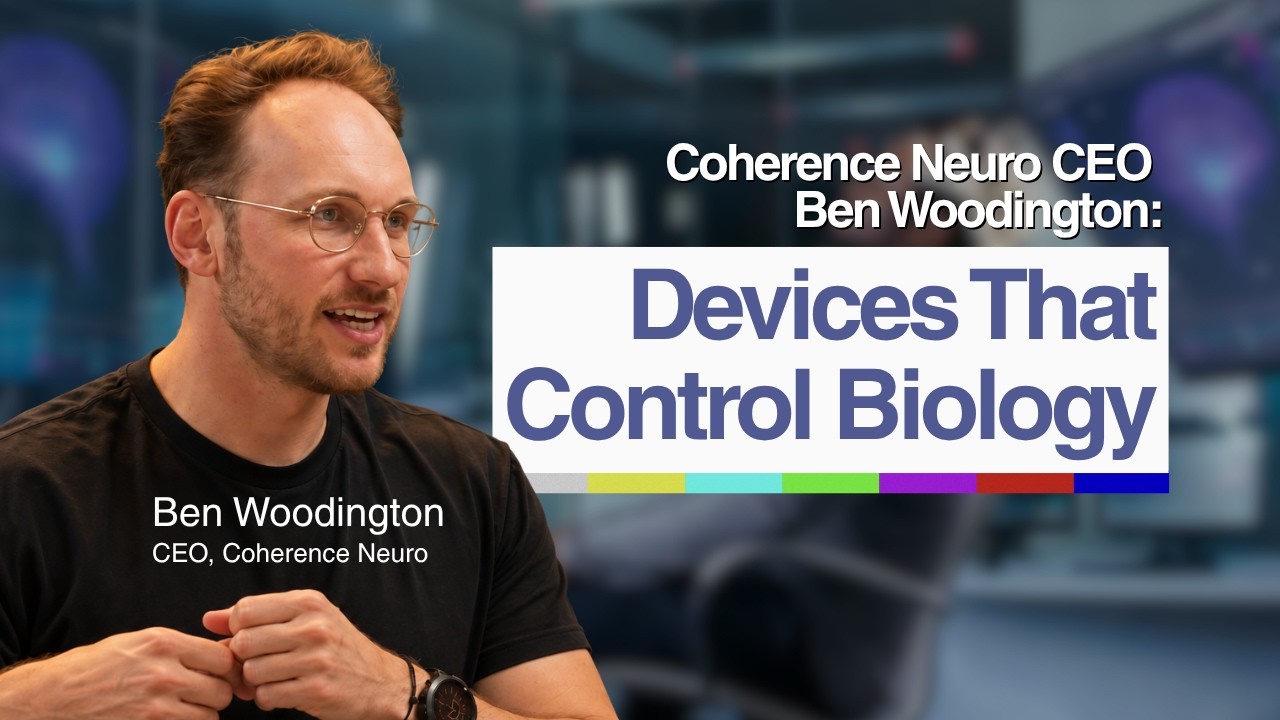
Recorded 22 October 2026 · 20 min
Ben Woodington, co-founder and CEO of Coherence Neuro, says tumors form two-way communication networks with the brain, and that an interface left in place after surgery can both record and electrically modulate that conversation. The company announced a $45 million Series A led by Founders Fund and the OpenAI Startup Fund, built on this premise and aimed first at brain cancer.
The interview leaves a gap between ambition and evidence. Woodington describes fast engineering progress and a vision of therapeutics that learn from recorded data. No efficacy results are presented, and he names regulators, not engineers, as the binding constraint. Whether tumor biology responds to stimulation as hoped is the unresolved question.
Hardware and data converge — ▶ 2:36
Woodington attributes the timing to two shifts. On hardware, the device uses materials that did not exist 20 years ago, and electronics are far smaller. On data, AI and big-data processing were not available 5 to 10 years ago. He estimates his neuroscience team's output has risen about 5x in 2 to 3 years, because work once done by people "mashing data behind a computer" is now automated. The 5x figure is his own estimate, with no baseline given. The implication is that implants matter only if their recordings can be analyzed at scale.
Same stack, different aim — ▶ 3:53
Brain-computer interface (BCI) work splits into technology that augments humanity and technology that cures disease, often called therapeutic BCIs. Woodington argues the underlying technologies are fundamentally the same: interfacing with the body through electricity or ultrasound. What differs is the direction they are pushed, such as cursor control versus depression, Parkinson's, addiction, brain injury, or stroke. Coherence has pointed its stack at cancer, and he says not only brain cancer but cancers throughout the body. The implied logic is platform reuse across indications.
Tumors talk to the brain — ▶ 5:13
Woodington began a PhD around 2017 to 2018 assuming it was "the engineers' time to cook now." He instead found how little is known about brain function and disease interaction. His co-founder Elise showed him that cancer forms communication networks with the brain and nervous system, a dimension he says no one understood until about 7 to 10 years ago. The brain, he says, talks to the tumor in the same language, via nerves. Recording from those pathways reveals tumor activity and treatment response, and stimulation can modulate it.
Regulators set the pace — ▶ 7:27
Woodington says scientific and engineering progress is countered by the rate of the regulatory process, which explains public frustration over cancer cures that have not arrived. Asked about the biggest bottleneck, he answers without hesitation: regulators, not his engineering team. He says ways to accelerate exist but does not specify them, and acknowledges that studies run multiple years, 5 or longer. He still predicts the next 1 to 2 decades will be unrecognizable from today. The prediction rests on assertion rather than evidence offered in the interview.
Consumer implants, not soon — ▶ 10:07
Whether implants become consumer devices is, he says, the big question. Neuralink and others believe they will, and Woodington would not rule it out. He compares the inherent risk to cosmetic surgery and drinking alcohol, which argues that risk is tolerated, not that it is small. A survey at Coherence's offsite last year produced bullish estimates of 7, 10, and 12 years for a first consumer-grade implantable. He stresses this is not the company's intention, which is treating diseases that need treatment now.
Surgery as delivery channel — ▶ 12:05
Coherence's patients are very unwell and already facing surgery. Woodington says maybe 75% of the brain cancer patients go to UCSF as soon as they are diagnosed and have surgery, so clinicians simply leave the device behind and no secondary operation is needed. Neurosurgeons, he says, are eager early adopters. Ultimately the device is meant to be reached remotely, for example over Bluetooth, to change stimulation parameters and upload data. Editorially, attaching to a surgery that happens anyway lowers the adoption barrier a consumer product would face.
Therapeutics that learn — ▶ 15:41
A Melbourne clinical study is ongoing, and a first long-term study will implant patients for the rest of their lives. A South San Francisco lab will test the thesis of therapeutics that learn and reinforce across disease models, including pancreatic cancer. The aim is to train algorithms on recorded data to stimulate biology better. Woodington expects patient numbers to double or triple, noting the field went from 5 patients worldwide to 30 to 50. Devices should soon carry more electrodes and reach more brain areas, he predicts.
Coherence Neuro's wager is that a tumor is not an isolated mass but a participant in the body's communication system, and that anything participating in that system can be listened to and influenced. Ben Woodington says tumors form bidirectional communication networks with the brain and nervous system, using what he calls the same language, and that this was unknown until roughly 7 or 8 years ago. If true, cancer becomes partly an information problem. An implant can record electrical activity to infer what a tumor is doing and how it responds to treatment, and it can deliver stimulation to modulate it. That is the logic behind the company's first product, a fingertip-sized glass implant left in the brain at the time of surgery.
Woodington arrived at the idea sideways. He began a PhD in neurotechnology around 2017 or 2018 assuming it was "the engineers' time to cook now." The deeper he went, he says, the less he believed anyone knew about how the brain functions or how disease interacts with it. His co-founder Elise, working in the same lab, introduced him to the cancer-nervous system connection. The anecdote matters because it places the company's edge in biology as much as engineering. Brain tumors, he says, were assumed to be relatively well understood, yet an entire dimension of them was missing until about a decade ago.
Why is this buildable now? Woodington points to hardware and data. The device uses materials that did not exist 20 years ago, and electronics can be made far smaller. On the data side, AI and large-scale processing were not available 5 to 10 years ago. He estimates his team's output is about 5x higher than 2 or 3 years ago, since analysis once done by hand is automated. That figure is his own, with no baseline. The data argument is more interesting for what it implies: recordings, plus genetic and morphological information, feed new therapeutics, and the company's South San Francisco lab is meant to test whether those therapeutics can learn to stimulate biology better.
The same technology stack could point in other directions, and Woodington is candid about that. He distinguishes technology that augments humanity from therapeutic BCIs, and says the underlying tools are fundamentally the same. Only the direction differs, whether cursor control or depression, Parkinson's, addiction, and stroke. Coherence has chosen cancer, including cancers beyond the brain. He does not rule out implants eventually becoming consumer devices, citing an internal offsite survey with estimates of 7, 10, and 12 years. He stresses that is not the company's goal. His argument that risk is tolerated in cosmetic surgery and drinking alcohol shows tolerance exists, not that the risk is small.
The go-to-market logic is quieter but arguably more important. Coherence's patients are gravely ill and already facing surgery. Woodington says maybe 75% of its brain cancer patients go to UCSF right after diagnosis for an operation, so surgeons can leave the device behind without a second procedure. He describes neurosurgeons as eager adopters. The company can then interface with the patient and the disease, ultimately remotely over something like a Bluetooth link, adjusting stimulation parameters and receiving uploaded data. Editorially, this means each implanted patient is both a treatment and a data source, which supports the learning thesis.
The constraint, by his account, is not technical. Woodington says scientific and engineering progress is slowed by the pace of regulation, and that studies must run for multiple years, 5 or longer. He names regulators as the biggest bottleneck, ahead of his own engineers. He says there are ways to accelerate approval but does not say what they are. The company has a clinical study running in Melbourne and plans a first long-term study in which patients are implanted for the rest of their lives. Those studies will take time to mature even if everything else moves quickly.
The weakest link is evidence. The interview presents mechanism, motive, and momentum, but no outcomes. Woodington says the device allows tumor control and describes the lab work as testing the underlying thesis, which implies the central causal claim is still being proven. His optimism about the next 1 to 2 decades and his forecast that patient numbers will double or triple are predictions, not findings. The next signal is the data he promises. If stimulation measurably changes tumor behavior, regulatory timelines will matter enormously. If it does not, faster approval would not rescue the premise.
The open question. Does electrical stimulation actually change tumor behavior enough to treat or cure patients? Woodington describes the device as able to control tumors and says the company is still testing the thesis that therapeutics can learn to stimulate biology more effectively. He promises exciting data but presents none here. The answer will determine whether the recorded-data flywheel produces better treatment or just better measurement.
Watch the full video at https://www.youtube.com/watch?v=tAAw-lAAslU.
Comments ()