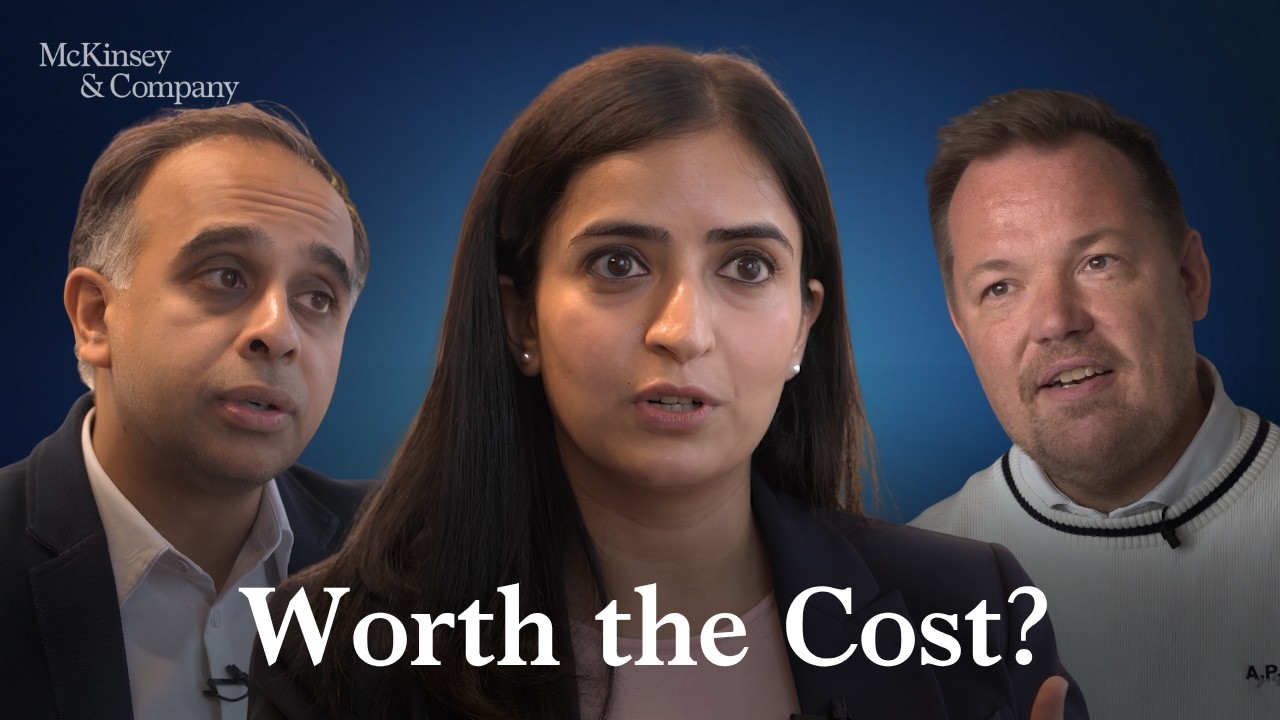
Recorded 20 October 2026 · 19 min
Enterprise AI cost has stopped behaving like a technology price and become a behavioral variable. Pricing is moving from fixed seats to consumption, and model choice, agent design and individual habits now set volume. The practitioners on this panel describe current cost estimates as "napkin math," and one cites research that spend rises 4 times, on average, when a company moves from pilot to production.
The tension is that falling per-token prices have not lowered bills, because usage grows faster than prices fall. Most speakers say AI is worth it when measured completely, and they propose cost per task or per successful output as the right unit. One speaker dissents, calling AI individually rational but possibly not worth it for society.
Three buckets of spend — ▶ 0:18
Research cited by one speaker says AI spend rises 4 times, on average, when companies move from pilot to production. Cost arrives through three channels: direct providers such as OpenAI, Anthropic and Gemini; indirect cloud compute, which appears separately on the cloud bill whenever a model is called; and AI embedded in SaaS tools. Because these sit in different budgets, the first task is inventorying every source. Most pilot-stage cost is predictable license fees, which is why pilot figures understate what production will cost.
Open access drives model drift — ▶ 1:05
License fees are predictable, but open-ended access is not. At one client, usage and spend doubled between months 2 and 4, and usage shifted from Sonnet to Opus in months 3-5. The speaker doubts those users needed the stronger model; they moved because they could. A second speaker says Cursor users at McKinsey tend to pick the latest frontier models when given the choice. Both accounts are practitioner observations, not measured studies, but they point to model routing as a cost lever.
Tokens aren't word counts — ▶ 3:17
Billing happens per million tokens, but cost cannot be estimated by counting words. Output tokens cost far more than input tokens. Context windows keep growing as users add references and images. Reasoning models generate intermediate thinking tokens that users never see but pay for. Models are also stateless, so remembering anything means resending everything, and costs compound as a conversation lengthens. Each layer widens the gap between a simple prompt and its bill, which is why the speakers call early estimates napkin math.
Seats give way to consumption — ▶ 4:58
One speaker says many frontier companies switched in Q1 of this year from per-seat to consumption pricing, so unchanged usage can cost 2-3 times more immediately. Another reads this as strategy: per-seat pricing got users hooked while they stopped caching or trimming context windows, and consumption billing then exposed those habits. That is interpretation of vendor intent, not something the discussion demonstrates. The structural point is that fixed pricing hid inefficiency that variable pricing now charges for.
Jevons paradox in tokens — ▶ 6:23
Per-token prices have fallen almost 90%, a figure the speaker calls standard industry quotation, yet consumption has surged as use moved from chat windows to agents, with networks of sub-agents expected next. Coding models showed the effect in April and May, when a single user could run up thousands of dollars in a day. Before the end of Q1, one speaker says, executives worried about adoption; now they worry about cost. The speaker's conclusion is that cost per task, not per token, is what organizations actually pay for.
Cost per successful output — ▶ 8:21
A poorly designed agent can consume up to 30x more tokens than a well-designed one, so an agent's cost has no fixed answer. The proposed metric sums inference, human validation, observability, vector storage and orchestration, divides by successful outcomes, and compares that with the fully loaded cost of the replaced human or tool. Failures matter because retries repeat the spend, as in an airline rebooking agent. Frequency matters too: thousands of daily rebookings justify build cost, while a tax-audit agent might run once a year per employee.
Value needs a measurable outcome — ▶ 12:25
The speakers split AI into personal tooling, automation and rebuilding the business, each with a different value-cost equation. Personal tooling is a cost of doing business; automation depends on savings against build and maintenance cost. A team of 5 engineers gained 20-30% capacity, but with no dollar value because all 5 were still needed. The speaker likens faster output without a measurable outcome to building roads that fill with more cars. Two operators ran the same customer use case with very different results, because one redesigned and automated the workflow before adding AI.
The central claim is that enterprise AI cost has stopped behaving like a technology price and become a behavioral variable. One speaker calls current estimates of what generative AI will add to a workload "napkin math." Another cites research showing that AI spend rises 4 times, on average, when a company moves from pilot to production. The causes lie less in any single price than in two facts. Spend arises in many places at once, and volume is largely set by what employees and agents choose to do once access is open. Budgeting therefore becomes a question of governance as much as procurement.
Visibility comes first, and it is harder than it sounds. Spend flows through AI providers such as OpenAI, Anthropic and Gemini, through cloud bills because every model call carries compute cost, and through AI embedded in SaaS tools. A banking client shows what happens without a unified view. Its spend began at $2-3 million a year. New contracts then turned consumption-based, and everyone gained access to every tool and model with no ROI checks or governance guardrails. Finance projections climbed well above $25 million. The client's response was a single AI control plane that traces spend to teams and individuals and asks why a request was not routed to an open-weight model.
Behavior does the multiplying. Under license pricing, costs were predictable; open-ended access is not. One speaker notes that Cursor users at McKinsey, given a choice, tend to select the latest frontier models, and compares this to giving children unlimited candy. Another describes a client whose usage and spend both doubled between months 2 and 4, with usage moving from Sonnet to Opus by months 3-5. The speaker doubts those users needed the stronger model. That is a practitioner's judgment, not a measured finding, but it identifies a concrete lever: matching the model to the task.
Vendor pricing changes compound the problem. One speaker says many frontier companies switched in Q1 of this year from per-seat to consumption pricing, so identical usage can cost 2-3 times more immediately. Another reads this as deliberate: per-seat pricing got users hooked while they lost habits like caching and trimming context windows. That is an interpretation of vendor strategy, which the discussion does not demonstrate. The mechanics make the transition painful. Output tokens cost far more than input tokens, context windows keep ballooning, and reasoning models generate hidden thinking tokens that users pay for. Because models are stateless, longer conversations resend and compound context.
Falling unit prices do not offset any of this. A speaker invokes the Jevons paradox: per-token prices are down almost 90%, a figure the speaker describes as standard in the industry, yet consumption has climbed as chat gave way to agents. Networks of agents, such as one orchestrating 4 sub-agents, are expected next. Coding models showed the effect in April and May, when one user could run up thousands of dollars in a day. The speakers conclude that cost per task, not per token, is what matters. Agent design swings that figure widely: a poorly designed agent can use up to 30x more tokens, and deterministic if-this-then-that steps in ticket resolution need no agent at all.
The proposed metric is cost per successful output. It counts inference, human validation, observability, vector storage and orchestration, plus the cost of failures that force a process to repeat. An airline rebooking agent illustrates the point: customers change their minds, the seat disappears, and the process restarts. That total is then compared with the fully loaded cost of the human or tool being replaced, and weighed against usage frequency. An airline handles thousands of rebooking requests daily, while an agent auditing employee tax filings might run once or twice a year per employee. The framework is sound, but it presumes that value can be expressed in money.
The speakers' own examples show where that presumption strains. A team of 5 engineers gained 20-30% capacity after a workflow redesign that delivered diagnosis and a proposed fix with every ticket. Yet there was no dollar value, because all 5 were still needed. The speaker compares this to building more roads and filling them with more cars. Two operators ran the same customer use case from pilot to production with drastically different results. One redesigned and automated the workflow first; the other threw AI tools at it. Most of the panel says AI is worth it if value is measured completely, both financial and non-financial. One speaker dissents: worth it for individual companies, perhaps not for society, like athletes who dope because everyone else does. The discussion offers no evidence on that question. It also leaves open how organizations will measure outcomes rigorously enough to make cost per successful output meaningful, since the panel itself concedes that some gains never reach a ledger.
The open question. Cost per successful output assumes the value side can be measured. Yet the panel's own example of 5 engineers gaining 20-30% capacity produced no dollar value, and the panel's closing advice is to measure value completely, both financial and non-financial. If productivity gains cannot be converted into money or outcomes, how should a company decide whether a rising AI bill is justified, and who enforces that discipline before consumption pricing exposes the gap?
Watch the full video at https://www.youtube.com/watch?v=qYefxlsfXAU.
Comments ()