Recorded 31 October 2026 · 30 min
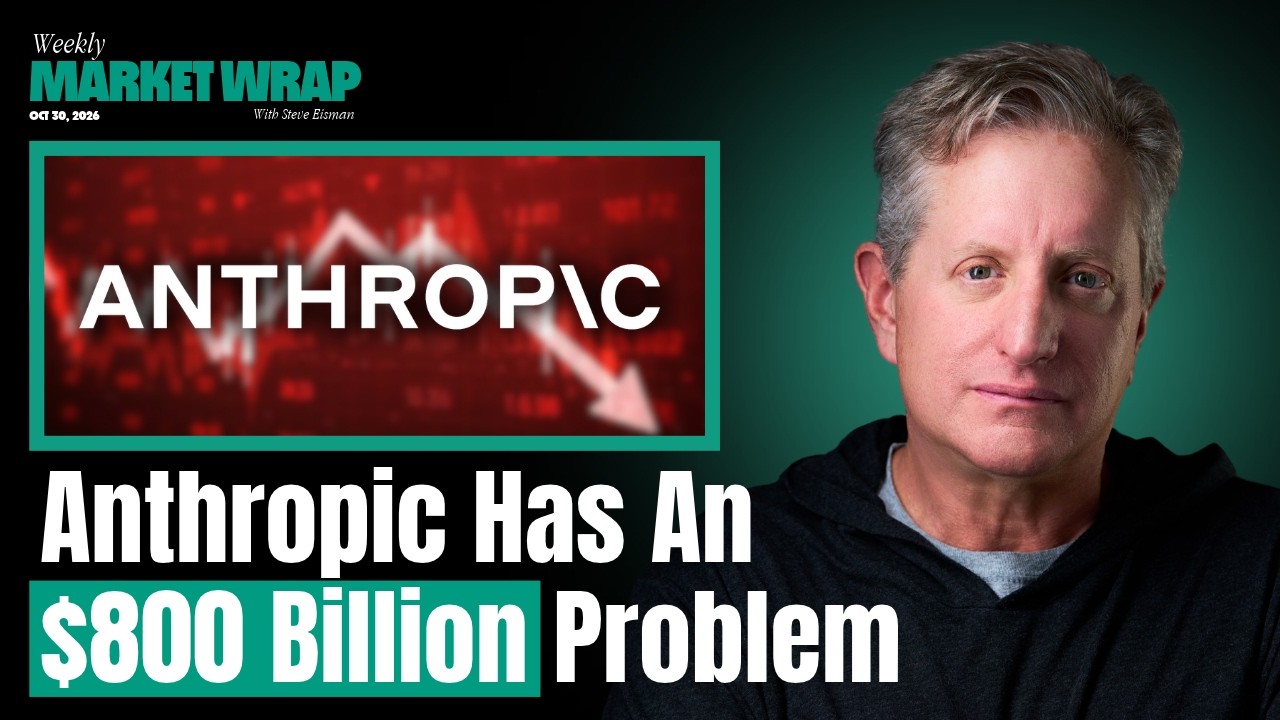
Steve Eisman, host of The Real Eisman Playbook, argues that Anthropic's S1 flatters the company by stopping at the second quarter of 2026. Third-quarter figures he says are already public show sequential revenue growth falling to 45% from 147%, just as the prospectus lists roughly $800 billion of future compute commitments. He sees no margin for error.
A week of earnings reports supplies the backdrop. Google, ServiceNow, Intel and Amazon fell sharply, and Eisman reads those moves as questions about whether AI capex keeps growing and whether software is durable. His evidence is selective and partly anecdotal, and he concedes there are too many variables to predict whether Anthropic will deliver profits.
Strong S1, silent quarter — ▶ 3:31
For the first 6 months of 2026, Anthropic's top five customers accounted for 25% of revenue, debt stood at $6.2 billion, and the Q2 2026 adjusted operating margin was a positive 19%. Eisman calls the concentration "not bad," the debt "not terrible" and the margin "quite good." His caveat is that the margin was recorded at the height of token maxing, which the prospectus does not address. The S1 also omits third-quarter numbers, which Eisman says are already public and which he considers the ones that count.
$800 billion in commitments — ▶ 4:03
As Eisman reads the prospectus, Anthropic has made multi-year compute and equipment commitments of about $800 billion: Broadcom $161 billion, SpaceX $121 billion, Google $115 billion, Amazon $110 billion, Microsoft $45 billion, NScale $45 billion, Lambda $35 billion, AMD $20 billion, and $150 billion for TPU providers including Google. He says there is no margin for error and that compute costs could explode starting in 2027. The transcript does not say how the Google and TPU figures overlap.
Token maxing unwinds — ▶ 5:31
Eisman's thesis is that enterprises told employees to use AI regardless of cost, lifting Anthropic and OpenAI, until costs got out of control this summer and cheaper open-weight models became an option. His table, using his own revenue-to-compute ratio, shows Q4 2025 growth of 43% and a ratio of 0.69x, then 135% and 147% sequential growth in Q1 and Q2 2026 with the ratio at 2.08x. In Q3 growth fell to 45% and the ratio to 1.70x. Token maxing as the cause is his assumption, not documented in the S1.
Price cuts, uncertain payoff — ▶ 7:44
Anthropic cut token pricing by as much as 50% in October to spark demand. Open Router data show token demand rising, but Eisman doubts it is enough to offset the cuts. He cites two bullish readings: Anthropic may be embedding itself in enterprises before raising prices, and delayed data center openings could keep prices inflated until compute supply arrives. He concludes there are too many variables to predict profitability, and expects the IPO to proceed with OpenAI following soon.
Microsoft's capex undershoot — ▶ 13:38
Microsoft's quarter was strong: revenue of $92 billion grew 19%, and Azure revenue of $33 billion grew 48%. The problem was spending. Capex and finance leases of $45 billion, up about 30%, came in well below the $51 billion consensus, and neocloud stocks including CoreWeave and Nebius fell 5-9%. The group was already suffering from higher debt costs. Microsoft closed flat Thursday. The implication is that one company's lower capex is another's lost revenue, even when end demand looks healthy.
Search moat erodes — ▶ 14:54
Google's stock fell 12% after revenue grew 25% but EPS of $2.67 trailed last year's $2.87 and free cash flow was negative $9.1 billion. The key figure was search revenue growth of 12%, versus 19% in Q1 2026. Eisman argues a capital-light, high-moat business is being replaced, slowly, by a capital-intensive, low-moat one, because switching costs between LLMs look inexpensive. This is his interpretation of a single quarter's deceleration, not a demonstrated displacement.
SaaS apocalypse returns — ▶ 16:35
ServiceNow fell 27% after guiding current remaining performance obligations growth to 18.5%, against 19.7% consensus and 21% in Q3. Revenue was $4.1 billion, up 21%, and EPS of $1 was a slight miss. The stock had fallen from 210 in July 2025 to below 100 in early summer 2026, then rallied to 159. Eisman says the narrative was always too blunt, since many software firms are deeply embedded in enterprises. The weak backlog guidance revived the fear anyway, and S&P and Moody's also fell on software worries.
Beats no longer enough — ▶ 19:59
Caterpillar's EPS rose 45% and revenue 17%, but both only barely beat, and the stock fell 9%. GE Vernova's EPS rose 193% and orders rose 96% to $29 billion, yet it also fell, probably, Eisman says, from selling after a strong run. Intel, up 150% this year, beat on EPS (52 cents, up 126%) but fell 18% after hours on guidance: PCs down 12% in 2026 and 10% in 2027, and Q4 revenue of $15-16 billion against a $17 billion consensus. Quanta, with a record $64 billion backlog and raised guidance, rose 5%.
Amazon holds capex flat — ▶ 22:10
Amazon missed on EPS ($1.89 versus a $1.96 estimate) and on revenue of $202 billion, up 12%. The decisive detail was that it left its 2026 capex budget unchanged at $220 billion. Eisman notes every hyperscaler had raised its budget every quarter until now. He expects the market to question whether AI capex growth is over, with broad ramifications for servers, chips and every other kind of data center equipment. Amazon fell about 6% after hours.
CoreWeave as specialty lender — ▶ 23:10
CoreWeave's cost of debt has risen from 9% to 15%, which Eisman says caused a huge correction in the AI complex. A viewer correctly noted the coupon is still 9% and the 15% is the effective yield on discounted bonds, but new debt for new data centers will cost 15%. CoreWeave has $36 billion of debt, slightly over $50 billion with leases and other obligations. Eisman likens it to a specialty finance company, which fails when fixed income markets lose confidence, and notes it competes with far larger hyperscaler balance sheets.
Power as binding constraint — ▶ 25:28
Joseph, an electrical contractor building a data center, tells Eisman that power, not GPUs, high-bandwidth memory or money, limits data center construction from 2027 onward. Builders pay his workers $150 extra per day on top of $65 an hour. New transmission lines are 24-plus months out, substations take 1-2 years, and announced capex becomes stranded capex. He expects Amazon and Meta to feel more strain than Microsoft and Google, with CoreWeave and Oracle last in line. Eisman says that if Joseph is right, construction slows sometime next year. The evidence is one practitioner's account.
Steve Eisman's central claim is that Anthropic's S1 flatters the company by stopping at the second quarter of 2026. The third-quarter figures, which he says are already in the public domain, tell a different story. Sequential revenue growth fell to 45% from 147% in the second quarter. His efficiency measure, quarterly revenue divided by compute and infrastructure expense, fell to 1.70x from 2.08x. Eisman says this is what he had feared. Anthropic is still growing, but the surge that made the first half look extraordinary appears to have been temporary. Media commentary on how great the numbers looked through the second quarter, he argues, missed the quarter that counts.
His explanation is token maxing, the period in which enterprises told employees to use AI and to hell with the cost. The baseline matters. In the fourth quarter of 2025, just before it began, Anthropic's sequential revenue growth was 43% and its revenue-to-compute ratio was 0.69x. Growth then jumped to 135% in the first quarter and 147% in the second, and the ratio passed 2x. Eisman says the boom ended this summer, when costs got out of control and companies gained the option of cheaper open-weight models. Two qualifications apply. The third-quarter ratio remains far above the pre-boom level, and Eisman expected slower growth, not collapse. The token-maxing account is also his own assumption, and the prospectus is silent on it.
The revenue picture matters more because of what Anthropic has promised to pay. According to Eisman's reading of the prospectus, compute and equipment commitments over the next several years total about $800 billion: Broadcom $161 billion, SpaceX $121 billion, Google $115 billion, Amazon $110 billion, Microsoft $45 billion, NScale $45 billion, Lambda $35 billion and AMD $20 billion, plus $150 billion to TPU providers including Google. He sees no margin for error and warns that compute costs could explode from 2027. Meanwhile Anthropic cut token pricing by as much as 50% in October to spark demand. Open Router data show token demand rising, but Eisman doubts the increase is enough to offset the cuts.
Eisman is careful not to overreach. He cites two arguments that favor the bulls. One school of thought holds that Anthropic's strategy is to embed its product deeply in enterprises and then raise prices. Separately, if data center openings are delayed while demand stays high, prices will be artificially inflated until compute supply is fully available. He concludes there are too many variables to predict whether Anthropic can deliver profits, and he expects the IPO to proceed, with OpenAI following soon. His thesis concerns trajectory, not a verdict on valuation. Editorially, both bullish readings depend on prices rising later, while the only price move in the evidence is a cut.
The week's earnings reports supply a wider test of whether AI spending keeps compounding. Microsoft's results were strong: Azure revenue of $33 billion grew 48%, and total revenue of $92 billion grew 19%. Yet capex and finance leases of $45 billion, up about 30%, fell well short of the $51 billion consensus, and neocloud stocks including CoreWeave and Nebius fell 5-9%. Amazon then kept its 2026 capex budget unchanged at $220 billion. Until now, Eisman notes, every hyperscaler had raised its budget every quarter. He expects the market to ask whether AI capex growth is over, with consequences from servers to chips to every other kind of data center equipment. The implied logic is that one company's spending is another's revenue, so even a pause hurts suppliers.
Suppliers were punished even for good numbers. Intel had risen 150% this year. It reported EPS of 52 cents, up 126% and a beat, yet fell 18% after hours on guidance: a PC market declining 12% in 2026 and 10% in 2027, and fourth-quarter revenue of $15-16 billion against a $17 billion consensus. Caterpillar's EPS rose 45% and revenue 17%, but both only barely beat, and the stock fell 9%. GE Vernova grew EPS 193% and orders 96% to $29 billion, yet it also fell, which Eisman attributes probably to selling after a strong run. Quanta, with EPS up 82% and a record $64 billion backlog, rose 5%. The pattern suggests expectations, not fundamentals, set the bar, and the bar for AI-linked companies is high.
Google and ServiceNow carry the sharper structural argument. Google's revenue grew 25%, but EPS of $2.67 trailed last year's $2.87, free cash flow was negative $9.1 billion, and search revenue grew only 12% against 19% in the first quarter of 2026. The stock fell 12%. Eisman reads this as a capital-light, high-moat business being replaced, slowly, by a capital-intensive, low-moat one, because switching costs between LLMs look cheap. ServiceNow fell 27% after guiding backlog growth to 18.5%, against 19.7% consensus and 21% in the third quarter, reviving the SaaS apocalypse narrative. Editorially, this sits uneasily beside the bull case for Anthropic. If switching costs are as low as Eisman suggests, the pricing power that case requires is harder to assume.
Financing is a second constraint. CoreWeave's cost of debt has risen from 9% to 15%, which Eisman says helped cause a huge correction across the AI complex. A viewer correctly noted the coupon remains 9% and the 15% is the effective yield on discounted bonds. Eisman agrees, but says new debt for new data centers will cost 15%. CoreWeave has $36 billion of debt, slightly over $50 billion including operating leases and other obligations. Eisman likens its model to a specialty finance company: borrow from fixed income markets, build, and rent out the compute. Such companies fail when bond investors lose confidence, he says, and CoreWeave competes with hyperscalers whose balance sheets and other businesses can support the buildout.
A third constraint is physical. Eisman relays a comment from Joseph, an electrical contractor building a data center, who says power, not GPUs, high-bandwidth memory or money, is the binding constraint, and that 2027 onward will be about who has electricity. Builders are paying his workers $150 extra per day on top of a $65 hourly wage. New transmission lines are 24-plus months out, substations take one to two years, and announced capex becomes stranded capex without power. He expects Amazon and Meta to feel more strain than Microsoft and Google, and CoreWeave and Oracle to wait longest. Eisman thinks that, if Joseph is right, construction slows sometime next year. The evidence is one practitioner's view, though a vivid one.
The unresolved issue is whether the slowdown is about demand or supply, and the two readings carry different consequences. If demand is fading, as Anthropic's third-quarter numbers and price cuts suggest, the 2027 compute bills arrive against slower revenue. If power delays are throttling construction, as Joseph contends, Microsoft's capex undershoot and Amazon's flat budget may reflect supply, and Eisman's own scenario of elevated prices during a shortage becomes plausible, although the $800 billion of commitments remains. Eisman presents both stories without reconciling them, and the transcript offers no data to separate them. Which one dominates will determine whether those commitments look manageable or punishing.
The open question. Is the slowdown demand-driven or supply-driven? Eisman offers both stories without reconciling them. Anthropic's third-quarter growth and October price cuts point to fading demand, while an electrical contractor's account points to power delays throttling data center construction. The first scenario leaves $800 billion of commitments facing slower revenue. The second could keep prices elevated during a shortage, as Eisman himself allows. The transcript contains no data that separates the two, and the answer determines how those commitments should be judged.
Watch the full video at https://www.youtube.com/watch?v=z-pClpi6eTY.
Comments ()