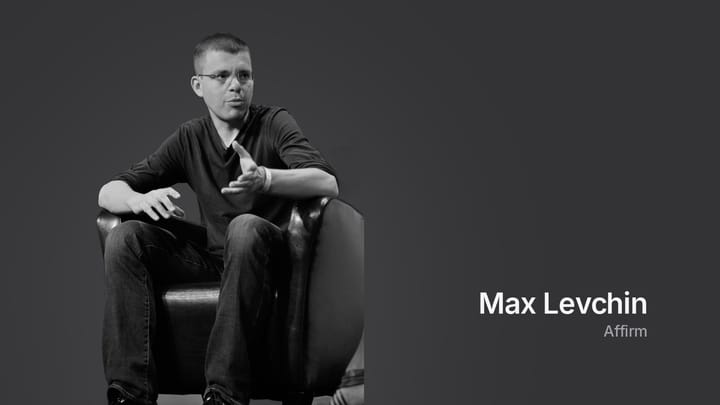

Recorded 3 September 2026 · 59 min
The card is the best payment interface ever built, and convenience beats everything as the amount falls. Max Levchin uses that rule to explain why a refuelling wand, Amazon's palm scanner and crypto have all failed to displace it where the volume lives, at the level of a cup of coffee. The market is the world's largest, with no niche smaller than $100 billion, but the rules underneath it barely move.
Levchin and Alex Rampell co-founded Affirm and have known each other since 2009, so much of the conversation is a founding story. Their first idea was social credit and paying with your identity. It did not work until a beauty retailer showed that the real job was fixing shoppers' budgets, not their pajama problem.
The tension runs through the whole talk. Payments reward incumbent rules and small boring conveniences, yet Levchin thinks agents may finally put the card up for renegotiation. Rampell is less sure how fast people will hand over the wallet.
Tap won by accident — ▶ 1:31
Apple Pay and Google Pay penetrated far more than Rampell expected, because changing consumer behavior is hard. The cause was a string of accidents. The EMV liability shift made merchants replace their magstripe terminals or eat fraud losses, such as the Best Buy TV that a customer later disowns. The new machines happened to support contactless. Nobody tapped when they arrived. COVID and ubiquitous phones then did the rest. Three unrelated forces, a mandatory new terminal, a pandemic and a phone in every pocket, moved behavior that no one could have planned.
The 2.5-second wall — ▶ 4:09
Visa and Mastercard enforce a hard 2.5-second limit on the loop between network, issuing bank, merchant and acquiring bank, with about 10 seconds in total. Online, firms can run anti-fraud checks first. Offline, there is no room. Apple Pay and Google Pay shifted the timing by putting secure enclaves in the phone that already know the card. Levchin finds it shocking that the networks have not relaxed the limit to something like 15 seconds, which would let issuers bid on credit terms. The rules are roughly 60 years old and largely intact.
Bigger dollars, smaller rake — ▶ 5:56
"Once you go really big, the numbers get small," says Rampell. A $40 trillion wire earns its processor little, because nobody takes 2% of it. The revenue sits in small payments. Starbucks built prepaid accounts so it pays the networks once on a $50 load instead of per cup. B2B is the exception everyone chases. Pay me sooner failed as an idea for a related reason. GE pays about 5% for credit while its small supplier pays 15%. Levchin says that revenue is lower than in consumer, where everyone understands convenience and rivals undercut each other.
No okay outcomes — ▶ 10:42
Levchin saw a Mastercard and gas-station wand that let drivers wave and refuel, and was sure it would replace cards. It did not. Payments have an unobvious but clear critical mass: everyone needs your widget or network, or it dies. There are no okay outcomes in between. The wand was only a little faster than the card already in the pocket. Amazon's palm payment at Whole Foods was not faster either. The speakers agree it was slower, just fun, and Amazon discontinued it. Other than the phone, nothing has beaten the card.
Crypto fails the coffee test — ▶ 13:46
Levchin was late to PayPal. He arrived after the DigiCash bankruptcy party and was booed off stage at a cryptography conference because PayPal was not anonymous. His point was that people do not care about anonymity. They need to pay for coffee. Bitcoin impressed him as a solution to the Byzantine generals problem, and as a store of value it has been extraordinarily successful. As a payment method he is not convinced. If a wallet passphrase is too long, the buyer looks for change, then pulls out a debit card.
Pay with your identity — ▶ 20:05
Rampell's pitch to Levchin was the pajama problem: you are upstairs, the credit card is downstairs. His answer was a general-store model for the web, where someone with 500 Facebook friends and 1,000 photos is probably a low credit risk, and people not seeking credit are the better risk. Levchin cites Israeli grocers and Japanese business cards used as tabs. Their motives differed. Levchin wanted to build a great credit score from data like PayPal's. Rampell wanted to close transactions with merchants. Rampell admits the Facebook friend premise was wrong.
Free flowers — ▶ 26:57
Rampell built a PHP clone of the 1-800-Flowers site with Facebook Connect checkout, and Jim McCann loved it. He recognized it from postpaying orders for service members. Rampell then invented a 7% merchant discount rate, and a finance colleague read it as "free flowers" because nobody had to repay. The merchant's buyer would not pay 7% either, since the option sat after product selection and cannibalized his credit card volume. Levchin calls this the "great nothing" period, one every startup passes through before product market fit.
Budget, not pajamas — ▶ 32:56
Beautylish told shoppers earlier in the funnel that they could pay in installments, and conversion rose 30% instantly. That reframed the product as solving a budget problem, not a pajama problem. Tradzy reported a 35% lift. Mattress firms then raised the merchant's willingness to pay. A Harvard Business Review article said mattresses are replaced every 7 years, margins run near 80%, and missing the cycle is costly. Merchants funded the rate, so consumers got a true 0%. Levchin built Affirm against deferred-interest cards that charge retroactive interest, with no late fees.
Negative acquisition cost — ▶ 44:07
Affirm has transacted with 50 million-plus Americans and is live in four countries. It is paid to acquire customers, while Rampell says most consumer companies hand their economic value to Google and Facebook. Brands want Affirm to own the relationship, since they do not want to send dunning notices. The loans run as long as 3.5 years versus about 6 weeks for the average pay-later product, so underwriting needs real machine learning. Levchin says that is hard to copy, and 39 billing contacts give 39 chances to upsell. He calls these loans the hardest part of payments.
Entrepreneurs by design — ▶ 49:30
PayPal's hiring screen asked what candidates would do afterwards. The welcome answer was that this was the last job before founding their own company. YouTube, Yelp and LinkedIn followed soon after the team dispersed. Levchin adds a subtler reason: the team knew each other in sweaty rooms, screaming over whiteboards. He had seen Elon Musk tired and grumpy in the company kitchen and Peter Thiel calling to say the company might run out of money. "They're not gods." Knowing the unpolished versions told Levchin that big ambitions are reachable.
Agentic payments over shopping — ▶ 52:47
Levchin is less optimistic about agentic shopping and very optimistic about agentic payments. People want to see their Friday night outfit, and he enjoys researching bike parts. But the card may finally be up for renegotiation because agents are smarter than plastic. Rampell sees agents serving people with more time than money, as Camel does. Levchin expects slow adoption. People weigh delivery risk and retailer reputation, though AI may already be capable and users just haven't trusted it. Instacart shows grocery shopping is already fully delegated, but returns and tracking could slow the rest.
Payments punish anything that is only slightly better. Max Levchin says there is no comfortable middle. A new payment method reaches critical mass, so that everyone needs your widget or network, or it fades. He saw it with a wand that Mastercard and a gas-station network built for refuelling. You waved it at the pump. Levchin was sure it would take over from cards. It was only a little faster than the card already in the pocket, and that was not enough. Amazon's palm scanner at Whole Foods followed the same path. It was not faster. Levchin and Alex Rampell agree it was slower. It was fun, and Amazon discontinued it.
Crypto fits the pattern. Levchin read the Bitcoin paper and admired it as a solution to the Byzantine generals problem. He never thought it would become a payment method and is not convinced it is one now. As a store of value it has been extraordinarily successful. But ask when anyone last spent a Bitcoin on something important. The test is the coffee. If the wallet passphrase is too long, the buyer reaches for change or a debit card. Convenience takes over as the amount falls. He knows this from his own history. PayPal's founding insight was to drop anonymity, which got him booed off stage at a cryptography conference. People did not care. They wanted to pay for coffee and online purchases.
That logic points the money in an odd direction. "Once you go really big, the numbers get small," Rampell says. A $40 trillion wire is worth little to whoever processes it, because nobody gets 2% of it. The revenue sits in small, frequent payments. Starbucks built prepaid accounts so it paid the networks once on a $50 load instead of on every cup. B2B is the exception everyone chases, and even there the picture is mixed. A big company pays a small supplier net 90, and the supplier borrows at 15% while the big company borrows at about 5%. Levchin calls that idea lending, not payments, and says the revenue is lower than in consumer. Everyone understands convenience, and plenty of rivals will offer a slightly cheaper charge.
If better design loses, what changes behavior? Accidents. Rampell points to the EMV liability shift. Merchants who did not replace their magstripe terminals would eat fraud losses, so everyone bought new machines. Those machines happened to support tap. Nobody used tap until COVID and phones arrived. Three unrelated forces moved consumer behavior. Levchin adds the hidden constraint. Visa and Mastercard enforce a hard 2.5-second limit between network, issuing bank, merchant and acquirer. Online, anti-fraud checks can run first. Offline, there is no room. Apple Pay and Google Pay got around it with secure enclaves that already know your card, so they do the work before talking to the network. What shocks him is that the networks have not relaxed the limit to something like 15 seconds, which would let issuers bid on credit terms. The rules are roughly 60 years old and largely intact.
Affirm is the same lesson applied to a company. The founders began with a different idea. Rampell called it the pajama problem: you are upstairs, the card is downstairs. Levchin wanted to build a better credit score from social data, the digital version of a general store that lets you pay next time. They built a demo for Jim McCann of 1-800-Flowers. He loved it and recognized it, because his company had once done the same for service members. Then came the pricing sheet. Rampell made up a 7% merchant discount rate. A finance colleague looked at it and said "free flowers". The merchant was no happier. He argued Affirm cannibalized his card volume and would pay nothing. The company wandered through what Levchin calls the great nothing.
The break came from a beauty retailer, Beautylish, which told shoppers earlier in the funnel that they could pay in installments. Conversion rose 30% instantly. The founders realized they were not solving the pajama problem. They were solving a budget problem. Tradzy sent screenshots of a 35% lift. Then the mattress companies arrived. A Harvard Business Review article said people replace mattresses once every 7 years, and margins run near 80%. Winning the one purchase in a cycle was worth almost any price. So merchants paid a high merchant discount rate, which let Affirm charge consumers a true 0%. Levchin is vocal about the alternative. Deferred-interest cards advertise 0% with an asterisk, and a late payment makes interest accrue retroactively to the first day. Affirm charges no late fees and no deferred interest. The same logic had a limit. Merchants in for-profit education will accept rates up to 50%, but consumer dissatisfaction drove losses so high that Affirm left that segment in about half a year.
What this built is unusual. Rampell notes that most consumer companies pay heavily to Google and Facebook for customers. Affirm's customer acquisition cost is negative. It is paid to acquire a customer. It has transacted with 50 million-plus Americans and is live in four countries. Brands want Affirm to own the relationship, because they do not want to send dunning notices. Levchin adds the harder part. Loans of 3.5 years need real machine-learning underwriting, not a FICO shortcut, and few competitors manage it. The same loans give 39 chances to upsell the customer. The hardest part of payments is also the moat.
The next renegotiation is agents. Levchin says the credit card may finally be up for renegotiation, because agents are smarter than plastic, even rewritable plastic. But he separates agentic payments, which he is very optimistic about, from agentic shopping, which he is not. People want to see what they will wear on Friday night. He loves researching bike parts and will not delegate that. Grocery shopping, though, is already agentic. An Instacart shopper swaps whole milk for another brand and nobody thinks twice.
Rampell pushes back from the other side. Some people have more time than money. Camel, a price tracker, is a top 100 site that few high earners have heard of. A user knows the SKU and wants the lowest price. Agents could port that behavior to everyone. Levchin agrees directionally and then hedges. Adoption will be slow. Price is not the only variable. People also weigh whether the item arrives on time, and pick the reputable retailer over the cheapest. Agents must learn preferences that shift with the input. Maybe, he says, "AI is already there. It's just that you haven't yet trusted your agent to do as good a job as you would."
That is where the card's history bites. Every challenger lost on convenience, and trust is a convenience cost. Returning a wrongly bought bike part, or waiting on a parcel nobody can locate, are the quirks that may make the road more protracted than people think. Levchin does not claim to handicap the pace. He only says it will happen.
The open question. Levchin says the card is up for renegotiation because agents are smarter than plastic, and that the only gap is that people haven't yet trusted their agent. He also says adoption will be slower than expected, and he names open problems: returning a wrongly bought part and tracking a parcel in transit. Trust and logistics may be the whole problem, not a residual one. His own history says payments tolerate no "okay outcomes" and that nothing slightly better survives. The question is what an agent offers over the card in a coffee-sized purchase, where he says convenience wins.
Watch the full video at https://www.youtube.com/watch?v=J3pegsM5drk.
Comments ()