Recorded 29 October 2026 · 30 min
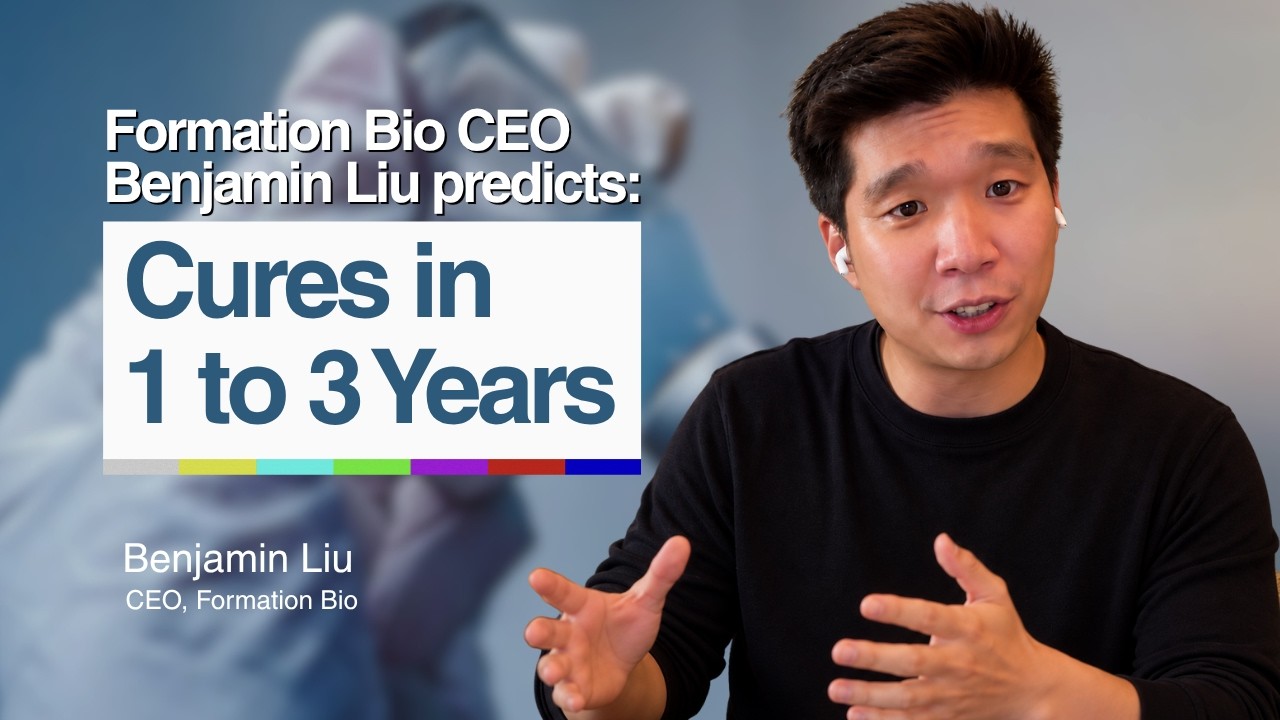
Benjamin Liu, co-founder and CEO of Formation Bio, argues that AI is making drug candidates abundant while clinical development stays scarce, so the binding constraint on new medicines is now the cost and capability needed to run trials. He spoke on the MTS podcast on the day Formation announced a $600 million fund to license stalled drugs and push them through clinical trials with AI.
The fund's design is the distinctive part. It finances individual assets rather than companies, a structure Liu says corrects the incentives that push biotechs to sell after phase 2. Much of the case rests on Liu's own framing and arithmetic, and the conversation offers little quantified evidence that AI actually shortens trials.
Discovery outpaces development — ▶ 1:06
Liu says the number of discovered drug candidates has doubled over the past 10 years, even before AI, while approvals have stayed roughly constant at 50 a year. His conclusion is that the bottleneck has moved to drug development and clinical trials, where a single trial can cost $50 million or $100 million. He also projects that today's 2.5x drugs per target will grow to 5x, 10x or even 100x over time, which would widen the gap further. The projection is his own forecast, not a measured trend.
Second-priority assets stall — ▶ 4:45
A biotech that discovers 5, 10 or 100 candidates must put its scarce capital behind the lead asset once trials begin, so the second or third priority may never be developed even if just as good. Formation offers capital plus development expertise in exchange for upfront payments, equity, milestones and royalties. Liu notes drugs typically sell for about 1x peak sales after phase 2 and are worth little before it. He cites PureTech's licensing of a Lilly drug into Karuna, later bought by BMS for $14 billion, as a similar model.
Safety studies resist compression — ▶ 7:50
Liu is explicit that some steps cannot be sped up. Testing a drug in humans for 6 to 12 months requires chronic toxicology in animals over a comparable duration, and a one-year endpoint takes a year. He defends this because side effects are often unknown, and adds that animal models are typically predictive anyway, such as testing a cartilage-growing drug in a rat, horse or dog. The acceleration Formation claims therefore comes from the surrounding trial operations, not from skipping safety or translational evidence.
Billable hours distort trials — ▶ 9:22
Contract research organizations work on cost-plus, billed-per-hour models, so more site visits and manual source data verification generate more revenue. Liu describes this as an incentive misalignment: the vendor earns more the slower and more manual the process is. Formation's answer is an AI-enabled trial engine, which he also calls a CRO, designed to disintermediate those billable activities. The claim is about overhead rather than biology, though no figures are given for time or cost savings.
Genetic evidence screens targets — ▶ 10:05
Formation's Atlas tool evaluates target-indication pairs across genetic databases such as UK Biobank and All of Us, the literature, proprietary perturb-seq data and real-world data. The underlying principle is that a target with genetic implications for a disease is more likely to work in it. Cassini maps market white space where unmet need exists. Liu says this automates work that explains why pharma companies employ 100,000 people, but stresses that human judgment and taste remain necessary to know whether an idea is good.
Uneven frontiers framework — ▶ 12:57
Liu identifies three consequential predictions: drug design, toxicity and clinical efficacy. AI progress comes first where data is copious, benchmarks are clean and feedback loops are short. Binding experiments take minutes to days, toxicity weeks to months, and trials years, with higher variability and little human perturbation data. His forecast is that discovery will be commoditized while clinical trials are the last problem to resolve, producing a society with abundant candidates but a fundamental empirical bottleneck.
The phase 2 selling trap — ▶ 16:50
Liu offers a mechanism for why no enduring big pharma company has emerged since the 1980s. Phase 2 succeeds about 30% of the time, and a pharma buyer will pay about 1x peak sales, his example being $3 billion. Phase 3 carries a 60% chance of success and a 2-3x peak sales sale, or $6 billion to $9 billion, against a 40% chance of zero. Risk-adjusted, he says, companies sell after phase 2. Editorially, the phase 3 expected value looks higher before costs and time, so risk tolerance is doing much of the work.
Ten shots, hub and spoke — ▶ 17:45
Formation's structure lets it sell a NewCo without selling the whole company. Liu argues that with only 3 shots, selling after the first winner returns capital better on both multiple and internal rate of return, whereas with 10 shots the expected hit rate of 3 in 10 justifies continuing. The fund lets Formation take twice as many shots or more without raising equity each time. Central capabilities avoid redundant single-asset teams and high burn rates, and Liu says the structure lowers Formation's cost of capital over time.
Pharma's R&D spending ceiling — ▶ 21:21
Large pharma companies are cash-rich but sensitive to their income statements. Liu says Wall Street penalizes spending much beyond 20-25% of current sales on R&D, which caps the number of shots even when cash is available. This creates room for an outside vehicle that gives non-lead assets an alternative development path. For limited partners such as endowments, foundations, hospitals and family offices, the pitch is biotech exposure with a shorter J-curve, since assets are 2 to 4 years from value inflection.
Longevity needs intermediate endpoints — ▶ 23:30
Liu says a fund can run a barbell of conservative and high-upside assets, and Formation is focused on drugs that help people live longer and healthier: cartilage regeneration, muscle loss, bone density, cognition and cardiovascular. His commercial case is that two GLP-1s earn more revenue than OpenAI and Anthropic combined, profitably. The obstacle is that proving a drug prevents a fracture or knee replacement years later could require a 5, 10 or 15 year study, so he points to intermediate endpoints such as bone mineral density as predictors.
Shared development infrastructure — ▶ 25:48
Liu says a clinical-stage biotech must otherwise build manufacturing, regulatory, data management, biostatistics and clinical operations from scratch, and a platform built for oncology may not suit neuroscience. Formation centralizes those functions alongside Atlas, Forge for study design and its trial engine, creating economies of scale across assets. He claims the AI systems in some places do the work of entire teams autonomously, but offers no measured examples, and stresses that experienced human drug developers remain central.
Drug discovery is getting cheaper and faster, but that does not mean more medicines reach patients. That is the core claim of Benjamin Liu, who says the number of discovered drug candidates has doubled over the past 10 years while approvals have held roughly constant at 50 a year. His reading is a mismatch between abundance upstream and a fixed-width channel downstream. A single clinical trial, he notes, can cost $50 million or $100 million, and that cost, along with the expertise needed to run phases 1 to 3, is what stops candidates from being developed. Formation Bio's $600 million fund is a bet that this constraint will persist for a long time and that financing it is a distinct asset class.
Liu's explanation for why the bottleneck lasts rests on what he calls uneven frontiers. Three kinds of prediction matter: drug design, toxicity and clinical efficacy. Progress arrives first where data is copious, benchmarks are clean and feedback loops are short. Whether a drug binds a target is physics and chemistry, with experiments that take minutes to days. Toxicity signals take weeks to months. Efficacy trials take years, vary more, and depend on human perturbation data that largely does not yet exist. From this he infers that discovery will probably be commoditized while clinical trials are the last problem to resolve. That is a forecast, not an observation. Read plainly, the argument is that a system moves at the speed of its slowest feedback loop.
Not everything can be accelerated, and Liu is explicit about it. Testing a drug in humans for 6 to 12 months requires chronic toxicology in animals over a comparable period, and a one-year endpoint cannot be shortened. He defends those requirements because side effects are often unknown, and he adds that animal models tend to be predictive anyway, as when a cartilage-growing drug is tested in a rat, horse or dog. The compressible parts are operational. Contract research organizations bill cost-plus by the hour, so more site visits and manual source data verification mean more revenue. Liu calls this an incentive misalignment that AI systems can disintermediate. The claim concerns overhead rather than biology, which makes it more credible than a promise to skip steps.
Formation's software is aimed at the judgment-heavy front end of development. Atlas screens target-indication pairs against genetic databases such as UK Biobank and All of Us, the literature, proprietary perturb-seq data and real-world data, on the principle that a target with genetic implications for a disease is more likely to work in it. Cassini maps white space where unmet need remains, and Forge helps design studies. Liu says this replaces work that helps explain why pharma companies employ 100,000 people. He also insists that human judgment and taste remain essential, because without them it is hard to know whether an idea is any good. The company pairs the software with veteran drug developers, including a head of R&D who previously ran R&D at Biogen.
The fund's structure targets a specific failure. A biotech that discovers 5, 10 or 100 candidates must put its limited capital behind the lead asset once trials begin, so the second and third priorities, which Liu says may be just as good, stall. Formation offers capital and development capabilities in exchange for upfront payments, shared equity, milestones and royalties. It acquires the drug, places it in a NewCo and carries it past phase 2 or phase 3. This is explicitly not company investing. Liu points to PureTech, co-founded by Formation's chief business officer, which licensed a drug from Lilly into Karuna, later bought by BMS for $14 billion, as a similar template.
The most analytically interesting argument concerns why no enduring big pharma company has emerged since the 1980s, with Vertex cited among the last. Liu calls it the phase 2 trap. By his numbers, phase 2 succeeds about 30% of the time, and a successful asset sells for about 1x peak sales, his example being $3 billion. Running phase 3 offers a 60% chance of success and a sale at 2-3x peak sales, or $6 billion to $9 billion, against a 40% chance of zero. Editorially, 60% of those figures exceeds $3 billion, so the case for selling rests on risk tolerance, cost and time rather than expected value alone. Liu says that, risk-adjusted, companies sell.
The remedy has two parts. A hub-and-spoke design lets Formation sell a NewCo without selling the whole company, and a portfolio supplies enough shots for the odds to work. Liu argues that with 3 shots, a company returns capital better, on both multiple of invested capital and internal rate of return, by selling after the first winner. With 10 shots, the expected hit rate is 3 in 10, so continuing becomes worthwhile. The fund lets Formation take twice as many shots or more without raising equity each time. Central capabilities avoid redundant single-asset teams and their high burn rates, and Liu says the structure lowers Formation's cost of capital over time. Proceeds can be recycled, which he calls a stepping stone toward commercializing drugs itself.
Why don't large pharma companies simply fund these second-tier assets themselves? Liu says they are cash-rich but sensitive to their income statements. Wall Street penalizes them for spending much beyond roughly 20-25% of current sales on R&D, so the number of shots is limited by perceived efficiency, not by cash. That leaves a gap an outside vehicle can fill, alongside pharma's appetite to acquire: he cites $300 billion of drugs going off patent and typical purchases at around 1x peak sales after phase 2 and 2-3x after phase 3. For limited partners such as endowments, foundations, hospitals and family offices, the pitch is biotech exposure with a shorter J-curve, since assets are 2 to 4 years from value inflection.
Liu wants the portfolio to avoid the fifth, sixth, seventh or eighth drug in a category, and he describes a barbell of conservative and high-upside bets. The stated focus is drugs that help people live longer and healthier: cartilage regeneration, muscle loss, bone density, cognition and cardiovascular disease. His commercial argument is that two GLP-1s earn more revenue than OpenAI and Anthropic combined, and do so profitably. The obstacle is evidence. A drug that prevents a fracture or a knee replacement 5 years out would traditionally require a 5, 10 or 15 year study. Liu points to intermediate endpoints such as bone mineral density as predictors of long-term outcomes, though he does not address whether regulators would accept them.
The weakest link in the case is evidence about the engine itself. Liu quantifies the pipeline imbalance, the economics of exits and the fund's structure, but offers no figures on how much faster or cheaper Formation's AI-enabled trial engine runs trials than a conventional contract research organization. His own framework also contains a tension. If trials are the last problem AI solves because their feedback loops are slow, then AI's contribution to the bottleneck is largely limited to selection and operations, the areas he describes. Whether that yields a durable advantage is untested. By his own logic, the answer is years away, arriving at the value inflection points the fund was built to reach.
The open question. Does Formation's AI-enabled trial engine reduce the cost and duration of trials enough to change the economics Liu describes? He supplies figures on the pipeline imbalance, exit multiples and fund structure, but none on how much faster or cheaper the engine runs trials than a conventional contract research organization. His own framework says clinical outcomes are the slowest feedback loop to resolve, so the first real test will arrive only when assets reach the 2-to-4-year value inflection points the fund was built around.
Watch the full video at https://www.youtube.com/watch?v=O-kvYFSn7sA.
Comments ()