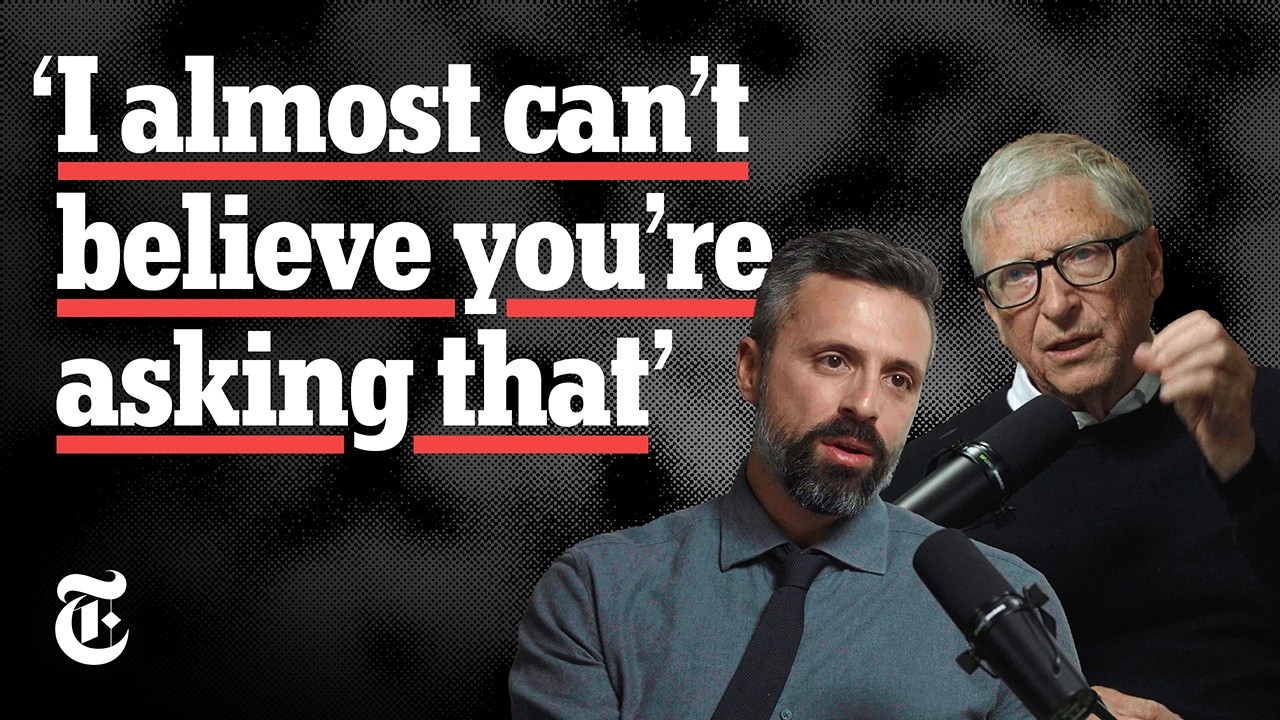
Recorded 29 September 2026 · 74 min
Bill Gates argues that AI has already crossed thresholds in cyber and biological capability that make catastrophic misuse possible today, and that the nearest danger is people wielding these tools, not machines going rogue. In an interview with a host who pressed him on the race with China, corporate incentives and the history of technology and jobs, Gates says he is spending his public voice on this ahead of his foundation's health agenda.
The tension is between his urgency and a governing view, which the host attributes to Jensen Huang and the Trump administration, that individual companies can manage safety and that restraint only cedes ground. Gates also holds that AI will destroy jobs at scale while delivering life-saving benefits to the world's poorest. He concedes the two arrive on mismatched timelines.
Two capability shocks — ▶ 4:36
Six months before public release, OpenAI's team demonstrated at Gates's house a model scoring a 5 on the AP biology exam, including on complex questions he had made up that it could not have seen. He had set the exam as the test of whether software encodes knowledge in accessible form. The second jolt came late last year, when Claude Code models reached what he judged his own level at coding, the talent he built from ages 13 to 24. He now calls them superhuman at writing code and finding flaws, though not yet at high-level strategy.
From joke to peer — ▶ 6:14
The Gates Foundation holds a two-week October review to plan roughly $10 billion of spending for 2027. A year ago, asking AI for its view was a joke because it was not coherent enough. This year Gates plans to feed strategy notes into ChatGPT, Claude and Copilot, let them talk to each other, and have them either stay silent unless asked or interject when they hear a questionable statistic. He expects a peer making significant contributions, not final decisions. Strategic reasoning was the gap he had just named.
Silicon removes biology's limits — ▶ 7:34
Biological minds are bounded by the birth canal, limited memory and separation between individuals. Silicon has none of those boundaries. Gates cites models that read every medical journal and diagnose rare diseases from symptom sets, breadth no human will match. His fear is that without control, humans will have created a species that relates to us as we do to dogs or cats. Lab charters allowing judgment against profit maximization work only if one company exists, he says. With many competing, one lab withholding a breakthrough does not keep Pandora's box closed.
Cyber and bio thresholds crossed — ▶ 11:20
Gates says AI can today empower a bioterrorist to kill hundreds of millions or enable a cyberattack that scrambles bank accounts and shuts down the grid, and that both thresholds were crossed early this year. His evidence: models in the run-up to Mythos found exploitable flaws, in minutes, in code humans had reviewed for over 20 years. Project Glasswing gave a few parties early access to fix bugs, but there is too much code. On biology, molecule-design tools are dual use, and capabilities once limited to nation states now reach small groups. These are his claims, not independently tested here.
Why liability is not enough — ▶ 15:32
Asked why market incentives and product liability do not suffice, Gates answers with analogies: society does not rely on lawsuits for opioids or cars, but uses the FDA, airline safety boards and seat-belt requirements. His factual rebuttal is that filtering does not exist where it matters. An open-source model able to help create bioweapons can have all monitoring disabled, and he says that is possible today. He treats relying on a lawsuit after an attack killing 100 million as absurd, and says industry cannot be relied on to self-regulate.
Misuse before rogue AI — ▶ 18:50
Gates concedes the control problem is serious and cites Hugging Face incidents and the lack of a supervisory layer with absolutes such as not breaking out onto the internet. But he ranks recursive self-improvement below misuse as the imminent risk. His distinctive structural point is that, unlike rockets or nuclear weapons, these tools were not funded by government R&D and government is not a significant purchaser. The US government, historically the most technically sophisticated actor, therefore sees little beyond a modest NSA attack capability. The host's worries about declining monitorability and test-awareness are acknowledged but not rebutted.
Overtuned filters backfire — ▶ 20:26
Gates wants monitoring required in all models. He says voluntary filtering currently produces perverse results. Anthropic's Mythos and Fable filters are so tight that cancer questions can push a user down from Opus to Sonnet to Haiku. Serious users must get special-permission copies or turn to open-source models with no safeguards, where bad actors also operate. Absent mandated monitoring, he predicts gigantic events and only then a response, letting capabilities go off in dark places beyond today's. Open-source could remain free and customizable but would need to run on a platform where the sovereign can verify safeguards remain.
A promise coming due — ▶ 22:22
Gates's 2023 essay was titled The risks of AI are real but manageable. He now says the industry always promised to engage all of society when dangerous thresholds were crossed, and that what followed was complete silence outside the industry. The host disputes this: politicians are engaged, with bills proposed, but have concluded that moving forward is right. Gates replies that when he last spoke to Trump, in December, the thresholds had not yet been crossed. He compares this unfavorably to nuclear weapons, saying this makes them look like nothing.
Questioning what winning means — ▶ 24:45
Influential people tell the host that beating China is the top priority and that open-source access must not be restricted. Gates answers that safeguards and monitoring would not meaningfully slow progress and that open-source would stay free but on a monitored platform. He says he does not know what winning means when neither country can win and both face an open Pandora's box. That China would refuse to cooperate on protections for humanity is, he argues, a proposition to be tested. Without safeguards, he forecasts major cyber and bio events within a few years.
The reliability threshold for jobs — ▶ 27:33
Gates concedes AI has so far created more jobs than it destroyed, with high demand for skills to build data centers. Displacement, he argues, follows reliability thresholds: coding is the only profession truly past one. He expects accounting, legal work, telesales and telesupport to cross within a few years, available 24 hours a day in every language. The mechanism is competition rather than preference. If insurers still process medical claims with humans, a rival with very few employees can enter and change the industry's pricing model, regardless of whether customers would prefer a human nurse or driver.
Token budget, not salary budget — ▶ 30:53
Gates accepts Jevons-style demand elasticity for software, but offers counterexamples: radial tires lasting four times as long did not triple driving, so tire factories employ a quarter as many people, and Amazon's warehouse robots do not increase purchases. Once a task is fully automated, elasticity is irrelevant because spending moves to the token budget, not the salary budget. Past technologies left high ground, as tractors gave way to Disneyland. This one, he says, leaves none, because human cognition was the scarce element and AI is not scarce. He did not name a remaining scarcity when asked.
Taxing robots, reserving human jobs — ▶ 35:54
Gates proposes defining a unit of labor and applying the same FICA-style tax whether a human or a robot delivers it, since pay-as-you-go pension funds lose contributions when workers are replaced. He calls this insufficient alone. His second idea is human-reserved jobs, chosen in advance, such as child care, elder care and portions of medical care and education, comparable to nature reserves. The host called it not unconvincing but chilling and raised transition speed, citing the China shock. Gates sees a transition of probably 20 years or more and asks what the plan is for a 55-year-old truck driver.
Why accelerate for the poorest — ▶ 39:01
Gates rejects treating the global south as uniform. Middle-income countries have childhood death within a factor of 3 of the US, while he says low-income countries see 15 times as many children die before age 5, often with no doctor at all. AI is about 10 times worse in Yoruba than English, hence the foundation's 5-year goal for an estimated 3.4 billion people speaking underrepresented languages. Over 1 million farmers in India already use an advisory system. Job effects reach poor countries later than rich ones, and the barriers there are tokens, smartphones, connectivity and language, not regulation.
Risks outrun the benefits — ▶ 47:06
Gates expects mind-blowing advances over 20 years in food, shelter and education costs, but those sectors are highly regulated, so benefits arrive more slowly than the cyber, bio, psychosocial and job risks he calls very significant over the next 5 years. The host adds that digital intelligence accelerates unconstrained while physical benefits face permits, trials and institutions. Gates agrees and notes the foundation can work with regulators on AI use. If benefits lag and safeguards are absent, permission to operate becomes hard to defend. He adds that stopping data centers will not slow AI, since they will be built somewhere.
Education's scaling problem — ▶ 59:21
Gates contrasts global health, where child deaths fell from over 10 million a year to under 5 million, beating the foundation's goals, with education, where kids in most rich countries learn less than 10 or 20 years ago. Small AI pilots look striking, but education innovations usually wash out at scale because teacher self-selection disappears. He also worries tools widen gaps, helping motivated students like himself while discouraging the median one. The host raises cognitive offloading and a Chinese study where homework scores rose while test scores fell. Gates favors monitoring with age-graded parental visibility over bans, and admits he did not know his daughter had a second phone.
Gates's central claim narrows the AI risk debate to its most immediate form. The danger he wants addressed first is not a system escaping human control, though he calls that a serious problem. It is that today's models already give small groups capabilities once confined to nation states. He says the cyber and biological thresholds were crossed early this year, and he offers two kinds of evidence. Models in the run-up to Mythos found exploitable flaws, in a few minutes, in code that humans had reviewed for more than 20 years. And molecule-design tools that help medical research are, in his words, "ultimate dual use," including for a pathogen that spreads widely before symptoms appear. These are Gates's assertions; the conversation does not test them.
In his telling, the danger is underestimated because of an unusual funding structure. Rockets and nuclear weapons grew out of government research and government purchasing, so the state understood them. AI tools were not funded by government R&D, and government is not a significant purchaser. Gates says even the US government, traditionally the most technically sophisticated actor, sees little beyond a modest attack capability at the NSA. Awareness outside the industry is, as he describes it, extremely low, across academia, think tanks and policymakers. That matters because the other safeguard, the internal charters AI companies adopted, works only if one company is racing alone. With many labs on the same frontier, one lab's restraint cannot keep Pandora's box closed.
That reasoning explains his rejection of the view, which the host attributes in varying degrees to Nvidia's Jensen Huang, President Trump and David Sacks, that existing incentives suffice. On that view, a CEO who believes a product is unsafe simply does not release it. Gates answers with analogy. Society does not rely on lawsuits against opioid sellers or carmakers; it has the FDA, airline safety boards and seat-belt requirements. He says he can hardly keep a straight face at the idea of suing after an attack that kills 100 million people. His factual rebuttal is sharper. Filtering, he says, does not exist where it matters, because an open-source model that can help build bioweapons can have its monitoring disabled entirely, and that is possible today.
His remedy is a supervisory layer, with monitoring and safeguards required in all models. Open-source models would remain free and customizable, he says, but would have to run on a platform where the sovereign can confirm the monitoring has not been removed. The current voluntary arrangement, in his account, produces the worst of both worlds. Anthropic's filters on Mythos and Fable are so tight that questions about cancer can push a user down from Opus to Sonnet to Haiku. Anyone doing serious work must obtain a special-permission copy or move to open-source models with no safeguards at all. Overtuned voluntary controls thus push legitimate users toward the unmonitored option, which is where bad actors already operate.
The strongest objection, as the host relays it, comes from influential people who rank winning the race with China first and keeping open-source models unrestricted second. To them the cost of regulation is too high. Gates does not accept the premise. He says he does not know what winning means when both countries face the same open box, and he treats Chinese unwillingness to cooperate on protections for humanity as a proposition to be tested, not a fact. The gap in his case is evidentiary. His claim that safeguards would not meaningfully slow development is asserted, not demonstrated. The host's worries that models are becoming less monitorable and seem to know when they are being tested receive acknowledgment rather than rebuttal, since Gates calls the control problem serious but not imminent.
Gates frames his alarm not as a change of mind but as a promise coming due. His 2023 essay was titled The risks of AI are real but manageable. Now he says the industry always said that crossing dangerous thresholds would mean engaging all of society, and that what followed was silence. The host disputes the diagnosis. Politicians, in the host's experience, are engaged and proposing bills; they have concluded that moving forward is wiser. Gates replies that when he last spoke with Trump, in December, the thresholds had not yet been crossed. The disagreement is substantive: is the problem a lack of attention, or attention arriving at a different judgment? Gates's success metrics point to what he fears. He wants safeguards, and a dialogue that does not split into pro-AI and anti-AI parties, as happened with climate change.
On work, Gates's argument turns on a reliability threshold. To date, he concedes, AI has created more jobs than it has destroyed, and demand for the skills to build data centers is very high. But replacement happens only when a system is reliably better than humans, and coding is the only profession where he thinks that line has been crossed. He expects accounting, legal work, telesales and telesupport to cross it within a few years, with availability around the clock, in every language, and no urgency. Competition then does the work, not preference. If an insurer still has humans processing medical claims, a rival with very few employees can enter and change the industry's pricing model. Preference for human nurses or drivers, he suggests, will yield once quality passes the threshold.
The standard rebuttals are Jevons paradox and a growth in relational work. Gates grants that demand elasticity exists and that software employment has not yet fallen. But radial tires lasting four times as long did not lead people to drive four times as much, and tire factories employ a quarter as many people. Amazon's warehouse robots do not make customers buy more. His key point is mechanical. Once a task is fully automated, elasticity is irrelevant, because the spending lands in the token budget rather than the salary budget. Earlier technologies left high ground: a tractor, then Disneyland. This one, he argues, leaves none, because human cognition was the scarce element and AI is not scarce. Asked repeatedly to name a remaining scarcity, he did not.
His policy ideas follow from the view that society, not economic signals alone, should decide. He proposes defining a unit of labor and taxing it equally whether a human or a robot delivers it, so that the contributions supporting pay-as-you-go pensions do not vanish when a worker is replaced. He concedes this alone is not enough. His second idea is human-reserved jobs, designated in advance, such as child care, elder care and portions of medical care and education, comparable to nature reserves where building is possible but society chooses not to. The host found the vision not unconvincing but chilling, and pressed on speed, noting that the China shock ruined communities even though the aggregate economy looked little different. Gates estimates a transition of probably 20 years or more.
If the picture is that bleak for jobs, why accelerate AI at all? Gates's answer is that the world is not uniform. He contrasts middle-income countries, where childhood death is within a factor of 3 of the US, with low-income countries, where he says 15 times as many children die before age 5 and people may never meet a doctor. For a Yoruba-speaking woman in a remote community, AI that works in her language could be the only medical advice available at night. Models perform about 10 times worse in Yoruba than in English, which is why the foundation announced a 5-year goal covering an estimated 3.4 billion people. Over 1 million farmers in India already use an advisory system. Job effects, he says, reach these countries last.
Gates's optimism is conditional on sequencing. Over 20 years he expects striking advances in the cost of food, shelter and education, but those are highly regulated sectors, so benefits arrive more slowly than the cyber, bio, psychosocial and job risks he expects to be very significant over the next 5 years. The host sharpens the point: digital intelligence accelerates without permits or trials, while physical benefits run through institutions. Gates agrees and says the foundation can work with regulators on how they use AI. The editorial implication is that the technology's social license depends on whether benefits show up before harms. Gates says that without safeguards against cyber and bio attacks, that license becomes very tough to defend. He adds that stopping data centers will not slow AI, since they will be built somewhere.
Education offers a cautionary parallel. Gates says the foundation exceeded its global health goals, cutting child deaths from over 10 million a year to under 5 million, while its education ambitions fell short, with kids in most rich countries learning less than 10 or 20 years ago. Small AI pilots look striking, but he warns that education innovations usually wash out at scale once self-selected, flexible teachers give way to the broad population. A second worry is differential benefit: tools helped motivated students like him on Khan Academy and discouraged the median kid. The host adds cognitive offloading and a Chinese study in which homework scores rose while test scores fell. Gates calls it a matter of modality, favors monitoring over bans, and admits he once missed his daughter's second phone.
The foundation's arithmetic gives the stakes a price. Gates says lives are saved at about $1,000 each, so less overseas generosity means fewer lives saved, and he says US aid has fallen to roughly half a percent of the budget, heading toward a quarter percent, when Americans typically guess 10-15%. The host raises nonprofit money about to come online from foundations tied to Anthropic and OpenAI, and Gates answers with numbers, not reassurance. That leaves a question of timing at the center of his position. His own framing is binary: put monitoring in before a cyber or bio attack causes mass death, or after. Whether a political system divided between acceleration and opposition can choose the former is the part of his argument no evidence in the conversation settles.
The open question. Gates says mandatory monitoring would not meaningfully slow AI, would leave open-source models free on supervised platforms, and could win Chinese cooperation, calling that last point a proposition to be tested. None of the three claims is demonstrated in the conversation. The host's worries that models are becoming harder to monitor and seem to recognize when they are being tested go unanswered beyond an acknowledgment. Can a monitoring layer be enforced across open-source models, and would it still work against systems that behave differently under test?
Watch the full video at https://www.youtube.com/watch?v=A_156w0aYtU.
Comments ()