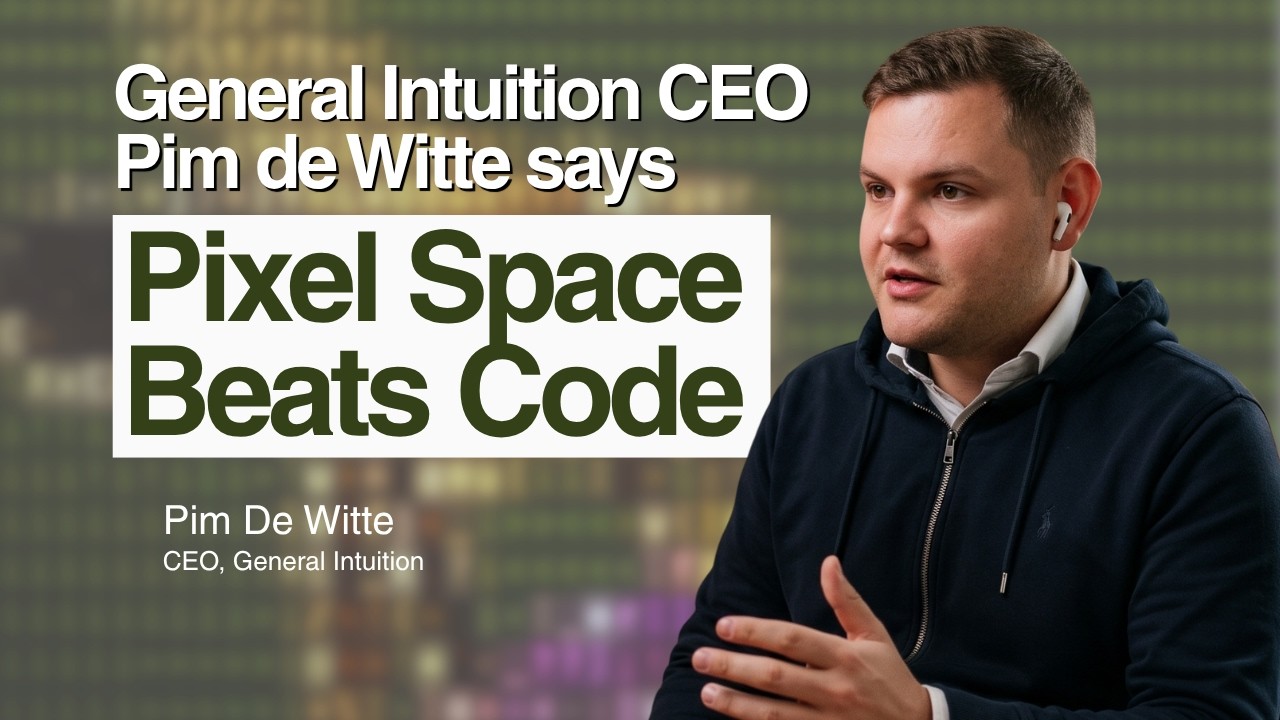
Recorded 7 October 2026 · 22 min
Pim Dwight, co-founder and CEO of General Intuition, is betting that pixels can become a general scaling axis for AI the way code did for Anthropic. Problems get moved into pixel space, and models trained on action-labeled video learn to act on them. The lab recently raised $220 million at a $6.2 billion valuation, after showing that models trained on gameplay can also control real robots.
The tension lies between two routes to physical intelligence. Code-writing LLMs produce impressive robot demos that Dwight calls slow, while pixel-native policies are faster but unproven at the scale of text models. He also argues that world models themselves are a thin moat, because the scarce asset is action data that pixels cannot reveal. The interview offers few quantitative results to test these claims.
Real-robot transfer drove funding — ▶ 1:21
Between the host's cited earlier round (a $320 million Series A about three months before) and the new $220 million raise, General Intuition showed its models can control real-world robots. The logic is that humans use one primitive, vision in and actions out, to play games and to teleoperate robots via Quest 3, keyboard and mouse, or controllers. The models do the same. Before the previous round, the recipe was proven only in simulation and games. Dwight credits scaled data, compute and better model-building, and says the proof attracted new capital.
Pixels versus code for robots — ▶ 2:38
Frontier LLMs such as Claude can control robots in demos, but through code, which Dwight says is usually slow because it must be written, often compiled and deployed onto the robot. Models native to pixel space can be much faster. What remains unclear to him is how the two converge: how to combine coding's strengths with vision-based policies, and how the whole stack fits with text models. He calls world models, broadly, natively frame-based or pixel-based models, and promises models from the company this year.
Game controller as universal interface — ▶ 5:34
Humans are extremely general agents despite weak physics primitives, Dwight argues, so robots may not need exact coordinates, only knowledge of what must change at each moment. General Intuition maps game-controller or keyboard-and-mouse inputs into its models. Robotics companies then need not retrain locomotion or balancing policies, since those already accept controller inputs from teleoperators. He says almost every robot ships with this interface. The focus is policy learning, building agents on top of world models, rather than precisely predicting pixels, because the company's advantage lies in action data.
Bot data hits a ceiling — ▶ 8:28
A model trained on more than 10,000 hours of bot-generated Rocket League gameplay (the host's understanding) raised the question of whether human data is still needed. Dwight says yes. Bots like Nexto, a strong RL bot, fail at human mechanics such as the flip reset, and complex human sequences make the approach break down. Still, the world model learned collisions, score and timing, and synchronized them across many players. Dwight sees this as evidence that world models can learn dynamics previously thought out of reach, with applications beyond games.
Multi-view prediction forces geometry — ▶ 10:21
Dwight says gameplay data scales with predictable gains, with strong generalization and compositional generalization: strategies learned in one game appear in another, in combinations humans may not have made. The multi-viewport design tested whether forcing a model to predict several viewpoints at once, such as four players looking at the same scene, makes it learn 3D structure from less data. Predicting a single stream only requires modeling how pixels change, not the world beneath. The transcript does not report the results of that experiment.
Actions, not pixels, are the moat — ▶ 11:54
Dwight argues world models are a weak moat because an event need only be seen once for its dynamics to be learned. Action trajectories are far more varied, and much of their information is invisible in pixels. In his hypothetical, a plane lands on video, but nothing shows the rudder moved. With ground-truth action sequences, omitting the rudder makes the plane crash. That missing information matters for operating out of distribution and generalizing to new environments. The moat, he says, lies in what is built on world models, such as behavioral policies, not in the world models themselves.
Simulation first, then one system — ▶ 16:01
Dwight's one-year prediction is that most token consumption will sit in simulation, not on physical devices, and that winners will emerge from simulation. He calls current robot demos on Twitter too slow and impractical, with real physical systems working at scale perhaps by mid-to-late next year. His 10-year bet is a single system, with no system 1 and system 2 split, scaling along one axis he hopes is pixels. He reasons by analogy: just as people moved problems into code space, they will move them into pixels, like ultrasound sensor data rendered as images.
Pim Dwight's central claim is that the road to general physical intelligence runs through pixels rather than code. His argument is an analogy. Anthropic, he says, focused hard on code and bet that people would bring increasingly more problems into code space. They did, and others built harnesses around that. General Intuition wagers that the same will happen to pixels. An ultrasound, in his example, is sensor information rendered into pixel space that a human annotates by looking and clicking. Force readings from teleoperation can likewise be rendered as images. He describes the company as the lab that is "scaling pixels all the way."
The practical lever is the game controller. Humans play games and teleoperate robots using the same primitive: vision in, actions out. General Intuition maps controller or keyboard-and-mouse inputs into its models, so robotics companies need not retrain locomotion or balancing policies that already accept those inputs. Dwight says almost every robot ships with this interface. That makes the approach unusually easy to deploy, because it plugs into existing control stacks rather than replacing them. It also explains the company's emphasis on policy learning, building agents on top of world models, over predicting precise pixels.
The evidence that this works is the transfer from games to hardware. Before its previous round, General Intuition had proven its recipe only in simulation and games. By the time of the $220 million raise at a $6.2 billion valuation, Dwight says, models trained on gameplay could also control real robots. He credits more data, more compute and better model-building. The claim comes from the company, though, and the interview offers no benchmarks, task descriptions or success rates. Investors apparently found it persuasive. Readers cannot yet judge it independently, and Dwight says the team has little time to publish papers.
Why would action data matter more than world models? Dwight's answer is informational. A world model learns from pixels, and an event needs to be seen only once for its dynamics to be absorbed. But pixels omit causes. A plane may land on video with no trace that the rudder moved, whereas a ground-truth action sequence reveals that omitting the rudder crashes the plane. Action trajectories are also more varied than the events they produce. In his view, that makes labeled action sequences the deeper moat, and world models more useful as training environments than as defensible assets.
The Rocket League results sharpen the point. A model trained on over 10,000 hours of bot-generated gameplay, as the host understood it, learned collisions, score and timing, and synchronized them across many players. Yet Dwight says bots like Nexto break down on human mechanics such as the flip reset, so human action sequences remain essential. The multi-viewport design adds a mechanism: predicting four players' views at once may force a model to internalize 3D geometry, which a single stream does not require. Dwight says he wanted to test whether this reduces data needs. The transcript reports no result.
The strongest uncertainty comes from Dwight himself. He says it is unclear how pixel-native models will play with frontier LLMs and text models. Code-driven robot control looks impressive but is slow, since code must be written, compiled and deployed. Pixel policies are faster, but the open problem is combining the best of both. His forecasts add a tension. He expects most token consumption next year to sit in simulation, calls current robot demos too slow to be practical, and sees physical systems working at scale only by mid-to-late next year. Meanwhile, his 10-year bet is that everything collapses into one scaling axis, which he hopes is pixels, though he allows it could be code or a combination.
The next test is a harder one. Dwight says the models can control anything driven by a game controller but not the hands of a humanoid, because those actions are not in the training data. His stated next phase is action-space transfer, not just moving between environments. By editorial inference, the controller interface that makes deployment practical today may also bound the approach's reach. If transfer holds as embodiments grow more complex, the pixel thesis gains real force. If it requires new action data for each embodiment, the moat Dwight describes becomes a recurring cost.
The open question. Dwight says a game controller can drive almost any robot but not the hands of a humanoid, because those actions are absent from the training data. His next phase is action-space transfer, not just environment transfer. Does a controller-shaped interface, the source of the approach's practicality, also cap how far the recipe generalizes? The interview offers no evidence on that, and no results on how pixel-native policies would combine with code-based LLMs.
Watch the full video at https://www.youtube.com/watch?v=ttgM5tpPoWE.
Comments ()