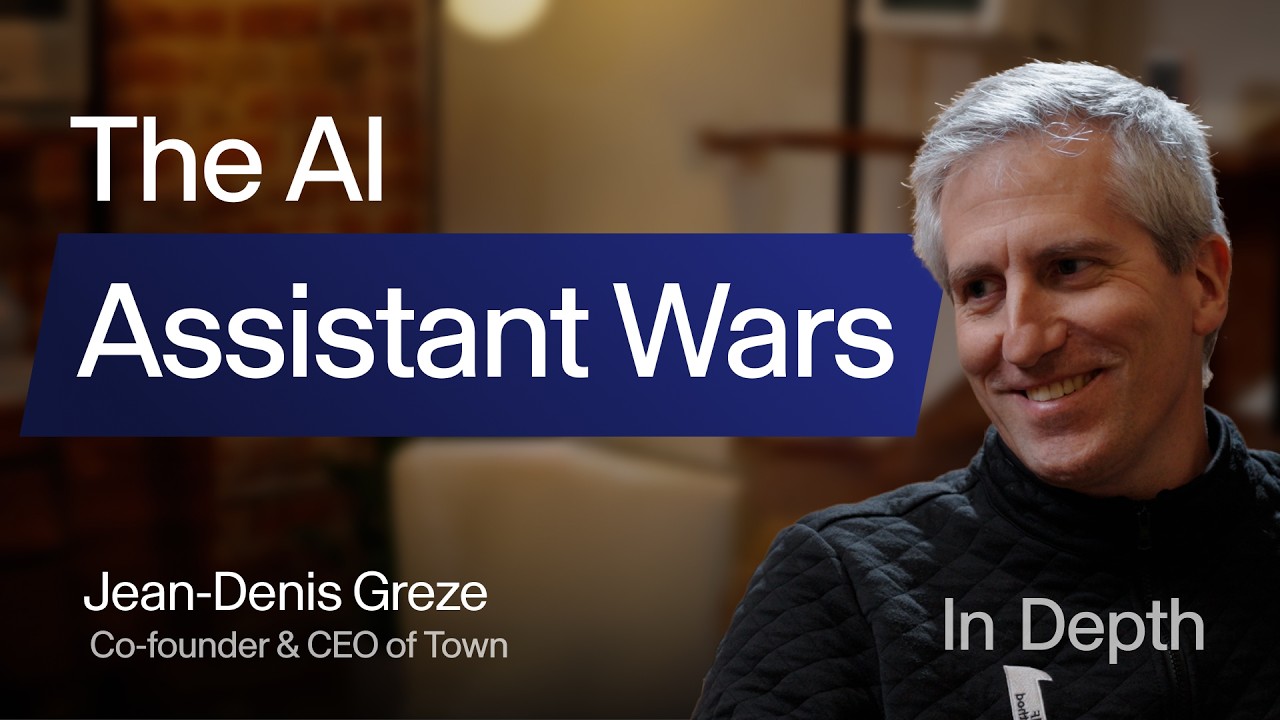
Recorded 28 October 2026 · 48 min
Jean Denigrees, known as JDG, co-founded Town, a work AI assistant that has just announced a Series B at a $1 billion valuation. His central claim is that in the new agent market a product lead is measured in weeks, so lasting advantage has to come from places features cannot reach: neutrality across AI labs, user trust, and teaching people what agents can do. He sees the stakes as larger than a single app, calling these assistants a window through which people will interact with content.
The tension is that the same forces that created the opportunity also remove the usual protection. Model improvements reach every competitor at once, and well-funded incumbents with distribution are entering. JDG says he always expected this and argues the incumbents are less scary than they once were. The conversation tests what a startup can still own when copying takes weeks, and whether trust in agents that share information between people can be built fast enough.
Two interfaces, not one — ▶ 3:35
JDG expects people to keep two agent interfaces on their phones, one for work and one for personal life, because the data constraints differ. Companies do not want their data monetized through ads or transaction cuts, and do not want sales-meeting notes sitting in a personal knowledge bubble that leaves with a departing employee. Consumers may accept those trade-offs for a free product. Calendars are the exception: he expects a softer membrane there so personal date nights and work meetings do not collide. Even travel needs different APIs, integrations and service expectations in each context.
Work has no ceiling — ▶ 7:11
Town chose work over personal use because AI turns power into intelligence, and personal life has a limit on both what intelligence can improve and what people will spend. In JDG's view, booking a restaurant is close to solved, and only about 12 months of improvement remain. Work offers no comparable ceiling: if spending on AI generates revenue, companies keep spending more tokens. Workplaces also add multi-person complexity and data silos that AI can break down. He concludes that the market is bigger, willingness to spend higher, and the product problem more interesting.
Two model steps unlocked agents — ▶ 9:20
JDG dates the agent boom to two capability steps. First, Anthropic's models in November and December of last year could autonomously handle some white-collar work such as labeling email, scheduling and generating automation code, which is when OpenClaw took off. Second, in June or July the models got good at browser and computer use, letting agents operate tools like Figma or video editors instead of only APIs. He also says knowledge-work accuracy rose from roughly 70-80% in the first quarter to 90-95%, with errors that are less damaging. Agents also became proactive, suggesting tasks unprompted.
Moats compress to a quarter — ▶ 12:56
Town launched in June and, through July, JDG thought it was untouchable. Competitors can now dissect a feature and launch a version in weeks to months, where it once took years to decades. Rather than two years to build network effects, he has a quarter or two of clean air after each launch, and believes winning means being right four or five times over 18 months. The compression is symmetric, though. Incumbents lack network effects too, and startups can now build in 12 months what once took 5 years, which he says makes incumbents look less scary.
Neutrality beats vertical integration — ▶ 16:10
OpenAI and Anthropic supply Town's models while shipping competing products. JDG's response is to ask business customers who will have the best frontier model in 1, 2 or 5 years, then ask why they would commit to a product that supports only one lab's models. He argues the product layer should be neutral and route to the best model at the right price, noting open-weight models can cost 10-20 cents on the dollar relative to frontier ones. Some customers, he says, bet on a lab that was the wrong choice for 12-15 months and now feel burned by large token commitments.
Tokens, seats, and ROI visibility — ▶ 18:04
JDG declines outcome-based pricing, as promoted by Sierra's Brett Taylor, because outcomes in an assistant are unclear. Town sells bundles of tokens priced at inference cost plus a platform fee, and users choose what to spend them on: $10 a month on calendar rules or $99 on recruiter candidate search. Customers asked for the predictability of seat pricing with tokens included, then usage-based pricing above that once they see where ROI appears. He sees four enterprise differentiators: data privacy and security, model routing, data ownership and portability, and visibility into token ROI.
Education is the product — ▶ 25:06
JDG argues Town's real product is an onboarding platform that teaches mainstream users what AI can and cannot do, because the core problem of horizontal assistants is getting humans to use them well. About 10% of users found agent-to-agent early. To spread it, the team had the agent add itself to email threads and manage scheduling back-and-forth, and shipped this only to new users. They use it more and then start finding other uses. The principle is to deliver new features inside existing behavior so users learn by seeing, rather than by discovering them.
One towny per person — ▶ 29:13
Town gives each person a named agent with a consistent personality rather than one all-knowing company agent. JDG gives three reasons. A company-wide agent forces an enterprise sale to IT before a user can see value, whereas Town starts with email, calendar and one system of record. A global agent cannot hold private data. And people want their own tailored assistant. Shared company integrations, skills and routines are opt-in. He and co-founder Tony Vincent disagreed about one agent versus many, resolved by deciding they were building a relationship, which needs one agent. JDG also admits he was wrong that browser use was not ready.
Trust moved beyond security — ▶ 32:16
Early Town required a human in the loop for any write action touching untrusted data. Customers then wanted fast deletion, minimal indexing and no training without opt-in, and later cared that agents not make them look stupid and explain their decisions. JDG says his initial assumption about injection attacks is now basically not true, as long as the harness labels messages correctly, though agents can still be injected. Multiplayer is the new problem: approving every handoff between agents scales badly, so AI must apply sharing policies a business can inspect. Agent actions happen in visible channels, which he says deters abuse.
Why small businesses first — ▶ 37:20
JDG says letting AI decide what moves between colleagues' agents would not work in a Fortune 100 today. Mapping trust intuitions, such as teammates versus people in other countries, is hard and will take time. Town therefore targets teams in Silicon Valley and 25-person small businesses, where implicit trust already exists. His internal strategy doc holds that Google and Microsoft cannot adapt to this future because none of their enterprise customers are ready to endorse it. This is his strategic judgment about incumbents, not demonstrated evidence.
AI will decide sharing — ▶ 44:37
JDG's contrarian bet is that AI will increasingly decide what gets shared from you, not with the world but with family and co-workers, when they need something that lives in your systems. He likens it to the backlash when Facebook introduced an algorithmic feed. The hard part, he says, is neither agent-to-agent communication nor privacy, which must simply be right. It is delivering value people have never experienced, such as avoiding loops between humans, so they learn the capability exists. Users have no expectation of it yet, which he sees as the real challenge.
The lesson Town's CEO, Jean Denigrees (JDG), draws from his first months at the center of the agent boom is that a product lead no longer buys time. Town launched in June, and through July he believed it was untouchable. Within months other entrants were in the race. Competitors can now take a good feature apart and ship their own version in weeks to months, where it once took years to decades. The implication he states plainly: instead of two years to build network effects and real moats, he has a quarter, maybe two. Everything else in his strategy follows from one question, which is what remains defensible once features are cheap to copy.
The mechanism is that capability reaches everyone at once. JDG dates the first wave to November and December of last year, when Anthropic's models began to handle some autonomous white-collar work, which is when OpenClaw took off. The second came in June or July, when models got good at browser and computer use, so agents could operate tools like Figma or a video editor instead of being limited to well-shaped APIs. Reliability moved too. In his account, knowledge-work accuracy rose from roughly 70-80% in the first quarter of this year to 90-95%, with mistakes that are less annoying. Since these gains come from the labs, every rival inherits them, which helps explain why copying is so fast.
That symmetry cuts both ways, and JDG leans on the second edge. Incumbents with distribution, such as Microsoft and Google, mostly lack network effects as well, so a startup can close the gap with companies that once seemed impossible to challenge. Startups now take ambitious mandates that would have needed 5 years and build them in 12 months. His own conclusion is a treadmill: a company probably has to be right four or five times over 18 months, shipping something like team and agent-collaboration features and hoping for one to three months of clean air. This is a founder's reading of a market he is inside, offered without data on how often fast followers actually win.
Neutrality is the most concrete moat he proposes. OpenAI and Anthropic are both suppliers and competitors, and JDG says their reassurances that Town is a valued API customer sit alongside competing launches. His answer is to put a question to buyers: who will have the best frontier model in a year, two years, five? Nobody knows, so why commit to a product that supports only one lab's models? He adds that open-weight models can cost 10-20 cents on the dollar relative to frontier models, and that some customers who bet on a lab that proved the wrong choice for 12-15 months feel burned by their token commitments. The argument is plausible but self-interested, because model routing is precisely what Town sells.
Town's market and pricing choices rest on elasticity. JDG argues that personal life has a ceiling: booking a restaurant is close to solved, and people will spend little on it. Work has no comparable limit, since anything that generates revenue invites more token spending, and workplaces add multi-person complexity and data silos that AI can dissolve. He expects people to carry two interfaces, one for each domain, because companies will not accept ads, training on their data, or notes that leave with a departing employee. Pricing follows from this. He rejects outcome-based pricing because outcomes are unclear, sells tokens at inference cost plus a platform fee, and found customers wanted seat pricing with included tokens first and usage-based pricing above that. Town's second most expensive plan is $99 a month.
A less obvious claim is that Town's actual product is education. JDG says the core problem for horizontal assistants is getting a mainstream person to understand what AI can and cannot do, and that this is an onboarding problem. About 10% of users found agent-to-agent collaboration early. To spread it, the team had the agent add itself to email threads and handle calendar back-and-forth, and gave this only to new users. They use it more and then discover other uses. The logic is to deliver new capability inside existing behavior, so users learn by seeing. He pairs this with fast experimentation, since an agent's behavior can change without altering the interface, but insists users still need to be heard.
Trust, in his telling, is the most unstable part of the design. Early Town required a human in the loop for any write action triggered by untrusted data. Customers then asked for fast deletion, minimal indexing and no training without opt-in, and later cared that agents not make them look stupid and explain their reasoning. JDG now says his initial assumption about injection attacks is "basically not true today," while stressing that agents can still be injected. The harder problem is multiplayer. Approving every handoff between agents scales badly with participants, so AI has to apply sharing policies a business can inspect. His safeguard is that agents act in visible channels, so someone probing a boss's agent for salaries is both refused and exposed.
This leads to JDG's most contrarian bet: that AI will increasingly decide what information is shared among people who are close, such as family and co-workers, when they need something that lives in your systems. He compares the reaction to the one Facebook met when it introduced an algorithmic feed. The idea explains several choices. Each person gets a named towny, partly because a global agent cannot hold private email and calendars, and partly because a company-wide agent forces an enterprise sale starting with IT. It also explains the focus on small businesses. He says Fortune 100 deployment is "No way" today, and that Google and Microsoft cannot adapt because none of their enterprise customers will endorse this future.
The evidence for the trust claims is thinner than the evidence for the speed claims. JDG says that empirically in the data agents do little weird, but gives no figures, and the public-channel safeguard depends on teams small enough to have implicit trust. He is candid that mapping sharing intuitions is hard and will take time. He also says the difficult part of agent-to-agent is neither the technology nor privacy, which must simply be right, but delivering value people have never experienced, so they learn to expect it. That leaves a question for his whole thesis. If features can be copied in weeks, can trust, neutrality and a habit of delegation be copied just as quickly, or do they accumulate at the slower pace that he says network effects no longer have?
The open question. JDG's most ambitious idea is that AI will decide what information flows between colleagues' agents, yet he concedes that mapping sharing policies is hard, will take time, and works today mainly in small teams with implicit trust. Can those policies scale to organizations of thousands without reintroducing the approval friction he wants to remove? His evidence for safety is empirical and unquantified, so the claim that injection is no longer a serious constraint remains unproven at that scale.
Watch the full video at https://www.youtube.com/watch?v=ER7iIvMDEsw.
Comments ()