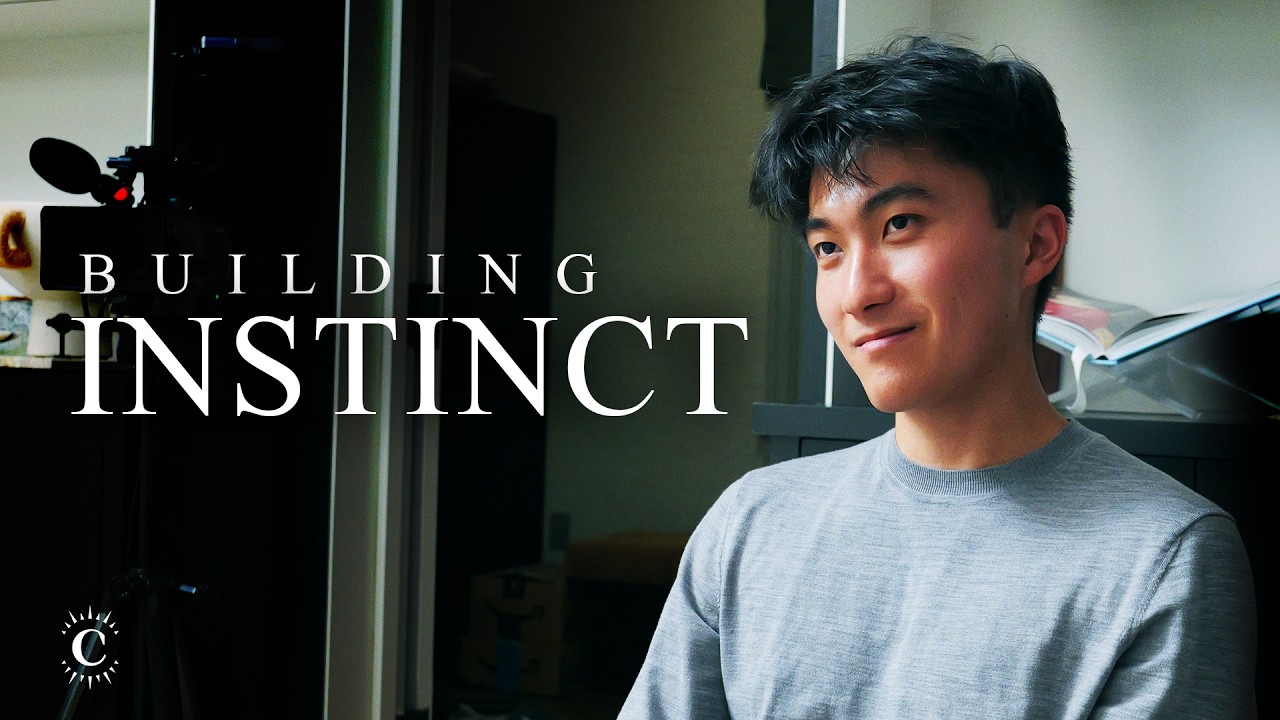
Recorded 29 September 2026 · 85 min
The founder of Instinct, a year-old company building a personal assistant reached by text, call and email rather than an app, argues that agents will move digital business from monetizing attention to monetizing transactions. His reasoning is that when friction falls to near zero, users transact more, so services whose revenue comes from the underlying good gain while those living on screen time lose. He says Instinct is approaching $1 billion a year in transaction volume on a small, invite-only base.
The tension is that the same agent must stay aligned with its user while earning a take rate from merchants. It must also win enough trust to hold credit cards and inboxes, and scale a product whose compute need he says doubles roughly weekly against a lead time of months. The conversation is a rare look at the economics behind a consumer agent.
An assistant, not an app — ▶ 1:33
Instinct is reached by text, phone call or its own email address, with no application. It has its own computer, so it can do what a user does on the internet. The founder says early traction came because users already know what AI should do, which is act for them, an expectation dating to ChatGPT in 2023, so no vision-selling is needed. The agent can call a user about something urgent, such as a document due at 3 p.m. when it is 2:55. He warns against confusing a simple interface with limited ability.
Weighted trust network — ▶ 7:20
A network launched about 10 days before the interview lets users' agents negotiate directly, starting with scheduling. Connections are meant only for trusted people, with different access levels: spouses may share everything, colleagues perhaps only a work calendar and selected inbox items. Edges carry weights, unlike a friend graph. If someone probes beyond granted access, the owner's agent alerts them, so social consequences reinforce technical limits. Early uses include a friend group whose agents plan a weekly outing and coordinate one shared Uber for 6 people.
Reservations as two-sided matching — ▶ 15:59
An agent can check restaurant availability every 5 seconds across every site, exploiting a first-come, first-served system. The founder proposes the opposite use: agents communicating intent on both sides, so a user can signal a 30th birthday while a restaurant chooses to prioritize birthdays or major anniversaries. The claim is that matching what each side wants yields more special occasions for users and a better clientele for restaurants. The partnerships that would implement this are unannounced, and no results were presented.
Travel drives volume — ▶ 19:10
Travel is 50% of Instinct's transaction volume, and the platform is approaching over $1 billion a year on what the founder calls a very small invite-only user base. A single voice note, I need to be in New York tonight, triggers location lookup, flight booking against stored airline, seat, class, meal and card preferences, then hotel, Uber rides and calendar entries. He frames travel agencies as collaborators because of their data and networks, not as targets for disruption. The figures are self-reported.
Trust takes several weeks — ▶ 23:21
Time to first credit card, password or sensitive item serves as a trust proxy. Three weeks in, 40% of users have shared a personal credit card, a figure that includes users who may have churned. Users who connect at least one sensitive piece of information show 80% retention. The founder reads this as trust snowballing over several weeks, under a principle that users control and can retract their data. Causation is unproven: users already getting value may be the ones who share.
Decoupled firewalls and monitors — ▶ 25:37
The founder separates storing sensitive data, which he calls tractable though laborious, from the new surface of an agent holding cards, email and calendars. Incoming content passes through firewalls that can block malicious material meant to manipulate the agent. Every action and thought is checked by a monitor decoupled from the agent's own incentives, able to pause or reject it, for instance catching a hallucinated proper noun before a tool call. An early version lacked these protections; he says it prompted a new system, not patches, and gives no incident details.
Objectives over tasks — ▶ 28:39
The founder argues an agent smarter than its user becomes dangerous if funded like Google, TikTok, Instagram or Snapchat, where brands pay to sway behavior. Instinct is described not as a task accomplisher but as pursuing higher-level objectives: building trust and watching the user's back. Doing the requested task is one way to signal safety, so it performs a superset of what other AI products do, while staying robust to ill-intentioned requests. No evidence was offered on how it handles such conflicts in practice.
Take rate for distribution — ▶ 31:40
Instinct is free to users; merchants would pay a blanket transaction take rate, in the manner of Apple Pay. Benchmarks he cites: Shopify roughly 2-3%, Amazon upwards of 10%, Apple in-app purchases 30%. He says Instinct will not reach 30% but does not know where it falls. He dismisses the payments stack, where about 40 parties share 2-2.5%, as too small a pie. Some boutique hotels, he says, would pay up to 30%. It works only if digital behavior moves to agents and distribution power is real.
Attention versus underlying service — ▶ 39:04
The founder plotted digital businesses by revenue share from user attention, such as ads and upsells, versus the underlying good. The naive view is that a 70% ad business shrinks to 30%. His counter is that cutting checkout clicks has raised transaction volume, and a proactive agent, such as a car always lined up for calendar events, increases interactions. Social media, reliant on attention, is most exposed. He did not know Uber's or DoorDash's actual splits. His advice is scaled experiments, such as exposing 1% of users, not going all in.
Understandability over capability — ▶ 49:03
A founding principle was to optimize for understandability, meaning how well users can predict what happens, not for capability. The founder credits this for engagement and word of mouth. Messages are shaped to reading patterns, front-loading information because readers take in about 80% of the first line and 50% of the next. Because trust at 2-3 weeks resists simulated evaluation, he relies on taste and staged rollouts: himself, the team, early access, then the public. He concedes others may deliver a seemingly similar experience.
Invite scarcity growth loop — ▶ 54:10
The program began with about 200 friends and family, each given 5 invites. Daily growth climbed from 1-2% to 3-4%, then 6-9%, and is now 10-11%, with $0 spent on marketing, per the founder. Roughly 10% of users spend a scarce invite each day, and invites reportedly sold on eBay for $300. He says scarcity exists to control compute, not for exclusivity. His open question: incumbents can reach 1-2 billion people immediately, while Instinct owns no such service, so where do the curves cross?
Compute bought months ahead — ▶ 57:58
At 10% daily growth, compute need doubles roughly weekly, but capacity has a lead time of several months. Buying 2x is consumed in a week; 5x in under 3 weeks; 10x amounts to 10x leverage. Short-notice purchases cost 3-4x, and a wrong forecast misses by a similar factor. Even 5-8% daily growth for the 3-4 month lead time implies 100 million users. He spends about 40% of his time on this and says growth outpaces Claude Code or Codex.
Frontier quality, low cost — ▶ 1:00:26
The founder claims Instinct matches a frontier model he calls Opus 5 on A/B tests, internal evaluations and engagement, at very low cost. The mechanism is workload shaping: much agent work can finish in minutes or hours, not hundreds of milliseconds, so batch-oriented deployments can be 3x, 5x or 8x more efficient on the same compute, with smaller gains compounding. His personal goal is a free product for life, though he does not commit to it. The host asked for per-user cost; no figure was given.
Proactive agents multiply tokens — ▶ 1:03:07
Coding products run when prompted; Instinct wakes and sleeps on its own. It might scan at 6 a.m. before the user wakes, stay silent midday, then intervene at 4 p.m. when value can be added, so only a subset of its work is interactive. The founder concludes compute demand will be orders of magnitude beyond what was assumed, since more care for the user means more background reasoning. He declined to give a number, so this remains a qualitative claim.
Software collapses into objectives — ▶ 1:12:11
After 20 years of app proliferation and consumer fatigue, the founder expects software to collapse into one easy interface. Some users already send over 90% of messages by voice, and he imagines ordinary earbuds as an always-on channel. The larger shift is from tasks to objectives: individuals pursue 3-4 month fitness goals, while he describes small businesses running back offices on Instinct, with inventory bounds instead of purchase orders. Capability is meant to expand, not shrink. The examples are early and unquantified.
Instinct's founder is making a claim about where the money in consumer software will move. Today much of it sits in attention: time spent in apps, ads, upsells. His argument is that an agent which removes nearly all friction between a user's intent and a completed transaction turns that model inside out. The user stops spending time on screens. The business behind the underlying good or service sees more transactions, and the agent, not the app, holds the distribution. Instinct plans to be paid by merchants for that distribution while staying free to users. Nearly everything else he describes, from trust to safety architecture to compute, serves that wager.
The mechanism is friction. By his reasoning, cutting the clicks needed to order food or a ride has raised transaction volume for the same underlying good, and an agent can take friction close to zero. It can also act unprompted. With access to a calendar, it can keep a car lined up for every appointment, accounting for traffic, or offer a user's usual meal after a late flight. He sorts digital businesses by how much revenue comes from attention versus the underlying service. Companies that earn mainly from the good, such as ride-hailing or delivery, should see more interactions. Those that earn nearly all revenue from attention, social media above all, face a threat. He did not know the actual split for Uber or DoorDash, so this remains a framework, not a measurement.
The strongest evidence is the early usage data. Travel is 50% of Instinct's transaction volume, and the platform is approaching $1 billion a year on what the founder calls a very small, invite-only base. The workflow he describes explains the pull: one voice note saying he needs to be in New York tonight yields a flight matched to stored airline, seat and card preferences, plus a hotel, Uber rides and calendar entries. Caveats apply. The figures are the founder's own, and the volume is a run rate from a young product. The 10% daily growth he cites cannot persist for long, and he himself models a slowdown to 5-8%. A billion-dollar run rate on a tiny base shows intensity of use, not yet breadth.
A more interesting second-order idea is that agents change the structure of marketplaces, not merely their convenience. Restaurant reservations are first come, first served. An agent polling every 5 seconds across every site would simply win that race for its user, an outcome that helps no restaurant. The founder proposes the opposite: agents that communicate intent on both sides, so a user can signal a 30th birthday while a restaurant chooses to prioritize birthdays or anniversaries. The trusted-person network, launched about 10 days before the interview, applies similar logic to people. Agents negotiate calendars directly within access levels each user sets per contact. The reservation scheme depends on partnerships he said have not yet been announced.
The monetization follows from the position Instinct hopes to occupy. The product is free to users, and merchants pay a blanket take rate for distribution, as with Apple Pay. The founder sketches the range: Shopify at roughly 2-3%, Amazon at upwards of 10%, Apple's in-app purchases at 30%. He says Instinct will not be at 30% but does not know where on the curve it will land. He waves off the payments stack, where he says about 40 parties share 2-2.5% of a transaction, as too small a pie to chase. Travel offers a bootstrap, since he says some boutique hotels would pay up to 30% for delivered bookings. The model works only if digital behavior moves to agent interfaces and Instinct holds real distribution power, a condition he calls an interesting intellectual question.
Here the argument meets its sharpest difficulty. The founder rejects ad-funded models because an agent smarter than its user, paid to steer behavior, would be dangerous. His answer is that Instinct is not a task accomplisher but pursues higher-level objectives, such as building trust and watching the user's back, and should never influence behavior against what the user wants. Yet a commission paid by merchants, by his account as high as 30% at some hotels, creates its own incentive: recommending whichever provider pays more. The transcript does not show how Instinct would guard against that. This is an editorial observation, not a point either speaker raised, and the founder answered the host's alignment question mainly by contrast with advertising.
Trust is the precondition for all of it, and the founder treats it as measurable. Time to first credit card, password or other sensitive item serves as a proxy. Three weeks in, 40% of users have shared a personal credit card, a figure that includes users who may already have churned. Users who connect at least one sensitive item show 80% retention. These are striking numbers for a consumer product, but they do not establish causation. Users already getting value may be the ones who hand over a card, making trust a consequence of retention rather than its cause. The founder's reading is that trust builds over several weeks and then snowballs, governed by user control, including the ability to withdraw data.
On safety, he separates two problems. Storing sensitive data is hard but tractable. Giving an agent autonomous access to cards, inboxes and calendars is new. His answers are architectural. Incoming content passes through firewalls that can reject malicious material, and every action and thought is checked by a monitor decoupled from the agent that can pause or block it. One example is a hallucinated proper noun caught before a tool call executes. He concedes an early version lacked these protections and had mistakes, which led to a new system rather than patches, though he gave no incident details. The design is plausible but cannot be verified from the conversation, and the host's point that earlier technology revolutions brought large breaches was met mainly by restating principles.
Growth has been unusual in its mechanics. Instinct launched to about 200 friends and family, each with 5 invites. Daily growth rose from 1-2% to 3-4%, then 6-9%, and is now 10-11% a day, with $0 spent on marketing, according to the founder. Roughly 10% of users spend one of their scarce invites each day. Some people ask for invites with embarrassment, and invites have reportedly sold on eBay for $300. He insists the scarcity controls compute rather than manufacturing exclusivity, though the two effects coincide. The strategic question he poses himself is whether compounding word of mouth can outrun incumbents that can distribute to 1 billion or 2 billion people at once. He offers no answer.
The cost of that growth is a compute problem, on which he says he spends about 40% of his time. At 10% a day, compute need doubles roughly weekly, while capacity has a lead time of several months. Buying 2x what he has would be consumed in a week, and 5x in under 3 weeks. Buying 10x means leverage he is unsure he can stomach. Short-notice purchases cost 3-4x, and a wrong forecast misses by a similar factor. Even if growth slows to 5-8% a day across the 3-4 month lead time, he says, the result is about 100 million users, and the question becomes whether to buy for that. He contrasts this with Instagram or Facebook, and says Instinct grows faster than Claude Code or Codex.
Two forces pull in opposite directions. On cost per unit, he claims Instinct matches the performance of a frontier model he calls Opus 5 in A/B tests, internal evaluations and engagement, at very low cost. The mechanism is workload shaping. Much of the work need not finish in hundreds of milliseconds but in minutes or hours, so batch-oriented deployments can be 3x, 5x or 8x more efficient on the same compute. No per-user cost figure was given. On volume, he argues an agent that wakes and sleeps by itself, scanning at 6 a.m. and intervening at 4 p.m., consumes far more tokens than prompt-driven coding tools, in quantities orders of magnitude beyond expectations. Cheaper units, many more of them. Add the stated aim of a free product and a roughly $1 billion round at about a $10 billion valuation, which the host cited. The founder says outside capital lets him avoid the local optimum of a $100-a-month subscription.
What he offers as differentiation is feel, not capability. Instinct's founding principle was understandability, meaning how well a user can predict what will happen. Messages are shaped around how people scan text, front-loading information because readers take in about 80% of the first line and 50% of the next. Because trust at 2-3 weeks resists simulated evaluation, he relies on taste and staged rollouts, from himself to the team to an early-access group to the public. He concedes others may deliver a seemingly similar experience, and says he spends little time on competition. That posture sits oddly beside a business that faces 3-4x penalties for misjudging compute, and it leaves open how defensible feel is once capabilities converge.
Where does this lead? The founder expects software to collapse into one simple interface after 20 years of app proliferation and consumer fatigue. Some users already send more than 90% of messages by voice, and he imagines ordinary earbuds as an always-on channel. The larger shift is from tasks to objectives. Instead of ordering stock, a small business sets inventory bounds and lets the agent pursue them, while individuals set fitness goals over 3-4 months. Each step raises both the agent's autonomy and the stakes of the trust and alignment questions above. Capability and risk expand together.
The decisive test will probably come from merchants. The host asked when companies such as Uber Eats turn adversarial toward agents that bypass their apps. The founder's answer is cooperation: approach partners with data on how their users already behave, then run scaled experiments, such as exposing 1% of users, so no company risks 70% of its revenue at once. It is a reasonable playbook, but it rests on early partners with forward-looking executives, and the transcript offers no evidence yet from a large incumbent that stands to lose attention revenue. If merchants accept commissions for distribution, Instinct's thesis holds. If they treat agents as intermediaries to block or squeeze, the take rate, and with it the free product, comes under pressure.
The open question. Can an agent that is free to users and paid by merchants remain aligned with the user? The founder rejects ad funding because paid influence would corrupt an agent smarter than its owner, yet he plans a take rate that he says could reach as high as 30% for some hotels. He does not explain how recommendations would be insulated from commissions, and no large incumbent has yet shown it will pay for agent-delivered volume while losing attention revenue.
Watch the full video at https://www.youtube.com/watch?v=Am7IWP8IpEc.
Comments ()